Determining Heart Rates of Others by Looking at their Faces

Post by Lina Teichmann

The takeaway

People can identify who a heartbeat belongs to by looking at a short video of their face. This suggests that it is possible for us to infer or feel other people’s internal bodily states.

What's the science?

Internal bodily states such as heartbeats have been suggested to influence how we experience the outside world. For example, our cardiac rhythm might be coupled with the emotional experience of a given scenario. This week in Cortex, Galvez-Pol and colleagues highlighted that we also have the ability to infer other people’s internal bodily states via visual assessment alone. Their findings show that observing someone else’s face is enough to determine the most likely owner of a given heartbeat.

How did they do it?

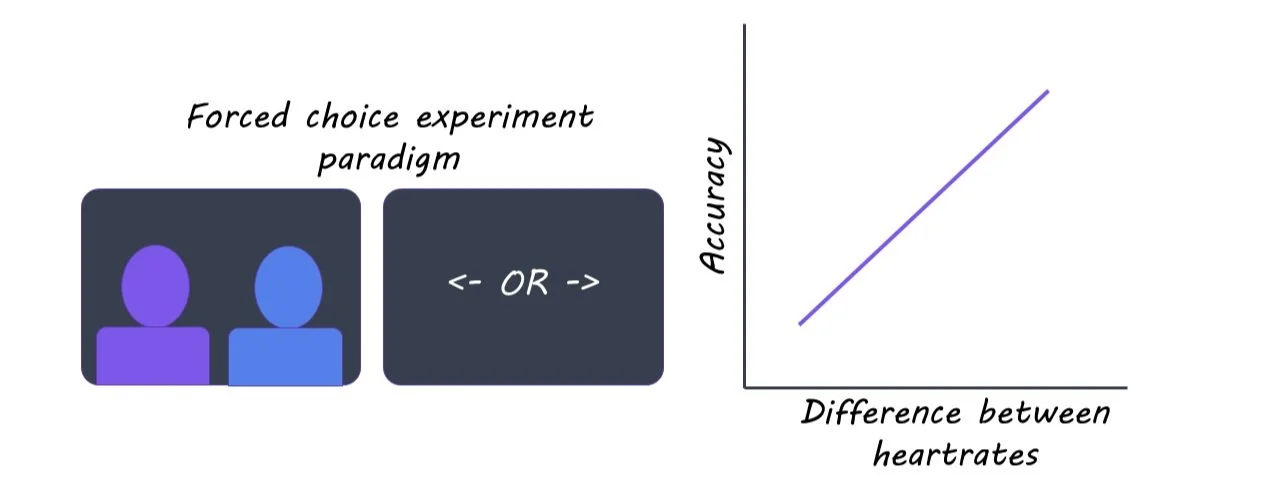
Participants completed 5 behavioural tasks to examine whether heart rate can be inferred above chance when viewing other people’s faces. In the initial experiment (referred to as the ‘natural configuration’), short videos of two actors were shown along with a square flashing at the same frequency as one of the actor’s heartbeats. Participants were asked to choose which of the two actors is the most likely owner of the heartbeat depicted. This experiment was replicated with a different set of participants later. In follow-up experiments (the ‘inverted configuration’), the authors inverted the faces of the actors, adjusted the colour of the faces for consistency throughout the video displays, showed still frames instead of videos, and replaced the face displays with geometric shapes.

What did they find?

In all experiments using face stimuli, the authors found that participants performed above chance at determining who is the most likely owner of the depicted heartbeat. In trials where the true heartbeats of the actors were most different, participants performed better than when the actors’ heartbeats were more similar. Performance was best in the natural configuration (dynamic videos with upright faces). Performance decreased but was still above chance in the inverted configuration. When the faces were replaced with geometric shapes, participants performed at chance.
What's the impact?

The results of this study suggest that we are able to infer other people’s internal signals such as heartbeats via visual assessment. It is possible that this is due to an ability to use visual cues such as varied redness of the face in response to blood pumping or small pulsing movements of the head, face, or eyes. Alternatively, we may be able to infer someone’s health (and therefore their heart rate) from their appearance. Overall, the study provides interesting insights into how we infer the internal states of others using visual perception, that warrant further research. 
Access the original scientific publication here.

Differential Effects of Acute Stress on Motivation in High vs. Low Anxiety

Post by Elisa Guma

The takeaway

Acute stress negatively impacts motivation in high anxiety individuals but improves motivation in low anxiety individuals. These opposing effects are mediated by the modulation of mesolimbic dopamine release via corticotrophin-releasing hormone.

What's the science?

The effects of acute stress on motivation tend to vary between individuals. Anxiety has been shown to moderate the effects of acute stress in learning, and may, in part, explain the variability observed in motivated behaviours by stress. These behaviours may share a common neurobiological mechanism via the action of corticotrophin-releasing hormone (CRH) action on CRH receptor 1 (CRHR1) in the mesolimbic dopamine neurons that project from the ventral tegmental area (VTA) to the nucleus accumbens (NAc). This week in Science Advances Zalachoras and colleagues investigate the mechanisms underlying differences in motivation in response to stress in an outbred strain of rats by combining behavioural, genetic, electrophysiological, histochemical and molecular analyses.

How did they do it?

The authors used outbred (genetically diverse) Wistar rats to model natural variation in trait anxiety. Rats were classified into either low anxiety or high anxiety phenotypes according to their performance on the elevated plus maze task. The authors tested the rats’ motivation using an operant conditioning task, in which rats had to nose-poke in an appropriate port to receive a palatable food reward. This task was then repeated, with the introduction of an acute stress exposure.

To investigate whether the CRH system was a good target for these motivation differences, the authors examined CRH receptor (CRHR1) expression levels in VTA dopamine neurons in the VTA of low and high anxiety rats and assessed variation in a single-nucleotide polymorphism associated with the CRHR1 gene in low, medium, and high anxiety rats. To investigate whether CRH actions on VTA neurons can mimic the effects of acute stress on motivation, the authors infused CRH (or a control; vehicle) into the VTAs of both low or high anxiety rats and tested motivated behaviour. They also measured dopamine levels in the target region of those VTA neurons, the NAc using microdialysis following CRH infusion.

To better understand the cellular properties of the VTA dopamine neurons in response to CRH, the authors performed ex vivo patch clamp recordings from dopamine neurons in low and high anxiety rats, as well as in a mouse model in which CRHR1 genes were specifically knocked out in dopamine VTA neurons. Behavioural and patch-clamp experiments were repeated in low anxiety rats for whom VTA CRHR1 levels had been downregulated, or in high anxiety rats where CRHR1 was overexpressed selectively in DA neurons in the VTA.

What did they find?

No baseline differences in motivation were observed in low and high anxiety rats, however, following exposure to acute stress, low anxiety rats had increased motivation relative to high anxiety rats. Low anxiety rats had significantly higher expression of CRHR1 in VTA dopamine neurons compared to high anxiety rats and showed variation in the distribution of a known single-nucleotide polymorphism for the CRHR1 gene, indicating that the CRHR1 gene could be mediating this behaviour.

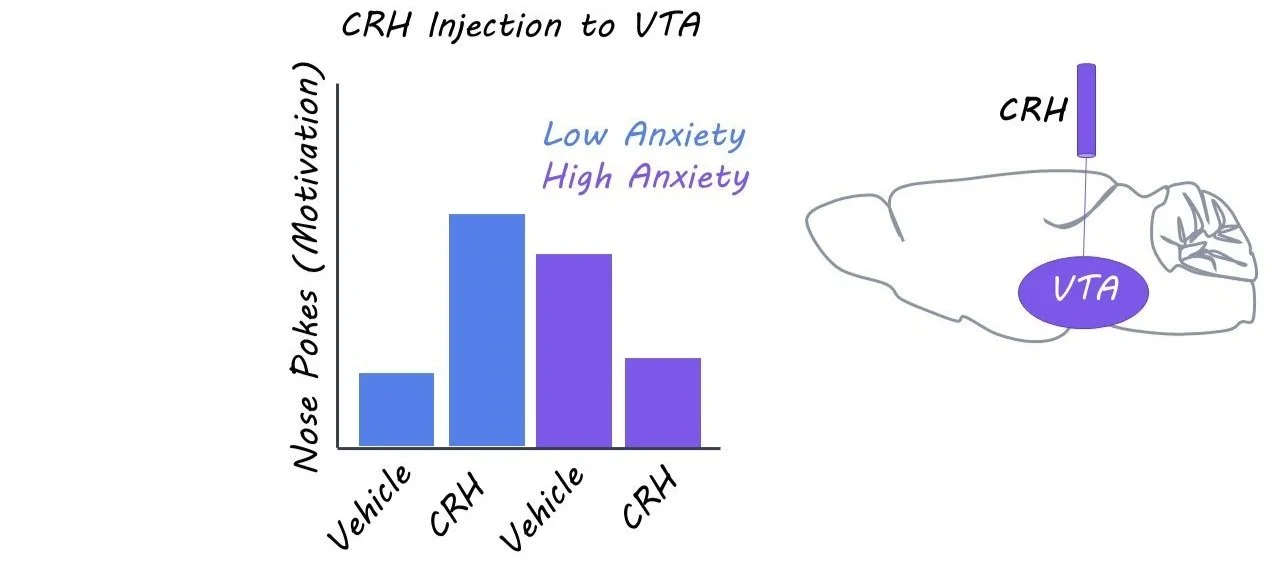
Consistent with the acute stress effects, CRH infusion into the VTA had an opposite effect on motivation for high and low anxiety rats: it improved motivation for low anxiety and impaired it for high anxiety rats. CRH infusion in the VTA also increased dopamine release in the NAc in the low anxiety group relative to the high anxiety group. These results were mirrored by the ex vivo patch-clamp recordings: firing rates of VTA cells were increased following the application of CRH in low anxiety rats, while the opposite effect was observed in high anxiety rats. Similarly, the CRH increased NAc dopamine release in low, but not high anxiety rats.

Downregulation of CRHR1 levels in the VTA of low anxiety rats abolished the improvement in motivation due to acute stress exposure and increased spontaneous firing in DA neurons of the VTA. In contrast, overexpression of CRHR1 significantly improved motivation both under normal and under stress conditions. The same effects were observed in the mouse model in which CRHR1 was knocked out of dopamine cells specifically, suggesting that the effects observed in the rat may be dopamine cell-specific.

What's the impact?

Acute stress exposure was found to facilitate motivated behaviour in low anxiety rats and impair motivated behaviour in high anxiety rats, mediated by the CRHR1. This research sheds light on how stress impacts motivation differently, depending on anxiety levels. 

Neuroinflammation in the Brain Influences Childhood Weight Gain

Post by Leigh Christopher

The takeaway

The neurobiological changes underlying weight gain in youth are not clearly understood. This research shows that there is a reciprocal relationship between neuroinflammation in the brain and weight gain in youth, suggesting a cycle exists between the two.

What's the science?

Obesity is a growing public health concern that can begin in childhood. Obesity can increase the risk of diabetes and heart disease and is also known to impact mental health. The nucleus accumbens is a brain region known to be involved in motivation and reward. Furthermore, glial cell proliferation in the nucleus accumbens is known to be an indicator of neuroinflammation and has been linked to weight gain in youth. This week in The Journal of Adolescent Health, Rapuano and colleagues investigate how nucleus accumbens cell density changes over time and how these changes are connected to weight gain in youth.

How did they do it?

The authors used a large-scale, publicly available dataset including data from over 11,000 youth throughout development. In this dataset, youth underwent magnetic resonance imaging (MRI) scans, and data such as Body Mass Index (BMI), waist circumference, and diet were recorded along with many other variables. With the use of MRI scans and longitudinal modeling, the authors were able to measure changes in cell density in the nucleus accumbens over a two-year period, and assess how these changes related to diet and waist circumference, an important metric for predicting weight gain in adolescents.

What did they find?

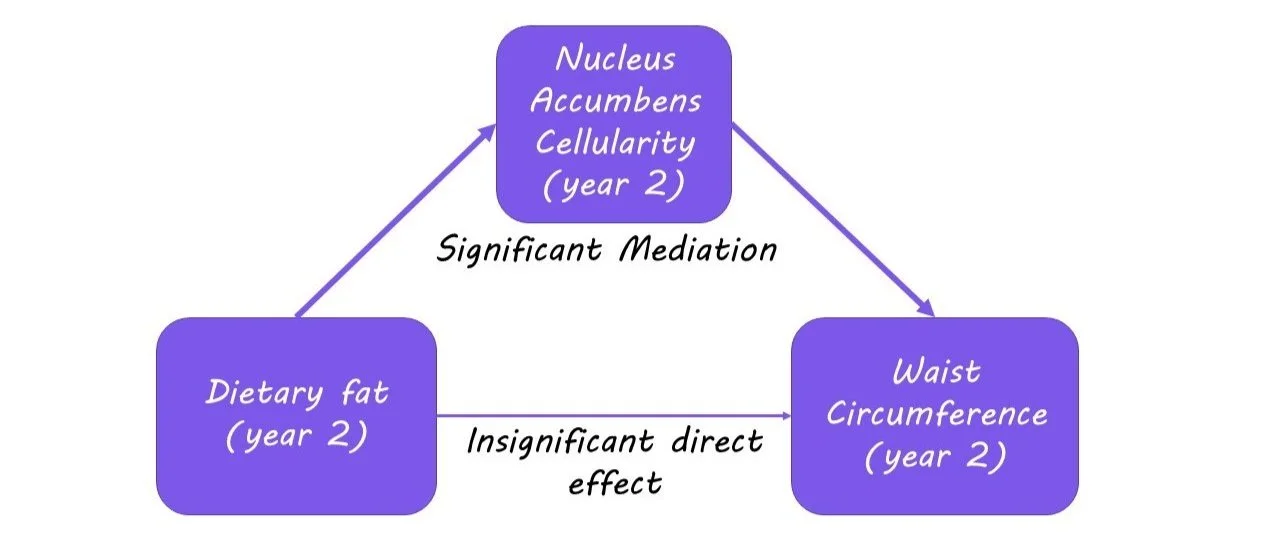
The authors found that baseline nucleus accumbens cell density (indicative of neuroinflammation) predicted an increase in waist circumference after two years and that in turn, baseline waist circumference predicted a two-year change in nucleus accumbens cell density. They also found that nucleus accumbens cell density mediated the relationship between diet and weight circumference. These results suggest a cycle, where increased food intake leads to glial cell proliferation and weight gain, which further perpetuates the proliferation of cells in the nucleus accumbens. Importantly, the results were not affected when controlling for confounding variables like genetics, education, and income.

What's the impact?

This study found a reciprocal relationship between cell density in the nucleus accumbens and weight gain, consistent with the ‘vicious cycle’ hypothesis of diet-induced brain changes, leading to weight gain. Furthermore, this research established the role of neuroinflammation in the nucleus accumbens as a key neurobiological change underlying weight gain in youth - highlighting its relevance as a target for future research.

Access the original scientific publication here.