Neuroinflammation in the Brain Influences Childhood Weight Gain

Post by Leigh Christopher

The takeaway

The neurobiological changes underlying weight gain in youth are not clearly understood. This research shows that there is a reciprocal relationship between neuroinflammation in the brain and weight gain in youth, suggesting a cycle exists between the two.

What's the science?

Obesity is a growing public health concern that can begin in childhood. Obesity can increase the risk of diabetes and heart disease and is also known to impact mental health. The nucleus accumbens is a brain region known to be involved in motivation and reward. Furthermore, glial cell proliferation in the nucleus accumbens is known to be an indicator of neuroinflammation and has been linked to weight gain in youth. This week in The Journal of Adolescent Health, Rapuano and colleagues investigate how nucleus accumbens cell density changes over time and how these changes are connected to weight gain in youth.

How did they do it?

The authors used a large-scale, publicly available dataset including data from over 11,000 youth throughout development. In this dataset, youth underwent magnetic resonance imaging (MRI) scans, and data such as Body Mass Index (BMI), waist circumference, and diet were recorded along with many other variables. With the use of MRI scans and longitudinal modeling, the authors were able to measure changes in cell density in the nucleus accumbens over a two-year period, and assess how these changes related to diet and waist circumference, an important metric for predicting weight gain in adolescents.

What did they find?

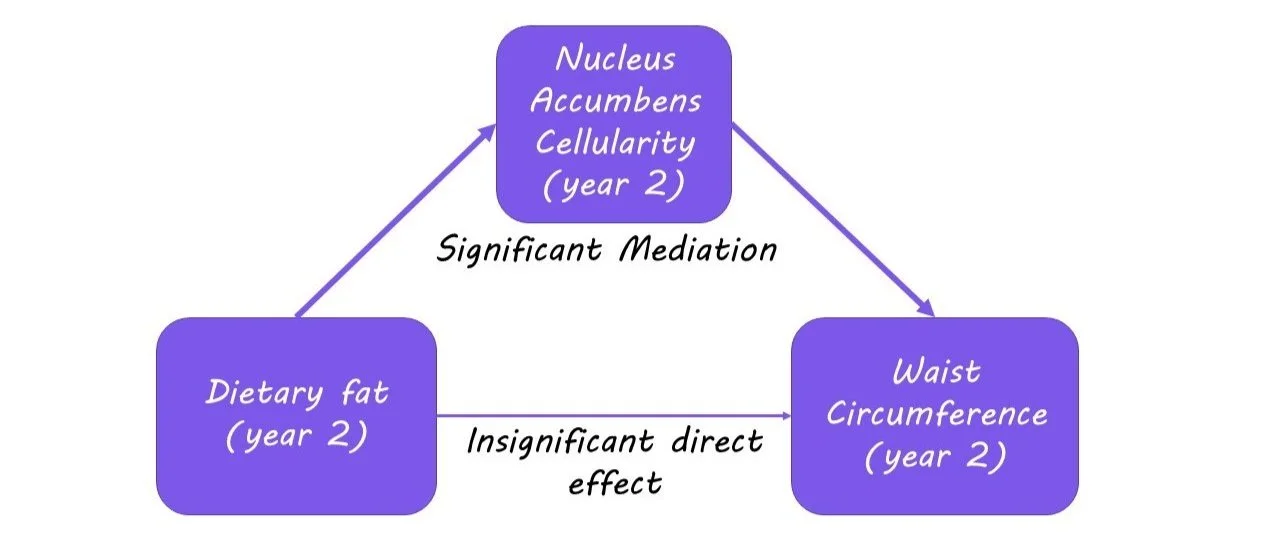
The authors found that baseline nucleus accumbens cell density (indicative of neuroinflammation) predicted an increase in waist circumference after two years and that in turn, baseline waist circumference predicted a two-year change in nucleus accumbens cell density. They also found that nucleus accumbens cell density mediated the relationship between diet and weight circumference. These results suggest a cycle, where increased food intake leads to glial cell proliferation and weight gain, which further perpetuates the proliferation of cells in the nucleus accumbens. Importantly, the results were not affected when controlling for confounding variables like genetics, education, and income.

What's the impact?

This study found a reciprocal relationship between cell density in the nucleus accumbens and weight gain, consistent with the ‘vicious cycle’ hypothesis of diet-induced brain changes, leading to weight gain. Furthermore, this research established the role of neuroinflammation in the nucleus accumbens as a key neurobiological change underlying weight gain in youth - highlighting its relevance as a target for future research.

Access the original scientific publication here.

Hippocampal Ensembles Support Memory for Nonspatial Events in Time

Post by Megan McCullough 

The takeaway

The firing patterns of neurons in the hippocampus code for sequences of nonspatial events which suggests that the hippocampus is critical for organizing our memories in time.

What's the science? 

Previous research has implicated the hippocampus in playing an integral role in the relationship between memory and behavior. More specifically, across species, the hippocampus is known to be necessary for the ability to remember when events occurred and the ability to then use this information to predict future events. Although many studies have shown this relationship, it remains unclear how hippocampal neurons support this complex function. This week in Nature Communications, Shahbaba and colleagues aimed to uncover the neural mechanisms for the involvement of the hippocampus in the temporal organization of past experiences using electrophysiological techniques and statistical machine learning methods. 

How did they do it?

Since previous research shows that the involvement of the hippocampus in memory is consistent across species, the following experiment was conducted with rats. The authors trained the animals in a nonspatial sequence memory task, which involved the presentation of sequences of odors. The rats were rewarded when they correctly identified whether each odor was presented in the correct position in the sequence. Over the course of a few weeks, neural activity was recorded from the pyramidal cell layer in the dorsal CA1 area of the hippocampus of each animal as they performed the task. The firing patterns of the neurons in the CA1 region during the task were then examined for patterns related to the time component of the memories of the odor stimuli. Machine learning was then used to uncover how sequential memories were represented by the firing pattern of the neurons in the hippocampus. 

What did they find?

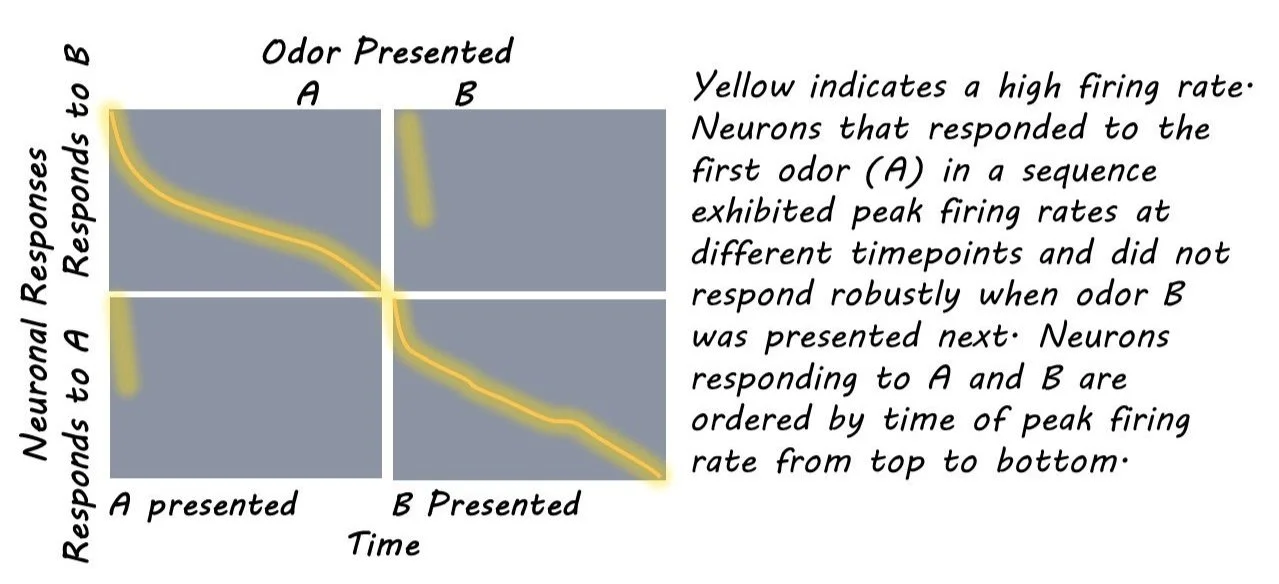
The authors found that the firing pattern of hippocampal ensembles encoded information about time during the presentation of each odor and for the full sequence of odors. The neuronal activity also captured the sequential relationship among the odors in the sequence. This illustrates the crucial role the hippocampus plays in supporting the temporal organization of memories. 

What's the impact? 

This study provides key evidence that hippocampal neurons code for temporal and sequential information of events and that this activity is important to correctly recall the order of events. These results broaden our understanding of the neural mechanisms behind how memories are organized with regard to time and how we use these memories to inform future events. This study joins a growing body of research into the mechanisms of human learning, memory, and decision making.

Changes in Smell, Food Cravings and Memory During Pregnancy

Post by Lani Cupo 

The brain changes during pregnancy

Many people know of the unusual cravings associated with pregnancy. But how does pregnancy impact the nervous system to such an extent that dill pickle ice cream can change from disgusting to delicious? Or to the extent that memory function is impacted? Many neural and cognitive systems are affected during pregnancy, leading to some of these phenomena such as changes in smell, food cravings, and cognitive difficulties. While some of the neural mechanisms underlying these changes are understood to some degree, many remain unclear. 

Perceptual changes associated with pregnancy

Olfaction (smell)

Some people report changes to smell before even confirming a pregnancy, and over two-thirds of pregnant people report enhanced sensitivity to smell. Additionally, up to 14% reported phantom smells during pregnancy. This increased sensitivity can be associated with morning sickness, most common during the first trimester of pregnancy. When surveyed retroactively, 75% of 500 women recalled that smells were less pleasant during pregnancy, including cigarettes, coffee, meat, food (in general), diesel exhaust, and sweat, with similar reports from lab research. A few scents (clove, musk, perfume, fruits, flowers, and woodlands) have been rated as more pleasant

To date, no study has definitively established the neuroscience underlying changes in olfactory perception. One hypothesis takes an evolutionary perspective, proposing that enhanced smell perception provides protection for the fetus by increasing the mother’s disgust response during a period of immunosuppression. There is some evidence to support the hypothesis that nausea and vomiting early in pregnancy is linked to maternal avoidance of potential food-borne pathogens as the foods that are generally averse are more likely to carry pathogens, such as meats, dairy, eggs, and bitter vegetables.

Gustatory (taste)

Perhaps more famous than olfactory changes during pregnancy are changes to gustation, where pregnant people crave specific foods. Most frequent cravings include sweet foods such as chocolate, milk, and fruit, however in a report on preferred flavors, the majority of women reported sour tastes, followed by salty. Along with cravings, there are several common food aversions, including meat, eggs, oregano, and bitter foods. Along with pregnancy, food cravings are most commonly experienced during perimenstrum (PMS – the ~8 days before onset of menstruation). Despite the commonality of food cravings in pregnancy, for some women unrestrained eating during pregnancy can contribute to excessive gestational weight gain, which can adversely affect both the mother and fetus. Of interest, while food cravings are reported globally, the type of food desired often changes regionally, with high rates of chocolate craving reported in North America (in all populations). In a survey of pregnant people, 50-90% of individuals experience cravings, most of whom had a prior history of cravings.

Similar to olfaction, the scientific literature offers no definitive explanations for changes to gustation. At present, there are several proposed hypotheses for food cravings. One suggests that changes to gustation reflect changes in nutritional requirements - as sodium requirements increase during pregnancy, this could be reflected in the increased affinity for salt. However, the nutritional demands of pregnancy include micronutrients, iron, and magnesium, and rarely do pregnant people crave foods rich with these nutrients, such as dark leafy greens or legumes. Several proposed hypotheses closely resemble the postulated hypotheses for perimenstrual food cravings. An early hypothesis suggested estrogen or progesterone levels may underlie the changes, however, there is little empirical evidence to support this hypothesis. One theory from the mid-nineties suggests endogenous opioid peptides (EOPs) may play a role in inducing food cravings, substantiated by an association between EOPs and food intake.

In addition to the possibility of physiological changes regulating cravings, there could be a potential psychosocial component of food cravings. One framework suggests that food cravings may arise from the tension between a desire to indulge in foods and avoidance, with cultural events removing the expectation of abstinence (such as PMS or pregnancy) leading to overindulgence. In this model, pregnancy (or PMS) is not seen as a cause of craving, but an allowance to acknowledge such desires.

Memory changes associated with pregnancy

50-80% of pregnant people report cognitive difficulties, with memory problems being the most common. However, cognitive changes during pregnancy receive less attention. One reason for this is the fact that while pregnant people subjectively report more memory challenges with everyday memory tasks around the home, they often perform as well as non-pregnant control participants on laboratory tasks. The research suggests pregnant people may have greater memory difficulty when more is demanded of their attention. The two types of memory they struggle with most include episodic prospective memory (remember to call your mother in two days) and habitual prospective memory (tasks that must be performed regularly, like attending appointments). While more research is required to establish the underlying cause of memory issues, there are a couple of hypotheses regarding the link. One potential explanation could be that increased cortisol or reduced estrogen leads to a negative effect on memory. However, aside from physiological changes, pregnancy is a time defined by many behavioral changes such as sleep disturbance and increased novel demands preparing for the baby. Along with disadvantages to memory, however, there are also reports of improved memory for faces. This improvement is speculated to be related to high levels of progesterone present during pregnancy.

What’s next?

Despite evidence from both surveys and the laboratory establishing cognitive and perceptual changes during pregnancy, there is little research into the biological changes underlying these alterations. We have a preliminary understanding of why smell, taste, or memory might be affected. Many hypotheses exist, however, more research is required to confirm some of these hypotheses and to understand the neural mechanisms underlying these changes. 

References +

Cameron, E. Leslie. "Pregnancy and olfaction: a review." Frontiers in psychology 5 (2014): 67.

Mercer, Michele E., and Mark D. Holder. "Food cravings, endogenous opioid peptides, and food intake: a review." Appetite 29.3 (1997): 325-352.

Meule, Adrian. "The psychology of food cravings: The role of food deprivation." Current nutrition reports 9.3 (2020): 251-257.

Orloff, Natalia C., and Julia M. Hormes. "Pickles and ice cream! Food cravings in pregnancy: hypotheses, preliminary evidence, and directions for future research." Frontiers in psychology 5 (2014): 1076.

Stadtlander, Lee. "Memory and perceptual changes during pregnancy." International Journal of Childbirth Education 28.2 (2013): 49-54.