
Changes in Smell, Food Cravings and Memory During Pregnancy

Post by Lani Cupo 

The brain changes during pregnancy

Many people know of the unusual cravings associated with pregnancy. But how does pregnancy impact the nervous system to such an extent that dill pickle ice cream can change from disgusting to delicious? Or to the extent that memory function is impacted? Many neural and cognitive systems are affected during pregnancy, leading to some of these phenomena such as changes in smell, food cravings, and cognitive difficulties. While some of the neural mechanisms underlying these changes are understood to some degree, many remain unclear. 

Perceptual changes associated with pregnancy

Olfaction (smell)

Some people report changes to smell before even confirming a pregnancy, and over two-thirds of pregnant people report enhanced sensitivity to smell. Additionally, up to 14% reported phantom smells during pregnancy. This increased sensitivity can be associated with morning sickness, most common during the first trimester of pregnancy. When surveyed retroactively, 75% of 500 women recalled that smells were less pleasant during pregnancy, including cigarettes, coffee, meat, food (in general), diesel exhaust, and sweat, with similar reports from lab research. A few scents (clove, musk, perfume, fruits, flowers, and woodlands) have been rated as more pleasant

To date, no study has definitively established the neuroscience underlying changes in olfactory perception. One hypothesis takes an evolutionary perspective, proposing that enhanced smell perception provides protection for the fetus by increasing the mother’s disgust response during a period of immunosuppression. There is some evidence to support the hypothesis that nausea and vomiting early in pregnancy is linked to maternal avoidance of potential food-borne pathogens as the foods that are generally averse are more likely to carry pathogens, such as meats, dairy, eggs, and bitter vegetables.

Gustatory (taste)

Perhaps more famous than olfactory changes during pregnancy are changes to gustation, where pregnant people crave specific foods. Most frequent cravings include sweet foods such as chocolate, milk, and fruit, however in a report on preferred flavors, the majority of women reported sour tastes, followed by salty. Along with cravings, there are several common food aversions, including meat, eggs, oregano, and bitter foods. Along with pregnancy, food cravings are most commonly experienced during perimenstrum (PMS – the ~8 days before onset of menstruation). Despite the commonality of food cravings in pregnancy, for some women unrestrained eating during pregnancy can contribute to excessive gestational weight gain, which can adversely affect both the mother and fetus. Of interest, while food cravings are reported globally, the type of food desired often changes regionally, with high rates of chocolate craving reported in North America (in all populations). In a survey of pregnant people, 50-90% of individuals experience cravings, most of whom had a prior history of cravings.

Similar to olfaction, the scientific literature offers no definitive explanations for changes to gustation. At present, there are several proposed hypotheses for food cravings. One suggests that changes to gustation reflect changes in nutritional requirements - as sodium requirements increase during pregnancy, this could be reflected in the increased affinity for salt. However, the nutritional demands of pregnancy include micronutrients, iron, and magnesium, and rarely do pregnant people crave foods rich with these nutrients, such as dark leafy greens or legumes. Several proposed hypotheses closely resemble the postulated hypotheses for perimenstrual food cravings. An early hypothesis suggested estrogen or progesterone levels may underlie the changes, however, there is little empirical evidence to support this hypothesis. One theory from the mid-nineties suggests endogenous opioid peptides (EOPs) may play a role in inducing food cravings, substantiated by an association between EOPs and food intake.

In addition to the possibility of physiological changes regulating cravings, there could be a potential psychosocial component of food cravings. One framework suggests that food cravings may arise from the tension between a desire to indulge in foods and avoidance, with cultural events removing the expectation of abstinence (such as PMS or pregnancy) leading to overindulgence. In this model, pregnancy (or PMS) is not seen as a cause of craving, but an allowance to acknowledge such desires.

Memory changes associated with pregnancy

50-80% of pregnant people report cognitive difficulties, with memory problems being the most common. However, cognitive changes during pregnancy receive less attention. One reason for this is the fact that while pregnant people subjectively report more memory challenges with everyday memory tasks around the home, they often perform as well as non-pregnant control participants on laboratory tasks. The research suggests pregnant people may have greater memory difficulty when more is demanded of their attention. The two types of memory they struggle with most include episodic prospective memory (remember to call your mother in two days) and habitual prospective memory (tasks that must be performed regularly, like attending appointments). While more research is required to establish the underlying cause of memory issues, there are a couple of hypotheses regarding the link. One potential explanation could be that increased cortisol or reduced estrogen leads to a negative effect on memory. However, aside from physiological changes, pregnancy is a time defined by many behavioral changes such as sleep disturbance and increased novel demands preparing for the baby. Along with disadvantages to memory, however, there are also reports of improved memory for faces. This improvement is speculated to be related to high levels of progesterone present during pregnancy.

What’s next?

Despite evidence from both surveys and the laboratory establishing cognitive and perceptual changes during pregnancy, there is little research into the biological changes underlying these alterations. We have a preliminary understanding of why smell, taste, or memory might be affected. Many hypotheses exist, however, more research is required to confirm some of these hypotheses and to understand the neural mechanisms underlying these changes. 

References +

Cameron, E. Leslie. "Pregnancy and olfaction: a review." Frontiers in psychology 5 (2014): 67.

Mercer, Michele E., and Mark D. Holder. "Food cravings, endogenous opioid peptides, and food intake: a review." Appetite 29.3 (1997): 325-352.

Meule, Adrian. "The psychology of food cravings: The role of food deprivation." Current nutrition reports 9.3 (2020): 251-257.

Orloff, Natalia C., and Julia M. Hormes. "Pickles and ice cream! Food cravings in pregnancy: hypotheses, preliminary evidence, and directions for future research." Frontiers in psychology 5 (2014): 1076.

Stadtlander, Lee. "Memory and perceptual changes during pregnancy." International Journal of Childbirth Education 28.2 (2013): 49-54.

Brain Activity in the Mesolimbic Network is Related to Affective Behaviour

Post by Negar Mazloum-Farzaghi 

The takeaway 

The brain mechanisms underlying affective behaviours like smiling, laughing, or expressing discomfort are critical to everyday life. This research shows that there is a distributed network of brain regions associated with different affective behaviors, and it's possible to differentiate these behaviors from neutral ones using brain activity recordings.

What's the science? 

Affective states and our associated behaviors are an essential part of daily life. However, the underlying neurological mechanism of affective behaviours remains unclear. Previous studies have found that different affective behaviours are related to distinct patterns of spatial brain activity in the mesolimbic network, with certain brain regions playing a more critical role in some affective behaviours compared to others. Moreover, it remains unclear whether different spectral patterns (frequency bands) of activity in the mesolimbic network can distinguish one affective state from another. This week in Nature Human Behaviour, Bijanzadeh and colleagues examined the brain mechanisms underlying naturalistic affective behaviours from epilepsy patients who had intracranial EEG (iEEG) electrodes implanted in their mesolimbic network. 

How did they do it?

The authors aimed to investigate whether changes in specific frequency bands (i.e., spectral features) in specific mesolimbic network brain regions (i.e., spatial features) would create ‘spectro-spatial’ patterns across the mesolimbic network, which would ultimately allow for the distinction between naturalistic affective positive and negative behaviours. To investigate this, the authors obtained 24-h audiovisual recordings and continuous iEEG data from 11 hospitalized participants with epilepsy. They analyzed 116 hours of behavioural and neural data from these participants who had electrodes placed in at least three mesolimbic structures (insula, anterior cingulate cortex (ACC), orbitofrontal cortex (OFC), amygdala, and hippocampus). Behaviours were categorized as positive affective behaviours (smiling, laughing, positive verbalizations), negative affective behaviours (pain-discomfort, negative verbalization), and neutral behaviours (control condition; minimum 10-minute periods where the participants showed neither negative nor positive affective behaviours).

The authors aligned each participants’ neural and behavioural data and extracted the spectral power in brain frequency bands from the electrodes in their mesolimbic structures. The average power in each frequency band (spectral features) for each electrode (spatial features) was computed and the two sets of features combined were referred to as the spectro-spatial features. Next, using statistics and machine learning methods, the authors trained models (binary random forest models) on the spectro-spatial features for the behaviours for each participant to determine whether models could distinguish between affective behaviours and neutral behaviours. Then, the authors examined which mesolimbic spatial features influenced the performance of the models. 

What did they find?

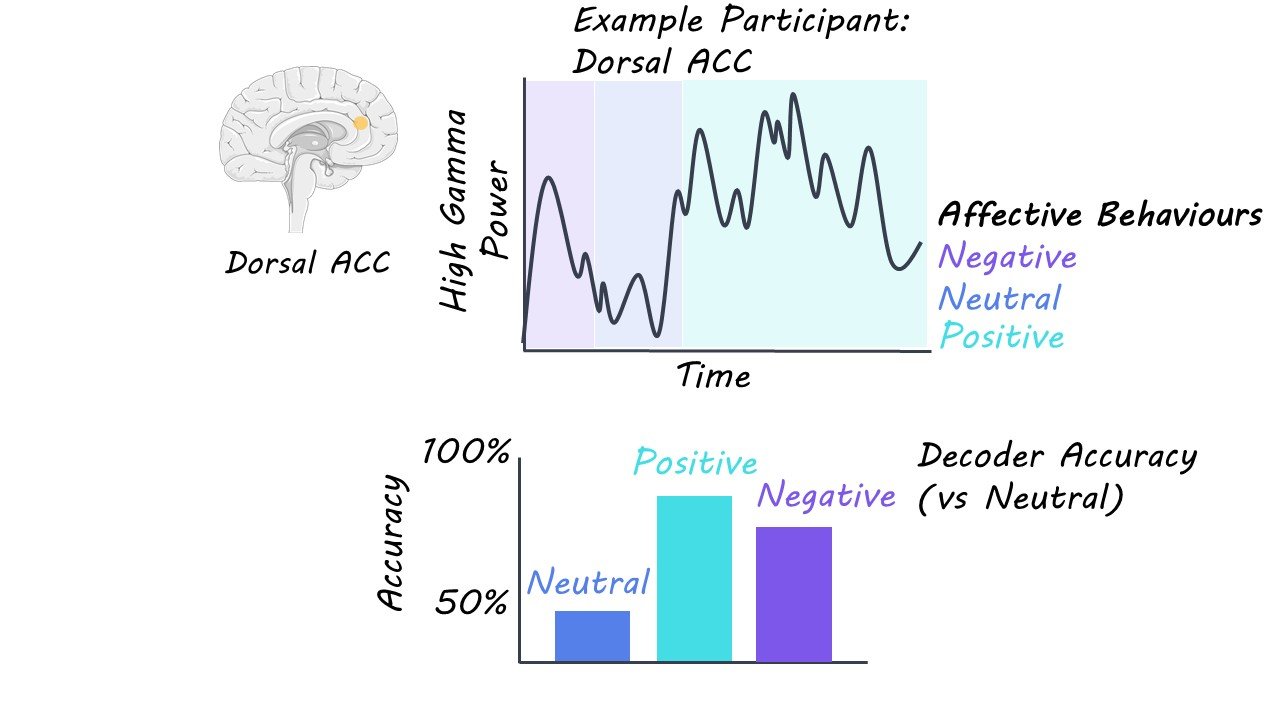
The authors found that, at the individual level, models were able to successfully decode positive (up to 93% accuracy) and negative affective (up to 78% accuracy) behaviours from neutral behaviours significantly greater than chance, and the group-level analysis replicated those results. Moreover, it was found that affective behaviours were associated with changes in activity in the mesolimbic network. That is, affective behaviours were related to increased high-frequency (gamma) and decreased low frequency bands (theta, alpha, beta).

Certain regions of the mesolimbic system (insula, ACC, hippocampus, and amygdala) were found to contribute more strongly to both positive and negative affective behaviours, compared to other regions (OFC). This finding suggests that increased gamma activity in these brain regions during both positive and negative affective behaviours may reflect emotional arousal in general. However, the results also revealed that distinct structures of the mesolimbic system may contribute to positive and negative affective behaviours in different ways. For example, increased gamma activity in the ventral ACC, dorsal ACC, and hippocampus was related to positive affective behaviours. In contrast, increased gamma activity in the amygdala was related to negative affective behaviours. Thus, this research suggests that there is a distributed network of brain regions that are associated with different affective behaviours in the mesolimbic system.

What's the impact?

Using statistical and machine learning methods, this study found that spectro-spatial features of brain activity in the mesolimbic network are related to naturalistic affective behaviours. This study further elucidates the neural mechanisms at play in the mesolimbic network. Advancing decoding models to be able to relate neural signals to more complex emotions will allow for more refined brain models of affective behaviours which may be used to inform treatments for mental health disorders.

Access the original scientific publication here.

The Deep Wiring of Speech in the Human Brain

Post by Anastasia Sares

The takeaway

Compared to other animals, humans have a highly developed capacity for speech. This study showed that human speech areas have high-fidelity and fast connections to deep brain nuclei—meaning that we may indeed be hard-wired to learn language.

What's the science?

The basal ganglia are a set of structures deep in the brain that help to regulate almost all other activity: they form circuits with other brain areas, regulating them and deciding whether to perform an action, or when to stop. One of these circuits is called the hyperdirect pathway; this pathway puts the brakes on an action or a process. In rodents, it was discovered by injecting special viral proteins and dyes that can climb along neural pathways. This was not ethically possible to do in humans, so it was unclear whether our brain architecture was similar. Scientists came one step closer in the 2010s, when the hyperdirect pathway was found in primates. In 2018, evidence of this pathway in humans was observed by careful electrical recordings during surgery. This confirmed that the hyperdirect pathway exists in humans, and it links to many areas of the cortex. This week in Cell Reports, Jorge and colleagues used a similar electrical stimulation and recording technique to look at speech-related areas of the brain. They concluded from the timing of the electrical responses that there is a hyperdirect pathway that connects areas associated with speech to the deep parts of the brain, perhaps explaining humans’ unique ability with language.

How did they do it?

The study recruited patients with Parkinson’s disease who were already being implanted with electrodes in a procedure known as “deep brain stimulation.” In this procedure, a long, thin electrode is inserted into the interior of the brain and is connected to an exterior pacemaker-like device that can deliver pulses of electricity directly to stimulate that brain region.

For Parkinson’s, the target of these stimulations is the subthalamic nucleus: one of the brain’s deep nuclei that works to inhibit actions that are not necessary. Stimulating the subthalamic nucleus helps to suppress the resting tremors that are associated with Parkinson’s disease. The subthalamic nucleus also happens to be the first stop of the hyperdirect pathway, and when stimulated, electrical activity can actually travel backwards to the cortex (at least, this is true in animal models). So, the researchers were able to take advantage of some electrodes placed on the surface of the brain during the surgery to measure and map out these backward-traveling signals. They would stimulate the subthalamic nucleus, then time how long it took for the signal to reach cortex. If the timing was short (< 10 milliseconds), then it was likely that the two regions were directly connected.

What did they find?

First, the authors confirmed the 2018 finding: they were able to measure electrical signals traveling backward from the subthalamic nucleus to the cortex. These signals arrived quickly, under 10 milliseconds, which means the connections were likely only a single neuron in length.

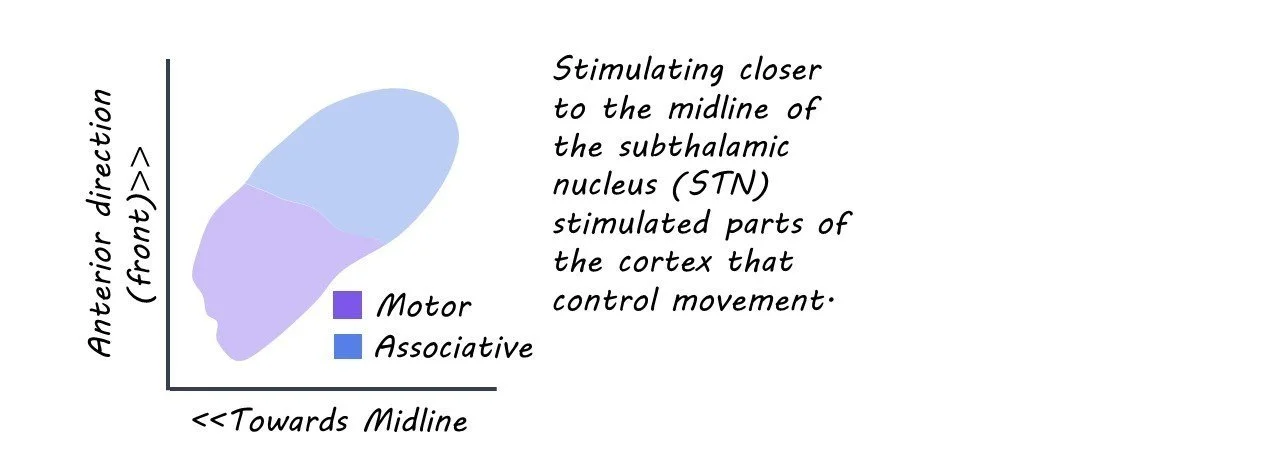
They then looked at how the placement of the stimulating electrode affected the activity in the cortex. Stimulating areas closer to the midline of the brain generated stronger signals in the parts of cortex that control movement while stimulating further from the midline generated signals in parts of the cortex that deal with sensory perception and forming associations. Many areas known for processing speech were affected by subthalamic stimulation, including the inferior frontal gyrus (classically known as Broca’s area), the auditory cortex, and association areas in the temporal cortex (roughly equivalent to the classical Wernicke’s area).

What's the impact?

This study demonstrates that speech areas of our brain are just a single neuron away from the deep inner nuclei of the brain. This super speedy pathway may contribute to our extraordinary capacity for speech, and help us understand what makes humans unique. Many current models of speech skip or gloss over the role of these deep brain loops in speech, and therefore these models may need to be updated to reflect the importance of these pathways. 

Access the original scientific publication here