Angiotensin-Converting Enzyme Inhibitors Modulate Brain Opioids

Post by Shireen Parimoo

The takeaway

Angiotensin-converting enzyme (ACE), an enzyme that normally regulates blood pressure in the body, is also important for reward processing in the brain. Inhibition of ACE in the nucleus accumbens may be a viable option for treating addiction and substance use disorders.

What's the science?

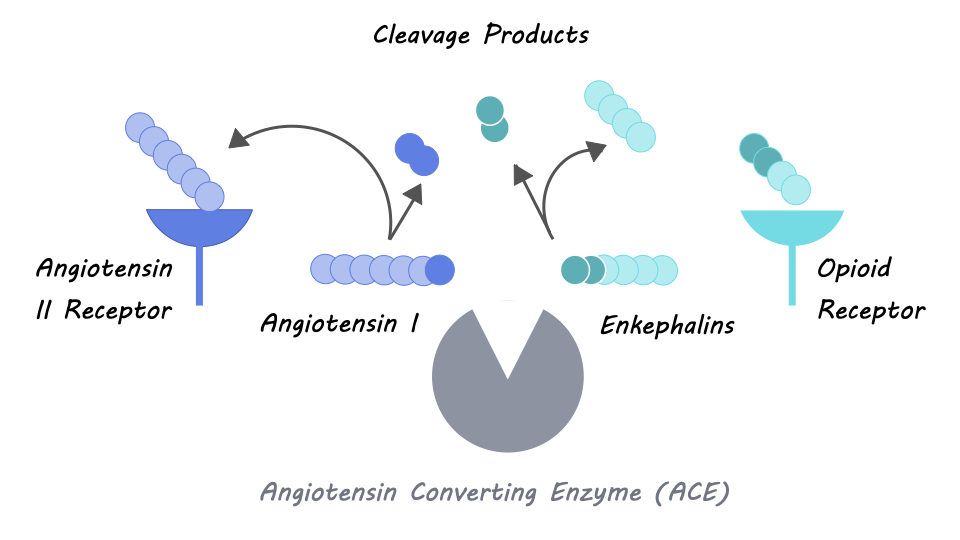
The nucleus accumbens (NAc) is a key region of the reward circuit in the brain and is implicated in addiction. Two types of NAc neurons – DS1 and DS2 neurons – are important in reward processing but are difficult to study separately because they receive similar inputs and express many of the same genes. This, in turn, makes it difficult to develop pharmacological treatments for addiction that specifically target DS1 or DS2 neurons. Interestingly, only DS1 neurons express angiotensin-converting enzyme (ACE), which is thought to modulate excitatory transmission within the NAc by acting on opioid receptors and may be important in reward processing. This week in Science, Trieu and colleagues sought to identify the exact mechanism by which ACE regulates synaptic transmission in the NAc and to elucidate its role in the reward pathway.

How did they do it?

The authors conducted a series of ex vivo and in vivo experiments. First, they quantified ACE expression in slices of NAc neurons and applied captopril (an ACE inhibitor) and naloxone (an opioid receptor antagonist). Recording mEPSPs (miniature excitatory postsynaptic potentials) from both DS1 and DS2 neurons in those slices allowed them to determine whether ACE affected synaptic transmission in the NAc through opioid signaling. Next, they used liquid chromatography-tandem mass spectrometry to examine the effect of NAc stimulation on the concentration of different enkephalins (e.g., Leu-enkephalins, MERF, etc.). Enkephalins are opioid peptides released by DS2 neurons and except for MERF, most enkephalins can be degraded by ACE. The authors assessed how ACE inhibition and optogenetic stimulation affected enkephalin levels, as well as the subsequent impact of elevated enkephalin levels on synaptic transmission in the NAc. They then applied captopril and MERF to NAc slices along with opioid receptor antagonists to identify the specific opioid receptors that are involved in ACE inhibition.
The authors also investigated the effect of ACE inhibition on excitatory transmission in vivo by administering captopril and optogenetically stimulating medial prefrontal neurons that provide excitatory input to the NAc. Finally, they used a place conditioning paradigm to study the impact of ACE inhibition on reward learning in mice. In this paradigm, mice typically prefer a context that is paired with a reward compared to a control context. The authors examined the impact of captopril on preference for a context paired with fentanyl, an opioid drug that normally has an excitatory effect on NAc neurons.

What did they find?

There was a higher concentration of ACE in DS1 compared to DS2 neurons in the NAc. Inhibition of ACE led to long-term depression (a form of synaptic plasticity) in the DS1 neurons but had no impact on synaptic transmission in DS2 neurons. Naloxone – an opioid receptor antagonist – prevented long-term depression in DS1 neurons when it was applied together with captopril. However, applying naloxone after captopril did not reverse LTD. These findings demonstrate that ACE inhibition triggers synaptic plasticity by acting on opioid receptors in the NAc.

Extracellular concentrations of all enkephalins increased following NAc stimulation, including MERF. However, inhibiting ACE increased MERF but had no impact on other enkephalins. Moreover, stimulating DS2 neurons increased MERF levels even in the presence of captopril, which indicates that MERFs are released by DS2 neurons. Applying enkephalins to both DS1 and DS2 neurons decreased the frequency (but not amplitude) of mEPSPs in the NAc, with the strongest effects resulting from MERF application. In DS1 neurons, captopril and MERF alone did not affect mEPSPs but applying them together reduced mEPSP frequency. Additionally blocking the mu opioid receptor prevented the reduction in mEPSP frequency, which suggests that ACE inhibition triggers synaptic plasticity changes in DS1 neurons by acting on the mu opioid receptors. Finally, medial prefrontal input to the NAc typically increases excitatory transmission in DS1 neurons, but this sensitivity was reduced in the presence of captopril. Similarly, mice who underwent place conditioning showed a strong preference for the fentanyl-associated context, but this preference was smaller when captopril was administered. Thus, ACE inhibition reduced NAc activity in vivo and modulated reward learning in mice by dampening the impact of reward at the neural level.

What's the impact?

This study is the first to demonstrate how ACE inhibitors modulate synaptic transmission in specific types of neurons in the nucleus accumbens. Given the crucial role of the nucleus accumbens in reward processing, ACE inhibitors hold considerable potential for the development of targeted drugs for treating addiction and substance use disorders.
Access the original scientific publication here.

A New Treatment for Huntington’s Disease

Post by Leanna Kalinowski

The takeaway

Scientists have uncovered a potential new treatment for Huntington’s disease that lowers the abnormal huntingtin protein levels caused by a mutation in the huntingtin gene.

What's the science?

Gene expression, the conversion of DNA into protein, is a fundamental biological process. It consists of two major steps: transcription, where the instructions that make up DNA are copied and rewired into messenger RNA (mRNA), and translation, where this mRNA is converted into proteins that the body can then use for several different functions. Genetic mutations that lead to abnormal protein levels following translation are responsible for a myriad of disorders, including certain cancers and Huntington’s disease.

Huntington’s disease (HD) is a neurodegenerative disorder with motor, cognitive, and psychiatric symptoms that are caused by a mutation in the huntingtin gene (HTT). This mutation involves a series of three DNA building blocks - cytosine, adenine, and guanine - that typically appear multiple times in a row in a genetic sequence. HTT genes without the mutation repeat this series between 10 and 35 times, while HTT genes with the mutation repeat it up to 120 times. This mutation is then transcribed into abnormal HTT mRNA, which then leads to the translation of an abnormally long HTT protein. Accumulation of this protein in the brain causes brain cells to progressively break down as people with HD get older, and there is currently no cure for this disease. This week in Nature Communications, Keller and colleagues examined whether branaplam, an experimental drug, could alter the HTT gene mutation and slow the progression of HD.

How did they do it?

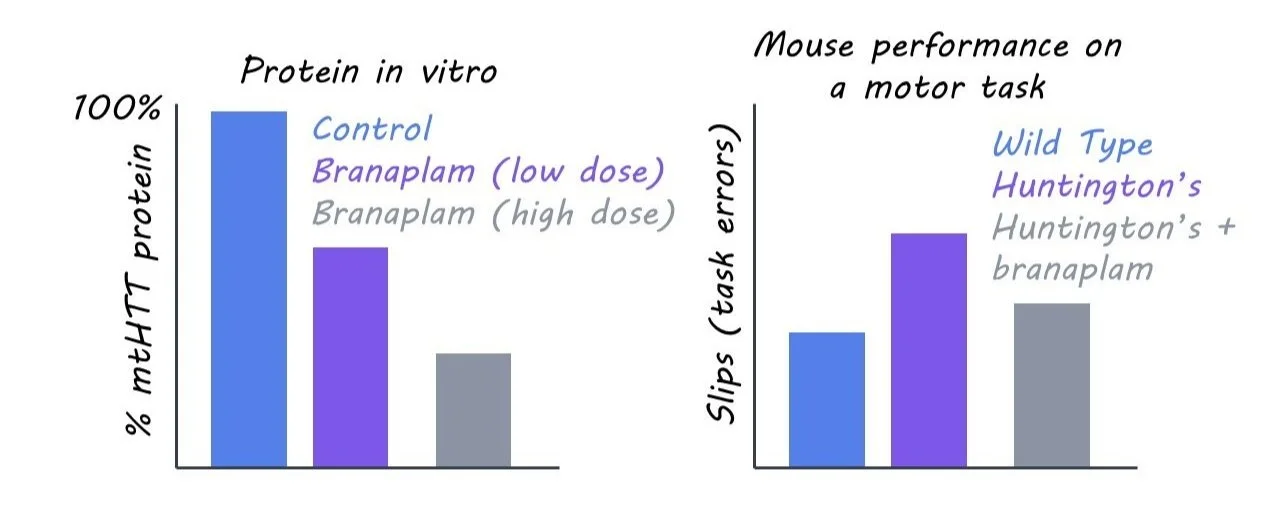
First, the researchers examined the impact of branaplam on gene expression by exposing brain cells to the drug in vitro (i.e., in a petri dish). After 24 hours, they then used RNA sequencing to measure mRNA expression levels of all genes in the cells, including the HTT gene.

Next, they examined the impact of branaplam on HTT mRNA, HTT protein, and HD motor symptoms in mice that were genetically modified to have HD-like symptoms. The first set of HD mice received branaplam every other day for six days, after which HTT mRNA levels were measured. The second set of HD mice received thrice-weekly doses of branaplam for either one or three weeks, after which HTT protein levels were measured. The final set of HD mice was treated intermittently with branaplam for three months, after which they underwent a motor coordination test.

Finally, they examined the impact of branaplam administration on HTT mRNA in humans by assessing infants enrolled in a separate study on branaplam. These patients received weekly doses of the drug for multiple weeks, after which their blood was drawn and tested for HTT mRNA levels.

What did they find?

First, the authors found that branaplam reduces HTT mRNA levels by impacting RNA splicing, which is a process that naturally happens between transcription and translation. Typically, this process involves the removal of RNA sequences called introns, which leaves behind RNA sequences that are called exons. When branaplam is administered to brain cells, it introduces a new “pseudoexon” into the HTT RNA sequence, which ultimately lowers HTT protein levels following translation. Next, they found that administering branaplam to a mouse model of HD leads to a similar genetic effect, where a pseudoexon is once again introduced to the HTT mRNA transcript and reduces HTT protein levels. These genetic changes also led to decreased motor impairments in HD mice compared to those that did not receive the drug. Finally, they observed a similar effect on HTT mRNA in infants that received the drug.

What's the impact?

Taken together, these results suggest a promising role for branaplam in reducing HTT protein levels by introducing a pseudoexon to its mRNA sequence. This drug not only reduces levels of the protein responsible for the neurodegeneration of brain cells in HD, but also improves motor impairments in a mouse model of HD. Future studies should assess the effectiveness of branaplam in treating symptoms and preventing further neurodegeneration in humans with HD.

The Effect of the COVID-19 Pandemic on Brain Inflammation

Post by Megan McCullough

The takeaway

Increased levels of biomarkers associated with neuroinflammation were observed in individuals studied after the beginning of the COVID-19 pandemic, but who had not experienced an infection of Sars-Cov-2.

What's the science?

The COVID-19 pandemic has had far-reaching effects on individuals who have experienced the societal impacts of stay-at-home measures meant to curb the spread of the virus. Previous studies have found an increase in reports of symptoms associated with psychological distress such as brain fog and fatigue since the onset of the pandemic. These psychological symptoms, as observed in various conditions such as fibromyalgia or chronic fatigue syndrome, have been previously linked to neuroinflammation. The effects the pandemic has had on the brain health of individuals who have not been infected with the virus are not well understood. This week in Brain, Behavior, and Immunity, Brusaferri and colleagues aimed to study the effects of the societal impacts of the COVID-19 pandemic on brain health by examining markers of inflammation in the brain.

How did they do it?

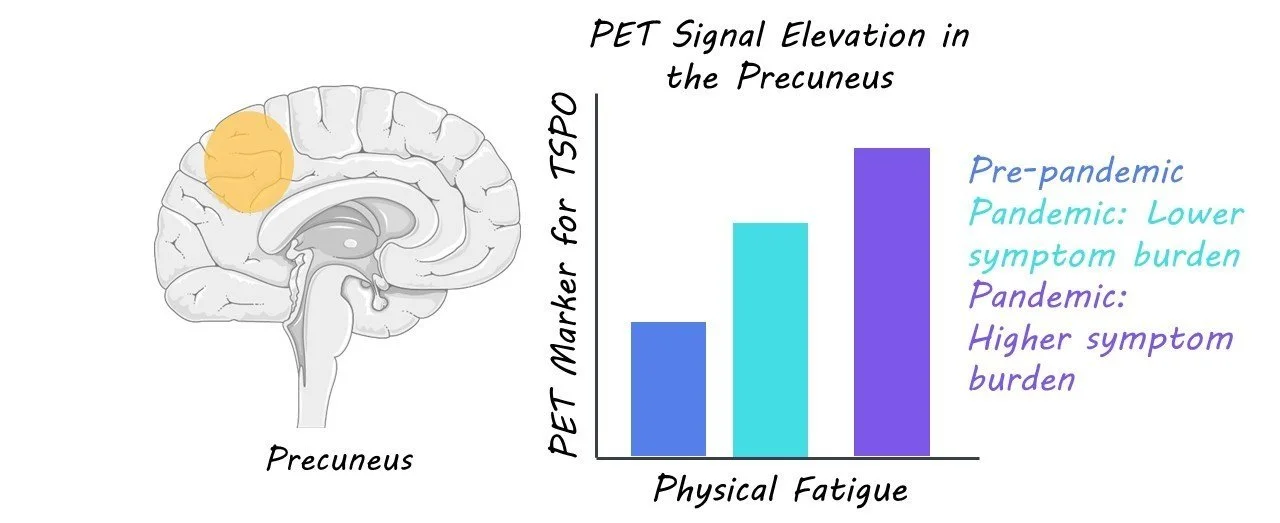
The authors conducted brain imaging on healthy participants studied after the pandemic onset and compared it to data from brain scans on healthy individuals conducted before the pandemic. Positron Emission Tomography and Magnetic Resonance imaging were used to study levels of the 18 kDa translocator protein (TSPO) and myoinositol (mIns). These biomarkers are indicative of an increase in activation of brain glial cells, a response indicative of neuroinflammation. The authors then looked at the link between these neuroinflammatory markers and behavior by administering a questionnaire that assessed impacts of the pandemic on the participants. Levels of TSPO and mIns were then compared between individuals in the pre-pandemic and the post-pandemic groups.

What did they find?

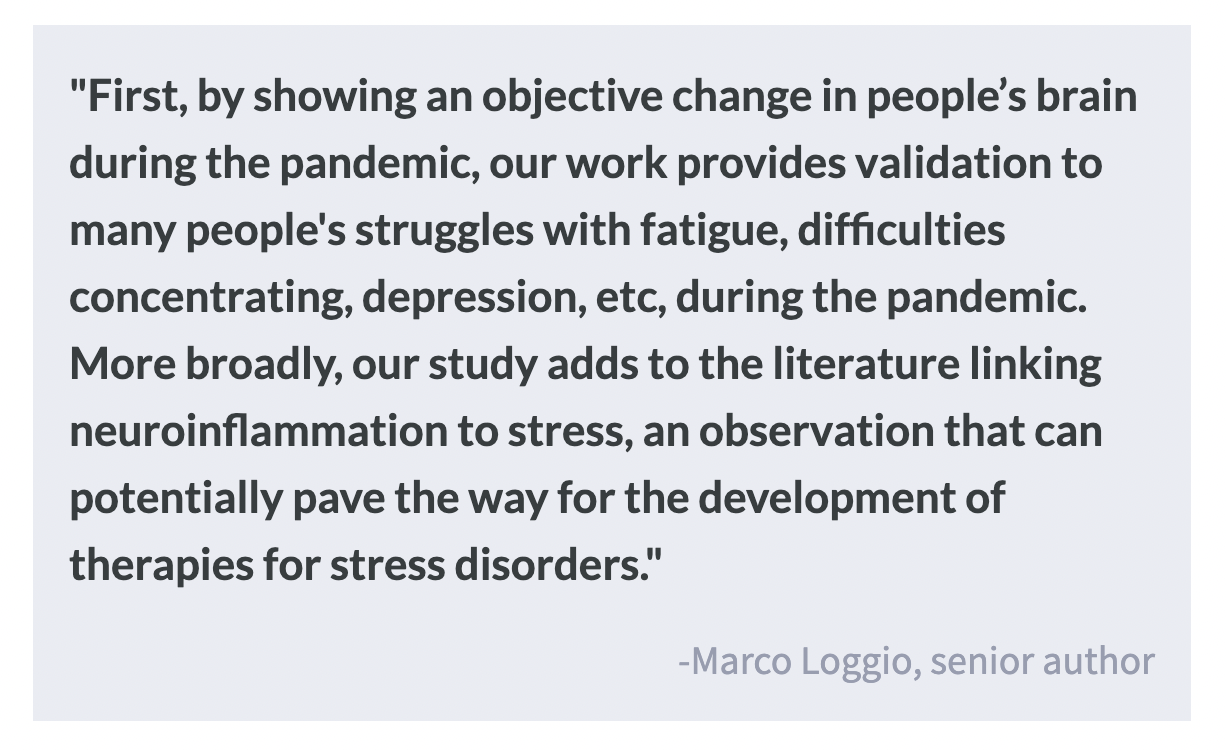
The authors found that participants in the Pandemic group had higher levels of the radiotracer that binds to TSPO in all the studied brain regions compared to participants in the Pre-Pandemic group, even after controlling for a series of factors (including age, vaccination status, etc). The individuals in the Pandemic group also had elevated levels of mINs in the thalamus. Because the participants in the Pandemic group had experienced lockdown orders for two months, these data suggest that neuroinflammation may be linked to experiencing the stresses of lockdown and social distancing requirements. The participants in the Pandemic group reported elevated symptoms of psychological distress such as mood alterations, fatigue, and decreased levels of cognition which have all been previously connected to neuroinflammation.

What's the impact?

This study is the first to show that there is evidence of neuroinflammatory markers in non-infected individuals during the COVID-19 pandemic. These results show that the impact of the pandemic on brain health reaches beyond the impacts of viral infection. These findings also provide a better understanding of the link between pandemic-related stressors and neuroinflammation in the brain.