Deliberate Errors Enhance Learning

Post by Elisa Guma

The takeaway

Deliberate errors followed by error correction may be a superior method of concept learning compared to errorless learning, particularly in low-stakes contexts.

What's the science?

Error commission is an intrinsic part of the learning process, but one that is typically avoided. Interestingly, some empirical work has suggested that making errors can enhance learning in low-stakes contexts. More specifically, there may be learning benefits from deliberately committing and correcting errors even when one already knows the correct answer, as opposed to avoiding errors—referred to as the derring effect. This week in the Journal of Experimental Psychology: General, Wong, and Lim investigated whether deliberate erring improves concept learning. 

How did they do it?

To experimentally test the derring effect, the authors conducted three experiments. In Experiment 1, the authors investigated whether making deliberate errors would enhance the learning of scientific term-definition concepts compared to errorless learning. Participants were asked to learn unfamiliar concepts and told to either error-cancel (deliberate erring in the definition), error-correct (deliberate erring with correction), or to copy the correct definition twice (errorless learning; control condition).

An example of a deliberate conceptual error in the error-cancel condition for the concept: “Cocktail party effect is the selective enhancement of attention to filter out distractions,” is: “Cocktail party effect is the selective enhancement of attention in making sense of distractions.” In the error-correction condition, participants additionally corrected their deliberate error by writing down the actual definition, and in the copy condition, participants wrote down the term-definition concept exactly as it was presented, then copied the key ideas in each concept again.

To assess whether the benefits observed in Experiment 1 were due to the generation of novel responses, the authors performed Experiment 2. The control group elaborated on each concept by generating an alternative conceptually correct definition, then wrote down the actual one (concept-synonym condition). For example, “Cocktail party effect is the increased focus on a particular object (selective enhancement of attention) to filter out distractions.”

Finally, to rule out the possibility that the deliberate erring advantage could be due to more elaboration, the authors ran Experiment 3 with a control group where participants generated a specific example of each concept after writing down the correct definition (concept-example condition). For example, “Cocktail party effect is the selective enhancement of attention to filter out distractions. At a noisy party, Kate was able to focus on what her partner was saying while ignoring other people’s conversations.”

In all experiments, following the learning phase, participants were tested on the definitions they learned. Each response was scored either as correct or incorrect, and errors were also coded into 4 categories: (a) commission errors (i.e., inadequate or incorrect responses that were different from participants’ initial deliberate errors), (b) omission errors (i.e., no response), (c) confusion errors (i.e., responses that gave the definition for another studied concept term instead), and (d) intrusion errors (i.e., in the errorful conditions only, responses that repeated the same deliberate errors that participants had committed during initial study).

What did they find?

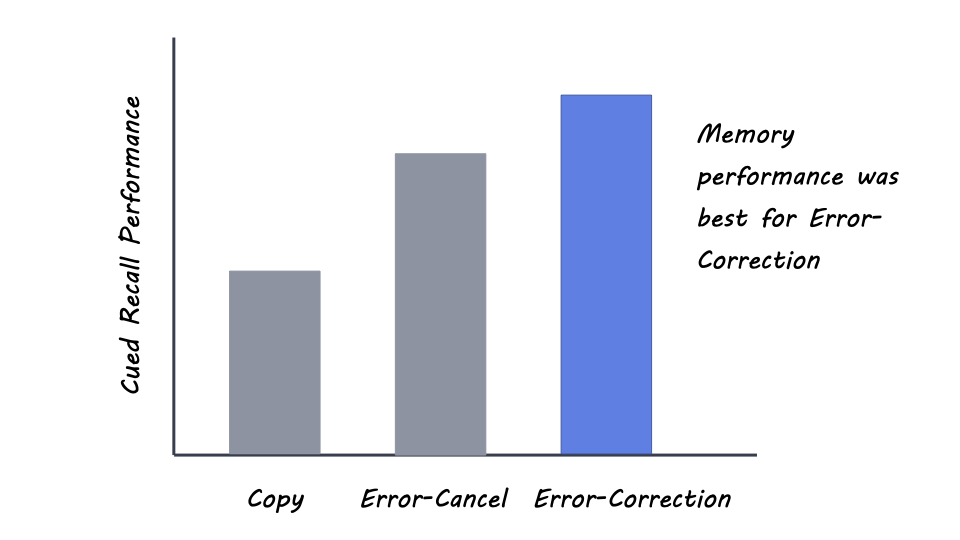
In Experiment 1, the authors found that learners performed better when they had deliberately generated incorrect definitions of scientific concepts compared to errorless copying of the definitions, supporting the derring effect. This advantage was even greater when learners were told to correct their deliberate errors. Interestingly, most of the errors at test were commission errors and not intrusion errors, indicating that deliberate erring did not interfere with test performance.

In Experiment 2, the error-cancel and error-correction methods still outperformed the concept-synonym method, providing further evidence for the advantage of deliberate erring even over actively generating alternative correct responses. Finally, in Experiment 3, the authors still found that the error-correction method outperformed the concept-example method, despite the latter being bolstered by a higher degree of elaboration.
What's the impact?

The findings in this study provide compelling evidence for the benefit of deliberate erring in low-stakes learning environments, particularly when one's errors are corrected. This method of learning may improve the processing of the correction after an error has been deliberately made, supporting better memory performance. Future work may investigate the effects of different kinds of deliberate errors across a range of educational materials. For example, teachers could integrate deliberate erring in homework assignments to help students learn better.
Sleep Instability in Aging is Driven by Hyperexcitable Neural Circuits

Post by Lincoln Tracy

The takeaway

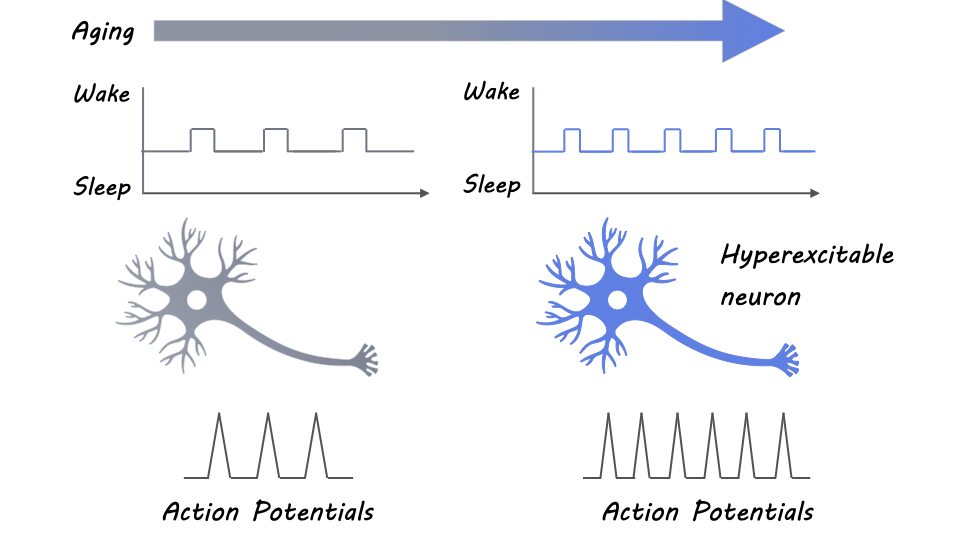
Increased excitability in the neural circuit responsible for an awake state is associated with sleep disruption as we age.

What's the science?

Sleep quality is strongly linked with cognitive function and has been shown to decline with age. However, the mechanisms responsible for sleep instability are unknown. One suggested mechanism is the emergence of increased excitability of arousal-promoting neural circuits (which keep us awake) as we get older, which disrupt sleep stability. The activity of hypocretin—also called orexin—neurons is strongly associated with wakefulness and is responsible for initiating and maintaining an awake state. This week in Science, Li and colleagues investigated whether the intrinsic excitability of hypocretin neurons is altered as we age and whether the altered activity leads to sleep instability.

How did they do it?

First, the authors compared sleep/wake patterns in young (< 5 months) and old (> 18 months) mice using electroencephalography and electromyography recordings, and determined the number of hypocretin neurons in these mice. Second, they used fiber photometry to record how active hypocretin neurons were while the mice were awake or asleep. Third, they used optogenetic blue light to stimulate hypocretin neurons to examine the effects on sleep and awake states. Fourth, they compared the excitability of hypocretin neurons between young and old mice using patch clamp recordings from brain slices. Finally, they explored the role of voltage-gated potassium channels in hypocretin neuron excitability, as altered potassium channel excitability could contribute to the neuronal hyperexcitability.

What did they find?

First, the authors found that old mice had fragmented awake and non-REM sleep periods—which happen right after you fall asleep—compared to young mice. Second, they found that older mice had almost 20-30% fewer hypocretin neurons than young mice, suggesting these neurons become more vulnerable as aging occurs. Third, the fiber photometry recordings revealed a lower threshold is required in older mice for hypocretin neurons to initiate the transition from sleep to an awake state. Fourth, using optogenetic blue light to activate hypocretin neurons resulted in old mice spending more time awake compared to young mice, consistent with the hypothesis that aged hypocretin neurons are more excitable. Fifth, the patch clamp recordings showed a greater proportion of aged hypocretin neurons fired spontaneously than younger neurons, again indicating their hyperexcitability. Finally, chemically blocking voltage-gated potassium channels increased hypocretin neuron activity in young animals and increasing potassium channel activity in aged animals decreased hypocretin neuron activity and rejuvenated sleep patterns.   

What's the impact?

Taken together, this study found that elevated hypocretin neuron excitability is associated with sleep disruption in aging. The finding that manipulating voltage-gated potassium channel activity alters the firing rates of hypocretin neurons suggests potential novel pharmaceutical approaches for addressing the poor sleep quality observed in aging.

A Neural Population Selective for Song in Human Auditory Cortex

Post by Andrew Vo

The takeaway

The human brain has regions specialized for music compared to speech or other sounds. Using brain recordings and imaging allows further decoding of brain responses specific to different types and features of music.

What's the science?

Music is an important part of society, culture, and the human experience. Research has demonstrated our brains have areas that selectively respond to music compared to speech or other sounds. However, whether this brain response to music contains further information about different types or features of music remains unknown. This week in Current Biology, Norman-Haignere et al. used a combination of brain recordings and imaging to identify neural subpopulations representing different types of music.

How did they do it?

The authors used intracranial recordings (ECoG or electrocorticography) from 15 human patients as they listened to a set of 165 natural sounds (e.g., diverse music, speech, vocalization, and ambient sounds). This recording method has the advantage of high temporal resolution of brain responses to brief auditory stimuli. These data were then analyzed using a custom algorithm that decomposed its statistical structure into components that represented different neural populations in the auditory cortex. Due to the limited spatial resolution of ECoG, the authors correlated their initial findings with functional magnetic resonance imaging (fMRI) responses to the same set of sounds but in a different set of 30 volunteers.

What did they find?

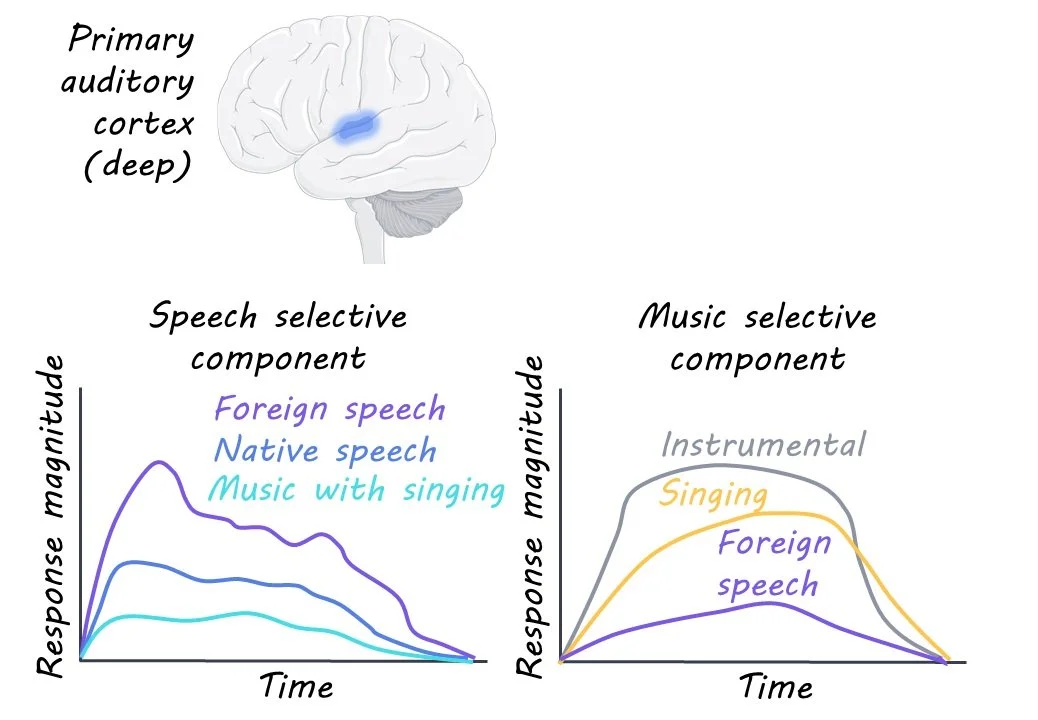
The authors identified 10 reliable components (patterns) from ECoG recordings that were stable across participants. Two of these components responded selectively to speech sounds, regardless of whether that speech was native or foreign to the listener. A different component responded strongly to music, both instrumental and with singing, and less so to speech or other vocalizations. Finally, a single component responded exclusively to music with singing (i.e., song). Using fMRI data, these components were found to be differentially represented along the superior temporal gyrus in the auditory cortex. Brain responses selective for speech, music, and song could not be explained by non-specific features of sound as the identified components showed comparatively weaker responses to matched synthetic sounds.

What's the impact?

This study showed that the human brain not only represents music uniquely from speech or other sounds but that this activity contains further information about different types of music — of note here, for song. The findings here demonstrate how combining the spatiotemporal features of ECoG and fMRI may allow for better decoding of music in the human brain.