The Link between Conspiracy Mentality and Political Affiliation

Post by Megan McCullough

The takeaway

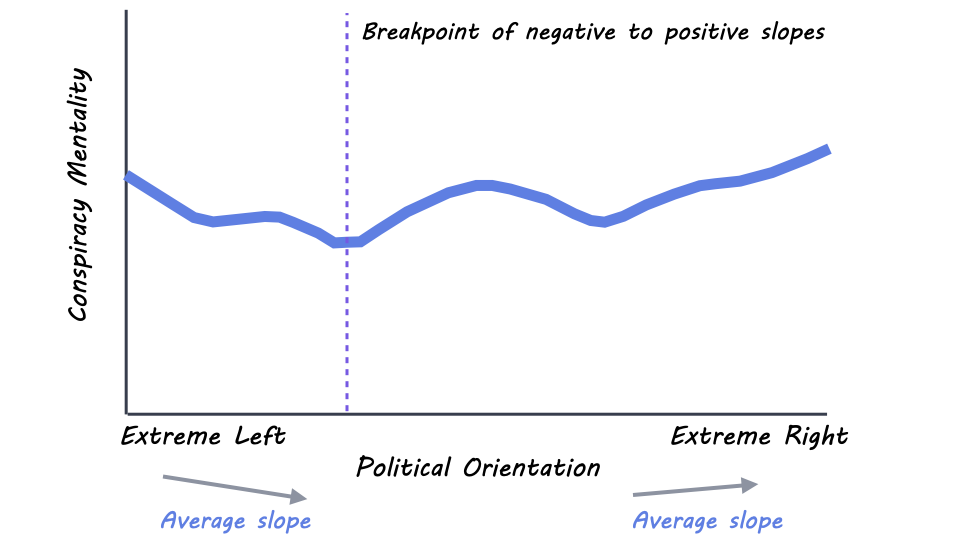
There is a relationship between political affiliation and the tendency to support conspiracy theories, with those on both the extreme left and the extreme right showing a greater conspiracy mentality than those in the political center.

What's the science?

Conspiracy mentality describes the tendency for individuals to endorse conspiracy theories, defined as beliefs that a certain group of people are secretly working together to achieve a malicious goal. Previous studies into the effect of political orientation on conspiracy mentality have shown a U-shaped relationship between political views and conspiracy mentality, suggesting that individuals at both political extremes have a higher tendency to support conspiracy theories than those in the political center. This week in Nature Human Behavior, Imhoff and colleagues used data from 26 countries to conduct the largest study to date into this relationship between political orientation and conspiracy mentality. The authors investigated the relationship between political affiliation and the tendency to support conspiracy theories while controlling for the theory that conspiracy mentality increases among a specific political party when their preferred political party is not in power.

How did they do it?

Data for this study came from two surveys that aimed to investigate the relationship between political leaning and conspiracy mentality. The first survey had a dataset from 23 countries and the second survey had samples from 13 countries, with over 100,000 surveyed individuals between the two surveys. Political orientation was measured using a self-reported scale that asked participants to rank themselves from extremely left-wing to extremely right-wing. Voting intentions were also gathered as a measure of political orientation. Both methods for determining political orientation were used because interpretations of right or left in a political context can be different across countries. Next, the Conspiracy Mentality Questionnaire was administered to assess conspiracy mentality in each of the participants. To determine if perceived lack of political control was a factor in the U-shaped relationship seen in previous research, the authors of this study collected whether the preferred political party was in power at the time of data collection and used this along with demographic information as control variables.

What did they find?

The authors found a consistent relationship between political orientation and conspiracy mentality across the 26 countries of study. Individuals at the extreme ends of the political spectrum were more likely to believe in conspiracies compared to individuals in the middle. The U-shaped relationship was not symmetrical; conspiracy mentality tended to be higher for those on the far right. The authors also found that individuals who supported political parties not included in the current government of their countries were more likely to exhibit conspiracy mentality compared to individuals whose parties were included in government. However, the U-shaped relationship was still intact when this variable was controlled for. This shows that although a perceived loss of control of a political party does influence conspiracy mentality, there are other more important factors at play to explain increased conspiracy mentality at both ends of the political spectrum.
What's the impact?

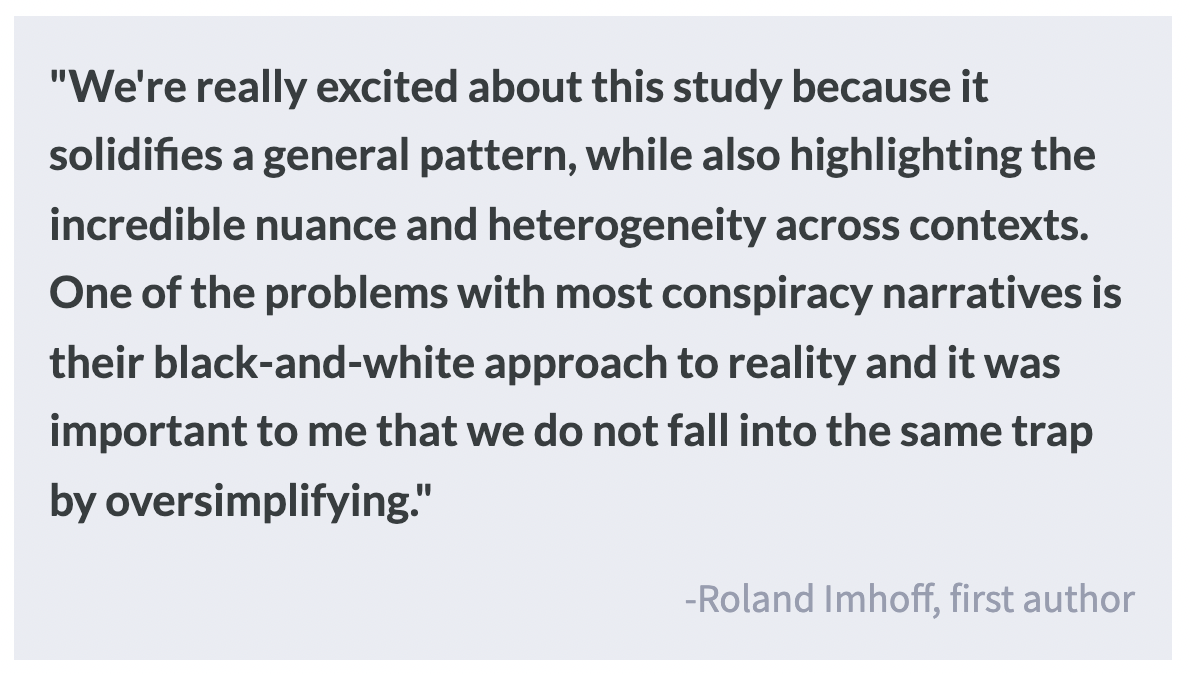
This is the largest study to investigate the relationship between political orientation and conspiracy mentality. This research is important as it provides nuance into the psychology behind conspiracy mentalities and provides a greater understanding of the connection with political affiliation.
Decoding Neural Activity of Imagined Speech

Post by Elisa Guma

The takeaway

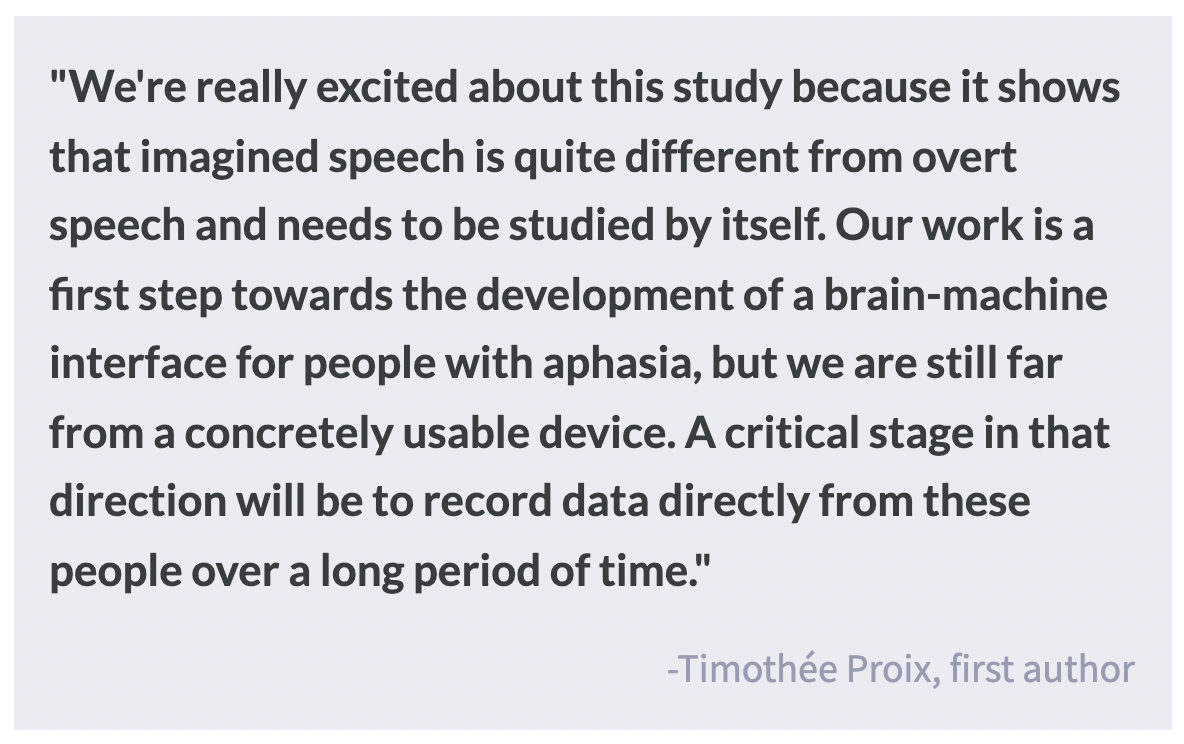
The accurate detection of low-frequency neural activity, unique to imagined speech, may aid in the creation of brain-computer interfaces used to help individuals with speech production deficits communicate.

What's the science?

Using brain-computer interface technology to decode neural features of overt or imagined speech may enable communication in real-time for individuals suffering from serious or complete speech production. While progress has been made in decoding overt speech, decoding imagined speech has been more challenging due to weaker and more variable neural signals. This week in Nature Communications, Proix and colleagues investigate the neural activity associated with overt and imagined speech production.

How did they do it?

Electrocorticographic (ECoG) recordings were acquired from individuals with refractory epilepsy who were implanted with a subdural electrode array as part of the standard pre-surgical evaluation process. While electrocorticographic recordings were being acquired, participants were asked to listen to or read multiple words or syllables (ex: ‘ba’, ‘da’, ‘ga’), after which they were instructed to either imagine hearing the word or syllable, imagine saying the word or syllable, or repeating the word or syllable out loud.

First, electrodes were localized to a patient’s pre-implant structural MRI such that the location of each electrode could be associated with a specific brain region. The signal was then transformed such that a power could be assigned to each recording in one of 4 known frequencies ranging from low to high: theta, low-beta, low-gamma bands, and broadband high-frequency activity. For each power spectrum, the authors investigated the association with either listened, overt, or imagined speech, and specific brain regions. Finally, the authors aimed to decode overt and imagined speech by training a specific classifier for each binary classification between distinct words or syllables.

What did they find?

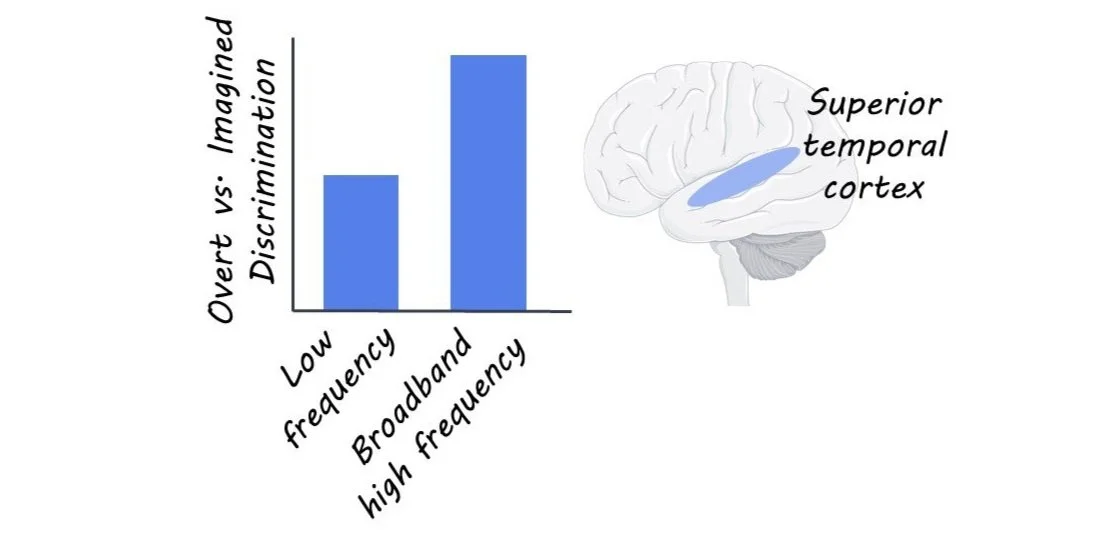
The authors found that overt and imagined speech engaged a large part of the left hemispheric language network including the sensory and motor regions, with more prominent involvement of the superior temporal gyrus for overt speech, potentially attributable to the auditory feedback due to hearing oneself speak. The power spectrum differences between overt and imagined speech were sufficiently reliable to accurately classify which task the participants were engaged in. Broadband high-frequency activity was most associated with overt speech decoding. Neural activity at both low- and high- frequency power could be used to decode imagined speech with equivalent or even higher performance than overt speech. These data suggest that low-frequency power may be critical for decoding imagined speech, that the process of decoding overt and imagined speech may be quite different, and that brain-computer trained on one type of speech production may not be applicable to the other.  

What's the impact?

This study examined neural activity associated with the production of overt or imagined speech and found crucial differences in their oscillatory patterns and neuroanatomical origin. Low-frequency power and cross-frequency dynamics may hold key information for decoding imagined speech. A better understanding of the underlying neural activity of imagined speech may inform more accurate brain-machine interfaces, which could greatly benefit those suffering from severe speech production deficits.  

The Benefits of Mindfulness for Athletes

Post by Shireen Parimoo

The mindfulness era

Sports performance requires as much mental toughness and perseverance as it does physical fitness and conditioning. In addition to physical conditioning, (elite) athletes must develop considerable mental fortitude and discipline, contributing to their performance in competitions. Some important mental skills that athletes develop include motivation, arousal regulation, recovery, the ability to cope with training demands and competition pressure, and the ability to focus on both the present moment and on future goals.

We know that physical fitness can be improved by following exercise programs and regimens, but how do athletes train their minds? Athletes often perform psychological skills training to supplement their physical training, which can include working on techniques like self-talk, goal setting, and imagery. For example, self-talk can reduce performance-related anxiety and increase self-confidence and motivation, both of which may then benefit performance. More recently, mindfulness meditation has become a popular practice among athletes and non-athletes alike. Mindfulness refers to a state of awareness of our thoughts and feelings (i.e., inner experiences) in the present moment. It is characterized by attention to the present moment, lack of reactivity and judgment, and increased acceptance of our inner experiences. Practicing mindfulness meditation has numerous psychological and cognitive benefits, such as reductions in depressive symptoms, anxiety, and stress, as well as improvements in attentional focus and emotion regulation.

There are two main approaches to researching mindfulness:

1.     Relating dispositional or trait mindfulness (e.g., as an individual, how well are they able to stay focused on the present moment?) to other psychological and performance-related outcomes.

2.     Mindfulness-based interventions. In this approach, psychological and performance outcomes are measured before and after an intervention during which participants learn about mindfulness concepts and mindfulness techniques like emotion acceptance.  

Do athletes benefit from mindfulness?

Across a variety of sports, research shows that individuals high in trait mindfulness are more likely to experience the flow state. Flow is a state of intense focus characterized by complete immersion in the task at hand that is accompanied by high levels of clarity, control over the task, ease and enjoyment of the task, and a sense of time flying by. More commonly, flow is what we call “being in the zone” during a task. Athletes who score high on trait mindfulness also tend to have better concentration, higher goal clarity, and an increased sense of control than those lower on trait mindfulness. Experiencing the flow state, in turn, is often associated with better performance.

Trait mindfulness has also been associated with a better ability to cope with sports-related challenges such as training demands, self-confidence and motivation, and performance-related worries. One of the reasons that trait mindfulness results in better coping skills is that mindfulness helps in the regulation of emotion and allows people to avoid ruminating on negative thoughts. Thus, higher mindfulness likely prevents athletes from being distracted by negative thoughts and provides more room for them to focus on their goal, which might then prevent them from faltering under pressure.

In line with this idea, trait mindfulness is related to higher self-reported sports performance and lower competition-related anxiety. Interestingly,  researchers have found that competition-related anxiety negatively impacts performance, but only in those who were low in mindfulness. As performance- and sports-related worries are likely pervasive among athletes, higher mindfulness may prevent those worries from interfering with performance.

Is mindfulness training effective?

Mindfulness-based interventions show promise in facilitating performance outcomes, likely by influencing both physiological and psychological variables. On a holistic level, mindfulness training has been shown to improve the well-being of athletes, along with reductions in burnout and improvements in sleep quality. Mindfulness also has a positive effect on physiological measures like salivary cortisol levels (a marker of stress) and resting heart rate (a measure of fitness).

On a psychological level, mindfulness training can lead to more frequent flow states, better attentional control, and fewer performance-related worries. In fact, one study showed that the impact of an 8-week-long mindfulness program reduced cortisol levels of elite athletes by also reducing their competition-related anxiety. Athletes who practiced mindfulness for four weeks also became better equipped at handling failures. Lastly, the impact of mindfulness on actual sports performance is currently unclear. According to a recent meta-analysis, mindfulness interventions improve performance in precision sports like dart throwing and shooting, but not in sports like running and cycling. Other work indicates that both subjective and objective measures of performance show improvements following mindfulness training, such as longer time to exhaustion on an endurance test. By and large, however, the impact of mindfulness training on objective performance outcomes is mixed and more research is needed to identify how different types and durations of mindfulness programs might benefit performance in various sports.

References +

Aherne et al. The effect of mindfulness training on athletes’ flow: An initial investigation. The Sport Psychologist (2011).

Birrer et al. Mindfulness to enhance athletic performance: Theoretical considerations and possible impact mechanisms. Mindfulness (2012).

Birrer et al. Helping athletes flourish using mindfulness and acceptance approaches – an introduction and mini review. Sport & Exercise Medicine (2021).

Buhlmayer et al. Effects of mindfulness practice on performance-relevant parameters and performance outcomes in sports: A meta-analytical review. Sports Medicine (2017).

Cathcart et al. Mindfulness and flow in elite athletes. Journal of Clinical Sport Psychology (2014).

De Petrillo et al. Mindfulness for long-distance runners: An open trial using mindful sport performance enhancement. Journal of Clinical Sport Psychology (2009).

Hamilton et al. Effects of a mindfulness intervention on sports-anxiety, pessimism, and flow in competitive cyclists. Applied Psychology: Health and Well-Being (2016).

Josefsson et al. Mindfulness mechanisms in sports: Mediating effects of rumination and emotion regulation on sport-specific coping. Mindfulness (2017).

Kee & Wang. Relationships between mindfulness, flow dispositions, and mental skills adoption: A cluster analytic approach. Psychology of Sport and Exercise (2008).

Mehrsafar et al. The effects of mindfulness training on competition-induced anxiety and salivary stress markers in elite Wushu athletes: A pilot study. Physiology & Behavior (2019).

Nien et al. Mindfulness training enhances endurance performance and executive functions in athletes: An event-related potential study. Neural Plasticity (2020).