
How the Immune System Interacts with Our Brains

Post by Anastasia Sares

What did we learn?

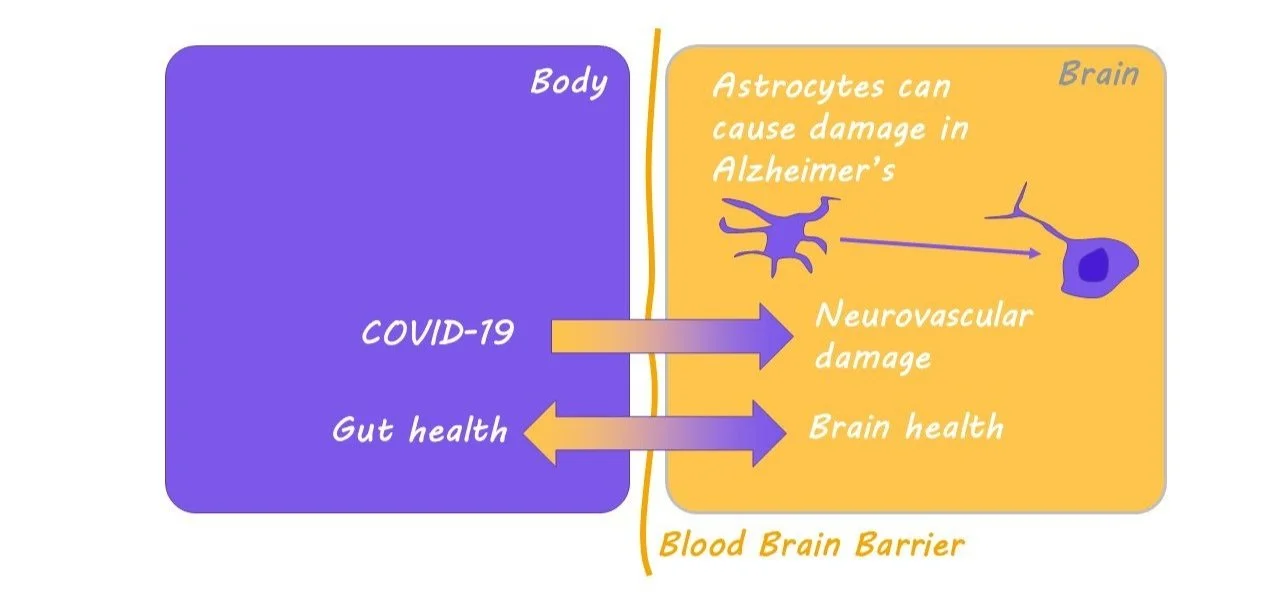
Neuroscientists are learning more and more about the role of the body’s immune system, the gut microbiome, and physical illnesses on brain function. Immune systems, when they are working well, defend the body and brain against infection. The brain has its own immune system, which normally stays separated from the rest of the body, protected by a layer of defense called the blood-brain barrier. While much of neuroscience focuses on neurons and the web-like connections between them, support cells (astrocytes) and immune cells (glia) can drastically affect the function of neurons. And if the blood-brain barrier is compromised, both diseases and the body’s immune cells can cross over and create complications.

In many dementias, astrocytes and glia can go rogue and attack neural synapses. In Alzheimer’s disease for example, abnormal proteins may use the cholesterol transport mechanisms in astrocytes to spread to different parts of the brain. Immune cells that are normally outside of the brain can also make their way into the brain when the body is under stress. In Lewy-Body Dementia, immune cells that are normally only found in the body appear around the sites of damaged brain tissue, and their immune response is amped-up. In addition, immune responses inside and outside of the brain can lead to neural inflammation, which may be one of the mechanisms of depression.

Still more surprising connections can be found between digestive health, including the gut microbiome, and neural health. A study by Wu and colleagues found that mice bred without microbiomes in their gut display reduced social behavior towards other mice, and bigger stress response to the few social encounters they did have. In fact, it has recently been suggested that during pregnancy, maternal infections and their corresponding immune responses may lead to both Autism Spectrum Disorder and digestion problems in the fetus, which could be why Autism and digestion issues are often linked. This is part of a research trend looking at the gut-brain connection, which made its way into pop science starting in 2015 with books like Gut, The Brain-Gut Connection, and the Psychobiotic Revolution.

Then there are, of course, the neurological side effects of the Sars-Cov-2 virus, which emerged in 2019 and has been the focus of fever-pace research since then. For example, a post-mortem study compared brains of people who died from COVID-19 to brains of people who died from other causes, and found that COVID patients had increased brain inflammation and damage to axons in the brain (the tendrils that neurons use to communicate with one another). The fact that COVID can cross the blood-brain barrier and have long-lasting effects on the nervous system make vaccination access and uptake even more important.
What's next?

Though a good proportion of studies examining the connection between the nervous system and the immune system are still taking place in mice and rats, there seems to be a transition toward more human studies, solidifying the connection between these two systems. Looking at the human body as a whole is bound to bring new insights into how our immune systems interact with and impact brain function.
Uncovering How Sleep Affects Memory and Brain Function

Post by Elisa Guma

What did we learn?

Sleep is an important part of our daily routine and a fundamental building block for our physical and mental health. Further, there is no major psychiatric disorder in which sleep is not affected. Although its complex physiology is not yet fully understood, recent findings suggest that during sleep, the brain is able to clear neurotoxins that accumulate during waking hours. Researchers have observed a dramatic increase in the volume of the interstitial system – the fluid-filled space that surrounds the cells of the brain – during sleep, which facilitates the flow of fluids through the brain, increasing the clearance rate of neurotoxins. The rate of clearance can be halted by just one poor night of sleep, leading to an accumulation of neurotoxic proteins in the brain. These neurotoxins include proteins such as B-amyloid, tau, and a-synuclein, whose pathological accumulation has been associated with the neurodegenerative diseases Alzheimer’s and Parkinson’s. This provides compelling evidence for the role of sleep in keeping our brain healthy and suggests that the disruption of adequate toxin clearing due to poor sleep may be a risk factor for neurodegenerative diseases. 

Sleep also plays a critical role in consolidating experiences into long-term memories. This year Skelin et al. uncovered that in order to support this process, the hippocampus produces a specific pattern of neural activity during sleep, sharp-wave ripples, characterized by large, fast, waves of activity, which stimulate high-frequency neuronal activity in regions of the memory circuit, the amygdala and temporal lobe. The activity of hippocampal neurons during sleep appears to act in concert with distant brain regions to coordinate the consolidation of memory. 

What's next?

These advances made in our understanding of sleep physiology help us to understand its critical role in supporting our health and wellbeing. Future work is needed to uncover the relationship between poor sleep and risk for psychiatric and neurodegenerative diseases. Maintaining healthy sleep habits is not always an easy task, but here are a few suggestions for good sleep hygiene below (more here).

  1. View sunlight in the morning by going outside, and do it again the later afternoon prior to sunset to help entrain your circadian clock

  2. Try to maintain a consistent sleep schedule

  3. Avoid caffeine within 8-10 hours of bedtime

  4. Avoid viewing bright lights, especially bright overhead lights between 10 pm and 4 am

  5. Limit daytime naps to less than 90 minutes

  6. Keep a cool bedroom

2022 should be an exciting year in furthering our knowledge of how sleep impacts our brain function and our day-to-day lives.

The Impact of Environment-Gene Interaction on Brain Development

Post by Elisa Guma

What did we learn?

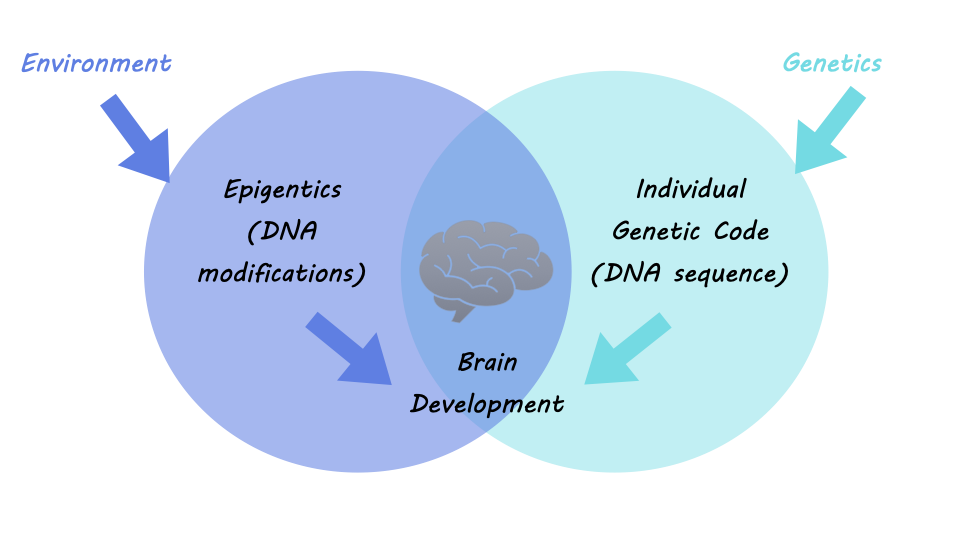
Brain development is a highly orchestrated, complex process driven by genetic background and its interaction with the environment, which can exert both positive and negative influences on development. For example, exposure to an enriched environment promotes the development of healthy brain circuits. Furthermore, environmental enrichment has been shown to help aid in the production of new neurons (neurogenesis) in the hippocampus, which may buffer against age-related cognitive decline. Recent evidence suggests that environmental enrichment may be exerting these positive effects by inducing epigenetic changes in the DNA of hippocampal neurons. More specifically, it can reverse the negative effects of aging on DNA methylation in neurons of the hippocampal dentate gyrus involved in neuroplasticity and neurogenesis, critical for learning and memory (see Zocher and colleagues).

Unfortunately, environmental exposures may also disrupt neurodevelopment, which may, in turn, increase the risk of developing psychiatric illness. These negative effects may be particularly heightened if coupled with genetic risk. Just as the hippocampus has been found to be sensitive to positive environmental pressures, it is also susceptible to negative influences. Recent evidence by Song and colleagues has shown that exposure to both a genetic risk factor (risk gene for schizophrenia, DISC1) and an environmental risk factor (in utero exposure to maternal infection) can disrupt the structural and functional development of projections from the hippocampus to the prefrontal cortex in early development. This pathway may underlie many of the cognitive deficits associated with psychiatric illness.

What's next?

Our genes and the environment we are exposed to act in concert to shape our brain and behavioral development. Understanding how these factors interact during specific developmental windows could help us identify how and when to intervene during a child’s development. Identifying potential environmental interventions to buffer against both environmental and genetic risk factors for psychiatric illness will be an interesting avenue for future research in 2022.