A Better Understanding of Memory Formation and Storage
Post by Shireen Parimoo
What did we learn?
The hippocampus is central to memory formation and retrieval as it receives and integrates information from across the brain. Memory for associations or episodic information (such as an event consisting of location, people, and time information) are particularly reliant on the hippocampus as it is thought to bind the different elements of an event together into a single representation. The formation and retrieval of memories are supported by the structure and function of the hippocampus and its interactions with the neocortex.
2021 only further advanced our understanding of the hippcampus’ pivotal role in how memories are formed and accessed. During memory encoding, Griffiths and colleagues showed that oscillatory activity within the hippocampus was related to better associative memory. Specifically, greater theta-gamma coupling during mnemonic binding predicted better memory for associations (e.g., a pattern and an item), while memory for single items was related to alpha/beta activity in the occipital cortex during stimulus perception. Gava and colleagues found that individual elements of associative events (e.g., location) are represented by different firing patterns in the same set of co-active hippocampal neurons and demonstrated how these representations are updated across repeated and novel experiences. Relatedly, Gonzalez and colleagues reported that dopamine receptors in the hippocampal CA1 subregion are not involved in retrieving an already-formed memory, but they are important for the consolidation and reconsolidation (i.e. a process whereby memories are reactivated, changed, and restabilized) of new memories. Memory reconsolidation is especially important for schema creation, as it allows information to be linked together across different memories to form a generalized representation of a concept (e.g., the concept of an “office”).
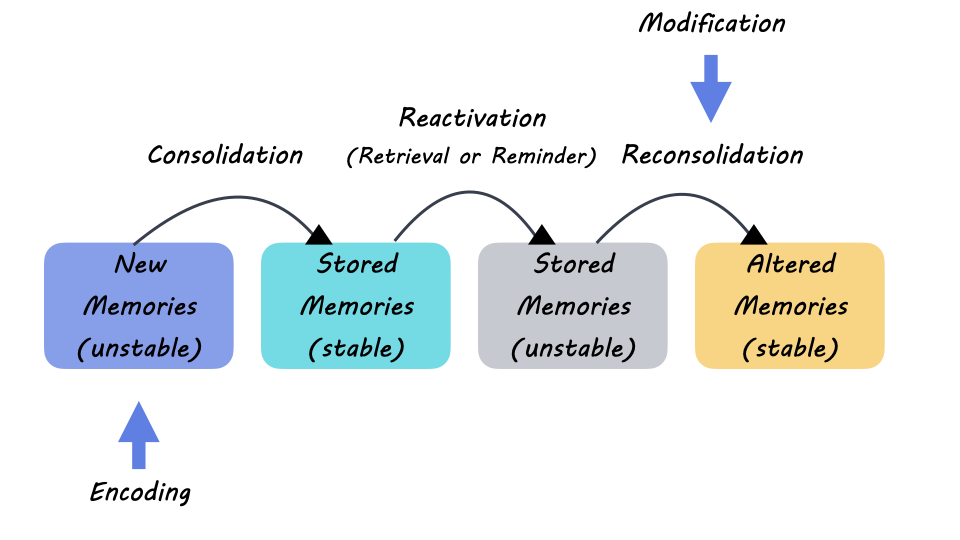
Hippocampal interaction with other brain regions is also important for storing and retrieving memories, particularly newer memories. During retrieval of autobiographical memories, for example, Gilmore and colleagues observed that activity in the posterior hippocampus was selective for recent compared to remote memories. The hippocampus also had greater functional connectivity with cortical regions during recall of recent memories rather than remote memories, further illustrating its differential involvement in temporally graded retrieval. Together, these studies highlight the diversity of hippocampal involvement across different stages of memory formation and retrieval, ranging from encoding and reconsolidation to temporally graded retrieval of autobiographical memories.
What's next?
As a field, cognitive neuroscience is getting increasingly closer to mapping out the neural mechanisms underlying memory formation and retrieval. We currently have some of the puzzle pieces showing how different anatomical brain regions or distinct brain circuits play a role in memory formation and retrieval. These seemingly disparate findings create exciting possibilities for future research to demonstrate how these pieces interact with each other to provide a more comprehensive picture of how the brain forms and stores memories.