
Morning Larks and Night Owls: The Impact of Chronotype

Post by Anastasia Sares

The takeaway

Chronotype, or day/night preference, is a genetically influenced trait that affects how active and alert we are at various points in the day. In the past few years, studies have linked chronotype to both mental and physical health, and people can suffer adverse effects when their daily schedule doesn’t align with their chronotype—a phenomenon called “social jet lag.”

How do we measure chronotype?

The simplest way to measure a person’s chronotype is by asking about their sleeping habits. It’s important to do this for workdays and for free days, as someone might change their habits between the two, and may try to make up for missed sleep on their free days by oversleeping. There are more objective ways to measure chronotype, but they take longer. Actimetry measures the amount of movement a person makes throughout the day by some kind of wearable device. Another popular measure is dim light melatonin onset, or DLMO, which measures how fast people produce the sleep-related hormone melatonin in response to dim light. All of these measures agree with each other pretty well, even an ultra-short version recently developed for use in clinics or as a part of other studies that don’t have much extra time.

Chronotype also varies hugely over the lifespan, with adolescents having very late chronotypes and older adults having earlier chronotypes. People in urban environments have more varied later chronotypes than those in rural environments, and even people’s location within a time zone (eastern vs. western edge) can affect their chronotype due to small differences in sunlight hours.

How is chronotype related to health outcomes?

Late chronotypes (night owls) are prone to more adverse health outcomes like hypertension and depression. However, it is not clear that being a night owl causes these effects. The less our daily schedule is synchronized with our natural sleeping rhythm, the more stress we experience, and this stress is what can lead to health problems. This is called “social jet lag,” and it is more likely to affect night-owls because societal structures tend to follow earlier schedules (the writer of this article, being a moderately late chronotype, still remembers getting up at 6:15 am during high school with much chagrin). Social jet lag is at its most extreme in shift-workers, like hospital staff who have work during the night.

Chronotype isn’t just a matter of psychology; every cell in the body has a circadian rhythm and is affected by these day-night cycles. Under social jet lag, the body’s cellular clocks adjust at different rates and cannot keep up with the switch between workdays and free days. It is these unsynchronized cellular clocks that may be responsible for the health risks of social jet lag. Worldwide, workers’ sleep habits when working from home during the COVID-19 pandemic shifted later, indicating that society as a whole had been under social jet lag.

How can we lessen the impact of social jet lag?

Chronotype can be manipulated to some degree. Being outside during the day can help to naturally regulate your sleep cycle. On the other hand, exposure to light before bed can disturb natural sleep-wake cycles, and so it is helpful to limit your evening screen time if you want to shift your schedule earlier (put away your phone!). A regular sleep schedule will also lower your risk for adverse health effects, especially if your work hours are very early or very late compared to your natural rhythm. However, don’t sacrifice your free-day sleep in order to keep a normal wake-up time. Rather, try to go to sleep at the same time each night.

On a societal level, we can take chronotype into account in school start times and in assigning shifts to workers, something that is already starting to be done. Some researchers are also calling for governments to abolish daylight savings time, which can cause a host of sleep-related problems.

What's the impact?

In our industrialized society, many people live predominantly indoors and are more detached from natural day-night cycles, making their chronotypes later and more varied. It is important to provide daily structures that accommodate differences in chronotype—this will have a significant impact on human health and well-being, as well as increasing work productivity and quality.

References +

  1. Roenneberg, T., Pilz, L. K., Zerbini, G., & Winnebeck, E. C. (2019). Chronotype and social jetlag: A (self-) critical review. Biology, 8(3), 1–19. https://doi.org/10.3390/biology8030054
  2. Shahid, A., Wilkinson, K., Marcu, S., & Shapiro, C. M. (2011). Munich Chronotype Questionnaire (MCTQ). STOP, THAT and One Hundred Other Sleep Scales, 245–247. https://doi.org/10.1007/978-1-4419-9893-4_58
  3. Ghotbi, N., Pilz, L. K., Winnebeck, E. C., Vetter, C., Zerbini, G., Lenssen, D., … Roenneberg, T. (2020). The µMCTQ: An Ultra-Short Version of the Munich ChronoType Questionnaire. Journal of Biological Rhythms, 35(1), 98–110. https://doi.org/10.1177/0748730419886986
  4. Kalmbach, D. A., Schneider, L. D., Cheung, J., Bertrand, S. J., Kariharan, T., Pack, A. I., & Gehrman, P. R. (2017). Genetic Basis of Chronotype in Humans: Insights From Three Landmark GWAS. Sleep, 40(2). https://doi.org/10.1093/sleep/zsw048
  5. Wittmann, M., Dinich, J., Merrow, M., & Roenneberg, T. (2006). Social jetlag: Misalignment of biological and social time. Chronobiology International, 23(1–2), 497–509. https://doi.org/10.1080/07420520500545979
  6. Hulsegge, G., Loef, B., van Kerkhof, L. W., Roenneberg, T., van der Beek, A. J., & Proper, K. I. (2019). Shift work, sleep disturbances and social jetlag in healthcare workers. Journal of Sleep Research, 28(4). https://doi.org/10.1111/jsr.12802
  7. Korman, M., Tkachev, V., Reis, C., Komada, Y., Kitamura, S., Gubin, D., … Roenneberg, T. (2020). COVID-19-mandated social restrictions unveil the impact of social time pressure on sleep and body clock. Scientific Reports, 10(1), 1–10. https://doi.org/10.1038/s41598-020-79299-7
  8. Roenneberg, T., Wirz-Justice, A., Skene, D. J., Ancoli-Israel, S., Wright, K. P., Dijk, D. J., … Klerman, E. B. (2019). Why Should We Abolish Daylight Saving Time? Journal of Biological Rhythms, 34(3), 227–230. https://doi.org/10.1177/0748730419854197
Perceived Social Support is Related to Depressive Symptoms in Those with Physical Disability

Post by Elisa Guma

The takeaway

Increased perceived social support can buffer against depressive symptoms in individuals with long-term physical disability, while decreased support can worsen symptoms.

What's the science?

Perceived social support is an important factor for maintaining good mental health in vulnerable groups, such as those with long-term physical disability, or in an aging population. Cross-sectional studies have identified a strong association between lack of social support and depression in these groups. However, no longitudinal studies — with comprehensive measures of social support — have been conducted to investigate the association between perceived social support and mental health outcomes. In Disability and Health Journal, de la Vega and colleagues assess the relationship between perceived social support and depressive symptoms in individuals with long-term physical disability including multiple sclerosis, spinal cord injury, and muscular dystrophy.

How did they do it?

Participants with one of three different chronic physical disabilities (spinal cord injury, multiple sclerosis, and muscular dystrophy) were asked to complete surveys every 12-15 months over the course of a 6 year period. The sample used for this study (n=475) included survey responses two time points, spaced 6 years apart. In addition to basic demographic information (age, sex, ethnicity, diagnosis, household income, marital status, education), the severity of depressive symptoms was recorded (using the Patient-Reported Outcomes Measurement Information System), as was the perceived social support (using the Multi-dimensional Scale of Perceived Social Support). 

With these data, the authors intended to ask whether a change in perceived social support over the two timepoints was associated with a change in depressive symptomatology. However, for a large majority of the sample, little change in perceived social support over the 6-year period as observed. Therefore, the authors identified a subgroup of individuals for which social support did change in order to investigate this relationship.

What did they find?

The majority of individuals enrolled in the study reported no differences in social support over the 6 year follow up period, with no differences in social support between the three diagnosis groups, or between men and women. Interestingly, the subset of individuals who did report changes in perceived social support also reported changes in depressive symptoms. Those that experience increased social support reported decreased depressive symptoms, while those that reported decreased social support reported increases in depressive symptoms.

What's the impact?

This study provides support for the association between social support and mental health outcomes, particularly in vulnerable individuals suffering from chronic physical disability. These findings suggest that providing social support to individuals struggling with chronic disability may be an important buffer against negative mental health outcomes. Investigating the provision of social support as a possible treatment intervention for individuals struggling with disability, as well as an aging population, or isolated groups will be an important avenue for future research.

Access the original scientific publication here.

The Relationship Between Anxiety and Breathing Perception

Post by Leanna Kalinowski

The takeaway

Many psychiatric disorders are thought to be associated with an impairment in interoception, which is the perception of your body’s internal physiological signals. Sensitivity towards and insight into breathing perception are altered in individuals with anxiety. 

What's the science?

Interoception, the brain’s perception of sensations within the body, is an important component of maintaining bodily homeostasis. For example, these perceptions tell you if you’re hungry, if your heart is beating too fast, or if you are experiencing shortness of breath. An impaired ability to monitor your body’s signals is believed to exist in a variety of psychiatric disorders. This is particularly seen with anxiety, where individuals may misinterpret their changes in breathing patterns when feeling worried. 

Previous studies on interoception treated it as a single entity, while recent studies identified that interoception spans multiple levels of perception. Notably, “lower” levels of interoception include sensory and psychophysical properties, while “higher” levels of interoception include one’s attention towards bodily signals and accuracy of interoceptive beliefs (i.e., metacognition). However, it is not yet known whether anxiety is differentially related to these levels of interoception. This week in Neuron, Harrison and colleagues evaluated the relationship between anxiety and each level of breathing-related interoceptive processing using self-report measures and two interoceptive breathing tasks.

How did they do it?

The researchers recruited thirty participants to first complete an anxiety questionnaire, after which they were separated into one of two groups: “low anxiety” and “moderate anxiety”. Then, participants were asked to complete three tasks. The first task was a set of questionnaires to assess participants’ subjective measures of anxiety and body awareness. The second task, called the filter detection task (FDT), was then used to measure breathing perception and metacognition. The FDT began with the participants taking three normal breaths on a breathing circuit. Then, one of two filters was applied to the circuit: one filter added resistance, and the other filter did not. Participants took three additional breaths with the filter, and then were asked (1) whether resistance was added and (2) how confident they were in their answer on a scale of 1 to 10.

The final task, called the breathing learning task (BLT), was used to measure brain activity during trial-by-trial interoceptive learning. During each trial, participants were shown one of two visual cues that were paired with either an 80% or 20% chance of breathing resistance being applied. Then, they were asked to predict whether it will be difficult to breathe, after which either a strong resistance or no resistance was applied using a breathing circuit. They were then asked to rate how difficult it was to breathe and subsequently repeated the entire task for a total of 80 trials. Brain activity was measured during all trials with functional magnetic resonance imaging (fMRI).

What did they find?

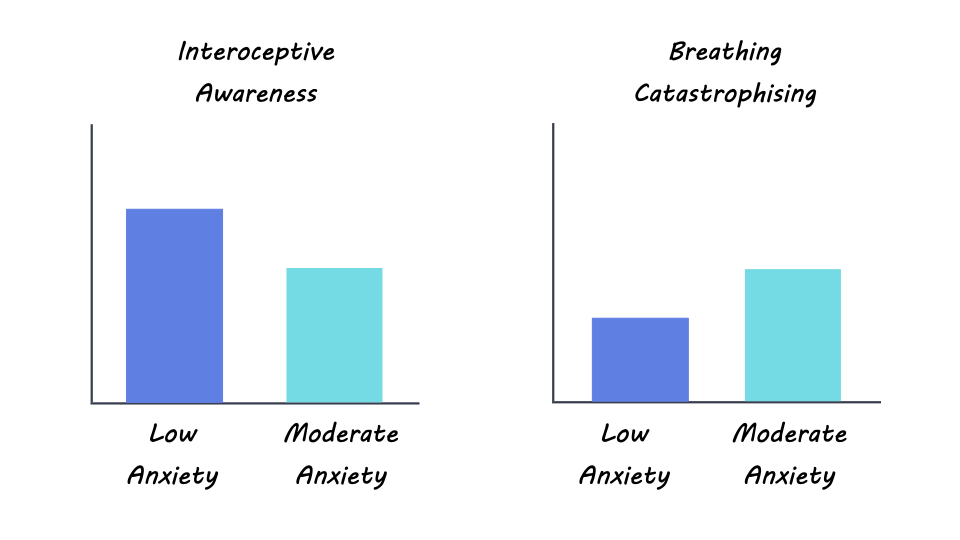
First, the researchers found that individuals with moderate anxiety showed greater self-reported overall body awareness compared to those with low anxiety. However, participants with moderate anxiety also showed reduced perceptual sensitivity to breathing resistance during the FDT and had lower confidence in their ability to detect breathing resistance, in contrast to the self-reported measures. These results demonstrate multiple different associations between breathing perception and anxiety.

Using the BLT, the researchers then found a relationship between anterior insula activity and both prediction certainty and magnitude of prediction errors on the BLT, suggesting that the anterior insula plays an important role in representing bodily perceptions and updating them as additional trials are completed. Participants with low versus moderate anxiety traits also showed differences in anterior insula activity with prediction certainty. Multi-modal analysis of data from all tasks showed that anxiety is associated with multiple levels of interoception, though stronger effects are seen at higher levels of the interoceptive process (i.e., aspects of metacognition). These results demonstrate that the association between breathing perception and anxiety persists across all levels of interoception.

What's the impact?

This study was the first to show brain activity associated with trial-by-trial interoceptive learning. These results provide new insights into how anxiety is related to breathing perception and implicate the anterior insula in representing and updating perceptions of breathing states. Future research is needed to determine whether these results translate to other interoceptive processes, such as cardiac or gastric states.