
Numerosity Processing Across Cortical Layers in Parietal Cortex

Post by Lina Teichmann

The takeaway

Different cortical layers in the brain have different response patterns when processing quantities of items (i.e. numerosity). Cortical layers from different brain regions tend to increase in response specificity from central towards deep and superficial layers.

What's the science?

Numerosity processing allows us to determine the size of a group of items and is an essential ability in everyday life. Previous studies have shown that numerosity processing involves a network of specialized areas in the brain. Some of these areas, such as the parietal cortex, contain neuronal populations that prefer (respond strongly to) a specific numerosity, while numerosities that are further away from the preferred numerosity evoke a weaker response. The preferences of a neuronal population can be summarized by a tuning curve that shows how strongly a population responds to different numerosities. The width of the tuning curve indicates the numerosity preference of a given population: If the tuning curve is narrow — for example only having a peak at numerosity 3 but a sharp drop for neighboring numerosities (2 and 4) — the tuning response is very specific.

In the visual cortex, it has been shown that the specificity of neural responses varies across cortical layers, with both deep and superficial layers showing increased specificity in comparison to central layers. This week in Current Biology, van Dijk and colleagues examine whether this principle holds beyond the visual cortex by examining the specificity responses of neuronal populations in the parietal cortex that are tuned for specific numerosities.

How did they do it?

Seven healthy volunteers viewed different numbers of dots displayed on a screen while their brain activity was recorded using a 7 Tesla MRI scanner. The number of dots increased and decreased over time. Using the functional Magnetic Resonance Imaging (fMRI) time-series data, numerosity tuning was modeled for different voxels (3D “pixels” in the MRI image). That resulted in a preferred numerosity and tuning width for voxels in each cortical location and depth for every participant. First, the authors examined the preferred numerosity and tuning width in different cortical layers. Then, they investigated the width profiles across cortical depths.

What did they find?

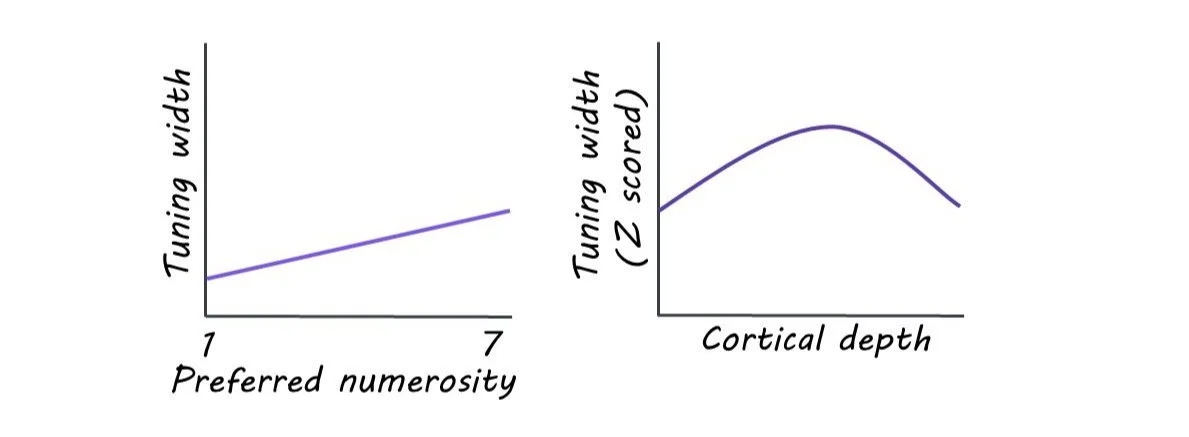
There are two main findings. First, the results show that across cortical depths in the parietal cortex, the specificity of numerosity responses decreases as numerosity preference increases, replicating earlier findings. For example, for a neuronal population preferring numerosity 5, the specificity is lower (i.e., larger tuning width) than for neuronal populations preferring numerosity 3. This pattern is consistent across cortical depths. Second, tuning profiles for preferred numerosity 2 and 3 showed that deeper and superficial layers have smaller tuning widths than in the central layers. This indicates that response specificity increases as you move away from central layers towards deep and superficial layers.
What's the impact?

Using numerosity processing as a tool to examine response specificity, the study provides evidence that specificity increases as we move away from central layers in the parietal cortex. This highlights that the response structure across cortical layers in the parietal cortex is similar to those in visual cortex, suggesting that processing across cortical depths is organized in a similar way throughout the cortex.
Access the original scientific publication here.

An Optimal Amount of Sleep for Cognitive Function in Preclinical Alzheimer’s Disease

Post by Megan McCullough

The takeaway

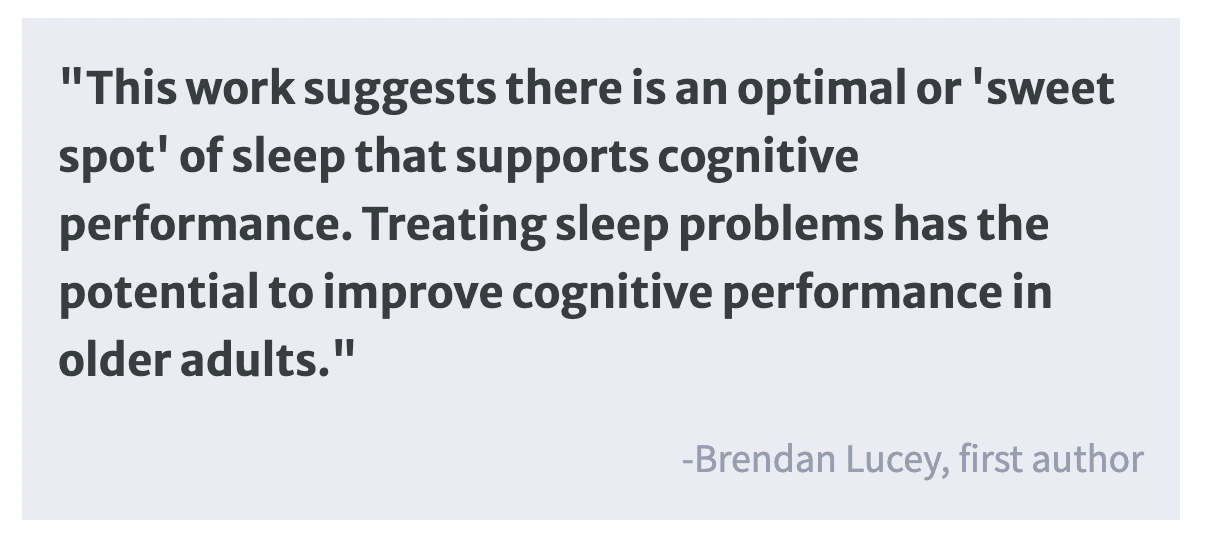
There is an optimal amount of sleep that supports cognitive function in older individuals at risk of developing Alzheimer’s disease. Too little or too much sleep is correlated with a decrease in cognitive function over time.

What's the science?

Alzheimer’s disease is a neurological disorder characterized by cognitive decline and dementia. Pathologically, it is marked by an increase in the abnormal buildup of proteins, such as amyloid and tau in the brain. Previous studies have implicated sleep disturbances in the pathology of Alzheimer’s by relating abnormal sleeping patterns to cognitive decline. However, these studies have not considered the participants’ Alzheimer’s disease biomarkers or genetic risk factors for the disease. This week in Brain, Lucey and colleagues aimed to study the relationship between sleep and cognitive function while controlling for biomarkers associated with Alzheimer’s.

How did they do it?

The participants included 100 older adults who were at risk for developing Alzheimer’s. The authors measured the sleep-wake activity of the participants over the course of 4-6 nights. Sleep was measured using an EEG device worn on the forehead. The participants also underwent standardized cognitive assessments, genotyping for genes associated with the disease, and tests for the buildup of abnormal proteins. Statistical analyses were then conducted to study the relationship between sleep patterns and cognition over time, controlling for Alzheimer’s biomarkers.

What did they find?

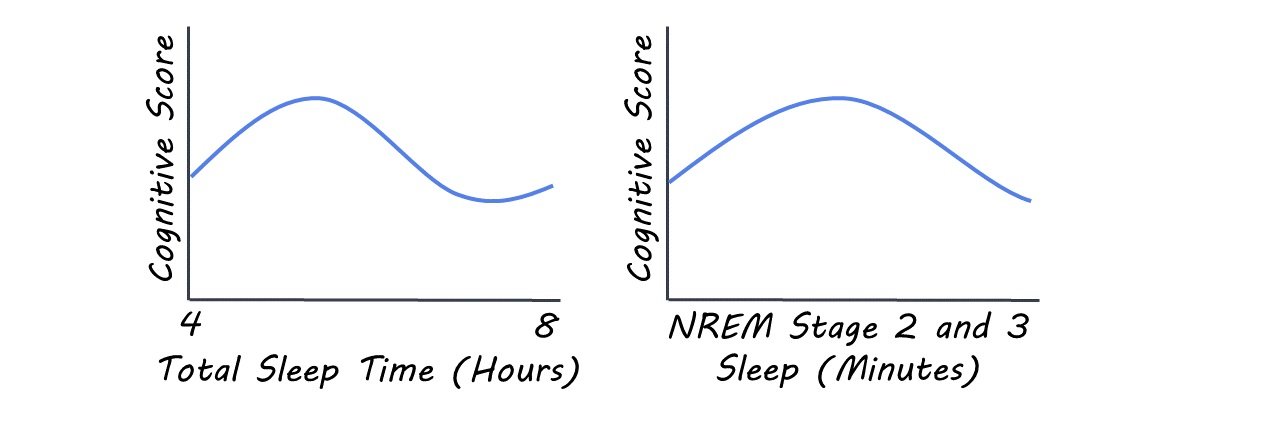
The authors found an inverse U-shaped relationship between sleep activity and cognitive performance over time. Cognitive scores were lower for individuals that slept less than about 4.5 hours or more than about 6.5 hours per night, with time asleep determined via EEG activity. The cognitive scores of individuals that slept between this range stayed stable. This relationship also held true when other measures of sleep activity were studied including time spent in REM and non-REM sleep phases. The same non-linear relationship was also seen when the data was adjusted for age and biomarkers of the disease. This suggests that there is an optimal range of time spent sleeping that supports cognitive function in individuals at risk of developing Alzheimer’s disease.

What's the impact?

This study is the first to show that an inverse U-shaped relationship exists between sleep activity and cognitive function even when participants were characterized by the presence of Alzheimer’s biomarkers. This is important as it suggests that there is a range of hours slept per night that supports cognitive function, even in individuals at risk for developing Alzheimer’s. These findings suggest that therapeutic efforts to optimize sleep duration could have a stabilizing effect on cognition.

Lucey et al. Sleep and longitudinal cognitive performance in preclinical and early symptomatic Alzheimer’s disease. Brain (2021). Access the original scientific publication here.

The 2021 Nobel Prize in Physiology or Medicine

Post by Lani Cupo

The quest to understand heat, cold and mechanical force

You take a bite of your curry and at once the powerful spice overwhelms you in a tidal wave of heat. Your eyes water, your nose runs, your friends laugh as your face turns red—you swear you could breathe fire to rival any dragon. Desperately you reach for a piece of bread or glass of milk—anything to quench the flame that has engulfed your head. But why does spicy food feel like fire? And why does it burn when you touch your eyes—organs that you don’t need to taste? The answers to these questions represent careers worth of work for two scientists and have recently earned them the most prestigious prize a scientist can win. In 2021, Drs. David Julius and Ardem Patapoutian were awarded the Nobel Prize in Physiology or Medicine for their work ultimately discovering the receptors providing the basis for sensing heat, cold, and mechanical force. In the following overview, we will explore exactly what the researchers discovered and why it earned them a place in the scientific halls of fame.

The Nobel Prizes were established by a Swedish chemist, engineer, and inventor Alfred Nobel, and first awarded in 1901. The prize in Physiology or Medicine is chosen “for the discovery of major importance in life science or medicine”, and the discovery must be “of great benefit for humankind”. Nominations are invited with confidential letters, then the Nobel Committee is responsible for selecting the winners, consulting with experts in the appropriate field.

Explaining thermosensation

How is heat from our environment communicated through the nervous system to the brain? To convey this information, thermal signals must be converted to electrical signals that can travel up nerves to the brain. Different neurons that carry these electrical signals respond to different types of sensory information based on the molecular receptors and ion channels that the neurons express.

Born in New York and educated at Massachusetts Institute of Technology, the University of California, Berkeley, and Columbia University, Dr. Julius first became interested in these receptors through his curiosity about psilocybin research. In 1997, his group at the University of California, San Francisco published seminal work in Nature describing the discovery of an ion channel responsive to painful thermal stimuli. To discover the channel, the group investigated capsaicin, a naturally-occurring compound in capsicum peppers responsible for their spicy or “hot” flavor. Before Julius’s research, it was known that exposure to capsaicin excited certain neurons, leading to nociceptive experiences (experiences that often result in the perception of pain), however the underlying molecular mechanism was unknown. In order to identify the mechanism, the group cloned the genes encoding the receptor.

The researchers set out to express genes encoding receptors in cells that do not normally respond to capsaicin. They first created a library of complementary DNA (cDNA) from messenger RNA derived from dorsal root ganglion neurons. The clones of the DNA were then transfected into cells from the kidney. These kidney cells were examined for changes to intracellular calcium (indicative of cell activation) in response to capsaicin. By repeating the process for pools of cloned DNA the researchers eventually discovered a 3-kilobase clone of cDNA that made kidney cells sensitive to capsaicin. They named the receptor “transient receptor potential vanilloid type 1”, or TRPV1 because a main structural component of capsaicin is known as a vanilloid. TRPV1 responds not only to capsaicin but also noxious heat, which is why the sensation of eating spicy food feels like “burning”.

Explaining mechanosensation

In addition to probing temperature sensory signals, research teams worldwide were investigating how mechanical stimuli, such as pressure, could be converted to neuronal signals. A similar hunt for the receptor responsible for mechanical stimuli responses was underway.

Dr. Patapoutian was born and raised in Beirut, Lebanon. After moving to the United States, he completed degrees at the University of California, Los Angeles and California Institute of Technology, followed by a postdoctoral fellowship at the University of California, San Francisco. His research on nociception led to the investigation of the receptors responsible for sensitivity to mechanical stimuli that underlie processes like touch and pain sensation, hearing, and blood pressure regulation.

Researchers first established that a line of mouse neuroblastoma (Neuro2A [N2A] cancer cells) responded to physical pressure. Next, they generated a list of genes that encoded ion channels and were enriched in the N2A cells and systematically knocked-down (removed the function of) the candidate genes one by one. After each gene was knocked down, they tested the cells to see if they still responded to pressure. This process allowed them to identify a gene that controlled pressure sensitivity, which they named Piezo1 after the Greek word for pressure (pίesi). Piezo1 is present in many species, from slime mold to humans, but vertebrates also have a second member, Piezo2. Using similar methods to Dr. Julius, Dr. Patapoutian extended the work on thermosensation to mechanosensation. Independently of one another, both researchers also used menthol (the chemical responsible for the taste of mint) to identify a channel that responds to cold temperatures, TRPM8. 

What’s the impact?

The contributions of Drs. Julius and Patapoutian to neuroscience provide an important puzzle piece for neuroscientists to understand how the external world is translated into signals perceptible to individuals. These advances in such fundamental elements of our perception changed the scientific understanding of how our brains recognize and interpret the surrounding world. By understanding the mechanisms underlying such environmental experiences, future scientists may also be able to better conceptualize what is happening when perception differs from expected, in the case of chronic pain or the lack of sensation. 

There is still much unknown about the channels responsible for our perception of heat, cold, and pressure. Future studies may focus on interactions between the receptors and the surrounding cell environment, further explaining methods of activation responsible for our sensations.

References +

Bautista, D. M. et al. The menthol receptor TRPM8 is the principal detector of environmental cold. Nature 448, 204–208 (2007). Access the original scientific article here.

Coste, B. et al. Piezo1 and Piezo2 are essential components of distinct mechanically activated cation channels. Science 330, 55–60 (2010). Access the original scientific article here.

Ranade, S. S. et al. Piezo2 is the major transducer of mechanical forces for touch sensation in mice. Nature 516, 121–125 (2014). Access the original scientific article here.

Caterina, M. J. et al. The capsaicin receptor: a heat-activated ion channel in the pain pathway. Nature 389, 816–824 (1997). Access the original scientific article here.

Mueller, B., Santora, M. & Engelbrecht, C. Nobel Prize Awarded for Research About Temperature and Touch. The New York Times (2021). Access the original article here.

The Nobel Prize in Physiology or Medicine 2021. “Press release: The Nobel Prize in Physiology or Medicine 2021”. Access the original article here.

The Nobel Prize in Physiology or Medicine 2021. “Scientific background: Discoveries of receptors for temperature and touch”. Access the original article here.