Perceived Social Support is Related to Depressive Symptoms in Those with Physical Disability

Post by Elisa Guma

The takeaway

Increased perceived social support can buffer against depressive symptoms in individuals with long-term physical disability, while decreased support can worsen symptoms.

What's the science?

Perceived social support is an important factor for maintaining good mental health in vulnerable groups, such as those with long-term physical disability, or in an aging population. Cross-sectional studies have identified a strong association between lack of social support and depression in these groups. However, no longitudinal studies — with comprehensive measures of social support — have been conducted to investigate the association between perceived social support and mental health outcomes. In Disability and Health Journal, de la Vega and colleagues assess the relationship between perceived social support and depressive symptoms in individuals with long-term physical disability including multiple sclerosis, spinal cord injury, and muscular dystrophy.

How did they do it?

Participants with one of three different chronic physical disabilities (spinal cord injury, multiple sclerosis, and muscular dystrophy) were asked to complete surveys every 12-15 months over the course of a 6 year period. The sample used for this study (n=475) included survey responses two time points, spaced 6 years apart. In addition to basic demographic information (age, sex, ethnicity, diagnosis, household income, marital status, education), the severity of depressive symptoms was recorded (using the Patient-Reported Outcomes Measurement Information System), as was the perceived social support (using the Multi-dimensional Scale of Perceived Social Support). 

With these data, the authors intended to ask whether a change in perceived social support over the two timepoints was associated with a change in depressive symptomatology. However, for a large majority of the sample, little change in perceived social support over the 6-year period as observed. Therefore, the authors identified a subgroup of individuals for which social support did change in order to investigate this relationship.

What did they find?

The majority of individuals enrolled in the study reported no differences in social support over the 6 year follow up period, with no differences in social support between the three diagnosis groups, or between men and women. Interestingly, the subset of individuals who did report changes in perceived social support also reported changes in depressive symptoms. Those that experience increased social support reported decreased depressive symptoms, while those that reported decreased social support reported increases in depressive symptoms.

What's the impact?

This study provides support for the association between social support and mental health outcomes, particularly in vulnerable individuals suffering from chronic physical disability. These findings suggest that providing social support to individuals struggling with chronic disability may be an important buffer against negative mental health outcomes. Investigating the provision of social support as a possible treatment intervention for individuals struggling with disability, as well as an aging population, or isolated groups will be an important avenue for future research.
Access the original scientific publication here.

The Relationship Between Anxiety and Breathing Perception

Post by Leanna Kalinowski

The takeaway

Many psychiatric disorders are thought to be associated with an impairment in interoception, which is the perception of your body’s internal physiological signals. Sensitivity towards and insight into breathing perception are altered in individuals with anxiety. 

What's the science?

Interoception, the brain’s perception of sensations within the body, is an important component of maintaining bodily homeostasis. For example, these perceptions tell you if you’re hungry, if your heart is beating too fast, or if you are experiencing shortness of breath. An impaired ability to monitor your body’s signals is believed to exist in a variety of psychiatric disorders. This is particularly seen with anxiety, where individuals may misinterpret their changes in breathing patterns when feeling worried. 

Previous studies on interoception treated it as a single entity, while recent studies identified that interoception spans multiple levels of perception. Notably, “lower” levels of interoception include sensory and psychophysical properties, while “higher” levels of interoception include one’s attention towards bodily signals and accuracy of interoceptive beliefs (i.e., metacognition). However, it is not yet known whether anxiety is differentially related to these levels of interoception. This week in Neuron, Harrison and colleagues evaluated the relationship between anxiety and each level of breathing-related interoceptive processing using self-report measures and two interoceptive breathing tasks.

How did they do it?

The researchers recruited thirty participants to first complete an anxiety questionnaire, after which they were separated into one of two groups: “low anxiety” and “moderate anxiety”. Then, participants were asked to complete three tasks. The first task was a set of questionnaires to assess participants’ subjective measures of anxiety and body awareness. The second task, called the filter detection task (FDT), was then used to measure breathing perception and metacognition. The FDT began with the participants taking three normal breaths on a breathing circuit. Then, one of two filters was applied to the circuit: one filter added resistance, and the other filter did not. Participants took three additional breaths with the filter, and then were asked (1) whether resistance was added and (2) how confident they were in their answer on a scale of 1 to 10.

The final task, called the breathing learning task (BLT), was used to measure brain activity during trial-by-trial interoceptive learning. During each trial, participants were shown one of two visual cues that were paired with either an 80% or 20% chance of breathing resistance being applied. Then, they were asked to predict whether it will be difficult to breathe, after which either a strong resistance or no resistance was applied using a breathing circuit. They were then asked to rate how difficult it was to breathe and subsequently repeated the entire task for a total of 80 trials. Brain activity was measured during all trials with functional magnetic resonance imaging (fMRI).

What did they find?

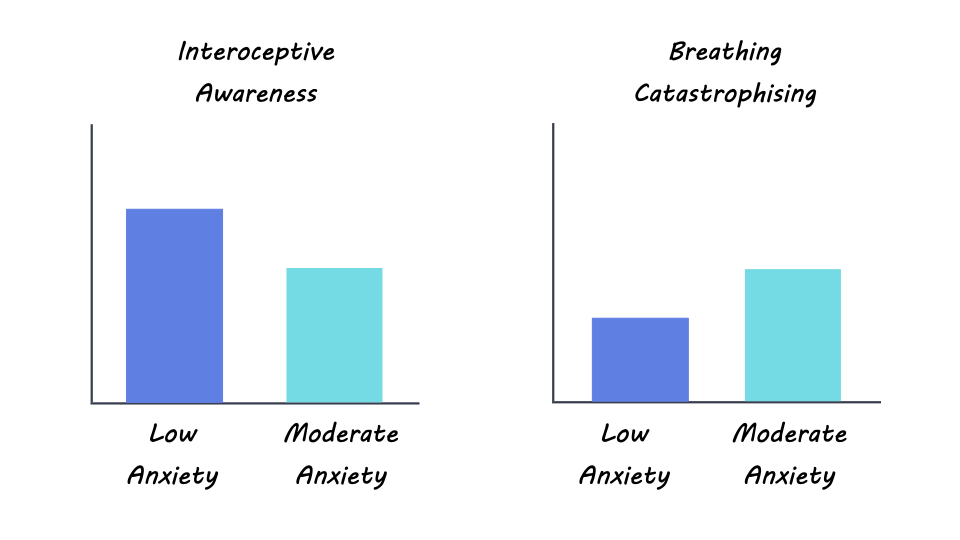
First, the researchers found that individuals with moderate anxiety showed greater self-reported overall body awareness compared to those with low anxiety. However, participants with moderate anxiety also showed reduced perceptual sensitivity to breathing resistance during the FDT and had lower confidence in their ability to detect breathing resistance, in contrast to the self-reported measures. These results demonstrate multiple different associations between breathing perception and anxiety.

Using the BLT, the researchers then found a relationship between anterior insula activity and both prediction certainty and magnitude of prediction errors on the BLT, suggesting that the anterior insula plays an important role in representing bodily perceptions and updating them as additional trials are completed. Participants with low versus moderate anxiety traits also showed differences in anterior insula activity with prediction certainty. Multi-modal analysis of data from all tasks showed that anxiety is associated with multiple levels of interoception, though stronger effects are seen at higher levels of the interoceptive process (i.e., aspects of metacognition). These results demonstrate that the association between breathing perception and anxiety persists across all levels of interoception.

What's the impact?

This study was the first to show brain activity associated with trial-by-trial interoceptive learning. These results provide new insights into how anxiety is related to breathing perception and implicate the anterior insula in representing and updating perceptions of breathing states. Future research is needed to determine whether these results translate to other interoceptive processes, such as cardiac or gastric states.

Numerosity Processing Across Cortical Layers in Parietal Cortex

Post by Lina Teichmann

The takeaway

Different cortical layers in the brain have different response patterns when processing quantities of items (i.e. numerosity). Cortical layers from different brain regions tend to increase in response specificity from central towards deep and superficial layers.

What's the science?

Numerosity processing allows us to determine the size of a group of items and is an essential ability in everyday life. Previous studies have shown that numerosity processing involves a network of specialized areas in the brain. Some of these areas, such as the parietal cortex, contain neuronal populations that prefer (respond strongly to) a specific numerosity, while numerosities that are further away from the preferred numerosity evoke a weaker response. The preferences of a neuronal population can be summarized by a tuning curve that shows how strongly a population responds to different numerosities. The width of the tuning curve indicates the numerosity preference of a given population: If the tuning curve is narrow — for example only having a peak at numerosity 3 but a sharp drop for neighboring numerosities (2 and 4) — the tuning response is very specific.

In the visual cortex, it has been shown that the specificity of neural responses varies across cortical layers, with both deep and superficial layers showing increased specificity in comparison to central layers. This week in Current Biology, van Dijk and colleagues examine whether this principle holds beyond the visual cortex by examining the specificity responses of neuronal populations in the parietal cortex that are tuned for specific numerosities.

How did they do it?

Seven healthy volunteers viewed different numbers of dots displayed on a screen while their brain activity was recorded using a 7 Tesla MRI scanner. The number of dots increased and decreased over time. Using the functional Magnetic Resonance Imaging (fMRI) time-series data, numerosity tuning was modeled for different voxels (3D “pixels” in the MRI image). That resulted in a preferred numerosity and tuning width for voxels in each cortical location and depth for every participant. First, the authors examined the preferred numerosity and tuning width in different cortical layers. Then, they investigated the width profiles across cortical depths.

What did they find?

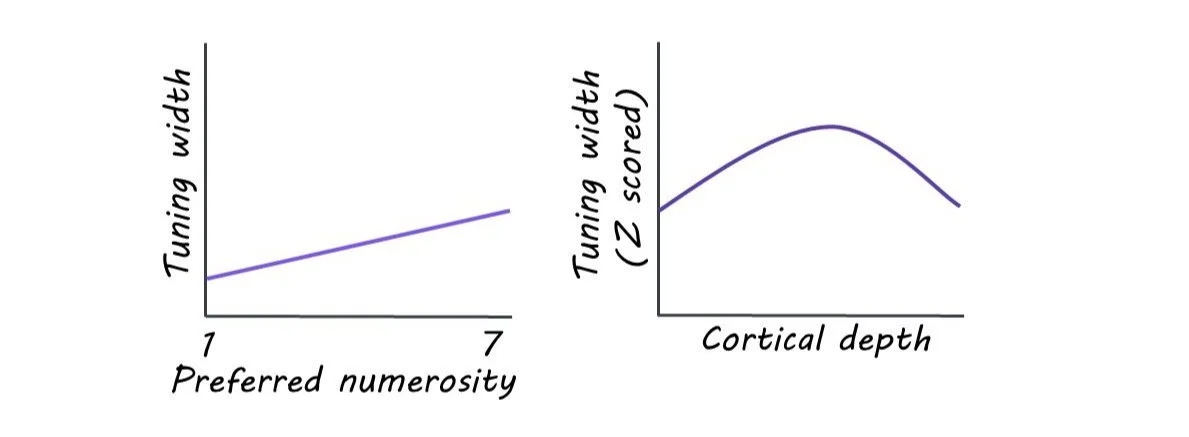
There are two main findings. First, the results show that across cortical depths in the parietal cortex, the specificity of numerosity responses decreases as numerosity preference increases, replicating earlier findings. For example, for a neuronal population preferring numerosity 5, the specificity is lower (i.e., larger tuning width) than for neuronal populations preferring numerosity 3. This pattern is consistent across cortical depths. Second, tuning profiles for preferred numerosity 2 and 3 showed that deeper and superficial layers have smaller tuning widths than in the central layers. This indicates that response specificity increases as you move away from central layers towards deep and superficial layers.

What's the impact?

Using numerosity processing as a tool to examine response specificity, the study provides evidence that specificity increases as we move away from central layers in the parietal cortex. This highlights that the response structure across cortical layers in the parietal cortex is similar to those in visual cortex, suggesting that processing across cortical depths is organized in a similar way throughout the cortex.

Access the original scientific publication here.