
The Two Stages of Action-Stopping

Post by Shireen Parimoo

The takeaway

Stopping an action that we have already initiated requires inhibitory control. There are two stages of action-stopping: an early detection stage where the brain identifies the need to stop an action, which triggers motor suppression, followed by a specific action-stopping stage.

What's the science?

Response inhibition involves the ability to stop an already initiated action (like reaching for a cup of coffee), often in response to a stop signal. In the time between seeing a stop signal and the stopping response, there is initially widespread motor suppression at 150ms followed by frontal cortex activity at 300 ms, both of which are thought to reflect inhibitory processes. However, these neural signatures may not be specific to response inhibition because the initial motor suppression has been observed in response to salient, non-stopping signals (attentional capture) and the frontal activity may occur too late to have any impact on the stopping response. This week in The Journal of Neuroscience, Tatz and colleagues investigated the time course of response inhibition during action-stopping.

How did they do it?

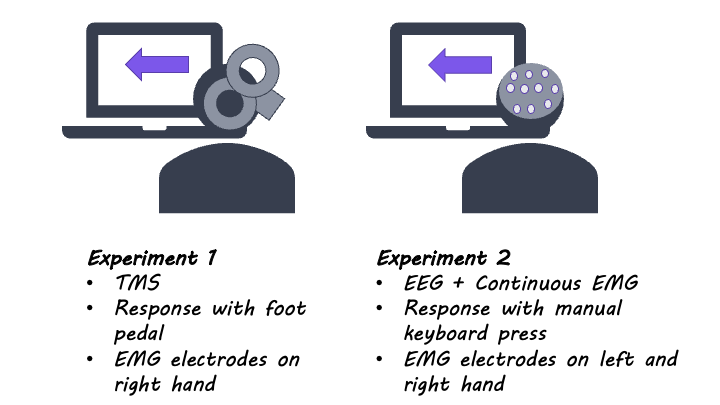
Two groups of young adults performed a stop-signal task in which they viewed white arrows on the computer screen (Go signal) and had to indicate the direction of the arrow. On a small subset of the trials, the arrow would change colors to magenta (Stop signal) or cyan (Ignore signal) after a variable delay period. Participants were instructed to stop their response upon seeing the Stop signal, but to continue with their response upon seeing the Ignore signal.

In the first experiment, participants (n = 27) responded with foot-pedal presses while transcranial magnetic stimulation was applied to their motor cortex to stimulate muscles in their hand. They applied stimulation at 150ms, 175ms, and 200ms after the Stop/Ignore signal onset. Muscular responses known as muscular evoked potentials (MEP) were recorded from their hands using electromyography, which allowed the authors to observe the magnitude and timing of global motor suppression (i.e., in muscles unrelated to the task). In the second experiment, participants (n = 20) completed the task with manual responses while their brain activity was recorded using electroencephalography. They also recorded partial muscular activity (prEMG) from the hands, which increases in response to the Go signal but rapidly declines when the Stop signal appears. Together, MEP and prEMG recordings allowed them to assess whether motor suppression occurred specifically in response to the Stop signal or if it was also elicited by the salient Ignore signal. Lastly, they used multivariate pattern analysis to determine whether brain activity in response to the Stop and Ignore signals could be decoded from one another.
Stopping_action_oct12.png

What did they find?

Participants were slower to respond on Ignore trials than on Go trials, indicating that the Ignore signal was indeed salient and triggered additional processing despite both trials requiring a response. The amplitude of MEPs was larger in response to Go signals than the Stop and Ignore signals, and larger on failed stopping trials compared to successful stopping trials. However, MEP amplitude didn’t differ between failed stopping and Ignore trials, as participants made a response in both cases. Importantly, there was no difference in MEP amplitude between Stop and Ignore trials when stimulation was applied at 150ms, which means that the early global motor suppression is not specific to Stop signals. Peak EMGs were observed less than 200 ms following successful Stop and Ignore signals and their latency did not differ between these trial types, further supporting the idea that early motor suppression is non-specific.

Neural activity on Go trials could be reliably decoded from Stop and Ignore signals immediately after the arrow appeared on the screen. However, neural responses on successful stopping and Ignore trials could not be distinguished from each other until ~180ms following signal onset. This timing coincides with the motor suppression response, suggesting that the inhibitory process associated with action-stopping is distinct from and occurs after the global motor suppression. On the other hand, activity associated with failed stopping and Ignore trials could only be distinguished ~400ms after signal onset, demonstrating that the failure to process the Stop signal elicits a similar neural response as the processing of a salient but non-stopping signal. Thus, Stop signals are initially treated as salient stimuli, and inhibitory mechanisms specific to action-stopping come online at a later stage of processing.

What's the impact?

This study found that action-stopping involves automatic and widespread motor suppression that is then followed by the engagement of selective response inhibition processes. These findings pave the way for future research to investigate alterations in the timescale of inhibitory control and the inhibitory processes that are impacted in populations with deficits in response inhibition (e.g., psychiatric disorders like ADHD).

Tatz et al. Common and unique inhibitory control signatures of action-stopping and attentional capture suggest that actions are stopped in two stages. The Journal of Neuroscience (2021). Access the original scientific publication here.
What Impact Do Video Games Have On the Brain?

Post by Lani Cupo

What are the challenges of gaming research?

Entertainment video games represent an industry that has increased its influence during the COVID-19 pandemic. As people of all demographics and ages were locked down in their homes, gaming became an outlet, not only for personal entertainment but also to spend time with others.

The term “video games” comprises a vast category, including social simulation games like Animal Crossing, first-person shooters like Call of Duty, and multiplayer online battle arena games like League of Legends. Furthermore, they can be accessed through diverse means, such as computers, consoles (like the PlayStation or Xbox), or cell phones. While the increasing number of gamers worldwide only increases the interest in research assessing the impact of gaming on the brain and behavior, any discussion of the consequences and benefits of “gaming” should include a nuanced appreciation of the stark differences between different games and styles.

Gaming research is further complicated by confounding factors that frequently accompany gaming habits, such as screen time, time spent sedentary, and sleep deprivation. Additionally, habitual gaming can be conflated with gaming or internet addiction, where the activity interferes with general daily functioning. Furthermore, there is potential selection bias in studies that sample long-term gamers, as players may self-select based on prerequisite abilities. Finally, the stigma around gaming in some populations, such as girls and young women, can alter the demographics of long-term gamers, skewing the generalizability of results.

What has been the focus of gaming research in the past?

In 2017, a meta-analysis revealed one-third of papers examining gaming with neuroimaging discussed gaming addiction, and 14% focused on gaming-related violence. Currently, most research focuses on so-called “action games” that largely comprise first-person shooters. While the results from these studies provide detailed information pertaining to potential benefits and consequences of gaming, they do not necessarily represent the majority of gaming experiences outside of the laboratory accurately. Additionally, many studies draw from expert opinions without relying on empirical evidence. To facilitate the interest in the impact of gaming on the brain and behavior, future studies should integrate the complex mosaic of factors in the experimental paradigms they are designing.

What benefits can gaming have on the brain and behaviour?

Depending on the style of game (the tasks demanded and focus of gameplay) developing proficiency in a game can improve a variety of skill sets, from cognitive and motor skills to teamwork and social coordination. Enhancements to perception and certain forms of attention are among the forms of improvement documented following sessions of gaming in laboratories. The action games studied in labs tend to afford benefits to forms of attention and perception that allow gamers to quickly scan the screen for small visual differences (potentially signaling enemies) and quickly orient attention.

Gaming can also improve social cognition. Despite predominant stereotypes of lone gamers, over 70% play with a friend, either cooperatively or competitively. Many games award effective cooperation, support, and helping behavior. Evidence suggests children who engaged with prosocial gaming were more likely to demonstrate helping behavior than before playing. Even playing violent games cooperatively has been shown to encourage prosocial behaviors.

Finally, games can be used in an educational setting to teach certain concepts or behaviors. For example, a popular game called Re-Mission was developed to help pediatric cancer patients understand the importance of continuing their treatments. Interestingly, video games have recently been designed to mimic cognitive remediation therapies employed in populations with chronic Schizophrenia in order to help combat cognitive deficits observed in the disorder. Evidence from magnetic resonance imaging (MRI) studies suggests commercial video games induce similar alterations in brain volume and plasticity as the cognitive remediation therapy training exercises (focused on improving attention, working memory, executive functioning, and social cognition), involving the temporal and frontal areas and the hippocampus.

What detrimental effects can gaming have on the brain and behaviour?

Much of the interest in the impact of video games stems from the fear that playing violent games may make children violent or aggressive. Despite research that suggests playing large amounts of violent games may increase aggressive thoughts, the size of the effect is questionable. Alone, video games are unlikely to turn children violent. Nevertheless, an individual’s ability to regulate emotion and arousal may mediate the relationship between violent video games and aggression.

Over the past decades, video game research has become more nuanced, not only allowing for the possibility of positive effects but also directing focus to subtler consequences. While the ability of gamers to rapidly switch their attention between objects may be enhanced, they may suffer from detriments to sustained attention, which could negatively impact performance in school. Performance in school often depends on attending class or reading books, which require attention for longer periods. Adolescent students who game often demonstrate poorer academic outcomes than their counterparts.

While harmless habits should not be conflated with addictions, there is demonstrable evidence that gamers can form addictions to gaming. Gaming addictions are defined differently by country but must include interference with daily functioning. They can have serious consequences, including the sacrifice of sleep, work, education, in-person relationships, and high rates of loneliness. Introduced in the Diagnostic and Statistical Manual 5, gaming addiction prevalence is hard to document, but peaks in Southeast Asia at around 10% with higher rates among older than younger participants. 

What is the impact of gaming on the brain?

Playing video games likely engages and impacts reward processing in the brain. One study of 154 14-year-olds found that frequent gamers (>9 hours per week) demonstrated increased left striatal volume, as well as enhanced activity associated with experiencing loss in a laboratory gambling task (Cambridge Gambling Task). The activity and brain volume was negatively correlated with deliberation time in the same task, implying they were relevant for decision making and reward processing.

In a functional MRI study, violent scenes in first-person shooter games impacted activity in key limbic regions, including activation of the dorsal anterior cingulate and decreased activity in the rostral anterior cingulate and amygdala during virtual violence. Initially, when addiction is forming, the prefrontal cortex and ventral striatum play a role in the decision to initiate the addictive behavior (gaming, in this case). Over time, as a compulsion to gaming develops, the dorsal striatum is activated through dopaminergic connections, and the dopamine pathways can undergo permanent changes. 

What’s the bottom line?

While gaming may not have the overwhelmingly negative impact many politicians and parents once feared, the evidence is still mixed. Sustained, long-term attention is likely reduced in gamers, while the ability to quickly reorient attention may be enhanced. The social impact represents a double-edged sword, sometimes contributing to prosocial behavior and other times increasing loneliness. Nevertheless, to establish a more comprehensive understanding of the impact of video games, researchers must incorporate greater nuance into the personal demographics of their participants and the complexities of the games they are exposed to.

Click to See References +

Bavelier et al. Brains on Video Games. Nature Reviews. Neuroscience (2011). Access the original scientific publication here.

Granic et al. The Benefits of Playing Video Games. The American Psychologist. (2014). Access the original scientific publication here.

Kühn et al. The Neural Basis of Video Gaming. Translational Psychiatry. (2011). Access the original scientific publication here.

Kuss et al. Internet Gaming Addiction: Current Perspectives. Psychology Research and Behavior Management. (2013). Access the original scientific publication here.

Mathiak, Klaus, and René Weber. Toward Brain Correlates of Natural Behavior: fMRI during Violent Video Games. Human Brain Mapping. (2006). Access the original scientific publication here.

Palaus et al. Neural Basis of Video Gaming: A Systematic Review. Frontiers in Human Neuroscience. (2017). Access the original scientific publication here.

Suenderhauf et al. Counter Striking Psychosis: Commercial Video Games as Potential Treatment in Schizophrenia? A Systematic Review of Neuroimaging Studies. Neuroscience and Biobehavioral Reviews. (2016). Access the original scientific publication here.

Unsworth et al. The Effect of Playing Violent Video Games on Adolescents: Should Parents Be Quaking in Their Boots? Psychology, Crime & Law: PC & L (2007). Access the original scientific publication here.


Remote Work: What’s the Impact on Team Collaboration?

Post by Ifrah Khanyaree

What's the science?

The COVID-19 pandemic has accelerated digital transformation across many industries and organizations. Within a matter of weeks of the onset of the pandemic, many office-based working adults shifted to working remotely full time. This week in Nature Human Behaviour, Yang and colleagues analyzed communication and working hours data from a large US tech company to find out the impact of remote work on employee collaboration and communication.                  

How did they do it?

The authors used anonymized email, instant message (IM), calendar, video/audio call, working hour data of 61,182 US Microsoft employees from December 2019 - June 2020, collected using Microsoft’s Workplace Analytics product. The authors then analyzed this data using a modified version of the traditional Difference-in-Difference model (DiD), which is a technique used in econometrics that measures causal effect between at least two sets of longitudinal data, where one group receives a ‘treatment’ and the other does not (the control group). This works because many of Microsoft’s employees were remote even before the pandemic hit; that group acts as the control group that also experiences the effects of working during COVID, but not the treatment (switching to remote work). 

They used a modified version of DiD both because COVID affected both the treatment and control groups and because their model measured the effects of changes in two different treatment variables instead of one - an employee’s remote work status and also their colleague’s remote work status.                            

What did they find?

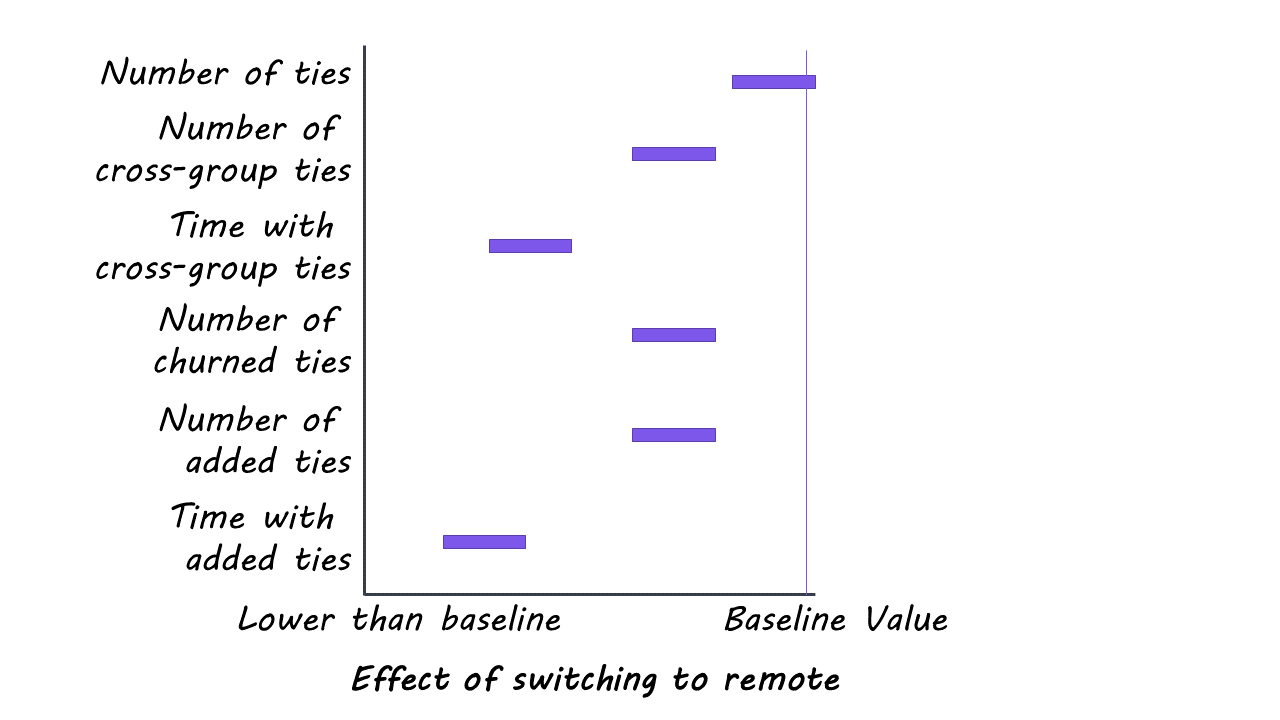
The authors found that the shift to remote work for all employees caused the communication network to become siloed: a decrease in cross-group communication but an increase in the connectedness of one’s own group. Remote work led to a substantial increase in unscheduled calls, emails, and instant messages, but a decrease in meeting hours, and total video/audio call hours. Synchronous collaboration, where more complex information can be conveyed, such as video calls, was decreased overall in favour of asynchronous communication, like emails or messages. Further, the total hours worked were increased. These changes were particularly enhanced for managers. Finally, connections between employees became more static, with fewer social connections being added or lost over time.

ifrah (2).png

What's the impact?

The authors suggest that the increase in asynchronous communication and more siloed networks could negatively affect workers’ productivity and innovation because of the difficulty in collaboration and sharing of information. They propose that firms carry on more qualitative and quantitative research before finalizing any remote work policies. Based on their analyses, firms that want to continue with full-time remote work need to be intentional about strengthening cross-group ties in their organizations. The sudden shift to remote work has brought about a much-needed acceleration and transformation to support working remotely, and it is likely that some version of remote work will continue to prevail even after the pandemic is over. Therefore more research needs to be done to understand the long-term effects of remote work on team communication and collaboration and what the downstream impact might be.

“While many people spent more time in virtual meetings after switching to remote work, after isolating the contributions of remote work in particular, as opposed to other (often pandemic-related) factors, we find tha (3).png

Yang et al. The effects of remote work on collaboration among information workers (2021). Access the original scientific publication here.