
Medial Parietal Tau Deposition is Associated with Hippocampal-Retrosplenial Functional Connectivity

Post by Shireen Parimoo

What's the science?

One of the hallmarks of Alzheimer’s disease pathology is the accumulation of misfolded tau protein, which begins in the transentorhinal region of the medial temporal lobe (MTL). Tau is thought to spread trans-synaptically between regions that are anatomically connected with the anterolateral entorhinal cortex (alERC), before spreading to the rest of the neocortex. Recent work suggests that tau might propagate from the MTL to functionally connected regions like the medial parietal cortex, which is part of the posteromedial memory network through its connectivity with the posteromedial entorhinal cortex (pmERC). It is important to better understand whether the functional connectivity between MTL regions and medial parietal cortex is associated with the spread of tau and episodic memory decline. This week in The Journal of Neuroscience, Ziontz and colleagues investigated the relationship between medial parietal tau accumulation and functional connectivity of MTL regions with the medial parietal lobe.

How did they do it?

Ninety-seven cognitively normal older adults (60–93 years old) were recruited from the Berkeley Aging Cohort Study and completed tests of verbal and visuospatial episodic memory. Participants also underwent a resting-state functional magnetic resonance imaging scan and a positron emission tomography scan, which allowed the authors to examine functional connectivity and amyloid/tau deposition in the brain, respectively. Functional connectivity was assessed between the hippocampus, alERC, and pmERC in the MTL and the retrosplenial cortex in the medial parietal lobe. The authors examined tau pathology in the entorhinal and inferior temporal cortices of the MTL, and in the medial parietal lobe, which included the retrosplenial cortex, posterior cingulate cortex, and precuneus regions. Specifically, they quantified tau deposition based on the signal magnitude of flortaucipir, a tracer that binds to tau protein in the brain. Lastly, they used the PiB tracer to examine amyloid-beta deposition in the medial parietal lobe and in the whole brain.

What did they find?

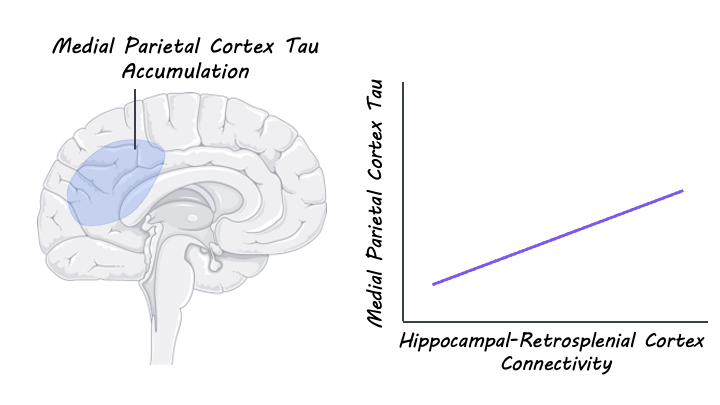
The retrosplenial cortex was functionally connected with the hippocampus and pmERC, but not with the alERC. Functional connectivity between these regions was not related to episodic memory. On the other hand, higher connectivity of the retrosplenial cortex with the hippocampus – but not with the alERC or pmERC – was associated with greater tau deposition in the medial parietal lobe. Medial parietal tau was not associated with functional connectivity between other regions, such as the hippocampus and the superior frontal gyrus. They also showed that the relationship between tau deposition in the medial parietal lobe and hippocampal-retrosplenial functional connectivity was unique to these regions.
tau_sept28.png

Higher medial parietal tau was related to greater tau deposition in the MTL as well as increased global amyloid-beta levels. Individuals with greater functional connectivity between the hippocampus and retrosplenial cortex showed stronger correlations between tau levels in the MTL and medial parietal lobe. Interestingly, these individuals were also likely to have worse visuospatial episodic memory, which is in line with the role of the medial parietal lobe in representing visuospatial information. Thus, visuospatial episodic memory suffered when tau levels and functional connectivity between the MTL and medial parietal lobe were both high.

What's the impact?

The results of this study suggest that tau might spread between regions that are functionally connected to each other. Tau pathology in cognitively healthy individuals might be a potential biomarker for the development of Alzheimer’s disease, a notion that is supported by the current finding that visuospatial memory was lower only in individuals who showed a stronger association between tau accumulation and functional connectivity. Overall, these findings provide an exciting avenue for future research to use tau and functional connectivity in conjunction to track and predict the trajectory of cognitive decline.
ziontz_sept28.png

Ziontz et al. Hippocampal connectivity with retrosplenial cortex is linked to neocortical tau accumulation and memory function. The Journal of Neuroscience (2021). Access the original scientific publication here.
An Optimal Period for Motor Recovery After Stroke

Post by Megan McCullough

What's the science?

Stroke recovery studies have used rat models to investigate the impact of motor training at different time periods after the brain injury. These studies have found that adult rats have critical periods of time after stroke where intensive motor retraining leads to the recovery of motor function. These post-injury critical periods are similar to periods of time in early development where there is increased neural plasticity and the brain is more sensitive to external stimuli. Previous research has not uncovered whether these critical periods also occur in human stroke patients. This week in PNAS, Dromerick and colleagues extended these rat model findings to investigate whether human stroke patients also had windows of time after the stroke that coincided with increased sensitivity to intensive motor training.

How did they do it?

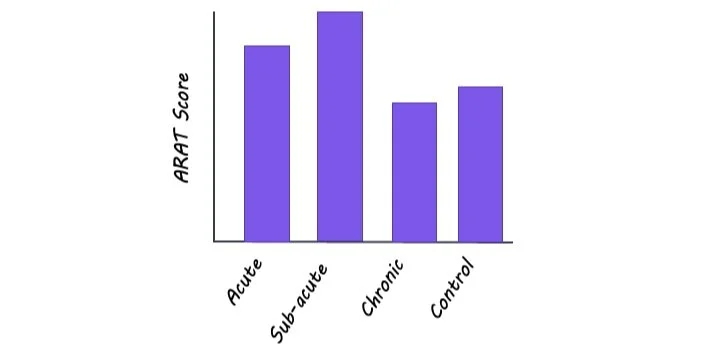
Stroke participants received 20 hours of motor therapy in addition to their standardized therapy at either less than 30 days post-stroke (acute), 2-3 months post-stroke (subacute), or 6 months or more post-stroke (chronic). The control group received only standard rehabilitation. The authors conducted pre-tests and post-tests for each participant using the Action Research Arm Test (ARAT), which measures upper extremity movement. The treatment was administered in a controlled clinical setting to create a realistic set of conditions for human stroke patients.

What did they find?

The researchers observed a relationship between the time after the stroke occurred and the rehabilitation therapy specific to this study. Patients in the subacute group showed a significant increase in motor function compared to controls. Patients in the acute group also showed a significant increase in motor function compared to controls; however, it was a smaller improvement than the subacute group. The patients in the chronic group did not show significant improvement in motor function compared to controls. This demonstrates that humans do have critical periods of time after brain injury where targeted treatment leads to increased improvement of motor abilities

stroke_sept28.png

What's the impact?

This study is the first to show that there are specific windows of time after brain injury where intensive motor therapy leads to an increased recovery of motor function in human stroke patients. Intensive motor therapy performed 2-3 months after stroke led to greater upper extremity motor recovery compared to patients who received this same therapy during different time windows after the stroke and compared to patients in the control group who received standard motor rehabilitation. This study has implications for the development of post-stroke treatments and further validates the translation of previous stroke research in animals to human brain recovery research.

Dromerick et al. Critical period after stroke study (CPASS): A phase II clinical trial testing an optimal time for motor recovery after stroke in humans. PNAS (2021). Access the original scientific publication here.
Updating our Ideas About Dopamine

Post by Anastasia Sares

What's the science?

Dopamine is known as the reward molecule: the chemical that we chase after for pleasure. A more precise theory popular among scientists is that dopamine encodes Reward Prediction Error: its release increases when we fail to accurately guess when the next reward will come, such as a pleasant surprise (ice cream, a hug, a paycheck), and decreases when we experience a lack of these things if we expected them to happen. This week in Current Biology, Kutlu and colleagues challenged this explanation of dopamine, arguing instead that it codes for saliency: responding to signals in our environment that need our attention, whether they are good, bad, or neutral.

How did they do it?

The authors combined a number of methods to measure dopamine activity in the Nucleus Accumbens, one of the major structures involved in motivation and reward. They trained mice using many different combinations of signals (tones or bursts of noise), rewards (sugar-water), or punishments (small foot-shocks or bitter-tasting water). In each experiment, the animals had to learn whether or not to respond to the signals by poking their nose into a small hole. This “nose-poke,” depending on the phase of the experiment, could result in a reward, delay a reward, bring a punishment, or help them avoid punishment. Sometimes the rewards and punishments came without warning, and sometimes the signals happened without any consequence.

The mice themselves were genetically altered (using optogenetics) so that dopamine release could be recorded using a certain wavelength of light. The cells in the Nucleus Accumbens could also be stimulated via another wavelength of light. Tiny fiber-optic cables implanted in the brain were able to deliver and record these light pulses.

What did they find?

The researchers observed dopamine activity for both rewards and punishments, and also when new signals were introduced without any relevance to reward or punishment. The profile of dopamine activity differed slightly between rewards and punishments. For rewards, dopamine activity after the signal could predict behavior on the current trial (whether the mouse poked its nose in the slot). For punishments, it was dopamine activity after the shock that predicted behavior on the next trial.

The researchers tried more things, like varying the intensity of a shock or the concentration of sweet and bitter substances. It turned out that dopamine was responding to intensity as well, and it didn’t matter if it was for a reward or a punishment—the more intense it was, the greater the dopamine response. Punishments without cues and cues without consequences also showed a dopamine response, which diminished with repetition. Adding an irrelevant cue enhanced the dopamine response, even though it had nothing to do with the reward.

anastasia2.png

Since this pattern of results doesn’t line up with the prevailing theory that dopamine only predicts reward or deviation from reward, the authors made an alternative suggestion: dopamine responds to saliency. In other words, anything that is new, important, and attention-grabbing will generate a dopamine response. Mathematical models using saliency predicted behavior better than the classical model, and stimulating the Nucleus Accumbens made mice act as they would if the signal were more salient, supporting this claim.

What's the impact?

This work calls into question the prevalent idea that dopamine has to do with reward and error prediction. Many neurodegenerative diseases and behavioral addictions involve an imbalance of dopamine, so it is important to accurately understand how dopamine impacts brain function. This will help us evaluate new treatments for these disorders, and also understand human behavior on a deeper level.

Calipari_Sept21.png

Kutlu et al. Dopamine release in the nucleus accumbens core signals perceived saliency. Current Biology (2021). Access the original scientific publication here.