
The Impact of Collective Risk on Social Norms and Cooperation

Post by Leanna Kalinowski

What's the science?

Collective action problems exist where groups benefit from cooperating to achieve a shared outcome, but personal incentives drive individuals to instead rely on others’ efforts. Examples of this can be seen in reducing infectious disease spread and climate change action among many other societal challenges. Laws to foster cooperation to address these global issues are often unavailable, unenforceable, or insufficient, leading society to rely on social norms to encourage compliance. However, it is not fully understood how social norms shape cooperation among strangers and whether the level of threat faced by a society plays a role in the norms that evolve. This week in Nature Communications, Szekely and colleagues used a 30-day collective-risk social dilemma to measure how social norms change in response to varying levels of risk.

How did they do it?

Participants first completed personality trait tests and a demographic questionnaire to determine individual-level factors that may lead an individual to follow social norms. Then, they were separated into groups of six and interacted through 28 daily rounds of the collective-risk social dilemma, with the groups being shuffled daily. At the beginning of each round, each participant was allocated 100 points and asked to decide how many of those points to contribute to the group’s collective pool. If a threshold number of points (300) was met, the collective risk was averted, and all participants got to keep their unspent points. If the threshold was not met, participants risked losing their points determined by a pre-set probability (p).

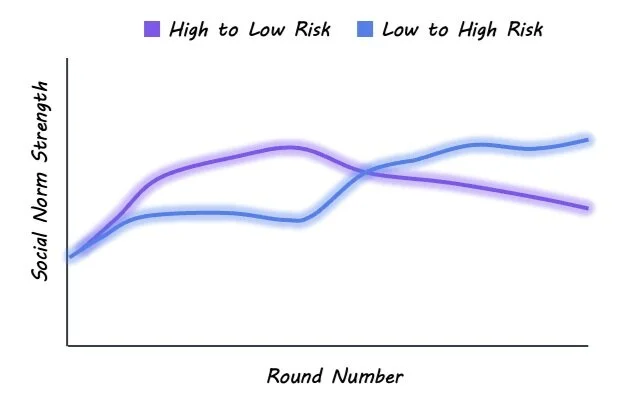
To determine whether higher risk environments led to stronger social norms, the probability of losing points was manipulated. Half of the participants experienced a low-risk environment for days 1-14 followed by a high-risk environment for days 15-28, while the other half of the participants experienced the risk environments in the opposite order. Following each round, participants’ personal normative beliefs and societal expectations were measured. Following the 28th round, participants were asked to determine their level of punishment for individuals who did not contribute at least 50 points.

What did they find?

First, the researchers found that societal expectations and personal normative beliefs have strong and positive associations with cooperative behaviors (i.e., number of points contributed). They then assessed whether cooperative behaviors are impacted by risk level, finding that there were stronger social norms in the high-risk environment compared to the low-risk environment. They also found that groups with stronger social norms are more likely to contribute more points and reach the collective threshold level compared to those with weaker social norms.
Social_Norms_Sept21.png

Next, they found that participants in the low-risk environment experienced a rapid strengthening of social norms upon entering the high-risk environment. Conversely, participants in the high-risk environment experienced a slow deterioration of social norms upon entering the low-risk environment. The presence of social norms was further indicated by punishment levels. Regardless of risk, low contributors (< 50 points) are punished with a higher intensity than high contributors (> 50 points).

What's the impact?

Taken together, these findings show that high risk of collective loss increases the strength of social norms, reduces tolerance of those who deviate from social norms, and increases cooperation. Understanding how social norms emerge during high-risk situations is imperative for developing policies to foster cooperation in the face of future global crises.

Szekely_Sept21.png

Szekely et al. Evidence from a long-term experiment that collective risks change social norms and promote cooperation. Nature Communications (2021). Access the original scientific publication here

Depleting Serotonin Impairs Reversal Learning

Post by Elisas Guma

What's the science?

Serotonin (5-hydroxytryptamine or 5-HT) is a key neurotransmitter in the brain, important for our ability to adapt previously learned responses to a changing environment — also known as reversal learning. Impairments in reversal learning and serotonergic dysfunction have both been reported in numerous neuropsychiatric disorders including obsessive-compulsive disorder (OCD), post-traumatic stress disorder, schizophrenia, and addictions. Despite its broad clinical relevance, few studies have investigated the impact of serotonin on behavioural adaptation in humans. This week in Molecular Psychiatry Kanen and colleagues sought to experimentally test the effect of serotonin depletion on reversal learning ability in healthy humans.

How did they do it?

Healthy volunteer participants were recruited to participate in one of two different experiments and randomly assigned to either acute tryptophan depletion (a serotonin precursor) or placebo in a randomized, double-blind, between-groups design. Tryptophan depletion was attained via consumption of a drink containing the essential amino acids but no tryptophan, while the placebo group’s drink included tryptophan. To ensure serotonin levels were depleted, blood plasma samples were collected.

In Experiment 1, 69 healthy participants were tested in an instrumental reversal learning task. Briefly, participants performed a series of trials in which they had to press a button with the correct finger based on the colour of the screen and the presence of a dot in one of five boxes (ex: red screen and dot in 4th box = right ring finger). In total, participants completed 4 rounds - 1 round of 20 trials of acquisition,  and three rounds of 20 trials of reversal learning where the rule was changed (ex: red screen and 4th dot = left index finger). Each of the 4 rounds was assigned a different level of reward salience (intensity). For the reward-punishment condition participants heard a cha-ching sound for correct answers (reward) and an aversive buzzer for incorrect answers (punishment). There were also reward-neutral (only the cha-ching sound), neutral-punishment (only the aversive buzzer), and neutral-neutral conditions.

Experiment 2 examined reversal learning in the Pavlovian domain. Participants were presented with two threatening faces, one of which was sometimes paired with electric shock (a level chosen by the participant to be uncomfortable but not painful), while the other was not. In the reversal learning phase the originally conditioned face became safe, and the initially safe face was paired with a shock.

What did they find?

For the instrumental learning task (Experiment 1), the authors found that participants who had received acute tryptophan depletion required more trials to criterion than the placebo group for the reversal in the most salient condition (reward-punishment condition). Further, in the reward-neutral condition, they also observed a deficit for the acute tryptophan depleted group, while no deficit was observed in the punishment-neutral or neutral-neutral conditions. Importantly, the magnitude of tryptophan depletion was related to the magnitude of reversal impairments in the reward-punishment and reward-neutral conditions.

elisa (3).png

In the Pavlovian acquisition (Experiment 2), the acute tryptophan depleted group also displayed reversal learning impairments, as they were not able to learn the association between face and shock had changed.

What's the impact?

This study provides evidence from two independent experiments that serotonin depletion impairs human reversal learning in both instrumental and Pavlovian domains. These deficits have not been well captured previously in humans, however, the findings are in line with observations made in other experimental animal studies, as well as in individuals with OCD. Understanding the role of serotonin in reversal learning, a fundamental learning process, may provide important insight into our understanding and development of treatment for conditions in which reversal learning is impaired.

Kanen JW et al. Serotonin depletion impairs both Pavlovian and instrumental reversal learning in healthy humans. Molecular Psychiatry (2021). Access the original scientific publication here.

Self-Determination Theory: Explaining Motivation to Exercise

Post by Shireen Parimoo

Why do people exercise?

Exercise is a physical stressor for our bodies that can be painful, sometimes resulting in injuries, yet people still dance, run, go to the gym, and play sports. Surely, they must derive some benefit from exercise that justifies the temporary pain. What keeps them motivated? Some exercise to improve or maintain their physical and/or mental health, others use exercise as a form of stress relief, while others focus on improving their appearance or on achieving a particular goal. These reasons are not mutually exclusive, as someone could have an achievement-focused mindset in their sport yet also feel like it helps them cope with the stresses of daily life.

Motivation refers to the factors that drive us to perform a behavior, like exercising or playing sports. Motivation not only influences our ability to initiate a behavior or change in lifestyle but also determines how successfully we can maintain that change over time. In general, motivation can be intrinsic and based on the inherent enjoyment that comes from doing something, or extrinsic and guided by factors outside of the activity itself such as competition or social factors.

Where does motivation come from?

According to the self-determination theory, motivation lies along a continuum of autonomy, ranging from fully autonomous to controlled sources of motivation. Autonomous motivation can be both intrinsic and extrinsic, such as exercising for fun (intrinsic), or because the outcome is consistent with an individual’s self-concept (extrinsic – integrated regulation) or their personal values (extrinsic – identified regulation). For example, identified regulation of behavior occurs when someone starts running because they want to be physically fit and value leading a healthy lifestyle, even if they do not enjoy the act of running. Controlled motivation is largely extrinsic, like exercising to lose weight, to win a medal, or to avoid feelings of guilt associated with leading a sedentary lifestyle. The last example illustrates introjected regulation, in which someone feels pressured or obligated to exercise because of the environment they are in, even if they do not enjoy it.

Successfully adopting and maintaining an exercise program are distinct stages of change that rely on different sources of motivation. For example, both autonomous and controlled motivation might be sufficient for someone to start exercising, but those who are autonomously motivated are more likely to continue exercising long-term. Identified and integrated regulation in particular are more predictive of long-term adherence to an exercise program because they are centered around an individual’s personal beliefs and values, which heavily influence their lifestyle. On the other hand, controlled motivation is less likely to lead to long-term maintenance of exercise behavior and may even be associated with a lower sense of psychological well-being.

How can motivation be improved?

It is not easy to go from forming an intention to exercise to implementing that change – motivation is crucial. A large body of research suggests that autonomous motivation can be fostered when three basic psychological needs are met:

Autonomy: how much control someone believes they have over their behavior.

Competence: how successfully someone feels in their achievements at their chosen sport or exercise program.

Relatedness: how much someone feels connected with and/or supported by their social environment.

Self_Determination.png

Each of these needs is met to varying degrees depending on the context and environment. Behavioral interventions that help address these psychological needs positively regulate autonomous motivation, which in turn leads to increased physical activity. Interventions focused on increasing the sense of autonomy and competence are most effective in facilitating behavior change. However, it is important to remember that interventions are typically not one-size-fits-all. For someone looking to start strength training, for instance, joining a local gym or fitness class might provide a consistent and supportive environment for exploration. Alternatively, others might benefit more in a one-on-one setting, like hiring a personal trainer.

On the contrary, not meeting these needs can be counterproductive. If a parent strongly pushes their teenager into joining the soccer team, for instance, the teenager may feel like they did not have any choice in the decision. If they also do not enjoy the sport, then they are less likely to continue playing. Similarly, setting unrealistic goals can lead to feelings of incompetence, which may lower someone’s motivation to continue exercising. Thus, although people might start to exercise for a wide variety of reasons, being mindful of their environmental and social context might help them effectively develop and maintain the habit.

Click to See References +

Conn et al. Interventions to increase physical activity among healthy adults: Meta-analysis of outcomes. American Journal of Public Health (2011).

Gillison et al. A meta-analysis of techniques to promote motivation for health behavior change from a self-determination theory perspective. Health Psychology Review (2019).

Knittle et al. How can interventions increase motivation for physical activity? A systematic review and meta-analysis. Health Psychology Review (2018).

Matsumoto & Takenaka. Relationship between basic psychological needs and exercise motivation in Japanese adults: An appraisal of self-determination theory. Japanese Psychological Research (2021).

Mehra et al. Aging and physical activity: A qualitative study of basic psychological needs and motivation in a blended home-based exercise program for older adults. In “Self-Determination Theory and Healthy Aging” (2020).

Ng et al. Self-determination theory applied to health contexts: A meta-analysis. Perspectives on Psychological Science (2012).

Ntoumanis et al. A meta-analysis of self-determination theory-informed intervention studies in the health domain: effects on motivation, health behavior, physical, and psychological health. Health Psychology Review (2021).

Olander et al. What are the most effective techniques in changing obese individuals’ physical activity self-efficacy and behavior: a systematic review and meta-analysis. International Journal of Behavioral Nutrition and Physical Activity (2013).

Ryan & Deci. Self-determination theory and the facilitation of intrinsic motivation, social development, and well-bring. American Psychologist (2000).

Teixeira et al. Exercise, physical activity, and self-determination theory: A systematic review. International Journal of Behavioral Nutrition and Physical Activity (2012).