
The Role of Astrocyte-Derived Cholesterol in Alzheimer’s Disease

Post by Ifrah Khanyaree

What's the science?

Alzheimer’s disease (AD) is a neurodegenerative disorder characterized by the accumulation of beta-amyloid (Aß) plaques in the brain and cognitive impairment. AD is estimated to affect over 20 million people worldwide. This week in PNAS, Wang and colleagues used super-resolution imaging to show that astrocyte cholesterol synthesis and its transport controls Aß accumulation and hence plaque formation in AD.                                                

How did they do it?

For the first experiment, the authors wanted to establish astrocytes as a key cholesterol source. They took a control cell culture and looked at a specific lipid cluster. They compared the size of this lipid cluster to the size of the same lipid cluster in neurons co-cultured with cholesterol-deficient astrocytes. As a second experiment, to establish the integral role of Apolipoprotein E, apoE (which is a cholesterol transport protein produced by astrocytes), they compared two cultures of cells — one loaded with apoE and a cholesterol source and the other only with apoE.

Next, the authors wanted to confirm whether astrocytes directly control Aβ peptide production (which leads to Aβ plaques). For this, only neurons were isolated from other cortical cells in one culture and, for a second mixed culture, both neurons and astrocytes were used. These cell cultures were treated with or without apoE, labelled, and then imaged with super-resolution microscopy. Finally, to confirm astrocyte-derived cholesterol as the regulator of amyloid precursor protein or APP (which generates Aß peptides) they knocked out the main transcriptional regulator of enzymes involved in cholesterol synthesis.

What did they find?

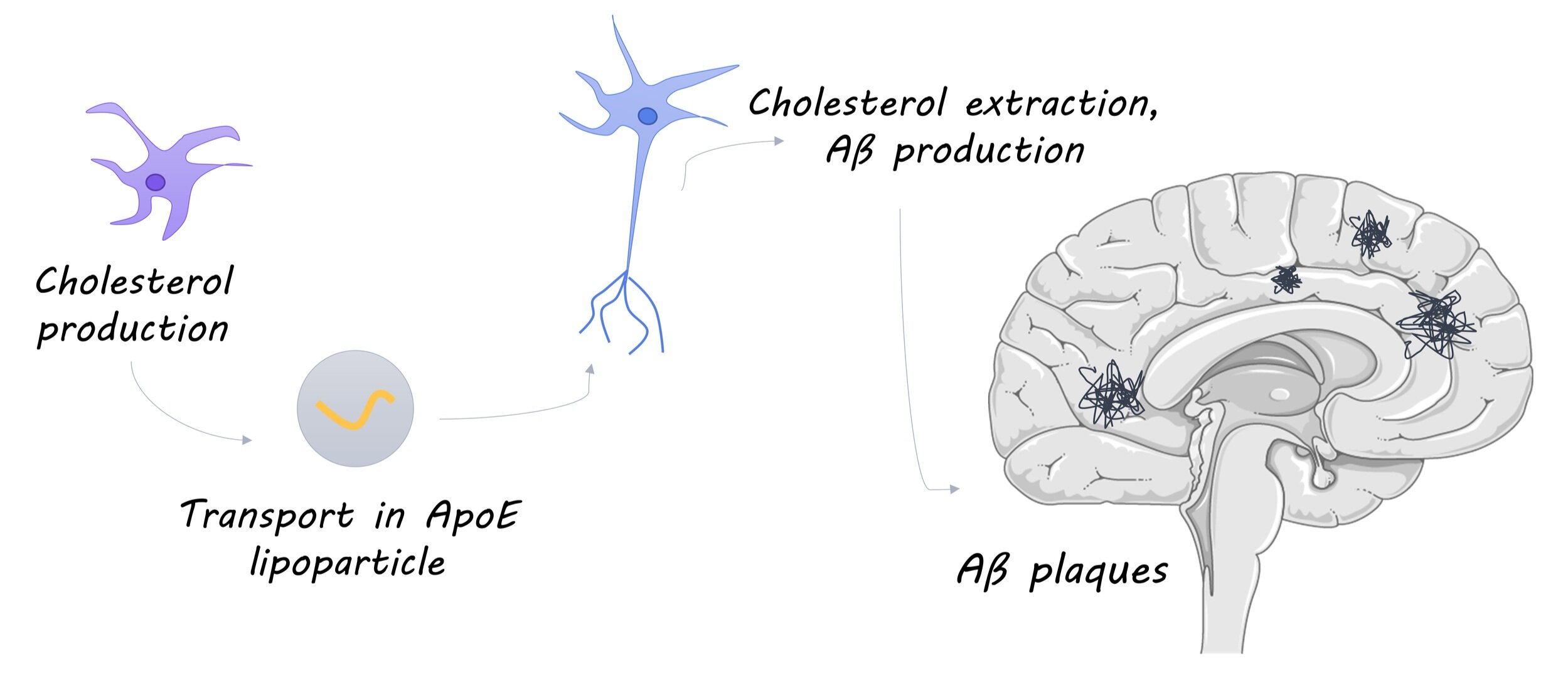
The authors found that without astrocyte derived cholesterol, the size of the lipid cluster in primary neurons was significantly smaller, suggesting that astrocytes are needed for the transport of cholesterol to neurons. This was confirmed in their second experiment, where they observed cells loaded with apoE and a cholesterol source increased in cluster diameter and those without cholesterol actually decreased in size as well as number.
ifrah (1).png

They were also able to confirm the role of astrocytes in APP regulation and Aß production. The authors observed a decrease in APP and lipid cluster association in a cell culture containing only neurons and apoE. The opposite effect was seen in a mixed culture with astrocytes with neurons. There was a 2.5x increase in APP association with lipid clusters. This demonstrates that astrocytes are necessary for synthesizing the cholesterol that is then shuttled to neuronal membranes. The more cholesterol that is loaded into neuronal membranes, the more APP interacts with enzymes that cleave it to make Aß peptides. 

What's the impact?

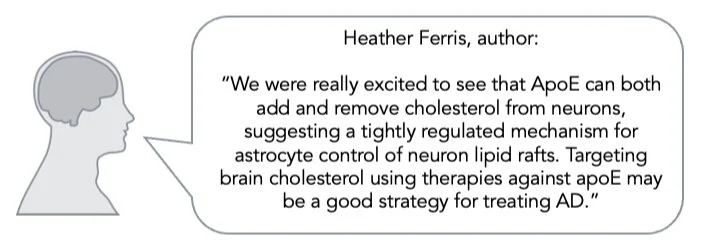
This study found that astrocyte-derived cholesterol tightly regulates the formation of beta-amyloid plaques in AD. Before this, the role of astrocytes in AD pathogenesis was not well understood. In this study, Wang and colleagues establish a molecular pathway that defines the role of astrocytes in plaque formation by the production and distribution of cholesterol to neurons.
Ferris_Aug31.png

Wang et al. Regulation of beta-amyloid production in neurons by astrocyte-derived cholesterol. PNAS (2021). Access the original scientific publication here.


How Has COVID-19 Impacted Neuroscience Research?

Post by Anastasia Sares

Science interrupted

The effects of the pandemic have been felt in every sector of life across the globe since the beginning of 2020, and neuroscience research is no different. This week in Neuron, Joy Snider and David Holtzman—one a laboratory scientist and the other a clinical researcher—narrate their own experiences and the influence of the pandemic on their fields.

Empty labs, full screens

Most in-person data collection and lab work was quickly deemed “nonessential” and placed under heavy restrictions, slowing progress to a crawl. Longitudinal studies (where people come in multiple times to be tested) that were begun before the pandemic were often unable to stay on schedule, compromising their original plans and possibly leading to data loss. MRI studies were especially risky if the imaging facility was connected to a hospital where COVID patients were treated, so many of these were put on hold as well.

On the other hand, forcing talks and conferences to move online, often at a reduced cost of attendance, removed barriers to these events and increased scholarly communication. The increase in participation was sometimes two- to three-fold, and people from around the world were able to dialogue. In addition, for some people, the lack of daily distractions at the lab was exactly what they needed to do in-depth analyses or writing, and paper submissions rose substantially.

A changed future

The setbacks caused by the pandemic will change the course of research long after. In animal research, the death of animals with highly specific genetics means starting back at square one, setting projects back years. Human clinical and preclinical studies also take years to approve, set up, and administer— some may need to go through these processes again and could lose participants. Fewer volunteering opportunities, projects on hold, and school closures impact careers across the board but disproportionately affect students, early-career scientists, and parents of young children who had to switch to virtual schooling at home. However, despite these difficulties, the push for remote communication and even remote testing could reduce the cost of scientific activities. 

What’s the bottom line?

The pandemic certainly presented challenges to researchers that may take years to recover from. However, it also led to surprising benefits, like the democratization of scientific events and more efficient remote testing. This could mean permanent changes to the way we conduct research moving forward.


Snider & Holtzman. Effects of COVI9-19 on preclinical and clinical research in Neurology: Examples from research on neurodegeneration and Alzheimer’s disease. Neuron (2021). Access the original scientific publication here.

Distinct Roles for Social Brain Network Regions in Strategy Development

Post by Lincoln Tracy

What's the science?

Social interactions lead to bursts of brain activity in the “social brain network”; a collection of different brain regions involved in social functioning. The right temporoparietal junction (rTPJ) is thought to play a crucial role in social-related brain activity. However, little is known about what the rTPJ and other brain regions do during these active periods, or if and how this activity differs depending on the specific social context. This week in Neuron, Konovalov and colleagues used changes in blood-oxygen-level-dependent (BOLD) activity of the “social brain network” during a standardized game paradigm to break down network activity into different contexts (e.g., social versus non-social, etc.).

How did they do it?

The authors recruited 60 volunteers aged 18 to 25 and randomly assigned these individuals to the social or non-social context to complete the standardized game paradigm inside a functional magnetic resonance imaging scanner. Participants in the social context were told they were playing a game of hide and seek against human opponents. In the social condition, the goal was to find a coin that could be hidden behind either a rock or a tree. Participants in the non-social context were told they were playing a guessing game where they needed to predict the next card drawn from a deck. Participants completed more than 200 guessing trials and scored or lost points depending on whether their guess was similar or different to their opponent, depending on the context. All participants actually played against two different computer algorithms—the learner and the sequencer. The learner algorithm kept track of the player’s play history, estimated the frequency of the player’s choices, and played the less frequent option. In contrast, the sequencer algorithm ignored the player’s choices and played a sequence that switched every two trials (e.g., tree-tree-rock-rock-tree-tree…).

The authors combined the behavioral choice data from the games with BOLD activity for the different brain regions to answer a series of questions. First, they tested whether the choices participants made against the two different algorithms led to different success rates between the social and non-social contexts. Second, they explored the strategies players used in the social context and whether these were the optimal strategies to beat the algorithms. Third, they asked whether “social brain network” activity differed between different contexts and algorithms encountered during the game. Finally, they explored unique functional roles of the “social brain network” regions. Specifically, they were interested in how the rTPJ interacted with other regions during the game.   

What did they find?

First, the authors found that participants performed better against the learner algorithm in the social context (compared to the non-social context) but that performance against the sequencer algorithm was the same regardless of context. These results suggest that the social context invoked a specific strategy that benefits when coming up against a reactive opponent. Second, they found that participant choices matched the optimal strategy 72% of the time. Third, they found that all brain regions were strongly tied to the outcome of the game, with more activation following a win than a loss. However, there was greater activation throughout the “social brain network” regions when the participant played against the learner algorithm compared to the sequencer algorithm. This pattern was highly similar to the analysis of the behavioral choice data. Finally, they found that connectivity between the rTPJ and other “social brain network” regions was increased when the participant won the game, confirming their hypothesis that the rTPJ communicates behaviorally relevant outcome information to connected brain regions.

What's the impact?

These results provide a new way of considering similar standard laboratory tasks that measure activity in “social brain network” regions where participants have to consider the mental states of other people. These findings provide crucial novel findings, as they support clear functional differences between the rTPJ and other social-related regions. The computational approach employed as part of this study could be used in clinical populations—such as autism spectrum disorder—to better understand neurocognitive characteristics within these populations.

Konovalov et al. Dissecting functional contributions of the social brain to strategic behavior. Neuron (2021). Access the original scientific publication here.