
Distinct Roles for Social Brain Network Regions in Strategy Development

Post by Lincoln Tracy

What's the science?

Social interactions lead to bursts of brain activity in the “social brain network”; a collection of different brain regions involved in social functioning. The right temporoparietal junction (rTPJ) is thought to play a crucial role in social-related brain activity. However, little is known about what the rTPJ and other brain regions do during these active periods, or if and how this activity differs depending on the specific social context. This week in Neuron, Konovalov and colleagues used changes in blood-oxygen-level-dependent (BOLD) activity of the “social brain network” during a standardized game paradigm to break down network activity into different contexts (e.g., social versus non-social, etc.).

How did they do it?

The authors recruited 60 volunteers aged 18 to 25 and randomly assigned these individuals to the social or non-social context to complete the standardized game paradigm inside a functional magnetic resonance imaging scanner. Participants in the social context were told they were playing a game of hide and seek against human opponents. In the social condition, the goal was to find a coin that could be hidden behind either a rock or a tree. Participants in the non-social context were told they were playing a guessing game where they needed to predict the next card drawn from a deck. Participants completed more than 200 guessing trials and scored or lost points depending on whether their guess was similar or different to their opponent, depending on the context. All participants actually played against two different computer algorithms—the learner and the sequencer. The learner algorithm kept track of the player’s play history, estimated the frequency of the player’s choices, and played the less frequent option. In contrast, the sequencer algorithm ignored the player’s choices and played a sequence that switched every two trials (e.g., tree-tree-rock-rock-tree-tree…).

The authors combined the behavioral choice data from the games with BOLD activity for the different brain regions to answer a series of questions. First, they tested whether the choices participants made against the two different algorithms led to different success rates between the social and non-social contexts. Second, they explored the strategies players used in the social context and whether these were the optimal strategies to beat the algorithms. Third, they asked whether “social brain network” activity differed between different contexts and algorithms encountered during the game. Finally, they explored unique functional roles of the “social brain network” regions. Specifically, they were interested in how the rTPJ interacted with other regions during the game.   

What did they find?

First, the authors found that participants performed better against the learner algorithm in the social context (compared to the non-social context) but that performance against the sequencer algorithm was the same regardless of context. These results suggest that the social context invoked a specific strategy that benefits when coming up against a reactive opponent. Second, they found that participant choices matched the optimal strategy 72% of the time. Third, they found that all brain regions were strongly tied to the outcome of the game, with more activation following a win than a loss. However, there was greater activation throughout the “social brain network” regions when the participant played against the learner algorithm compared to the sequencer algorithm. This pattern was highly similar to the analysis of the behavioral choice data. Finally, they found that connectivity between the rTPJ and other “social brain network” regions was increased when the participant won the game, confirming their hypothesis that the rTPJ communicates behaviorally relevant outcome information to connected brain regions.

What's the impact?

These results provide a new way of considering similar standard laboratory tasks that measure activity in “social brain network” regions where participants have to consider the mental states of other people. These findings provide crucial novel findings, as they support clear functional differences between the rTPJ and other social-related regions. The computational approach employed as part of this study could be used in clinical populations—such as autism spectrum disorder—to better understand neurocognitive characteristics within these populations.

Konovalov et al. Dissecting functional contributions of the social brain to strategic behavior. Neuron (2021). Access the original scientific publication here.
Long-Term Mental Health Impact of a COVID-19 Outbreak

Post by Ifrah Khanyaree

What's the science?

The COVID-19 pandemic has caused immense psychological distress worldwide and has been associated with an increased risk for mental illness. This week in Molecular Psychiatry, Benjamin and colleagues evaluated the long-term mental health and behavioural effects of the pandemic in a large cohort of Israeli adults.

How did they do it?

The authors collected responses from 4933 participants using a two-part online survey. The initial questionnaire covered demographic data, participants’ medical history, and COVID-19 related physiological symptoms. The second part asked for the effects of COVID-19 on participants' psychological and emotional well-being using clinically validated questionnaires. The questionnaire was to be answered once a day in a 6 week period after the end of the first outbreak and for the beginning of the second wave.

What did they find?

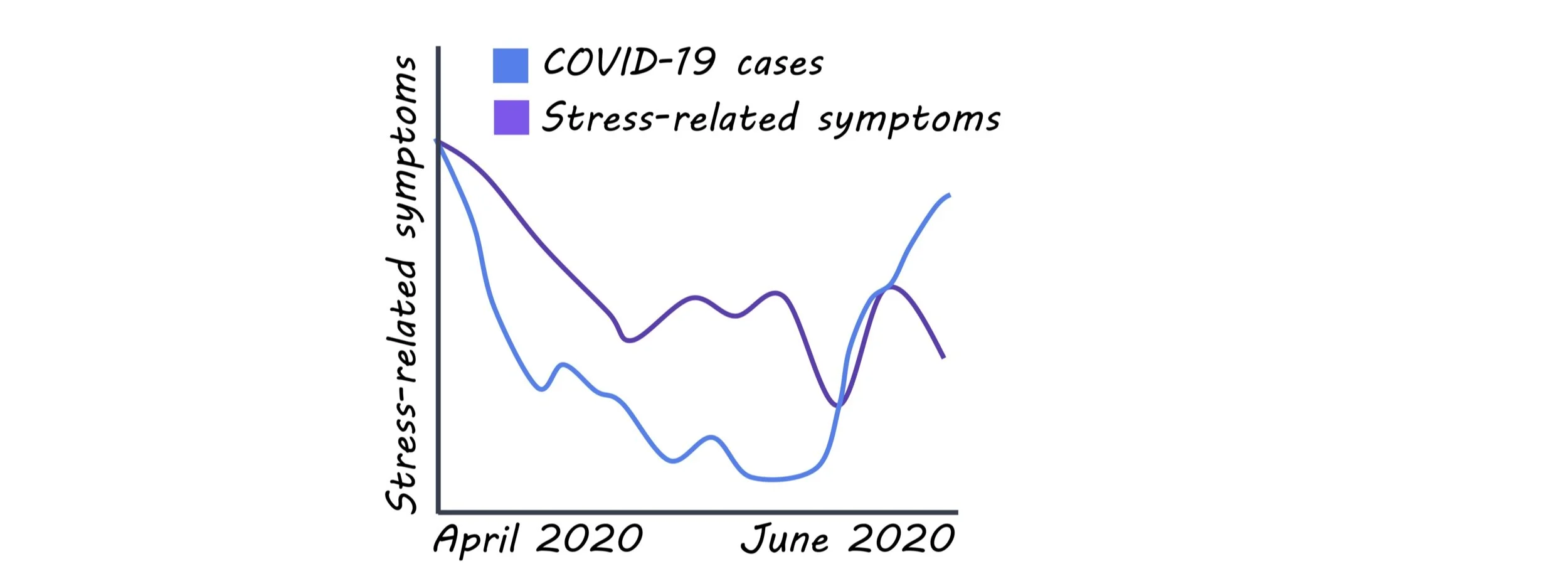
First, the authors focused on finding out the underlying causes of psychological distress among the population. They discovered that most people were more concerned with the situation in their country and people close to them contacting the virus in comparison to their own personal health or financial situation. Second, they looked into demographic differences and found that women reported higher general distress and stress-related physiological symptoms. Age-wise, younger participants reported significantly higher general emotional distress. The authors also looked into how socioeconomic (SE) status affected mental health in the pandemic and found that those of a lower SE status reported lower levels of national and global concern. Individuals who were unemployed reported significantly higher scores for personal emotional distress. Lastly, a positive correlation was seen between increasing COVID cases and participants’ scores on all the distress levels measured.                              

ifrah.png

What's the impact?

This study is the first to show mental health and behavioural effects on an adult population from the first peak of a COVID-19 outbreak to the start of another. The authors found that the highest mental health burden was associated with being young, unemployed and female. These results provide further evidence of the long-term unequal strain the pandemic has had on parts of our society. The study builds an important foundation for doing further work into investigating how our environment shapes our emotional well-being and how the mental health effects of the pandemic will unfold over time.    

Benjamin et al. Stress-related emotional and behavioural impact following the first COVID-19 outbreak peak. Molecular Psychiatry (2021). Access the original scientific publication here.

The Role of Neural Oscillations in Episodic Memory Formation

Post by Elisa Guma

What's the science?

Episodic memory is a category of long-term memory that involves the recollection of specific events, situations, and experiences, typically anchored to a specific time and space. Two distinct cognitive processes, with two distinct types of neural activity, are associated with this type of memory. First one must process a vast amount of sensory information about an event; next, these representations must be bound together to form a unique memory trace. It has been hypothesized that brain activity from the neocortex (in the alpha/beta oscillations) supports the prior (processing sensory information), while activity in the hippocampus (theta/gamma oscillations) supports the latter (mnemonic binding). This week in NeuroImage, Griffiths and colleagues set out to test this hypothesis by recording brain activity during an episodic memory task in healthy young adults.

How did they do it?

Seventeen participants performed a visual association memory task while fluctuations in brain activity were recorded using magnetoencephalography (MEG). During the encoding phase, participants were presented with a line drawing of an object (ex: a giraffe), a pattern (ex: blue background with orange dots), and a scene (ex: a train). Following a short interval, participants were given a short interval to create a mental image fusing all three stimuli (i.e., mnemonic binding) to help them recall this for a later memory test (ex: a blue and orange giraffe on a train). After associating 48 triads, and performing a distractor task, participants performed the retrieval task. Here, participants were presented either a line drawing or a scene and asked to recall the mental image they had made during encoding and asked to identify the pattern associated with the line drawing. Further, participants had to rate how confident they were in their choice (‘guess’, ‘unsure’, ‘certain’). For each trial, memory performance was coded as either ‘complete’ (remembered both the scene and pattern), ‘partial’ (remembered only one of the associations), or ‘forgotten’ (remembered neither scene or pattern).

The MEG data, which provides excellent temporal specificity compared to other brain imaging modalities, was preprocessed and corrected for potential motion (e.g. head movement) artifacts. Brain oscillations occurring at different wavelengths (alpha, beta, gamma, theta) were extracted from the neocortex and the hippocampus in order to test whether brain activity was associated with the following aspects of the task: (1) number of items recalled, (2) whether the scene was recalled, (3) whether the pattern was recalled, (4) the change in head position. Most importantly, the authors investigated whether alpha/beta power decreased with stimuli presentation and whether theta/gamma coupling (i.e. do the peaks and troughs of these two power spectra align) increased during mnemonic binding. The authors estimated the relationship between power (i.e. alpha, beta, gamma, theta) and the number of items recalled by participants (tested for significance using cluster-based permutation testing).

What did they find?

On average, participants correctly recalled both the associated pattern and associated scene on 38.3% of trials, recalled only one associated stimulus on 34.4% of trials, and failed to recall an associated stimulus on 27.3% of trials.

Next, the authors found that decreased alpha/beta power was associated with better memory performance noted by an increased number of items recalled. In the brain, this was localized to the bilateral occipital regions. Furthermore, no such relationship was observed with the mnemonic binding phase of the task, or with gamma/theta power, which indicates that this relationship is specific to the neocortex alpha/beta power, and sensory integration. The authors also found that hippocampal theta/gamma phase-amplitude coupling was indeed related to mnemonic binding; the number of items recalled scaled with the degree of coupling of theta/gamma power. This relationship was not observed for the sequence perception phase of the task, nor for other brain regions. 

elisa.png

What's the impact?

These data presented here suggest that memory-related decreases in neocortical alpha/beta power and memory-related increases in hippocampal theta/gamma phase-amplitude coupling arise at distinct stages of memory formation, with the former supporting information representation and the latter supporting mnemonic binding. This does not suggest that these two processes can occur completely independently, as mnemonic binding cannot occur without relevant perceived information. However, it does provide a deeper understanding of how two distinct cognitive processes are associated with distinct neural phenomena to create an episodic memory. Future work may investigate the integrity of these neural processes in the brains of individuals suffering from memory dysfunction

Griffiths BJ et al. Disentangling neocortical alpha/beta and hippocampal/theta/gamma oscillations in human episodic memory function. Neuroimage (2021). Access the original scientific publication here.