
Cognitive Behavioral Group Therapy and Mindfulness Based Stress Reduction Recruit Similar Brain Regions

Post by Lincoln Tracy

What's the science?

Social anxiety disorder is a common psychiatric disorder that affects around one in every eight people. Individuals affected by social anxiety disorder experience significant burdens on social functioning and quality of life. Two different treatments – cognitive behavioral group therapy (CBGT) and mindfulness-based stress reduction (MBSR) – have been proven effective in treating SAD. Previous research into the effects of CBGT and MBSR on social anxiety disorder has predominantly relied on self-report measures but has shown similar effects on decreasing negative thoughts while increasing mindfulness skills. Evidence suggests that CBGT and MBSR activate similar brain regions involved in emotion regulation. However, there is yet to be a study that directly compares the effects of CBGT and MBSR on emotion-regulating brain activation and how this activation relates to symptoms at 1-year post-treatment. This week in JAMA Psychiatry, Goldin and colleagues tested for common and specific effects of CBGT and MBSR on brain activity during emotion regulation in adults with social anxiety disorder.

How did they do it?

The authors recruited 108 patients with a diagnosis of social anxiety disorder. None of the patients were currently taking medication for their disorder. The patients were randomly assigned into one of three evenly sized groups: CBGT, MBSR, or the waitlist control group. Patients in the CBGT and MBSR groups received 12 2.5-hour sessions of their respective therapy from qualified instructors and received workbooks to supplement the 12 sessions. Assessments were completed at baseline and at 1-year post-treatment, consisting of self-report measures and completing an emotion regulation task while undergoing a functional magnetic resonance imaging (fMRI) scan. Pre- and post-treatment data were compared to determine: 1) the effects of treatment on negative emotions and brain activation compared to waitlist controls; 2) whether there were specific treatment effects on negative emotions and brain activation, and 3) if treatment-specific effects on negative emotions and brain activation related to social anxiety symptoms at 1-year post-treatment.

What did they find?

First, the authors found that compared to the waitlisted control patients, patients who received CBGT or MBSR displayed greater pre-treatment to post-treatment decreases in negative emotions while also increasing the recruitment of regulation-associated brain regions such as the prefrontal cortex when completing the emotion regulation task. Second, the authors found no difference between CBGT and MBSR with respect to negative emotions and brain responses during the emotion regulation task. This means that similar brain regions were activated during the task regardless of which treatment the patients received. Finally, the authors found that post-treatment negative emotion was associated with social anxiety symptoms at 1-year post-MBSR, but not post-CBGT.

What's the impact?

This study demonstrates that CBGT and MBSR may strengthen overlapping skills in dealing with social anxiety disorder and may rely on common emotion-regulating areas of the brain to produce these improvements. Both treatment approaches may be effective and have long-term benefits in patients with social anxiety disorder through the use of similar emotion regulation strategies. Further research is required to compare the effects of CBGT and MBSR with pharmacotherapy, as well as testing patients with different mood and anxiety disorders to see if the current results generalize to other clinical populations. 

Goldin et al. Evaluation of cognitive behavioral therapy vs mindfulness meditation in brain changes during reappraisal and acceptance among patients with social anxiety disorder: A randomized clinical trial. JAMA Psychiatry (2021). Access the original scientific publication here.
Neural Representation of Self: Independent or Interdependent?

Post by Lani Cupo

What's the science?

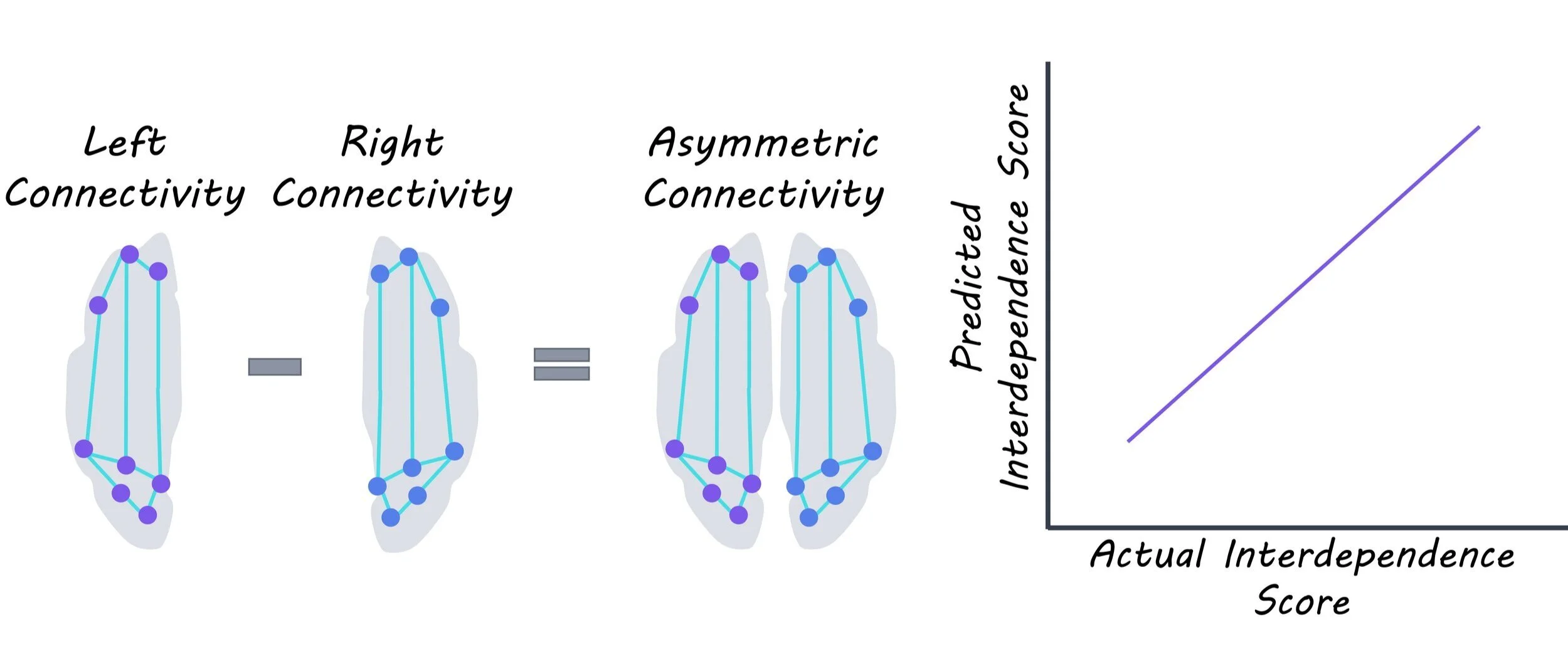
One path to better understanding how humans incorporate complex social information in relation to themselves is through the conceptualization of self. The degree to which the self is defined as independent or interdependent with others is known as self-construal, and can differ greatly across environments and cultural backgrounds. Previous research with anatomical and functional magnetic resonance imaging (fMRI) implicates a wide range of brain regions in different representations of self, however it is an open question how connectivity between different brain regions contributes to self-construal. This week in NeuroImage, Shi and colleagues used machine learning to conduct a hypothesis-free, whole-brain analysis of neural connectivity patterns to investigate the representation of self-construal in the connectivity between different brain regions.

How did they do it?

Participants comprised 307 students from Tsinghua University in Beijing - of relevance as the cultural upbringing of individuals drastically impacts self-construal. First, participants completed a questionnaire to assess their self-construal, with higher scores indicating orientation towards independence and lower scores indicating orientation towards interdependence. Then, they underwent fMRI scans for about 8.5 minutes in order to capture the activity of various brain regions. After parcellating the brain into regions based on a predefined brain atlas, the authors correlated fluctuations in the fMRI signal from across all regions to construct functional connectivity matrices describing how similar patterns of activity were between regions. In order to measure whole-brain connectivity, they used five matrices: left-brain (connectivity within the left hemisphere), right-brain (connectivity within the right hemisphere), global (left and right brain added together), interactive (connectivity between the left and right hemisphere), and asymmetric (the absolute value of right brain subtracted from left, where higher values indicate more asymmetry). The authors then trained machine learning algorithms to use data from the five connectivity matrices to predict participants’ scores on the questionnaire, determining whether they exhibited more independent or interdependent self-construal. This allowed the authors to compare which matrix most helped the model differentiate participants. Then, they verified their results using a different questionnaire in the same population. Finally, they identified the 200 connections that most contributed to model performance and checked whether these connections corresponded to known brain networks involved in cognitive functioning, including the default mode network (DMN), executive control network (ECN), and salience networks (SN).

What did they find?

Of all the matrices, the asymmetric one best predicted independent and interdependent self-construal among the participants. These results contribute to a hypothesis that there may be hemisphere specialization underlying self-referential thought. Mapping self-construal orientation onto networks revealed that independence correlated with increased connectivity between brain regions in the DMN and ECN, brain networks involved in both self-referential thought and goal-directed activity, respectively. The authors posit that these results may substantiate a theoretical idea that independent self-construal reflects more personal, affective aspects of self. Meanwhile, there was an different pattern in interdependence, with DMN-ECN connectivity showing a left dominance and DMN-SN connectivity showing a right dominance. The SN is a network involved in integrating cognitive, sensory and emotional information. While the interpretation of these results is still unclear, the authors note one hypothesis is that those with interdependent self-construals may be more sensitive to socially-relevant stimuli around them.

lani.jpg

What's the impact?

This study is the first to quantitatively examine patterns of whole-brain functional connectivity underlying self-construal, linking the patterns to previously established neural networks. The authors’ findings suggest that the representation of the self as independent or interdependent is represented in functional connectivity, especially in the relative involvement of the two hemispheres. Overall the results of their study could present a way of understanding how social cultural contexts affect the neural activity underlying the conception of self.

Shi et al. The divided brain: Functional brain asymmetry underlying self-construal. NeuroImage (2021).Access the original scientific publication here.

Recognizing Speech in a Noisy Environment

Post by Amanda McFarlan

What's the science?

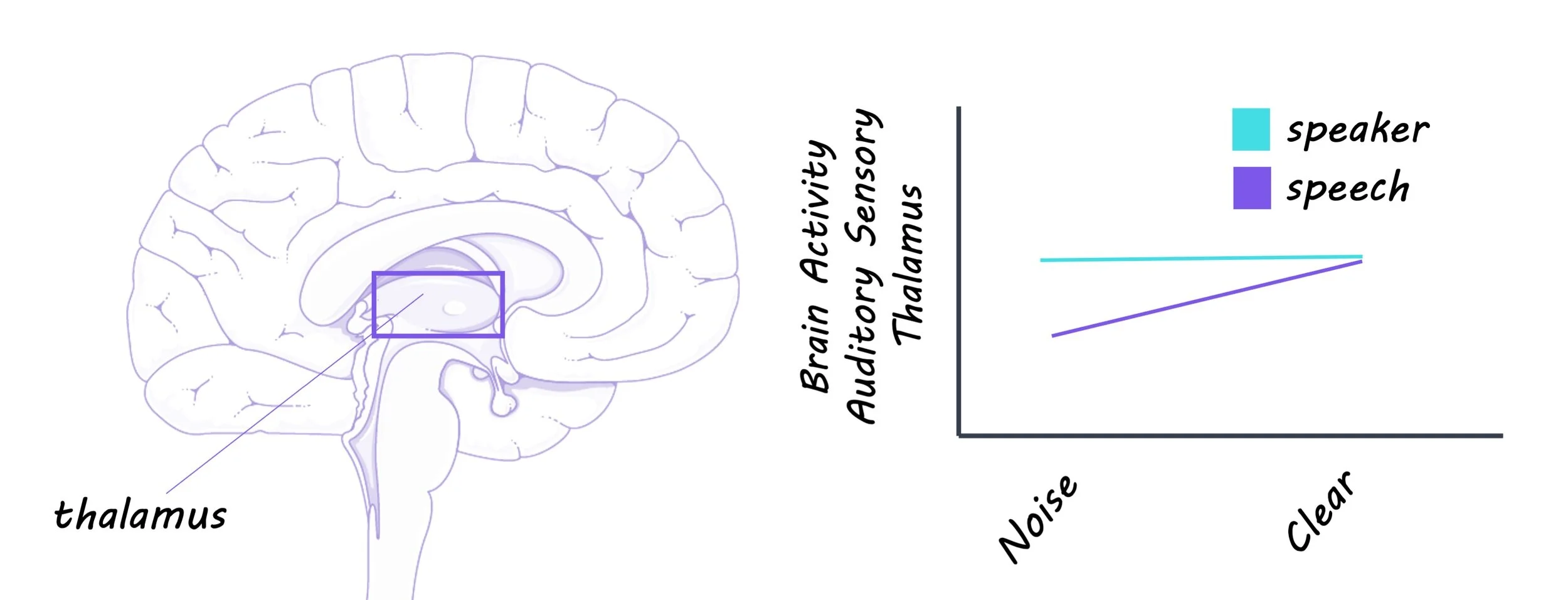
Recognizing speech in noisy environments is a challenging task that most humans are able to master. However, exactly how the brain is able to do this is not known. Previous studies have shown that speech recognition in the absence of background noise is associated with modulation in the activity of the left ventral medial geniculate body (vMGB) of the auditory thalamus. This modulation of the vMGB was shown to be greater for tasks that required participants to discern speech rather than other stimuli (e.g. the speaker’s voice or sound intensity), suggesting that it is task-dependent. This week in the Journal of Neuroscience, Mihai and colleagues investigated how background noise affects the task-dependent modulation of the left vMGB for speech.

How did they do it?

The authors used ultra-high field functional magnetic resonance imaging (fMRI) to measure brain activity while participants performed two auditory tasks. The first auditory task was the speech task where participants listened to a series of auditory syllables (made up of a vowel-consonant-vowel) and were asked to identify whether each new syllable was different from the previous one. The second auditory task was the speaker task. For this task, participants were asked to determine whether the voice of the person reading the syllables changed from one syllable to the next. The auditory syllables for the speech and speaker tasks were either presented with background noise (noise condition) or without background noise (clear condition).     

What did they find?

The authors found that activity in the left vMGB was increased during the speech task compared to the speaker task in the noise condition. Conversely, activity in the left vMGB was not significantly different for the speech and speaker tasks in the clear condition. The authors also explored whether differences in activity could be detected in other areas of the brain including the right vMGB, the cerebral cortex, and the central nuclei of the inferior colliculi. Their analyses revealed that, unlike in the left vMGB, the noise condition had no detectable influence on activity for the speech vs. speaker tasks in these brain regions.   

amanda_jul20.png

What’s the impact?

This study showed that the activation of the left vMGB is stronger when decoding speech compared to identifying a speaker if the listening environment is noisy, suggesting that the auditory thalamus may be particularly important for recognizing speech in the presence of background noise. Together, these findings provide insight into how the brain decodes speech in noisy conditions. Further research in this field may have clinical relevance for the treatment of individuals with difficulties in understanding speech-in-noise, including individuals with autism spectrum disorder, developmental dyslexia, and auditory processing disorders.

Mihai et al. Modulation of the primary auditory thalamus when recognizing speech with background noise. Journal of Neuroscience (2021). Access the original scientific publication here.