
Neural Representation of Self: Independent or Interdependent?

Post by Lani Cupo

What's the science?

One path to better understanding how humans incorporate complex social information in relation to themselves is through the conceptualization of self. The degree to which the self is defined as independent or interdependent with others is known as self-construal, and can differ greatly across environments and cultural backgrounds. Previous research with anatomical and functional magnetic resonance imaging (fMRI) implicates a wide range of brain regions in different representations of self, however it is an open question how connectivity between different brain regions contributes to self-construal. This week in NeuroImage, Shi and colleagues used machine learning to conduct a hypothesis-free, whole-brain analysis of neural connectivity patterns to investigate the representation of self-construal in the connectivity between different brain regions.

How did they do it?

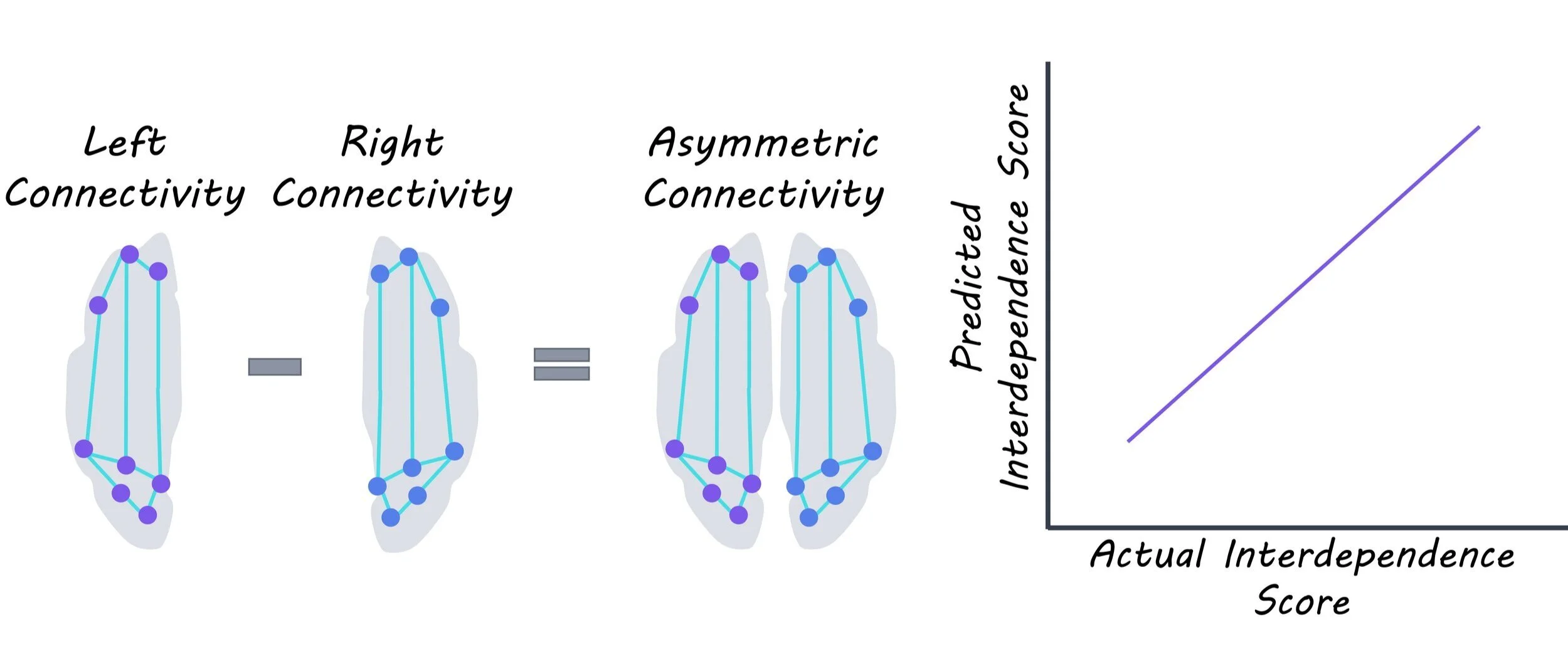
Participants comprised 307 students from Tsinghua University in Beijing - of relevance as the cultural upbringing of individuals drastically impacts self-construal. First, participants completed a questionnaire to assess their self-construal, with higher scores indicating orientation towards independence and lower scores indicating orientation towards interdependence. Then, they underwent fMRI scans for about 8.5 minutes in order to capture the activity of various brain regions. After parcellating the brain into regions based on a predefined brain atlas, the authors correlated fluctuations in the fMRI signal from across all regions to construct functional connectivity matrices describing how similar patterns of activity were between regions. In order to measure whole-brain connectivity, they used five matrices: left-brain (connectivity within the left hemisphere), right-brain (connectivity within the right hemisphere), global (left and right brain added together), interactive (connectivity between the left and right hemisphere), and asymmetric (the absolute value of right brain subtracted from left, where higher values indicate more asymmetry). The authors then trained machine learning algorithms to use data from the five connectivity matrices to predict participants’ scores on the questionnaire, determining whether they exhibited more independent or interdependent self-construal. This allowed the authors to compare which matrix most helped the model differentiate participants. Then, they verified their results using a different questionnaire in the same population. Finally, they identified the 200 connections that most contributed to model performance and checked whether these connections corresponded to known brain networks involved in cognitive functioning, including the default mode network (DMN), executive control network (ECN), and salience networks (SN).

What did they find?

Of all the matrices, the asymmetric one best predicted independent and interdependent self-construal among the participants. These results contribute to a hypothesis that there may be hemisphere specialization underlying self-referential thought. Mapping self-construal orientation onto networks revealed that independence correlated with increased connectivity between brain regions in the DMN and ECN, brain networks involved in both self-referential thought and goal-directed activity, respectively. The authors posit that these results may substantiate a theoretical idea that independent self-construal reflects more personal, affective aspects of self. Meanwhile, there was an different pattern in interdependence, with DMN-ECN connectivity showing a left dominance and DMN-SN connectivity showing a right dominance. The SN is a network involved in integrating cognitive, sensory and emotional information. While the interpretation of these results is still unclear, the authors note one hypothesis is that those with interdependent self-construals may be more sensitive to socially-relevant stimuli around them.
lani.jpg

What's the impact?

This study is the first to quantitatively examine patterns of whole-brain functional connectivity underlying self-construal, linking the patterns to previously established neural networks. The authors’ findings suggest that the representation of the self as independent or interdependent is represented in functional connectivity, especially in the relative involvement of the two hemispheres. Overall the results of their study could present a way of understanding how social cultural contexts affect the neural activity underlying the conception of self.

Shi et al. The divided brain: Functional brain asymmetry underlying self-construal. NeuroImage (2021).Access the original scientific publication here.
Recognizing Speech in a Noisy Environment

Post by Amanda McFarlan

What's the science?

Recognizing speech in noisy environments is a challenging task that most humans are able to master. However, exactly how the brain is able to do this is not known. Previous studies have shown that speech recognition in the absence of background noise is associated with modulation in the activity of the left ventral medial geniculate body (vMGB) of the auditory thalamus. This modulation of the vMGB was shown to be greater for tasks that required participants to discern speech rather than other stimuli (e.g. the speaker’s voice or sound intensity), suggesting that it is task-dependent. This week in the Journal of Neuroscience, Mihai and colleagues investigated how background noise affects the task-dependent modulation of the left vMGB for speech.

How did they do it?

The authors used ultra-high field functional magnetic resonance imaging (fMRI) to measure brain activity while participants performed two auditory tasks. The first auditory task was the speech task where participants listened to a series of auditory syllables (made up of a vowel-consonant-vowel) and were asked to identify whether each new syllable was different from the previous one. The second auditory task was the speaker task. For this task, participants were asked to determine whether the voice of the person reading the syllables changed from one syllable to the next. The auditory syllables for the speech and speaker tasks were either presented with background noise (noise condition) or without background noise (clear condition).     

What did they find?

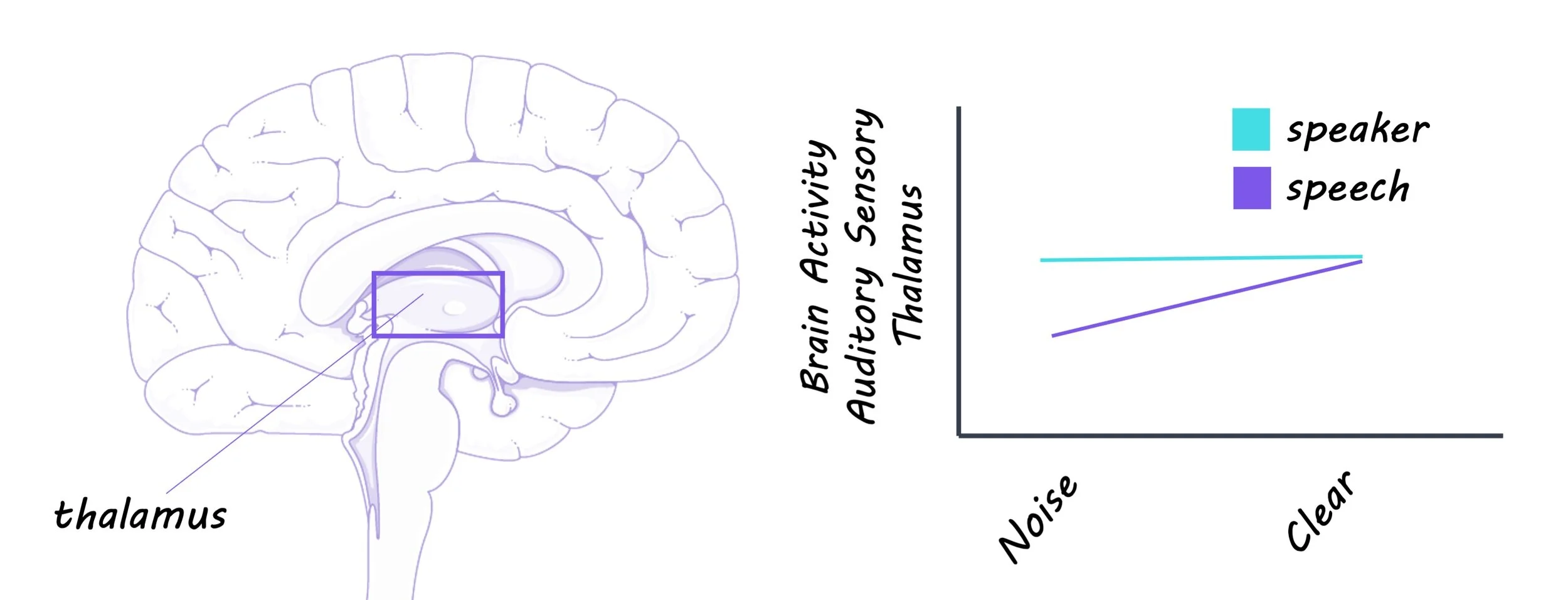
The authors found that activity in the left vMGB was increased during the speech task compared to the speaker task in the noise condition. Conversely, activity in the left vMGB was not significantly different for the speech and speaker tasks in the clear condition. The authors also explored whether differences in activity could be detected in other areas of the brain including the right vMGB, the cerebral cortex, and the central nuclei of the inferior colliculi. Their analyses revealed that, unlike in the left vMGB, the noise condition had no detectable influence on activity for the speech vs. speaker tasks in these brain regions.   

amanda_jul20.png

What’s the impact?

This study showed that the activation of the left vMGB is stronger when decoding speech compared to identifying a speaker if the listening environment is noisy, suggesting that the auditory thalamus may be particularly important for recognizing speech in the presence of background noise. Together, these findings provide insight into how the brain decodes speech in noisy conditions. Further research in this field may have clinical relevance for the treatment of individuals with difficulties in understanding speech-in-noise, including individuals with autism spectrum disorder, developmental dyslexia, and auditory processing disorders.

Mihai et al. Modulation of the primary auditory thalamus when recognizing speech with background noise. Journal of Neuroscience (2021). Access the original scientific publication here.

The Relationship Between the Menstrual Cycle and Sleep

Post by Shireen Parimoo

What is the menstrual cycle?

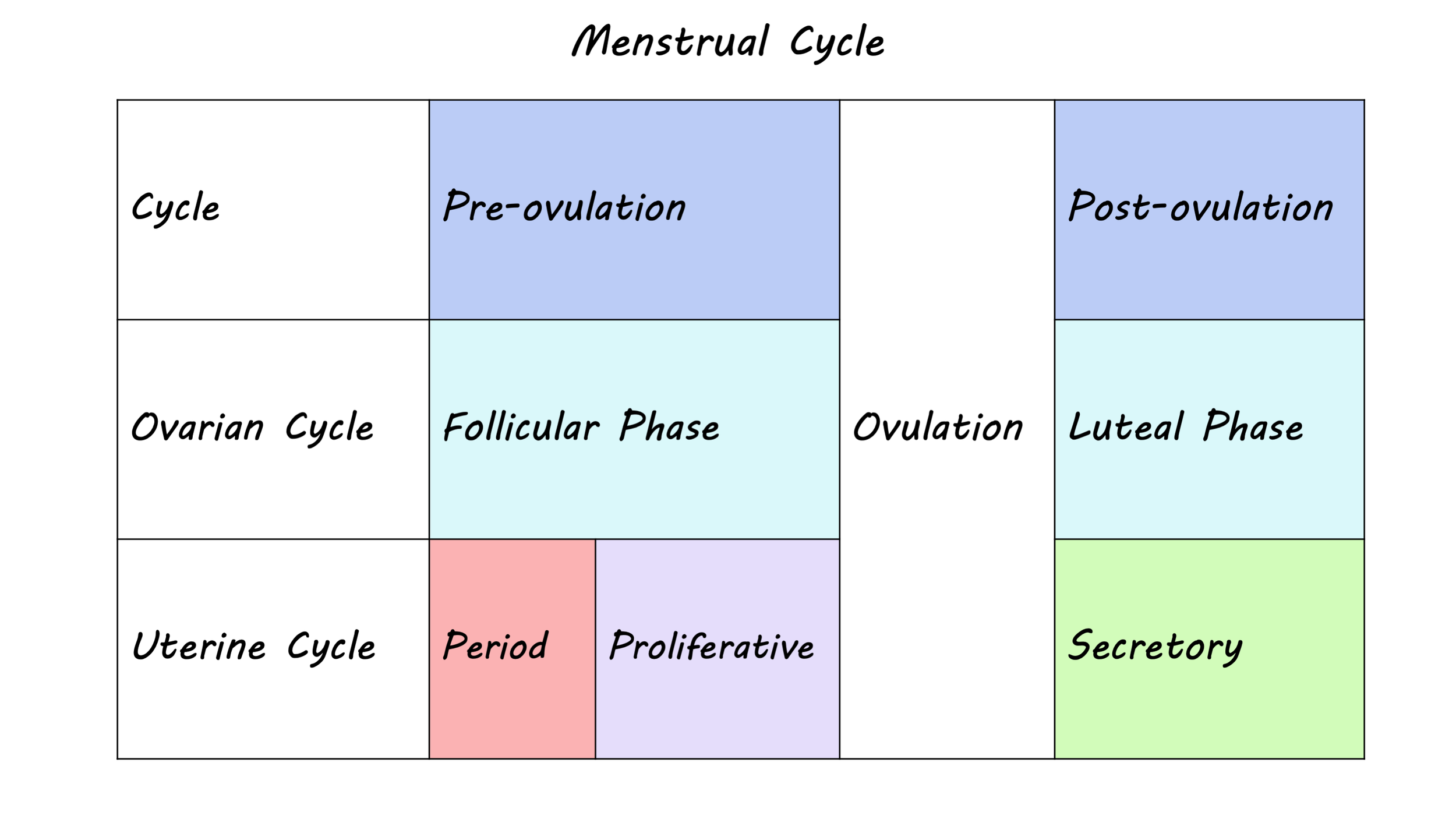
The menstrual cycle describes the fluctuation of ovarian hormones that typically occurs over a 28-day period, but can range anywhere from 21 to 38 days. The cycle is divided into two distinct phases: the follicular phase and the luteal phase. The follicular phase begins on the first day of menses - more commonly known as the period - which lasts between three to eight days. This phase ends with ovulation, when an egg is released from the ovary into the uterus, followed by the luteal phase, which lasts until the next menses.

In each phase of the menstrual cycle, hormonal changes result from an interaction between the brain and the reproductive system. In the follicular phase, follicle stimulating hormone released from the pituitary gland in the brain prepares the ovaries for ovulation and triggers the release of estrogens, which prepares the uterus for ovulation. Toward the end of the follicular phase, high levels of estrogens act on the brain to facilitate the release of luteinizing hormone, which in turn triggers ovulation. Once the egg is released, there is an increase in progesterone and estrogen but if pregnancy does not occur levels decline, leading to the next menses.

Cycle_Jul20.png

How does it affect sleep?

Sleep promotes physical and mental recovery, maintenance, and repair within the brain, and facilitates learning and memory. Thus, it is important to maintain a consistent sleep schedule and get good quality sleep, since sleep disturbances can not only interfere with day-to-day functioning and general well-being but can also disrupt cognitive performance and increase the risk of disease and dementia. Good sleep hygiene, such as keeping a consistent bedtime/nighttime routine, getting enough sunlight during the day, exercising regularly, and avoiding nicotine, alcohol, and stimulants in the evening can help. In general, women self-report more frequent sleep problems, increased daytime sleepiness, and poorer quality of sleep compared to men, yet objective measures like sleep duration suggest that women get more quality sleep than men.

Ovarian hormones partially contribute to these conflicting sex differences in objective and subjective measures of sleep quality. Across the female lifespan, the most pronounced hormonal changes take place during puberty, menses, pregnancy, and menopause, which coincide with sleep disturbances. During reproductive years, women experience more subtle fluctuations in their quality of sleep over the course of the menstrual cycle. Sleep disturbances are primarily observed during the luteal phase, partly due to elevated levels of estrogens and progesterone. For example, women report higher daytime sleepiness and more awakenings at night during the luteal compared to the follicular phase. Core body temperature at night is also elevated during the luteal phase, which is related to both hypersomnia (excessive sleep) and insomnia (inability to sleep). However, some objective measures of sleep quality such as total time spent sleeping and sleep efficiency are not consistently affected by the menstrual phase.

How is the brain involved?

Sleep consists of recurring cycles that usually last about 90 minutes, with one night of sleep involving between three to five sleep cycles. Each sleep cycle includes rapid eye movement (REM) sleep, when dreaming occurs, and non-REM sleep, which involves light and deep sleep. Polysomnography studies show that the duration of REM sleep is lower during the luteal phase than the follicular phase, whereas the duration of non-REM sleep becomes longer.

Ovarian hormones are increasingly being recognized for their relevance in non-reproductive functions through their impact on the brain. For example, there is evidence of better memory after a nap for women in the luteal phase compared to those in the follicular phase of their menstrual cycle. Estrogens and progesterone, which are elevated during the luteal phase, act on receptors in the hippocampus and the frontal cortex, regions that are involved in learning, memory, and decision-making. Moreover, these hormones have also been shown to have neuroprotective effects on the brain’s structure across the lifespan.

Slow-wave sleep (deep sleep) and sleep spindles are prominent features of non-REM sleep, which is when much of the sleep-related recovery and memory consolidation takes place. Sleep spindles refer to bursts of oscillatory activity (11-16 Hz) that typically occur during stage 2 of non-REM sleep. Notably, sleep spindles occur more frequently during the luteal phase of the menstrual cycle and are associated with memory performance. Higher levels of progesterone are thought to modulate spindle activity by acting on GABA receptors in the brain. Conversely, slow-wave sleep is characterized by low frequency oscillatory activity (0.5-3 Hz) and is reduced during the luteal phase. However, it is currently unclear how brain activity during different sleep stages is linked to specific phases of the menstrual cycle. More research is needed to better understand the complex and interdependent relationship between the female reproductive system and brain in relation to sleep and cognition. 

References

Alonso et al. Sex and menstrual phase influences on sleep and memory. Current Sleep Medicine Reports (2021).

Baker & Driver. Self-reported sleep across the menstrual cycle in young, healthy women. Journal of Psychosomatic Research (2004).

Bixler et al. Women sleep objectively better than men and the sleep of young women is more resilient to external stressors: the effects of age and menopause. Journal of Sleep Research (2009).

Brann et al. Neurotrophic and neuroprotective actions of estrogen: basic mechanisms and clinical implications. Steroids (2007).

Brinton et al. Progesterone receptors: form and function in the brain. Frontiers in Neuroendocrinology (2008).

Brown & Gervais. Role of ovarian hormones in the modulation of sleep in females across the adult lifespan. Endocrinology (2020).

Dorsey et al. Neurobiological and hormonal mechanisms regulating women’s sleep. Frontiers in Neuroscience (2021).

Driver et al. The menstrual cycle effects on sleep. Sleep Medicine Clinics (2008).

Genzel et al. Sex and modulatory menstrual cycle effects on sleep related memory consolidation. Psychoneuroendocrinology (2012).

Gervais et al. Ovarian hormones, sleep and cognition across the adult female lifespan: an integrated perspective. Frontiers in Neuroendocrinology (2017).

Johnson et al. Epidemiology of DSM-IV insomnia in adolescence: lifetime prevalence, chronicity, and an emergent gender difference. Pediatrics (2006).

Mong & Cusmano. Sex differences in sleep: impact of biological sex and sex steroids. Philosophical Transactions of the Royal Society B (2016).

Plante & Goldstein. Medoxyprogesterone acetate is associated with increased sleep spindles during non-rapid eye movement sleep in women referred for polysomnography. Psychoneuroendocrinology (2013).

Romans et al. Sleep quality and the menstrual cycle. Sleep Medicine (2015).

Schumacher et al. Progesterone: therapeutic opportunities for neuroprotection and myelin repair. Pharmacology and Therapeutics (2007).

De Zambotti et al. Menstrual cycle-related variation in physiological sleep in women in the early menopausal transition. Journal of Clinical Endocrinology and Metabolism (2015).