
Volume Increases in the Medial Temporal Lobe Following Electroconvulsive Therapy

Post by Amanda McFarlan

What's the science?

Electroconvulsive therapy (ECT) is recognized as an effective treatment for individuals with severe psychiatric disorders like treatment-resistant depression. Although ECT has been used in psychiatric practice for more than 80 years, the mechanisms that underlie the treatment response remain unclear. Neuroimaging studies have provided evidence of structural changes in the brain in response to ECT, however, the heterogeneity between studies has made it difficult to draw straightforward conclusions. This week in Biological Psychiatry, Janouschek and colleagues performed a meta-analysis to investigate structural changes in the brain following ECT treatment.     

How did they do it?

Several limitations including small sample sizes, different statistical approaches, and interstudy inhomogeneity have made it challenging to interpret the findings from neuroimaging studies involving ECT. Therefore, the authors aimed to overcome these limitations by pooling datasets from multiple studies. They searched PubMed and Google Scholar for structural MRI studies that involved ECT. They retrieved a total of 12 studies published between 2014 and 2019 that met the inclusion criteria for their analysis. With these studies, the authors used the statistical approach activation likelihood estimation to perform a quantitative coordinate-based meta-analysis and identify regions of significant convergence within the gray matter of the brain — in other words, the areas most commonly affected across multiple studies. In subsequent analyses, the authors investigated the robustness of their results by performing a jackknife analysis (leave-one-out) on the 10 studies (out of 12) that had reported significant results.  

What did they find?

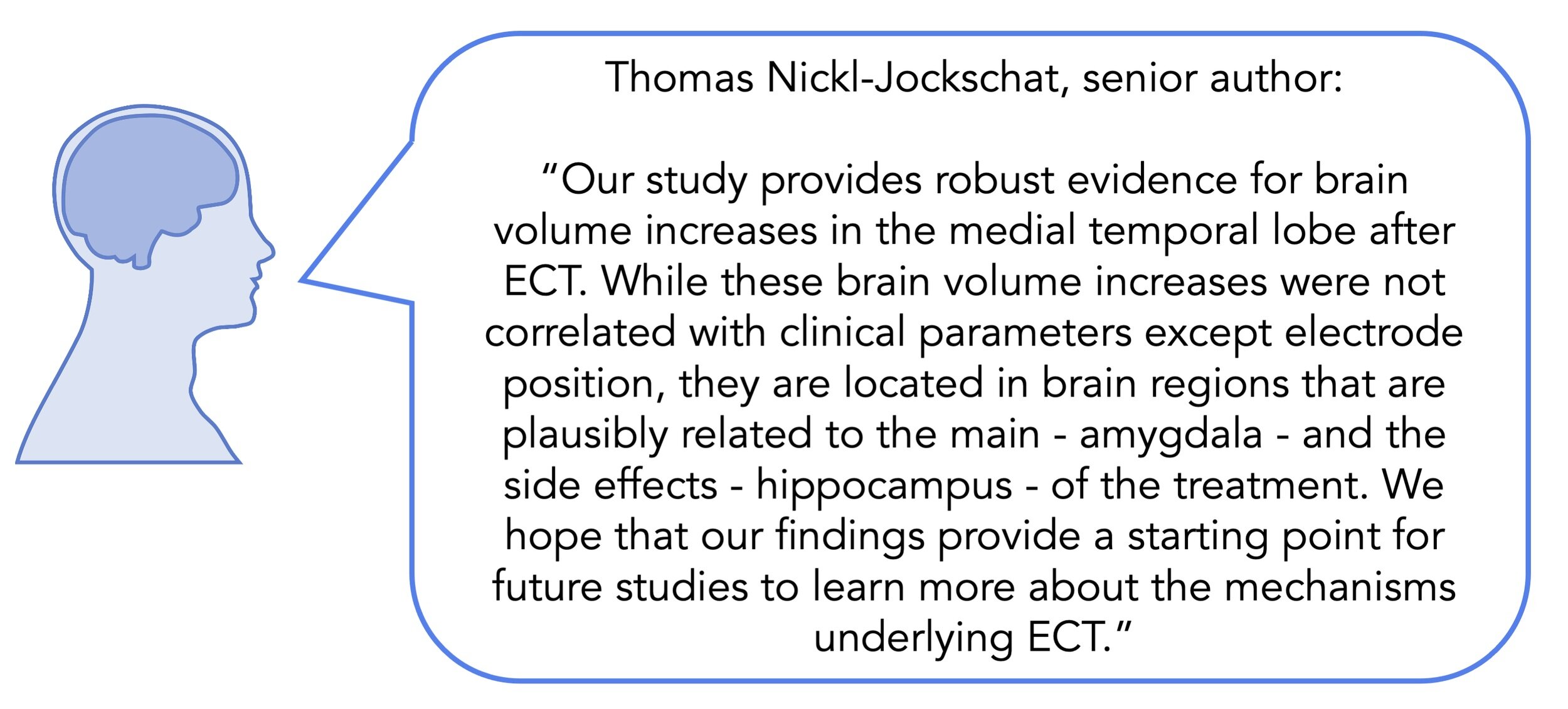
The authors identified 2 clusters within their dataset: a large cluster in the right hemisphere and a small cluster in the left hemisphere. The larger cluster was localized to the medial temporal lobe and mainly comprised the amygdala as well as a small portion of the hippocampus and basal forebrain. The smaller cluster was also localized to the amygdala but included the parahippocampal gyrus, hippocampus, and entorhinal cortex as well. Both clusters represented increases in grey matter volume. Next, the authors found that the cluster in the right hemisphere was mainly driven by studies that exclusively used right unilateral stimulations, with smaller contributions from bilateral and mixed stimulation paradigms. Conversely, the cluster in the left hemisphere was mainly driven by studies that used bilateral and mixed stimulations, which suggests that the position of the electrode during ECT may have a strong influence on the laterality of these findings. Other clinical or treatment parameters, such as age, gender, or treatment response did not have an influence on these brain structural changes. Finally, the authors corroborated their findings using the jackknife analysis and showed that there is evidence of bilateral spatial convergence in the amygdala and hippocampus across the studies involving ECT.  

Amanda (2).png

What’s the impact?

This is the first study to investigate brain structural changes during ECT using a coordinate-based meta-analysis of MRI studies involving ECT. The authors found evidence of a bilateral volume increase during ECT that was localized to the medial temporal lobe, particularly in the amygdala and hippocampus. In all, these findings are consistent with previous results from primary research studies and mega-analyses. These findings also help provide insight into the underlying mechanisms associated with treatment response following ECT. Future research is needed to better understand how volume changes might lead to a reduction in depression symptoms following ECT.
ECT_quote_June22.png

Janouschek et al. Meta-analytic Evidence for Volume Increases in the Medial Temporal Lobe After Electroconvulsive Therapy. Biological Psychiatry (2021). Access the original scientific publication here.
Does Sleep “Clean” Our Brains?

Post by Lani Cupo

Why do we spend so much of our life asleep?

An Irish proverb states: “A good laugh and a long sleep are the best cures in the doctor’s book.” We spend almost one-third of our lives asleep, but what makes sleep restorative, and why do we need so much of it? Sleep has many benefits like facilitating memory consolidation and emotion regulation, but today we focus on the role sleep plays in clearing the brain of neurotoxins that accumulate during waking hours. During daily functioning, the brain accumulates proteins such as β-amyloid (Aβ), α-synuclein, and tau over the course of waking hours. Accumulation of these proteins over the lifespan may contribute to brain pathology, so it is important that concentrations of these proteins are regulated. Recent evidence suggests that sleep may in part fill this role, helping to protect the brain by clearing the excess of these proteins.

What do we know?

Brain tissue is composed of three main components: neural cells, vasculature, and the interstitial system (ISS) referring to the space between cells and blood vessels. Most recent research on the brain focuses on cells such as neurons and glia, however, the ISS forms the microenvironment of the brain. It occupies 15-20% of total brain volume and plays a pivotal role in healthy brain functioning. Evidence from mice suggests that during sleep, interstitial volume can increase up to 60% allowing for increased flow between interstitial fluid and cerebrospinal fluid (CSF), the fluid in which the brain is floating. This might facilitate the improved clearance of toxins from brain tissue. While the mechanism allowing for the change in volume is still unknown, one hypothesis is that support cells known as astrocytes shrink during sleep, resulting in the observed volumetric changes.

To examine whether sleep facilitates the clearance of metabolites via CSF, one study in humans injected individuals with a CSF tracer they could image with magnetic resonance imaging (MRI) and investigated the impact of acute (one night) sleep deprivation on tracer clearance as a proxy for metabolite clearance. Following a night of sleep deprivation, tracer clearance was reduced, suggesting less effective clearance of neurotoxins. This finding is significant not only because it presents some of the first live human evidence, but also because the authors were able to assess clearance in deep structures within the brain.

During wakefulness, ISS contraction increases tissue resistance, reducing the influx of CSF. This potentially alters not only the clearance of excess neurotransmitters but also aggregates of proteins in the brain. Circadian rhythms, which help regulate sleep cycles, may also impact clearance by altering the permeability of the blood-brain barrier, the interface between circulating blood and the central nervous system. During sleep, this barrier becomes more porous, further impacting the clearance of proteins. Examining the clearance of the Aβ protein, one study in mice found the protein was cleared twice as fast during sleep as compared to wakefulness. This holds important implications for neurodegenerative disorders, as the accumulation of Aβ plaques is a hallmark of Alzheimer’s Disease (AD) pathology.

What are the implications for Alzheimer’s Disease?

Sleep is an important factor in the emergence of neurodegenerative disorders, such as AD and Parkinson’s Disease. When there is an imbalance between Aβ production and clearance in the brain, the protein can stick together causing aggregates, known as plaques, to form. Excess tau protein can also get stuck together forming “tangles”. The formation of Aβ plaques and tau tangles contribute to the loss of neurons and their connections. Similar to human studies, rodent models show that sleep deprivation elevates concentrations of Aβ, with concentrations increasing consistently over prolonged sleep deprivation. While an increased risk for AD has been associated with a shorter duration of sleep, the causal link between sleep deprivation and heightened risk for AD remains to be determined. It also remains unclear whether the mechanistic link between sleep disturbances and AD involves neurotoxin clearance.

The specific mechanism of toxin clearance from the brain is still unknown, although preliminary research implicates a specific water channel known as aquaporin-4 in the removal of interstitial waste. Recent studies implicate a brain region known as the locus coeruleus (LC) in the regulation of sleep - signaling from the LC is associated with states of wakefulness. This region displays volumetric abnormalities in AD, suggesting that it may be related to the pathophysiology of the disease.

What is the takeaway message?

During the time we sleep our brain tissues undergo changes that facilitate more efficient cleansing of the toxins and waste that naturally accumulate in our brains over the course of the day. This mechanism could underlie the observed association between neurological disorders like AD and sleep disturbance, however, it remains unclear whether sleep deprivations exacerbate AD pathology or if AD pathology exacerbates sleep disruption. Of course, if you don’t get enough sleep it does not mean that you will develop a neurological disorder, however, the research strongly suggests that sleep is a critical factor in brain health. Overall, the benefits of sleep are many-fold, and we are still learning exactly how sleep supports and protects our brain.


References

Albrecht, et al. Circadian Clocks and Sleep: Impact of Rhythmic Metabolism and Waste Clearance on the Brain. Trends in Neurosciences. (2018). Access the original scientific publication here.

Eide, et al. Sleep Deprivation Impairs Molecular Clearance from the Human Brain. Brain: Journal of Neurology. (2021). Access the original scientific publication here.

Goldstein & Walker. The role of sleep in emotional brain function. Annu Rev Clin Psychol. (2014). Access the original scientific publication here.

Huang, et al. Sleep, Major Depressive Disorder and Alzheimer’s Disease: A Mendelian Randomisation Study. Neurology. (2020). Access the original scientific publication here.

Lei, et al. The Brain Interstitial System: Anatomy, Modeling, in Vivo Measurement, and Applications. Progress in Neurobiology (2017). Access the original scientific publication here.

Mendelsohn & Larrick. Sleep Facilitates Clearance of Metabolites from the Brain: Glymphatic Function in Aging and Neurodegenerative Diseases. Rejuvenation Research (2013). Access the original scientific publication here.

Xie, et al. Sleep Drives Metabolite Clearance from the Adult Brain. Science (2013).Access the original scientific publication here.

Neuroinflammation Within Human COVID-19 Brains

Post by Lina Teichmann

What's the science?

A variety of neurological symptoms have been associated with COVID-19. For example, patients frequently experience loss of smell as well as headaches, fatigue, and memory impairments. This week in Immunity, Schwabenland and colleagues examined the effects of COVID-19 on the brain on a cellular, immunological, and anatomical level.

How did they do it?

Brain tissue of 25 COVID-19 patients was examined post-mortem and compared to brain tissue of three groups of control patients. These patients either (1) died of non-infectious causes which had little or no influence on the brain, or (2) had a history of severe respiratory diseases and were treated with extracorporeal membrane oxygenation, or (3) patients who had multiple sclerosis - an autoimmune disease of the central nervous system. The authors used imaging mass cytometry (IMC), a technique that allows for the spatial mapping and detection of immune populations in the brain. They examined the brain stem as well as the olfactory bulb in a subgroup of the patients as the olfactory bulb is the potential entry site for SARS-CoV-2.

What did they find?

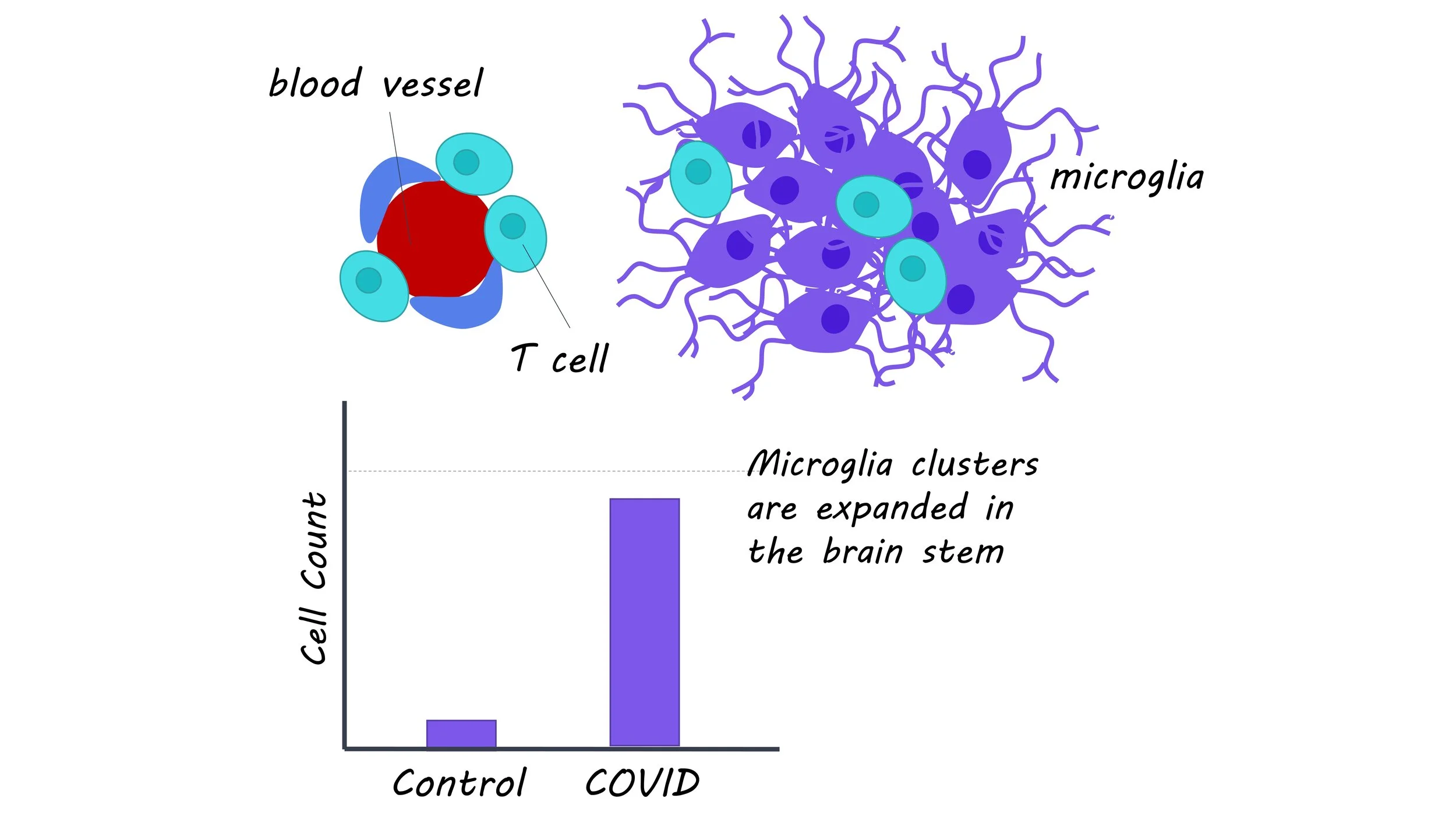
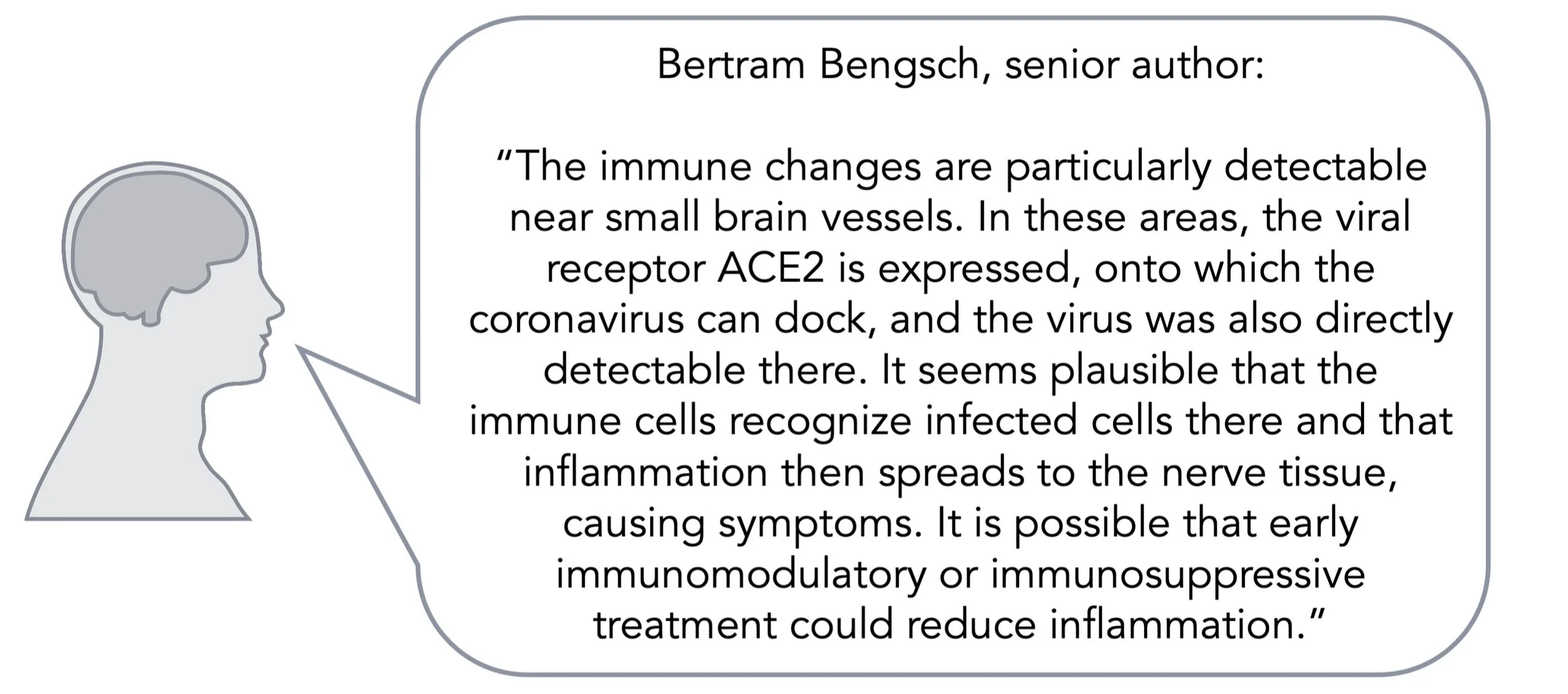
The results showed profound neuroinflammation in the brain tissue of COVID-19 patients with altered brain immune responses and associated neuronal damage, neither of which occurred in the control patient groups. Segmenting the IMC images showed that there were immune cell clusters of innate (non-specific immediate immune response) and adaptive (specific and long-lasting immune response) immune cells in COVID-19 patients that were not present in the brain tissue of the controls. The specific immune activation in COVID-19 brains consisted primarily of CD8 and CD4 T cells around blood vessels and clusters of macrophages and microglial cells that were associated with the disease. The specific characteristics of the immune infiltrate indicated microvascular injury in COVID-19 patients and a damaged blood-brain-barrier. In addition to vascular damage, the results also showed that the immune infiltration in COVID-19 patients was associated with axonal damage. Together, these results elucidate the specific inflammatory patterns of COVID-19 in the brain and indicate that the immune response in the central nervous system is particularly affected by the disease.

lina (1).jpg

What's the impact?

It is essential to understand the effects of SARS-CoV-2 on the body and brain. Schwabenland and colleagues identified neuroinflammatory responses triggered by COVID-19 and highlighted how the immune response is modulated due to the disease. These findings deepen our understanding of COVID-19 and offer new opportunities to develop treatments that could suppress neuroinflammation.

Bengsch_quote_June15.png

Schwabenland et al. Deep spatial profiling of human COVID-19 brains reveals neuroinflammation with distinct microanatomical microglia-T cell interactions. Immunity (2021). Access the original scientific publication here.