
The US Food and Drug Administration Approves Use of Aducanumab for Alzheimer’s Disease Treatment

Post by Shireen Parimoo

Treatments for Alzheimer’s disease

Alzheimer’s disease (AD) is a neurodegenerative illness characterized by the deposition of amyloid-β (Aβ) plaques and neurofibrillary tangles in the brain that lead to widespread neurodegeneration, resulting in dementia and eventual death. AD affects more than 20 million people in the world, and with a growing global aging population, it has become increasingly crucial to develop treatments that can stop or delay the progression of AD symptoms.

Over the decades, several drugs have been developed and tested in randomized clinical trials. The drugs that have previously been approved for treating symptoms of AD help regulate the level of neurotransmitters in the brain. For example, the drug Donepezil helps temporarily mitigate memory-related symptoms by preventing the breakdown of acetylcholine. So far, however, none of these drugs have been effective in preventing the progression of AD or treating the underlying neuropathology. In fact, no new drug has been approved by the United States Food and Drugs Administration (FDA) for AD treatment since 2003.

In The Lancet Neurology, Lon Schneider provides an overview of a novel AD drug – aducanumab – created by the company Biogen. Schneider outlines the mechanism by which the drug targets AD pathology along with the history of its development. Aducanumab is a monoclonal antibody that is markedly different from other AD drug candidates because it directly binds to and clears out Aβ deposits in the brain, thereby targeting the hypothesized neuropathological mechanism underlying AD progression.

Is aducanumab effective?

Early randomized clinical trials showed that aducanumab injections over a year reduced Aβ levels in patients with prodromal or mild AD, though the clinical effects were less conclusive. Following up on these promising results, 1650 patients were enrolled in two separate multi-year phase 3 trials in 2015 to determine the efficacy of aducanumab in reducing the clinical symptoms of AD.

Despite initially promising results, several factors halted further testing of the drug. Firstly, there were issues with uneven participant dropout, missed doses, and poor compliance with the treatment protocol between the placebo and drug groups. Secondly, futility analyses conducted to monitor the interim efficacy of the drug showed mixed results and undesirable side effects like brain swelling. Specifically, differences in clinical symptoms between patients taking aducanumab and placebo only emerged in one of the trials. Moreover, it is unclear whether the differences were due to the drug’s efficacy in improving symptoms or because of worsening symptoms in the placebo group.

Finally, some of the positive results were observed in patients who received high doses of aducanumab, were genetically less at risk for experiencing side effects, and were highly compliant with the treatment protocol. In contrast, the placebo group consisted of more patients who were genetically predisposed to developing side effects and experienced greater clinical decline. Together, these factors posed a challenge to the validity of the findings from the clinical trials.

What’s happening now?

In June 2021, the FDA approved aducanumab under its accelerated approval pathway. This decision came after the FDA advisory committee had initially voted against approving the drug in November 2020. The accelerated approval approach is typically taken when the benefits provided by a drug under consideration outweigh those of existing treatments and are likely to have desirable long-term effects as well.

According to the FDA, their primary reason for approving aducanumab was the reliable dose- and time-dependent reduction in Aβ plaques. It is hoped that in turn, a lower Aβ burden will reduce further clinical decline, even though the evidence for this effect is currently uncertain. The next steps include conducting phase 4 clinical trials to confirm the clinical benefits of aducanumab in AD patients.


Schneider, L. A resurrection of aducanumab for Alzheimer’s disease. Neurology (2020). Access the original scientific publication here.

https://www.fda.gov/drugs/news-events-human-drugs/fdas-decision-approve-new-treatment-alzheimers-disease
Dopamine and Brain Network Dynamics in Schizophrenia

Post by Lincoln Tracy

What's the science?

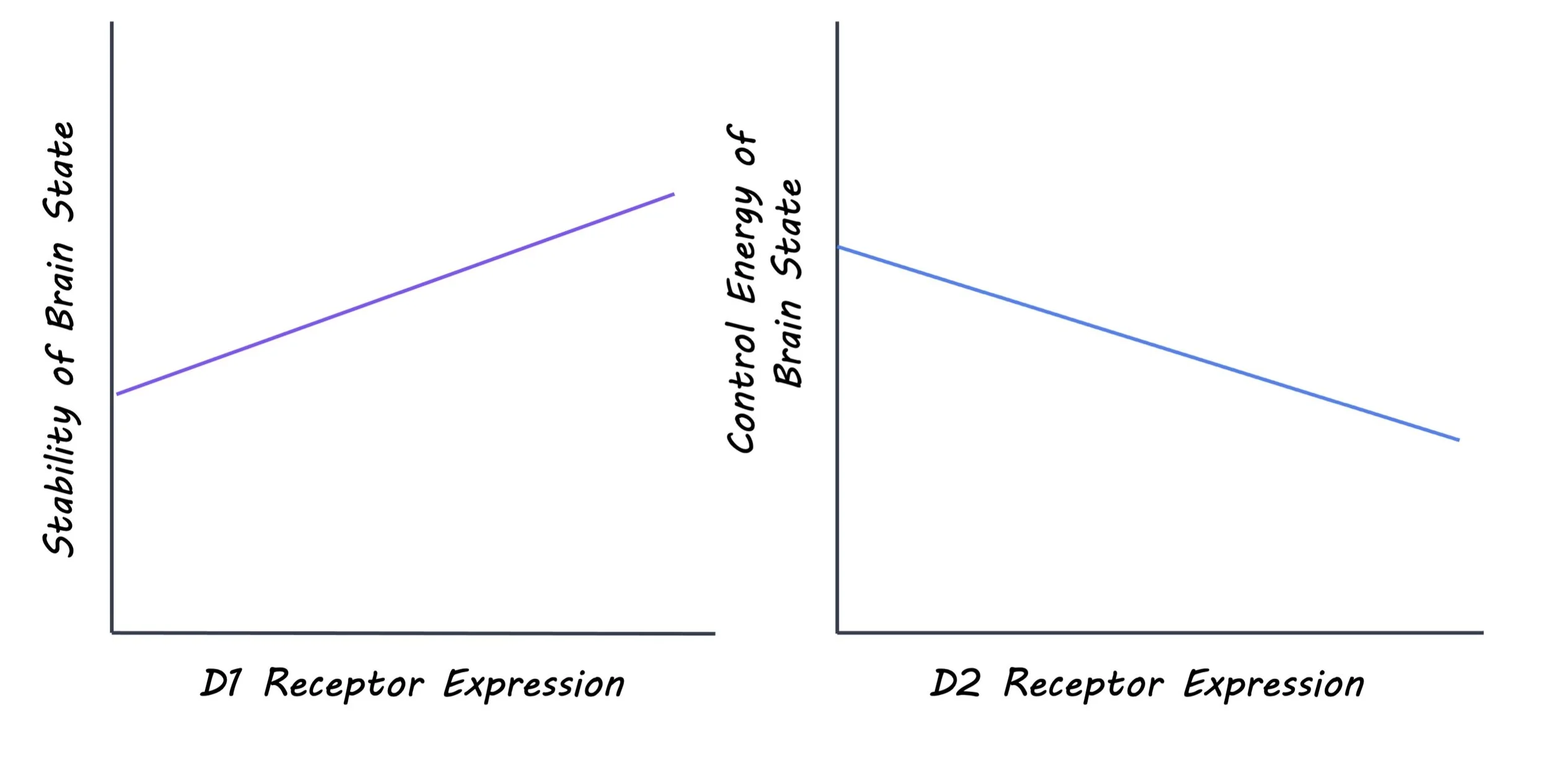
Working memory allows us to maintain and revise cognitive representations to successfully complete tasks. Dopamine D1 and D2 receptors are responsible for modulating the prefrontal neurons required for working memory in a dual-state manner; D1 receptors maintain cognitive representations while D2 receptors enable flexible shifts between different cognitive states. Evidence suggests that truly functional working memory requires a structured transition through global brain states and reconfiguration of interactions throughout the brain, but it is unclear how the brain guides such transitions and interactions. The network control theory (NCT) has been identified as a promising tool to study such questions. This week in Nature Communications, Braun and colleagues used NCT to study the stability of whole-brain neural states (measured by functional magnetic resonance imaging; fMRI) during a well-established working memory task.

How did they do it?

First, the authors recruited 178 healthy individuals and had them complete an N-back task while undergoing fMRI. The authors were specifically interested in comparing brain states and individual brain activity patterns under a working memory condition (i.e., 2-back) and an attentional control condition (0-back). Using these states, they examined how the brain transitioned between different cognitive states between the two task conditions and how much control energy was required to maintain state stability within a specific task. 

Second, the authors tested the system’s sensitivity to dopaminergic manipulation and whether interfering with D2-related signaling would increase the energy required to switch between the two brain states. A second sample of 16 healthy controls were administered amisulpride, a selective D2 receptor antagonist, before completing the N-back working memory task. 

Finally, the authors examined differences in brain state stability and control state transition ability by recruiting 24 individuals with schizophrenia (a condition involving dopamine dysfunction and working memory deficits) and a matched sample of healthy control participants. The N-back working memory task was completed again during an fMRI scan.

What did they find?

First, the authors found the more cognitively demanding 2-back brain state was less stable than the 0-back control state. The stability of the 2-back state was associated with higher working memory accuracy. Transitioning into the 2-back state from the 0-back required more control energy than transitioning in the opposite direction. The prefrontal and parietal cortices were found to steer the transition between states, while the default mode network was specifically implicated in transitioning to the more cognitively demanding state. Second, they found greater control energy was needed to transition between the N-back task states following amisulpride administration. There was no effect of amisulpride on brain state stability. Finally, they found brain state stability was reduced in individuals with schizophrenia during the 2-back, but not the 0-back, working memory task. Schizophrenic individuals required greater control energy for transitioning between the 0- and 2-back tasks. Together these results suggest schizophrenic individuals have a more diverse brain energy landscape, making the system more challenging to manage appropriately.

Dopamine_SZ.png

What's the impact?

These findings reveal the critical role dopamine signaling plays in steering whole-brain network dynamics (i.e., state stability and switching) during working memory and how this process is altered in schizophrenia. Importantly, this steering is done in a dual-state manner, where D1 and D2 receptors have unique but cooperative functions. Further research and consideration is required to elucidate the specific cognitive processes underlying brain activity and how other patient factors (e.g., schizophrenia severity, medication use, etc.) may influence network dynamics.

Braun_quote_June15.png

Braun et al. Brain network dynamics during working memory are modulated by dopamine and diminished in schizophrenia. Nature Communications (2021).Access the original scientific publication here.

Predicting Preference for Art Through Low- and High-Level Features

Post by Leanna Kalinowski

What's the science?

We are surrounded by visual art, from classic paintings in a museum to photographs on social media. While navigating through this art-filled world, we constantly make judgements about whether we like or dislike a particular piece. However, the process by which we perceive art is unclear. Do prior experiences with certain features of the piece of art shape our preferences, or are the visual properties of an image more important? The answer is that both are likely important. Computational methods have previously been applied to tease apart how we develop different preferences. However, in the case of visual art, this process is much more challenging due to the visual complexity and variation of some art. This week in Nature Human Behavior, Iigaya and colleagues developed and tested a computational framework to investigate how preferences for visual art are formed.

How did they do it?

The authors first divided the properties of an image into two categories: ‘low-level’ and ‘high-level’. ‘Low-level’ (i.e., bottom-up) features included those derived from an image’s statistics and visual properties, such as hue and brightness, while ‘high-level’ (i.e., top-down) features included those that require human judgement, such as realism and emotion. Participants were asked to report how much they liked various paintings and photographs on a four-point scale, and the authors used these ratings to determine the extent to which they could predict art preferences. They also applied machine learning: a deep convolutional neural network (DCNN) that had been trained for object recognition to predict the pattern by which these visual features emerge when the brain processes visual images.

What did they find?

By engineering a linear feature summation (LFS) model, the authors first observed that visual preference for art can be predicted through a combination of low- and high-level features. This model predicted preferences for both paintings and photographs, suggesting that the features used for driving visual preferences may be universal across different mediums. They also found that their model may represent a biologically plausible computation, as their DCNN model mirrored the results from the LFS model above. Specifically, when the authors did not specify certain features for the DCNN as they did with the LFS model, they found that the DCNN model could learn to predict all of those features on its own.

leanna (1).png

What's the impact?

The findings here uncover a mechanism through which art preferences can be predicted, shedding light on how these preferences are formed in the brain. These tools have the potential to influence the arts and media industry by predicting which works of art may be more likely to be preferred, and could be extended to predict judgements and perceptions beyond art.   

Iigaya_quote.png

Iigaya et al. Aesthetic preference for art can be predicted from a mixture of how- and high-level visual features. Nature Human Behaviour (2021) Access the original scientific publication here.