
Dopamine and Brain Network Dynamics in Schizophrenia

Post by Lincoln Tracy

What's the science?

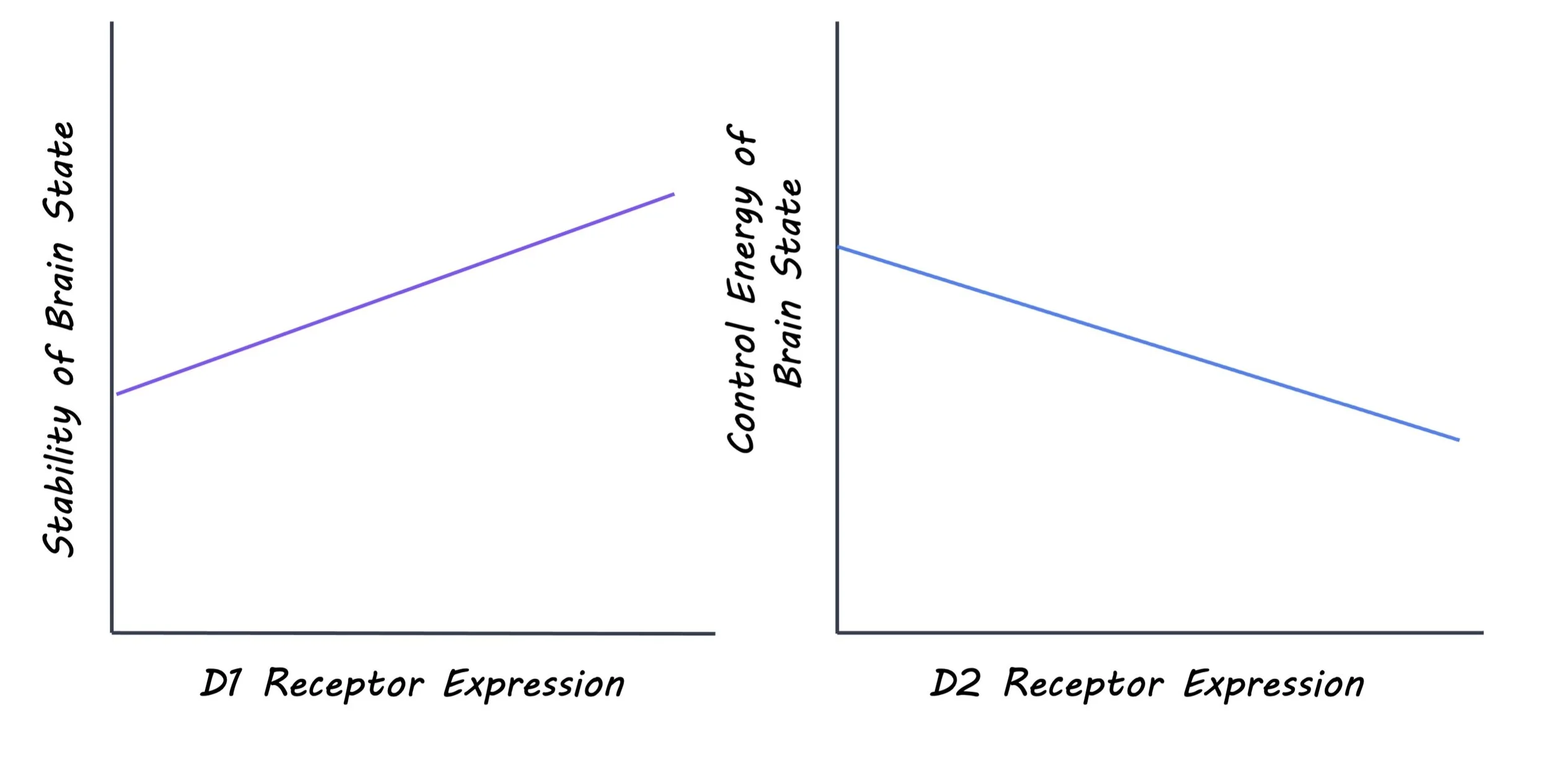
Working memory allows us to maintain and revise cognitive representations to successfully complete tasks. Dopamine D1 and D2 receptors are responsible for modulating the prefrontal neurons required for working memory in a dual-state manner; D1 receptors maintain cognitive representations while D2 receptors enable flexible shifts between different cognitive states. Evidence suggests that truly functional working memory requires a structured transition through global brain states and reconfiguration of interactions throughout the brain, but it is unclear how the brain guides such transitions and interactions. The network control theory (NCT) has been identified as a promising tool to study such questions. This week in Nature Communications, Braun and colleagues used NCT to study the stability of whole-brain neural states (measured by functional magnetic resonance imaging; fMRI) during a well-established working memory task.

How did they do it?

First, the authors recruited 178 healthy individuals and had them complete an N-back task while undergoing fMRI. The authors were specifically interested in comparing brain states and individual brain activity patterns under a working memory condition (i.e., 2-back) and an attentional control condition (0-back). Using these states, they examined how the brain transitioned between different cognitive states between the two task conditions and how much control energy was required to maintain state stability within a specific task. 

Second, the authors tested the system’s sensitivity to dopaminergic manipulation and whether interfering with D2-related signaling would increase the energy required to switch between the two brain states. A second sample of 16 healthy controls were administered amisulpride, a selective D2 receptor antagonist, before completing the N-back working memory task. 

Finally, the authors examined differences in brain state stability and control state transition ability by recruiting 24 individuals with schizophrenia (a condition involving dopamine dysfunction and working memory deficits) and a matched sample of healthy control participants. The N-back working memory task was completed again during an fMRI scan.

What did they find?

First, the authors found the more cognitively demanding 2-back brain state was less stable than the 0-back control state. The stability of the 2-back state was associated with higher working memory accuracy. Transitioning into the 2-back state from the 0-back required more control energy than transitioning in the opposite direction. The prefrontal and parietal cortices were found to steer the transition between states, while the default mode network was specifically implicated in transitioning to the more cognitively demanding state. Second, they found greater control energy was needed to transition between the N-back task states following amisulpride administration. There was no effect of amisulpride on brain state stability. Finally, they found brain state stability was reduced in individuals with schizophrenia during the 2-back, but not the 0-back, working memory task. Schizophrenic individuals required greater control energy for transitioning between the 0- and 2-back tasks. Together these results suggest schizophrenic individuals have a more diverse brain energy landscape, making the system more challenging to manage appropriately.
Dopamine_SZ.png

What's the impact?

These findings reveal the critical role dopamine signaling plays in steering whole-brain network dynamics (i.e., state stability and switching) during working memory and how this process is altered in schizophrenia. Importantly, this steering is done in a dual-state manner, where D1 and D2 receptors have unique but cooperative functions. Further research and consideration is required to elucidate the specific cognitive processes underlying brain activity and how other patient factors (e.g., schizophrenia severity, medication use, etc.) may influence network dynamics.
Braun_quote_June15.png

Braun et al. Brain network dynamics during working memory are modulated by dopamine and diminished in schizophrenia. Nature Communications (2021).Access the original scientific publication here.

Predicting Preference for Art Through Low- and High-Level Features

Post by Leanna Kalinowski

What's the science?

We are surrounded by visual art, from classic paintings in a museum to photographs on social media. While navigating through this art-filled world, we constantly make judgements about whether we like or dislike a particular piece. However, the process by which we perceive art is unclear. Do prior experiences with certain features of the piece of art shape our preferences, or are the visual properties of an image more important? The answer is that both are likely important. Computational methods have previously been applied to tease apart how we develop different preferences. However, in the case of visual art, this process is much more challenging due to the visual complexity and variation of some art. This week in Nature Human Behavior, Iigaya and colleagues developed and tested a computational framework to investigate how preferences for visual art are formed.

How did they do it?

The authors first divided the properties of an image into two categories: ‘low-level’ and ‘high-level’. ‘Low-level’ (i.e., bottom-up) features included those derived from an image’s statistics and visual properties, such as hue and brightness, while ‘high-level’ (i.e., top-down) features included those that require human judgement, such as realism and emotion. Participants were asked to report how much they liked various paintings and photographs on a four-point scale, and the authors used these ratings to determine the extent to which they could predict art preferences. They also applied machine learning: a deep convolutional neural network (DCNN) that had been trained for object recognition to predict the pattern by which these visual features emerge when the brain processes visual images.

What did they find?

By engineering a linear feature summation (LFS) model, the authors first observed that visual preference for art can be predicted through a combination of low- and high-level features. This model predicted preferences for both paintings and photographs, suggesting that the features used for driving visual preferences may be universal across different mediums. They also found that their model may represent a biologically plausible computation, as their DCNN model mirrored the results from the LFS model above. Specifically, when the authors did not specify certain features for the DCNN as they did with the LFS model, they found that the DCNN model could learn to predict all of those features on its own.

leanna (1).png

What's the impact?

The findings here uncover a mechanism through which art preferences can be predicted, shedding light on how these preferences are formed in the brain. These tools have the potential to influence the arts and media industry by predicting which works of art may be more likely to be preferred, and could be extended to predict judgements and perceptions beyond art.   

Iigaya_quote.png

Iigaya et al. Aesthetic preference for art can be predicted from a mixture of how- and high-level visual features. Nature Human Behaviour (2021) Access the original scientific publication here.

How Much Effort Does it Take to Just Listen?

Post by Anastasia Sares

What is listening effort?

We don’t often think about how much of our mental space we reserve for listening to speech—for many people, it feels effortless. However, there are often obstacles: background noises, distracting conversations, or age-related hearing loss, to name a few. According to some models, we have a limited amount of mental resources, and the more we spend trying to decipher speech, the less we have left over for critical thinking, memory, and other high-level processing. However, a nebulous concept such as “effort” isn’t easy to quantify, and scientists have tried a number of approaches, from self-report questionnaires to full-sized brain scanners. Here’s a run-down of all the techniques used to measure listening effort.

Using self-report measures

One way to measure effort on a task is to ask people about it directly. This is the simplest method, but it can get tricky because people may have different interpretations of what “effort” means. To be more precise, some recommend breaking down effort into sub-components, like mental effort, physical effort, time pressure, or frustration. The NASA task load index is one such breakdown. However, a recent study suggests that we should ask about tiredness, a question that is not present in the NASA task load index. In that study, people’s tiredness ratings during speech listening were shown to correlate with the next method of measuring effort: pupil size.

Using the size of the pupil (pupillometry)

Our pupils dilate under states of mental arousal or effort, and specifically when listening conditions are worsened. Using video recordings of the eye or special glasses with infra-red cameras, we can measure the size of a person’s pupil as they hear and respond to sounds—this is called pupillometry. It is less subjective than self-report, and we can evaluate the effort someone expends on a task without forcing them to stop and reflect. However, pupillometry currently needs specific lighting conditions, and sometimes the pupil response can plateau in complex tasks. So, there are still some challenges to using this method.

Using brain activity (EEG, fMRI, fNIRS)

Electroencephalography, or EEG, measures electrical activity in the brain and can be used as another way to tap into listening effort. Among other EEG measures, the N100 response to sound is one index of this effort. This automatic response happens 100 milliseconds after the onset of a sound, and it becomes bigger when the speech is made less intelligible. Another EEG measure of effort is alpha power. If we take the activity in the alpha range and sum up its power over the course of an experiment, we can see when more effort is being expended.

Blood flow to different brain areas has long been used as a proxy for brain activity in those areas. In particular, blood flow to the left inferior frontal region of the brain (close to the temples) and the superior temporal gyrus (just above the ears) can give us a hint about how much effort is being exerted. This can be done in a magnetic scanner that detects the magnetic properties of blood (fMRI) or using a cap with small infra-red lights pointed at the scalp (fNIRS). These blood flow methods are a little slower than EEG, but fMRI, in particular, can pinpoint the location of activity in the brain with better accuracy, and fNIRS is advantageous because it doesn’t interfere with hearing aids or other devices.

What’s the bottom line?

Hearing is a crucial aspect of health: hearing loss has a large societal burden and may contribute to the risk of dementia later in life. Armed with multiple tools to measure listening effort, we can study how it varies in different conditions and populations, and better understand the link between hearing and cognition.

References

Pichora-Fuller, M. K. et al. Hearing Impairment and Cognitive Energy. Ear Hear. 37, 5S-27S (2016).

Hart, S. G. & Staveland, L. E. Development of NASA-TLX (Task Load Index): Results of Empirical and Theoretical Research. Adv. Psychol. 52, 139–183 (1988).

McGarrigle, R., Rakusen, L. & Mattys, S. Effortful listening under the microscope: Examining relations between pupillometric and subjective markers of effort and tiredness from listening. Psychophysiology 58, 1–22 (2021).

Zekveld, A. A., Kramer, S. E. & Festen, J. M. Pupil response as an indication of effortful listening: The influence of sentence intelligibility. Ear Hear. 31, 480–490 (2010).

Koo, M. et al. Effects of noise and serial position on free recall of spoken words and pupil dilation during encoding in normal-hearing adults. Brain Sci. 11, 1–14 (2021).

Zhang, Y., Lehmann, A. & Deroche, M. Disentangling listening effort and memory load beyond behavioural evidence: Pupillary response to listening effort during a concurrent memory task. (2020). doi:10.1101/2020.05.04.076588

Obleser, J. & Kotz, S. A. Multiple brain signatures of integration in the comprehension of degraded speech. Neuroimage 55, 713–723 (2011).

Obleser, J., Wöstmann, M., Hellbernd, N., Wilsch, A. & Maess, B. Adverse listening conditions and memory load drive a common alpha oscillatory network. J. Neurosci. 32, 12376–12383 (2012).

Wild, C. J. et al. Effortful listening: The processing of degraded speech depends critically on attention. J. Neurosci. 32, 14010–14021 (2012).

Kousaie, S. et al. Language learning experience and mastering the challenges of perceiving speech in noise. Brain Lang. 196, 104645 (2019).

Zekveld, A. A., Heslenfeld, D. J., Johnsrude, I. S., Versfeld, N. J. & Kramer, S. E. The eye as a window to the listening brain: Neural correlates of pupil size as a measure of cognitive listening load. Neuroimage 101, 76–86 (2014).

Rovetti, J., Goy, H., Pichora-Fuller, M. K. & Russo, F. A. Functional Near-Infrared Spectroscopy as a Measure of Listening Effort in Older Adults Who Use Hearing Aids. Trends Hear. 23, 233121651988672 (2019).

Ford, A. H. et al. Hearing loss and the risk of dementia in later life. Maturitas. 112, 1–11 (2018).