Neural Mechanisms Involved in the Extinction of Long-Term Trauma

Post by Lina Teichmann

What's the science?

Traumatic experiences often result in enduring memories of fear. Exposure therapy is a common treatment to overcome trauma by exposing patients to the context of fear-inducing memories in a safe environment. However, it is known that exposure therapy is less successful if the traumatic experience occurred a long time ago. This week in Nature Neuroscience, Silva and colleagues used a fear extinction paradigm with mice to test how neural mechanisms involved in overcoming fear differ depending on the age of the traumatic memory.

How did they do it?

To mimic the trauma, the authors placed mice in a conditioning chamber, where they received electric shocks to their paws. After either 1 day or 30 days, the mice were re-exposed to the same chamber without receiving shocks (recall) with subsequent re-exposing events over several days (fear extinction). When the animals were re-exposed to the traumatic context, the fear response was behaviorally quantified by examining freezing responses (prolonged absences of motion). Viral tracing, neuronal activity mapping, fiber photometry, and chemo- and optogenetics were used to examine the effect of long-term fear extinction on neural circuitry. In particular, the authors examined the functional responses to long- and short-term fear extinction in infralimbic cortex to basolateral amygdala and thalamic nucleus reuniens to basolateral amygdala pathways.

What did they find?

To overcome trauma, fear-evoking contexts have to be newly associated with safety. The results show that the neural mechanisms underlying this type of fear extinction depend on whether the fear-evoking experience occurred recently or a long time ago. While direct connections from the infralimbic cortex to the basolateral amygdala are critical for recent fear extinction, long-term fear extinction requires the recruitment of an additional pathway. In particular, when overcoming long-term fear, fear-related information is sent upstream from the infralimbic cortex via the thalamic nucleus reuniens to the basolateral amygdala. The behavioral expression of fear – freezing – was modulated by the activity in the thalamic nucleus reuniens. The activity in the nucleus reuniens peaked just before the freezing response ended and the freezing length could be manipulated by artificially increasing or decreasing activity in this area. This finding suggests that activity in the thalamic nucleus reuniens plays a role in learning to associate safety with a context that initially evoked fear.

Fear_memories_June1.png

What's the impact?

Traumatic memories are often long-lasting and can lead to mental disorders such as post-traumatic stress disorder. Silva and colleagues show that the time that has passed since a fear-evoking event modulates neural mechanisms involved in overcoming trauma. These findings improve our understanding of long-lasting traumatic memories and set the stage for future research into how we can weaken traumatic associations.   
Graff_quote_June1.png

Silva et al. A thalamo-amygdalar circuit underlying the extinction of remote fear memories. Nature Neuroscience (2021).Access the original scientific publication here.
Experience Replay is Associated with Efficient Non-local Learning

Post by Andrew Vo

What's the science?

When we make decisions, we often rely on previously learned relationships between actions and their outcomes. Although it is relatively easy to assign a value to an action when they are experienced close together in time and space (local), it becomes more challenging to do so when they are further apart (non-local). It has been hypothesized that non-local learning is achieved via a model-based approach such as ‘experience replay’, in which a learned map of the environment is used to link local rewards to non-local actions. Direct evidence for such a mechanism in humans has yet to be established, however. This week in Science, Liu and colleagues used a novel decision-making task and non-invasive brain imaging to test how experience replay helps achieve non-local learning.

How did they do it?

To test their hypothesis, the authors designed a decision-making task that separated local and non-local learning. On each trial, the participant was presented with one of three starting arms. Each arm contained two paths, between which the participant would choose. Each path was composed of a sequence of three stimuli followed by a reward outcome. Critically, the two possible outcomes that were reachable in each arm were also shared across all starting arms. In this way, participants could use the learned outcome in the current arm (local) to inform and update their choices when encountering the other two starting arms (non-local), in a model-based approach.

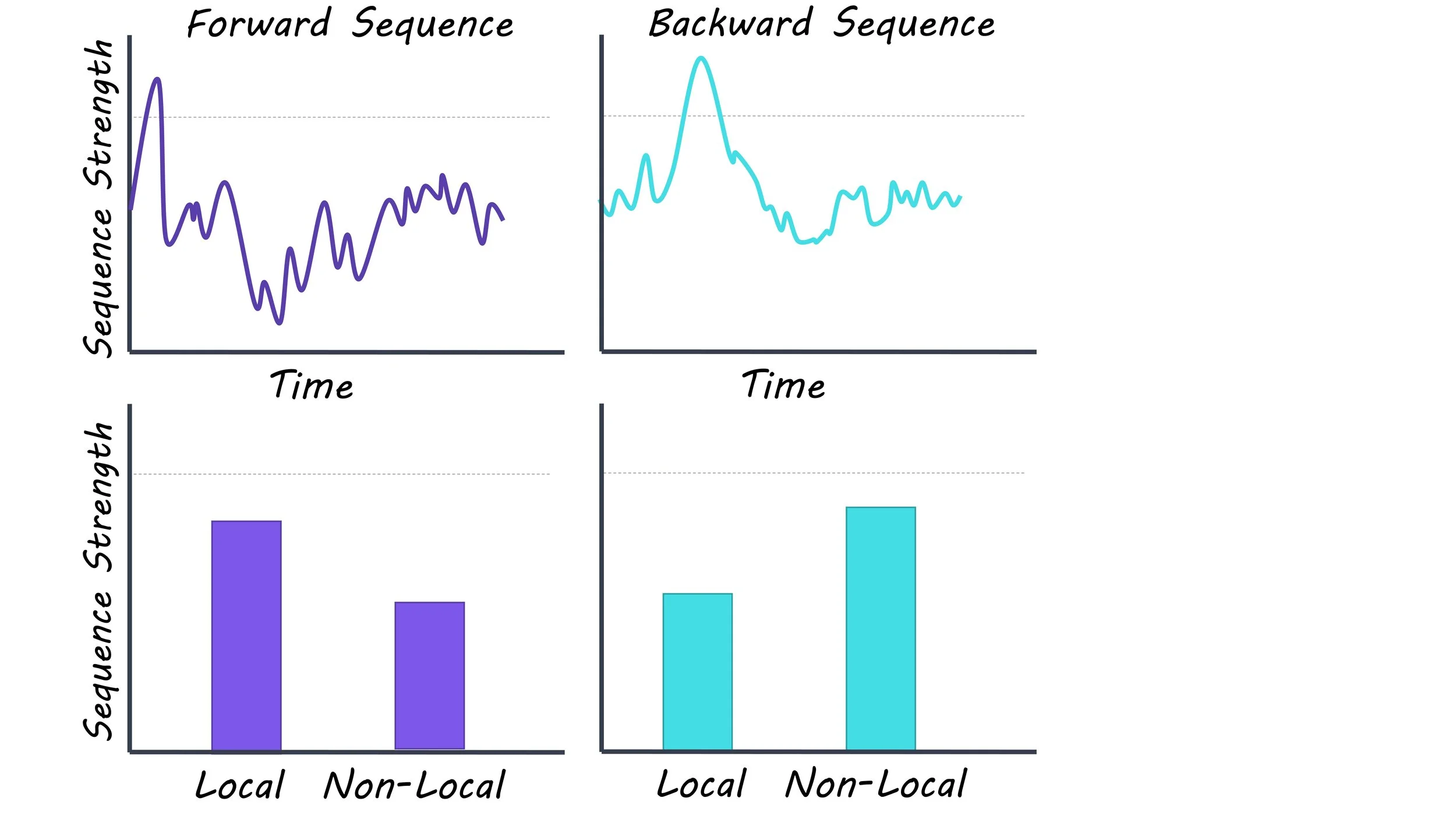
To measure neural replay, the authors used magnetoencephalography (MEG) to record fast whole-brain activity as participants performed the task. Replay was defined as the reactivation of a sequence at the time of reward receipt, which could occur in both forward (i.e., from the beginning of a path sequence to the eventual outcome) and backward (i.e., from the outcome at the end of a path sequence towards the beginning) directions. They also examined how neural replay was prioritized for non-local experiences based on their utility for future decisions. This utility was determined by the gain (i.e., how informative is this current reward for improving my choice at this arm) and the need (i.e., how frequently will this arm be visited in the future) of each experience. These two task features were manipulated by changing the reward and arm probabilities, respectively, across trials.

What did they find?

When participants encountered the same starting arm as before, they were more likely to favor the path that was previously rewarded, indicative of direct, model-free learning. This local learning was found to transfer to non-local experiences, as participants would favor the path leading to a previously rewarded outcome even when it was presented in a different starting arm. Using computational modeling, the authors found that values of non-local paths were updated to a similar extent as those of local paths, and learning rates were higher for non-local paths with greater priority (higher gain and need).

andrew (3).jpg

Examining MEG recordings, the authors observed two types of neural replay occurring after reward receipt: (1) a fast, forward replay that peaked at 30-ms lag, and (2) a slower, backward replay that peaked at 160-ms lag. The forward replay was associated with local actions and an increase in ripple frequency power, whereas the backward replay preferentially encoded non-local actions. Computational modeling revealed that only the backward replay was associated with efficient non-local learning. Similarly, only the backward replay was related to the utility (higher gain and need) of non-local experiences.

What's the impact?

In summary, this study revealed that backward replay serves as a neural mechanism for non-local learning and is prioritized based on utility for future decisions. The results here build upon model-based reinforcement learning theories largely tested in rodents and extend them to human behavior. They contribute to our understanding of how the brain might bridge the gap between direct and indirect experiences to guide our decisions.

Liu_quote_June1.png

Liu et al. Experience replay is associated with efficient nonlocal learning. Science (2021). Access the original scientific publication here.
How Neural Activity is Organized During Sleep

Post by Lani Cupo

What's the science?

During sleep, the hippocampus is relied upon to consolidate experiences into long-term memories by synchronizing subcortical and cortical activity through different patterns of neuronal firing. By examining patterns of brain activity during sleep, researchers can investigate how communication occurs between distant regions, coordinating wide-spread activity. This week in PNAS, Skelin and colleagues probe the synchronization of activity between the hippocampus, subcortical structures, and cortex during sleep in human participants, examining the role of the hippocampus in memory consolidation.

How did they do it?

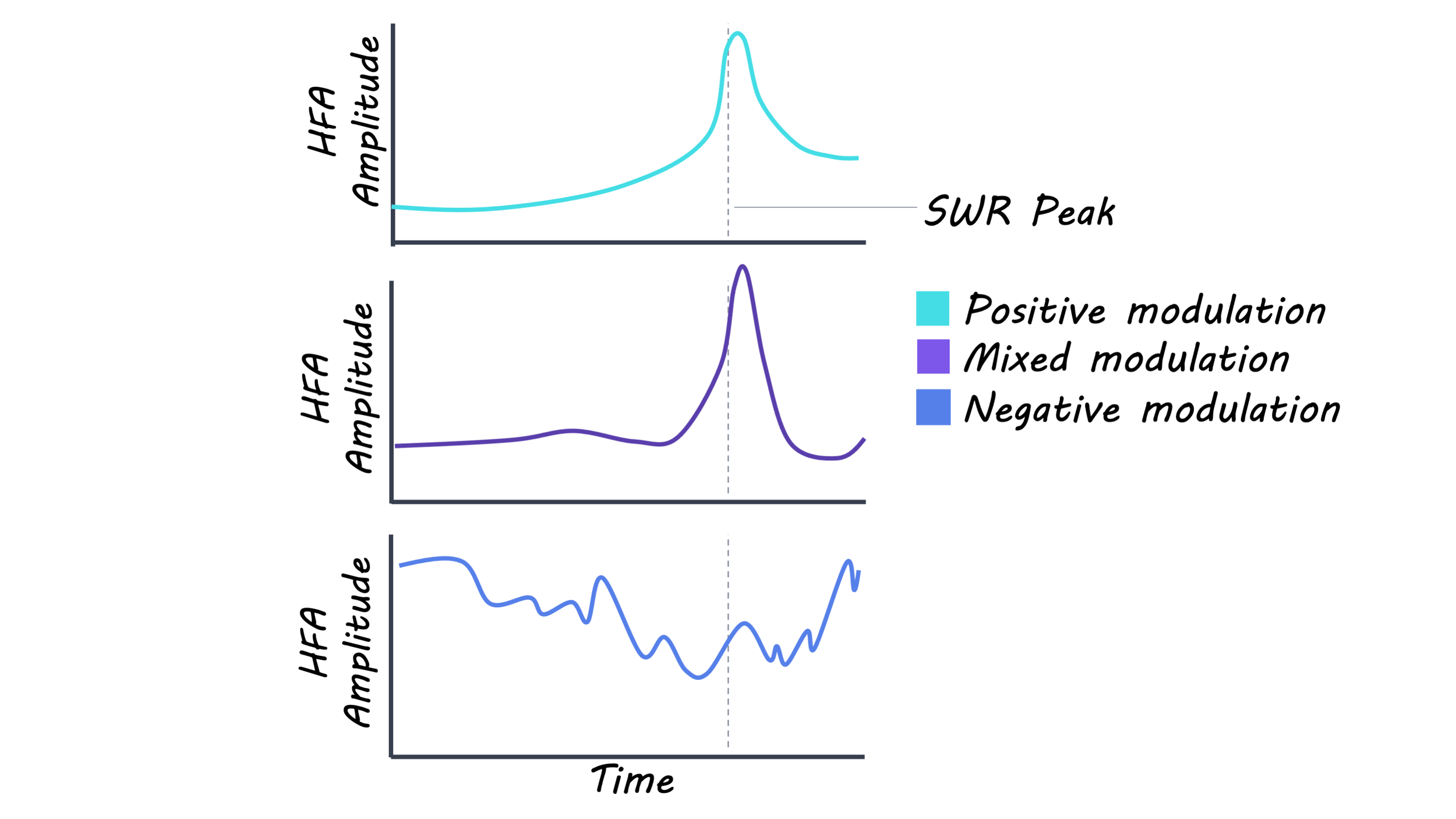
In order to assess brain activity during sleep, data from electrodes implanted into the brains of twelve participants with epilepsy for the purpose of seizure evaluation was obtained. While the participants slept, the electrodes recorded local brain activity (intracranial electroencephalography, iEEG), in the hippocampus, and its target regions, including the amygdala, temporal lobe, and frontal cortex. Two precise patterns of activity were identified within the overnight recordings. These included hippocampal sharp-wave ripples (SWRs), which are characterized by large, fast waves of activity (80-150 Hz), and high frequency activity (HFA; 70-200 Hz) in the target regions. HFA was previously shown to reflect the spiking activity in the electrode vicinity.

First, the researchers paired time series from each electrode in the hippocampus that contained at least 100 SWRs overnight with target sites acquired outside of the hippocampus. Each target site was identified as HFA+ if the HFA level was modulated during SWR or HFA- if it was not. This allowed the researchers to assess whether SWRs positively or negatively modulated HFA in target regions. Second, the researchers expected that SWRs would interact with slow-wave activity (SWA) or sleep spindles in target regions to modulate HFA, a hypothesis that they investigated by calculating synchrony between hippocampal SWRs and regional SWA, before correlating synchrony with the strength of HFA modulation. Finally, the researchers predicted that correlations between HFA amplitude across targets would indicate that modules of brain regions were functionally connected.

What did they find?

The authors first found that the most common modulations that occur simultaneously with SWRs are positive-modulations ipsilateral (in the same hemisphere) to the hippocampal activity in the temporal and amygdala regions of interest. This implies that SWRs in the hippocampus may play a role in stimulating neuronal activity predominantly in the amygdala and temporal lobe, especially in the same hemisphere of the brain.

The researchers also found that there was a consistent relationship between hippocampal SWRs phase-locking to SWA or sleep spindles in subcortical and cortical structures and HFA modulation in the same structures. These findings imply that SWA/spindles may play an important role in the SWRs modulation of HFA, and are involved in consolidating new memories. Interestingly, SWR-SWA coupling is present bilaterally (in both hemispheres), while the SWR-spindle coupling is present only in the brain hemisphere ipsilateral to SWR origin.

Lani_img_may25.png

Regarding their final hypothesis, the findings suggest that slow waves are synchronized across brain regions that are anatomically distinct, providing a possible mechanism for the functional association of distributed memory traces.

What's the impact?

This study found an interaction between hippocampal SWRs and subcortical/cortical slow waves plays a role in modulating HFA of specific regions—especially the amygdala and temporal lobe. Simply, the activity of hippocampal neurons during sleep acts in concert with distant populations of neurons to coordinate the consolidation of memories. The uncommon opportunity to study this human population with implanted electrodes lends deeper insight into how distributed memory traces are formed during sleep.

Skelin_quote_may25.png

Skelin et al. Coupling between slow-waves and sharp-wave ripples organizes distributed neural activity during sleep in humans. PNAS (2021). Access the original scientific publication here.