The Role of Self-Talk in Sports
Post by Shireen Parimoo
What is self-talk?
Self-talk refers to our inner dialogue, consisting of statements we say to ourselves, either in our mind or out loud. Most of us use self-talk in our lives, like giving ourselves a pep talk before a job interview or a date. This practice helps us appraise and regulate our thoughts and emotions and can help reduce stress and anxiety in certain situations. Athletes also engage in self-talk during training and in competition, saying things like, “keep going” and “focus on form”, or repeating mantras like, “I’m feeling strong”. In sports, self-talk can serve two functions:
Boosting an athlete’s motivation and encouraging them to put in more effort.
Directing attention to the relevant actions that the athlete must execute (“pass the ball”, “go faster”) to improve the quality of their movement or performance. This is thought to be more beneficial for sports requiring fine motor control, such as basketball, rather than gross motor control, such as running.
Types of self-talk
Self-talk varies along many dimensions. For example, self-talk can be positive (“I’m ready”, “I feel good”), negative (“I’m too tired to continue”), verbally articulated, internal, a statement (“I’m a winner”), or a question (“Who’s a winner?”), to name a few.
There are three broad categories of self-talk:
Self-expression: self-talk can often be a spontaneous expression of our thoughts and feelings in the moment (“this is so exciting!” or “it is so hot”).
Interpretive: we can use our inner voice to explicitly think through emotion or experience (“I’m so nervous, but I always feel this way before a game” or “I’m so nervous, maybe I shouldn’t have signed up for another race.”). This is important because negative thoughts can be evaluated differently by different people and therefore have a different impact on performance.
Self-regulatory: this is often used intentionally to guide behavior (“check your form”) or self-motivate (“Keep going, don’t stop now”).
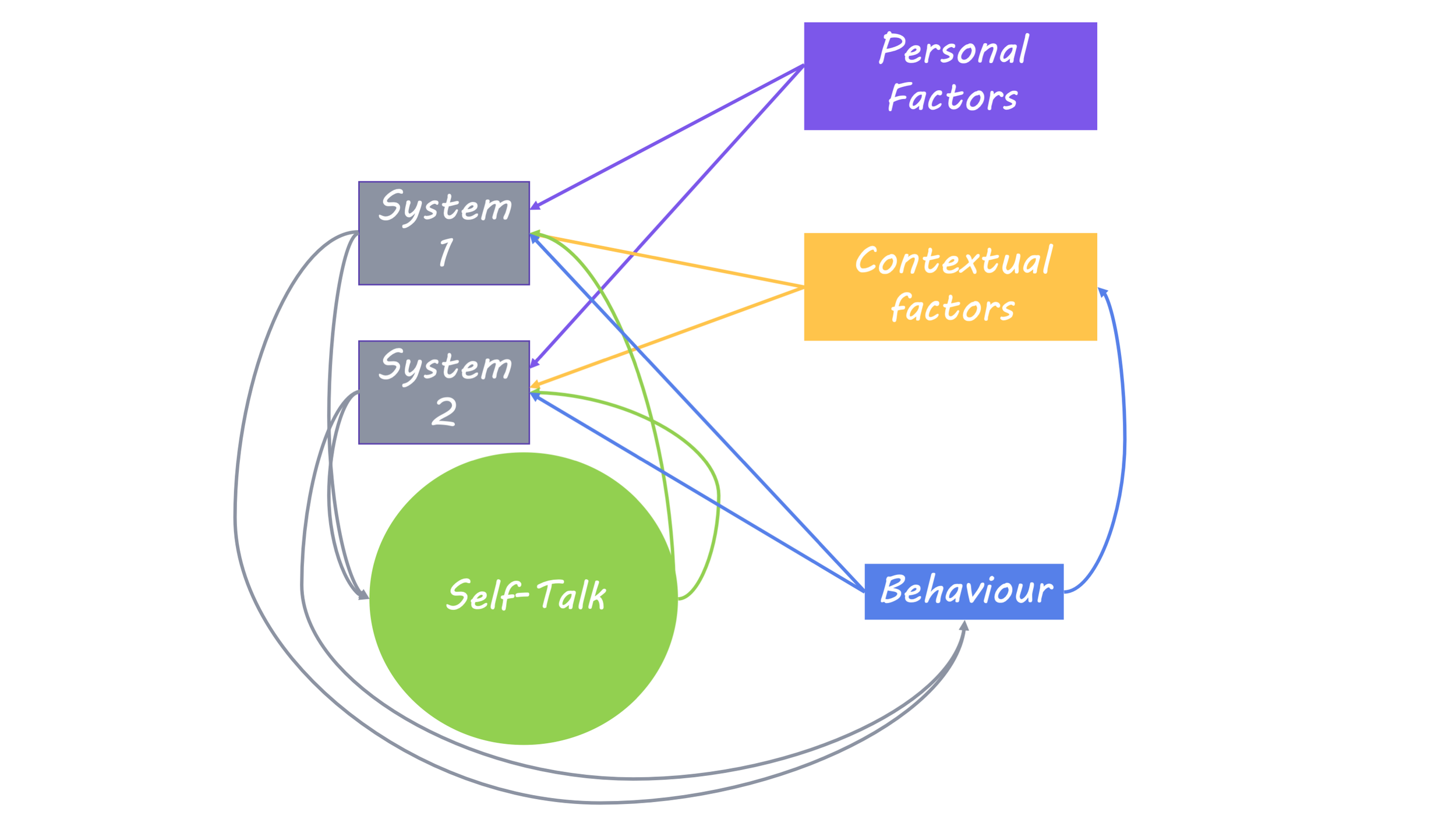
The type of self-talk that someone uses depends on traits like motivation, self-esteem, skill level, as well as on the context, like competition level (e.g., self-talk during practice vs during a game), the type of sport, and its culture (individual or team-based), prior experience (e.g., have they ever won a game vs have they consistently won in the past?), and the audience or where the sport is played (e.g., home vs away game).
Dual process theory and self-talk
Dual process theory proposes that two systems – System 1 and System 2 – underlie many thoughts and behaviors. Where System 1 is engaged in a rapid, automatic, and effortless manner, System 2 is slower, more effortful, intentional, and conscious in nature.
Under the dual process framework, System 1 might give rise to the spontaneous, self-expressive form of self-talk, making the athlete more aware of their feelings in the moment. System 2 might then be engaged to interpret the content of their self-talk based on any of the several factors identified above, such as their self-esteem and context. In addition, since self-talk arising from System 2 processing is more intentional, it can be used to regulate subsequent behavior.
Is self-talk effective?
A large body of research, as well as individual experiences of athletes and coaches, shows that self-talk is effective for improving athletic performance. The effectiveness of self-talk on performance depends on situational factors, the athlete, and the features of self-talk itself. For instance, some researchers suggest that instructional self-talk might be more beneficial during training because it helps the athlete finesse their skill, whereas motivational self-talk might boost performance in a competitive setting. Self-talk may primarily act by reducing performance-related anxiety among athletes, particularly when it is positive. Moreover, self-talk has been linked to greater enjoyment, self-confidence, and higher perceived self-competence.
There is an active area of research geared toward identifying the most effective forms of self-talk. Though research shows that positive self-talk is most effective for performance, some individuals might improve more than others through negative self-talk due to individual differences in motivation and self-esteem. Additionally, in situations where the content of self-talk conflicts with the context or with an individual’s beliefs about themselves, the self-talk might have no effect or even negatively impact performance. For example, a runner might have a positive mantra that they repeat, like “I’ve got this”. However, if they are neck and neck with another runner, they might begin to doubt whether they trained adequately enough to outcompete them. If this doubt begins to conflict with their mantra, they might start to fall behind, and rather than boosting motivation to keep going, the mantra is rendered ineffective. An athlete who does not start doubting their training might instead use the same mantra to push themselves harder to win the race.
Many self-talk intervention studies train athletes to use self-talk that engages System 2, the slower but more intentional type of self-talk. As described above, some forms of self-talk might rely more on System 2, but it may be difficult for someone to interpret or regulate their self-talk if this slower, more intentional system is maximally engaged by other thoughts. For example, a runner who is tired and doubting their training during a critical moment in a race might start to over-analyze their training and what they could have done better leading up to the race, leaving few cognitive resources to re-appraise the current situation. As a result, they might not be able to engage in motivational self-talk that would otherwise help push through the fatigue. Thus, a number of factors determine whether practicing self-talk has a beneficial effect on performance in any given situation.
References
Hardy, J. (2006). Speaking clearly: A critical review of the self-talk literature. Psychology of Sport and Exercise, 7(1), 81-97. https://doi.org/10.1016/j.psychsport.2005.04.002
Hatzigeorgiadis, A., Zourbanos, N., Galanis, E., & Theodorakis, Y. (2011). Self-talk and sports performance: A meta-analysis. Perspectives on Psychological Science, 6(4), 348-356. https://doi.org/10.1177/1745691611413136
Hatzigeorgiadis, A., Zourbanos, N., Galanis, E., & Theodorakis, Y. (2014). Self-talk and competitive sport performance. Journal of Applied Sport Psychology, 26(1), 82-95. https://doi.org/10.1080/10413200.2013.790095
McCormick, A., Meijen, C., & Marcora, S. (2017). Effects of a motivational self-talk intervention for endurance athletes completing an ultramarathon. The Sport Psychologist, 32(1), 42-50. https://doi.org/10.1123/tsp.2017-0018
Park, S-H., Lim, B-S., & Lim, S-T. (2020). The effects of self-talk on shooting athletes’ motivation. Journal of Sports Science and Medicine, 19(3), 517-521. PMID: 32874104
Van Raalte, J. L. & Vincent, A. (2017, March 29). Self-Talk in Sport and Performance. Oxford Research Encyclopedia of Psychology. https://doi.org/10.1093/acrefore/9780190236557.013.157
Van Raalte, J. L., Vincent, A., & Brewer, B. W. (2016a). Self-talk interventions for athletes: A theoretically grounded approach. Journal of Sport Psychology in Action, 8(3), 141-151. https://doi.org/10.1080/21520704.2016.1233921
Van Raalte, J. L., Vincent, A., & Brewer, B. W. (2016b). Self-talk: Review and sport-specific model. Psychology of Sport and Exercise, 22, 139-148. https://doi.org/10.1016/j.psychsport.2015.08.004
Walter, N., Nikoleizig, L., & Alfermann, D. (2019). Effects of self-talk training on competitive anxiety, self-efficacy, volitional skills, and performance: An intervention study with junior sub-elite athletes. Sports, 7(6), 148. https://doi.org/10.3390/sports7060148