Autophagic Degradation of the Dopamine Transporter Regulates Behavioural Effects of Cocaine

Post by Amanda McFarlan

What's the science?

Cocaine blocks dopamine reuptake and causes prolonged dopamine signaling in the brain by directly binding to the dopamine transporter. Researchers, however, have speculated that this might not be cocaine’s only mechanism of action, since other drugs that block dopamine reuptake, such as sibutramine or bupropion, fail to induce the stimulant effects of cocaine. Recent findings have shown that cocaine may be associated with autophagy, a lysosomal process that involves the degradation and recycling of cellular components to maintain cellular homeostasis. This week in Molecular Psychiatry, Harraz and colleagues examine the role of autophagy in regulating the molecular and behavioural effects of cocaine.

How did they do it?

The authors explored whether cocaine administration in cortical and ventral midbrain neuronal cultures induced autophagy. They used confocal microscopy and transmission electron microscopy to quantify levels of LC3-II, a microtubule-associated protein that tags the autophagosomal membranes. Then, the authors investigated the role of autophagy in the behavioural stimulant effects associated with cocaine. To do this, they treated mice with either one of three autophagy inhibitors (HCQ, vacuolin-1, or SBI-0206965) or saline 45 minutes prior to being placed in an open field test. After measuring baseline locomotor activity, they delivered intraperitoneal injections of either cocaine or saline and placed the mice back in the open field test to monitor locomotor behaviour. Next, the authors performed synaptosome fractions (separation of molecules in the synapse based on size or density) to explore the role of cocaine-induced autophagy on the degradation of the dopamine transporter. Finally, to examine the effect of autophagy on the rewarding actions of cocaine, the authors treated mice with either HCQ (an autophagy inhibitor) or saline prior to administering cocaine in the conditioned place preference paradigm.

What did they find?

The authors determined that cocaine induces autophagy with high potency in neurons. They showed that cocaine-induced locomotor stimulation was greatly reduced in mice that were treated with an autophagy inhibitor compared to mice that were treated with saline. Next, synaptosomal fractions from the nucleus accumbens (an area of the brain associated with reward) revealed that the dopamine transporter was largely depleted in mice that had been treated with cocaine compared to mice treated with saline. The cocaine-induced depletion of the dopamine transporter could be rescued with the administration of an autophagy inhibitor 90 minutes prior to cocaine administration. Notably, cocaine’s effects were selective for the dopamine transporter since levels of the serotonin transporter or tyrosine hydroxylase (an enzyme involved in the synthesis of dopamine) were unchanged. Finally, the authors found that cocaine-induced conditioned place preference was impaired in mice treated with HCQ compared to saline, suggesting that autophagy is involved in regulating the rewarding effects of cocaine.

amanda.png

What’s the impact?

This study is the first to show that cocaine induces autophagic degradation of the dopamine transporter with high potency. The authors found that this cocaine-induced autophagy was important for regulating behavioural characteristics associated with cocaine, including locomotion and reward. These findings provide new insights into the mechanisms by which cocaine acts in the brain.


Harraz et al. Cocaine-induced locomotor stimulation involves autophagic degradation of the dopamine transporter. Molecular Psychiatry (2021). Access the original scientific publication here.

Deep Projection Neurons in the Prefrontal Cortex Enable Cognitive Flexibility via Feedback Monitoring

Post by Elisa Guma

What's the science?

Cognitive flexibility refers to our ability to adapt and update strategies in response to changing environmental stimuli and is impaired in individuals across a range of psychiatric disorders. A large body of evidence from both rodent and human studies suggests that the prefrontal cortex (PFC) plays a critical role in supporting this behaviour, however, the mechanisms underlying this role of the PFC in cognitive flexibility remain to be elucidated. The PFC is thought to provide an attentional filter for the brain that biases sensorimotor responses during set-shifting (task switching to focus on a new, relevant stimulus), however, an alternative hypothesis suggests that the PFC supports set-shifting by monitoring feedback in response to recent decisions. This week in Cell, Spellman and colleagues investigate whether the PFC supports set-shifting behaviour through feedback monitoring or through attentional modulation of sensorimotor responses in a series of experiments in mice.

How did they do it?

The authors trained adult male water-deprived mice on an attentional set-shifting task comprising a successive series of stimulus-response discriminations in which the relevant stimuli (signifying a reward) and irrelevant stimuli were changed. Briefly, mice were presented one of two possible whisker vibration stimuli, and one of two possible odor stimuli to which they had to respond by licking either a left or right lick port to receive a water reward. They had to learn that either a specific whisker or odor stimulus signaled the location of the reward and to ignore irrelevant stimuli. These associations changed throughout the task, requiring mice to unlearn the previous association and learn the new one. Trials were classified into congruent trials in which whisker and odor rules cued the same response direction, or incongruent trials, in which whisker and odor rules cued opposite directions.

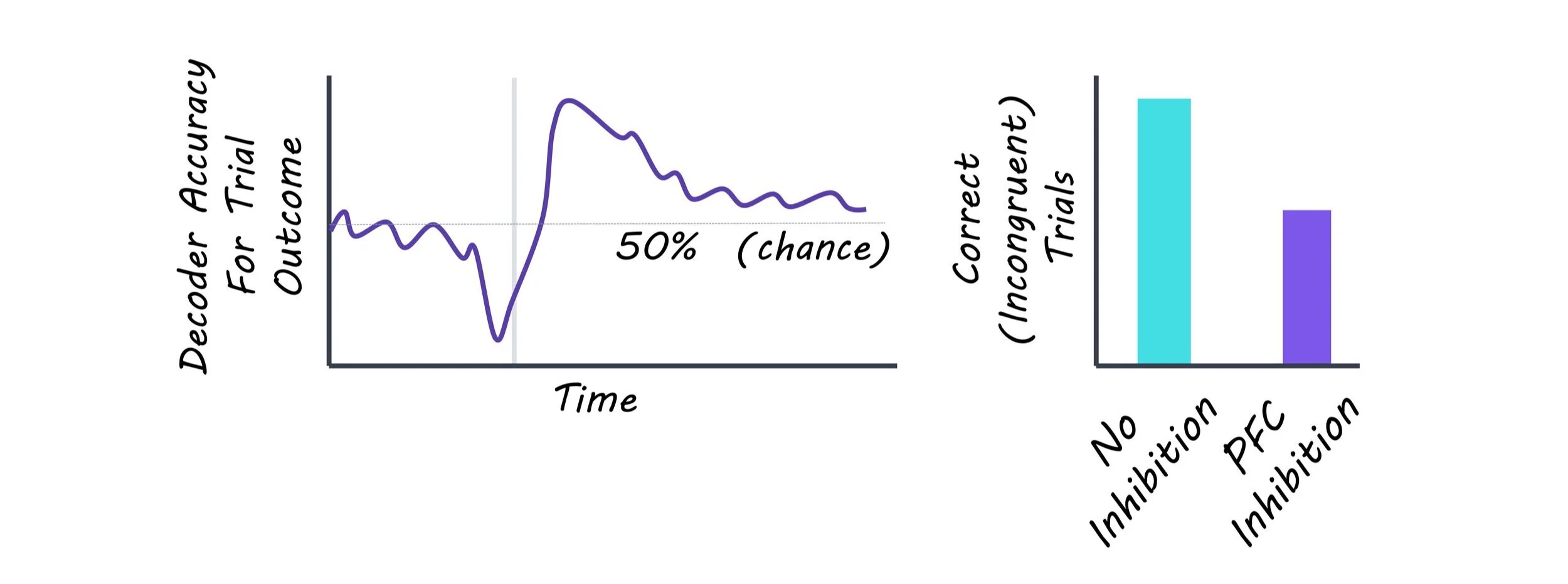
While the mice performed this task, the authors used GcaMP6f-mediated two-photon calcium imaging to examine neural activity in the PFC, for all neurons, as well as for two specific projections hypothesized to be critical for this task: a projection to the ventromedial striatum (PFC-VMS), or a projection to the mediodorsal thalamus (PFC-MDT). Neural activity data were classified, using a machine learning model (a support vector machine-based decoder), into different categories including whisker stimulus (ex: 35 versus 210 Hz), odor stimulus (ex: almond versus olive oil), response (left/right), outcome (correct/incorrect), and rule (attend to whisker or odor). Based on these categories, the authors were able to investigate the specific within-trial timepoints at which neurons were encoding either response or outcome, and how these signals were carried over into subsequent trials.

In order to shed light on the circuitry underlying the PFC’s role in attentional set-shifting, the authors used optogenetics to selectively inhibit PFC activity either during the attentional set-shifting trials or during the intertrial period following either congruent or incongruent trials. In addition to assessing the role of the PFC-VMS and PFC-MDT pathways in supporting rule-guided response, they also investigated the role of the posterior parietal cortex based on previous research implicating this region in cognitive flexibility and monitoring sensory history. Finally, the authors examined whether the spatial distribution of PFC neurons played an important role. They used retrograde tracers to specifically target either deep or superficial projection neurons from the PFC to ACC.

What did they find?

The authors found that the temporal components associated with whisker and odor stimulus peaked during the stimulus presentation, as expected, while components associated with outcome peaked during the inter-trial interval and persisted for up to four trials. This suggests that the response-associated patterns lag, rather than lead, the animal’s behavioural choice.

The optogenetic manipulation of PFC activity during the attentional set-shifting task led to an impairment in performance only when activation was silenced during the intertrial interval following incongruent trials, but not congruent trials, and not during the stimulus presentation. This suggests that interference with prior trial feedback, rather than preparation for the subsequent trial, caused impairment in performance. Additionally, silencing the posterior parietal cortex neurons during trials impaired performance on the incongruent but not congruent trials, suggesting that the posterior parietal cortex mediates responding in the task in a specifically rule-dependent manner.

elisa (3).jpg

Contrary to expectations, the two populations of neurons from the PFC-VMS and PFC-MDT pathways showed a striking degree of overall similarity in their task responsiveness. Even though there was no distinction between these two pathways, there was a great degree of heterogeneity in the functional properties of the neurons studies, with a range of correct- or incorrect-preferring neurons, which they probed further. They found that the heterogeneity in neural response was attributed to the depth of the cortical layer, highlighting the importance of deep cortical projection to the anterior cingulate cortex.

What's the impact?

These findings provide a novel model for the role of the PFC in cognitive flexibility. Rather than mediating top-down cognitive control, the PFC was shown to integrate and maintain representations of recent behaviours and their consequences. Future work may seek to elucidate the potential role of certain neurotransmitter systems, such as acetylcholine, as it plays a key role in mediating feedback monitoring signals in the brain. Further, this work could aid in our understanding of how neural circuitry may be impaired in neurodevelopmental disorders exhibiting attentional set-shifting deficits but should include the use of female mice.

Spellman_May4.png

Spellman al., Prefrontal deep projection neurons enable cognitive flexibility via persistent feedback monitoring. Cell (2021). The original scientific publication here.

What Factors Impact Our Perception of Pain?

Post by Lani Cupo 

Do individuals perceive pain differently?

Describing how bad our headache is, how much our broken arm hurts, or what childbirth feels like are complex and nuanced exercises in communication. If you and your sibling both have your wisdom teeth removed, what factors determine whether one of you will be in enough pain to fill a prescription for medication and the other won’t?

Among humans, the perception of pain can vary dramatically among individuals. According to a biopsychosocial model of pain, the perception of painful stimuli are influenced by three main types of factors: biological, psychological, and social factors. This means that there is not necessarily a consistent correspondence between pain and pathology. In other words, the same stimulus — consider a broken bone for example — may correspond with high degrees of distress in some individuals while others barely register the break as painful.

How do sex and gender impact the perception of pain?

Two widely investigated, nuanced factors impacting pain perception and expression are gender identity and biological sex. Scientific studies repeatedly report that in comparison with men, women exhibit more robust perceptual responses to experimentally-induced pain. For example, women report lower thresholds and tolerances to stimuli such as heat and pressure. Nevertheless, recent research suggests that differences in pain perception are fairly subtle, and driven by context. Sex differences are in part explained by the way in which experiments are conducted, as women may be more sensitive to rapid or dynamic changes in noxious stimuli, such as when the stimulus begins or increases in intensity. In contrast, women have been shown to habituate or adapt faster than men when a painful stimulus is consistently applied. Further, it is important to note that women tend to be more perceptive in general than men across many sensory modalities, including temperature, smell, taste, and vision. It can be easy to misconstrue reported sex differences and view them with an archaic lens that portrays women as oversensitive or weak in the face of adversity.

In humans, it can be tricky to separate the impact of biological sex from the impact of sociological factors. Rodent studies can lend insight, where biological sex is considered at the exclusion of gender. Such studies also reveal sex differences in pain perception, but recent research suggests that there is an interaction between sex and background genetic strain in mice and rats, with some strains demonstrating increased sensitivity in females, others demonstrating the opposite, and still others showing no difference.

The causes underlying sex or gender differences in pain perception have yet to be fully investigated, however, there are several proposed mechanisms. One hypothesis states that gender roles may alter the perception of pain; women may feel it is more permissible to express and feel pain. From a biological viewpoint, sex hormones have been shown to alter nociceptive processing. Castration of male rats and androgenization of female rats in the first week of life has also been shown to reverse sex-dependent effects of pain perception, pointing to a role of gonadal hormones on altered perception.

How does age impact the perception of pain?

Another common factor that can alter pain perception is age. As humans age, the threshold for pain increases, meaning it takes a more intense noxious signal to alert an older individual that something is wrong. This increases the risk of injury in older adults. Contrarily, tolerance for pain usually decreases, with older participants withdrawing from painful stimuli sooner than younger participants in experimental settings. This could be in part due to increased perception of pain as unpleasant in older ages. Unpleasantness differs from intensity, with the former representing how bothersome the pain is and the latter representing how severe it is. Most studies in humans, however, neglect to report data on the changing perception of pain unpleasantness.

Aging is associated with degradations to both neurons themselves and connections between brain cells. Changes in brain regions involved in the processing of painful stimuli, such as the prefrontal cortex, primary and secondary somatosensory cortex, hippocampus, anterior cingulate, insula, and thalamus, may in part be responsible for the changes in pain perception over the lifetime.

How do psychosocial factors impact pain perception?

Mood is one of the major psychosocial factors investigated in relation to pain perception. In patients with chronic pain, negative mood, such as transient anxiety and depression, are associated with greater intensity of pain. Of course, more intense pain could also result in lowered mood, however, in studies examining acute pain stimulus in healthy individuals, negative mood has also been linked with greater pain sensitivity. In contrast, positive moods can relieve pain, with pleasant stimuli such as music, pictures, and funny movies reducing pain perception. While not all pain can be mitigated by distraction or a positive mood, the idea that positive affect can help reduce the valence of painful stimuli is very powerful, providing alternative routes of analgesia to individuals experiencing acute or chronic pain in some cases instead of pharmaceutical drugs. Finally, some studies have investigated the impact of brief mindfulness or meditative practices on the perception of acute pain in the lab, finding reductions in pain responses and inspiring further research on the topic.

What does it all mean for me?

While there is a robust body of literature suggesting the role sex, gender, and age have on perceptions of pain, individual differences can, of course, outweigh the impact of demographic variables, meaning some women may have a higher pain threshold than men, or some older individuals may have a higher tolerance than some teenagers. Because pain sensation is so subjective and can be extremely difficult to communicate, it is important to recognize that individual differences can affect how people cope with pain and even what they consider to be painful. The fact that psychological variables, such as mood, can ameliorate pain provides an exciting future avenue that has the potential to help some individuals mitigate the negative impact of both acute and chronic pain.

References

Bushnell et al. Cognitive and emotional control of pain and its disruption in chronic pain. Nature Reviews Neuroscience. (2015). Access the original scientific publication here. 
Diatchenko et al. Genetic basis for individual variations in pain perception and the development of a chronic pain condition. Human Molecular Genetics. (2004). Access the original scientific publication here.

Fillingim. Sex, gender, and pain: Women and men really are different. Current Review of Pain. (2000). Access the original scientific publication here.

Gibson & Farrell. A review of age differences in the neurophysiology of nociception and the perceptual experience of pain. Clinical Journal of Pain. (2004). Access the original scientific publication here.

Hashmi & Davis. Deconstructing Sex Differences in Pain Sensitivity. Journal of Pain. (2013). Access the original scientific publication here.

Mogil et al. Sex differences in thermal nociception and morphine antinociception in rodents depend on genotype. Neuroscience & Biobehavioral Reviews. (2000). Access the original scientific publication here.

Sandhu & Leckie. Orthodontic pain trajectories in adolescents: Between-subject and within-subject variability in pain perception. American Journal of Orthodontics and Dentofacial Orthopedics. (2016). Access the original scientific publication here.

Taenzer et al. Influence of psychological factors on postoperative pain, mood and analgesic requirements. The Journal of Pain. (1986). Access the original scientific publication here. 

Zeidan et al. The effects of brief mindfulness meditation training on experimentally induced pain. The Journal of Pain. (2009). Access the original scientific publication here.