
Neurofeedback Facilitation Improves Gait and Balance in Post-Stroke Patients

Post by Amanda McFarlan

What's the science?

Recovery from gait and balance impairments that arise following a stroke usually occurs in the first 12 weeks post-stroke, after which point there is little improvement. Recently, it has been shown that functional near-infrared spectroscopy (fNIRS) mediated neurofeedback, a technique where an individual can learn to use feedback about their brain activity to further regulate their neural activity, may be a promising tool to treat post-stroke patients with impairments. This week in Neurology, Mihara and colleagues used a two-center, double-blind, randomized, controlled study to investigate whether fNIRS-mediated neurofeedback is a feasible method of treatment for recovery of gait and balance in post-stroke patients.

How did they do it?

The authors recruited a total of 54 adult patients who had experienced a subcortical stroke that resulted in hemiplegic gait and balance disturbances that persisted more than 12 weeks after stroke onset. The patients were randomly assigned to be in the treatment group or the control group. To evaluate their motor function, all patients received a clinical assessment which included measures like the 3-meter-Timed Up-and-Go test and the Berg Balance Scale. These assessments occurred at three time points: (1) before the neurofeedback intervention, (2) immediately following the neurofeedback intervention, and (3) two weeks after the neurofeedback intervention. The neurofeedback intervention consisted of six sessions in which patients underwent the facilitation of the supplementary motor area using fNIRS while performing a motor imagery task. In the treatment group, patients received real-time neurofeedback signals that represented the activity of their supplementary motor area while performing the task, while the patients in the control group received pre-recorded signals that did not match their brain activity.

What did they find?

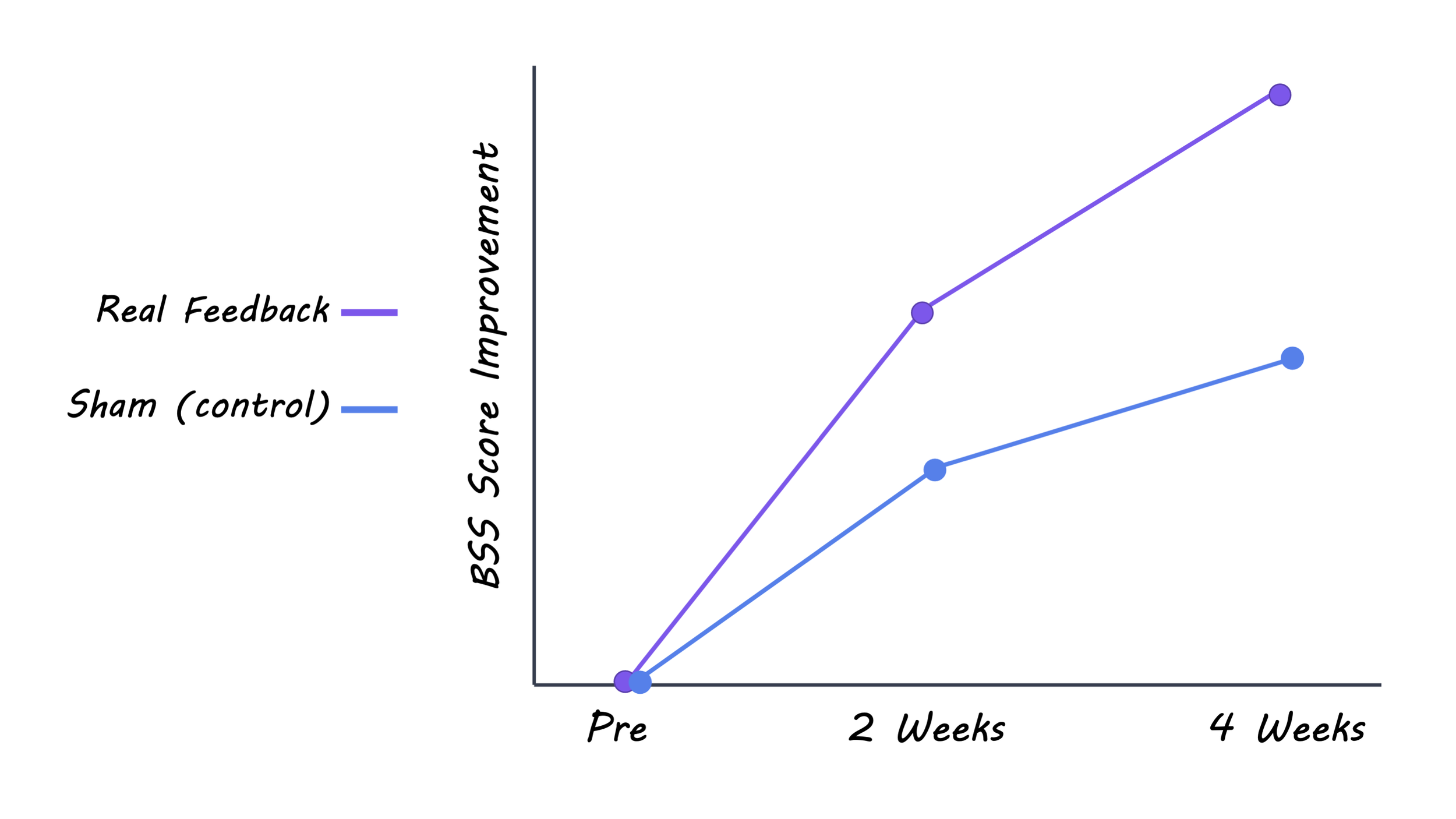
The authors found that following the neurofeedback intervention, the treatment group had a significant improvement on the 3-meter-Timed Up-and-Go assessment compared to the control group. The treatment group also had greater improvement on the Berg Balance Scale assessment compared to the control group. Additionally, when comparing the first and last sessions of the neurofeedback intervention, the treatment group had increased activity in the supplementary motor area and increased connectivity between the supplementary motor area and the ventrolateral premotor area. These enhancements in supplementary motor area activity and connectivity were positively correlated with balance recovery. Importantly, no adverse effects related to the neurofeedback intervention were reported during the study.
stroke_gait_img_april27.png

What’s the impact?

This study highlights the feasibility and efficacy of a neurofeedback-based intervention that can be used for the recovery of gait and balance disturbances in stroke patients. The authors showed that this intervention, which facilitates the activity of the supplementary motor area using fNIRS-mediated neurofeedback was correlated with balance recovery in post-stroke patients. Together, these findings provide evidence for a promising new treatment that may be useful for the recovery of stroke-related motor impairments.

stroke_quote_april27.png

Mihara et al. Effect of Neurofeedback Facilitation on Post-stroke Gait and Balance Recovery: A Randomized Controlled Trial. Neurology (2021). Access the original scientific publication here.
The Anterior Cingulate Cortex Directs Exploration of Alternative Strategies

Post by Andrew Vo

What's the science?

Life often throws us curve balls. How we successfully deal with such changes and challenges in our complex environments involves continuous evaluation of our ongoing strategy and switching away to alternative approaches when suitable. The anterior cingulate cortex (ACC) has been implicated in this arbitration between ongoing and alternative strategies, but whether this brain region plays an active role in this process or simply tracks related variables remains unclear. This week in Neuron, Tervo and colleagues demonstrated the role of ACC in strategy arbitration using a foraging task and pathway-specific ACC perturbation in a rodent model.

How did they do it?

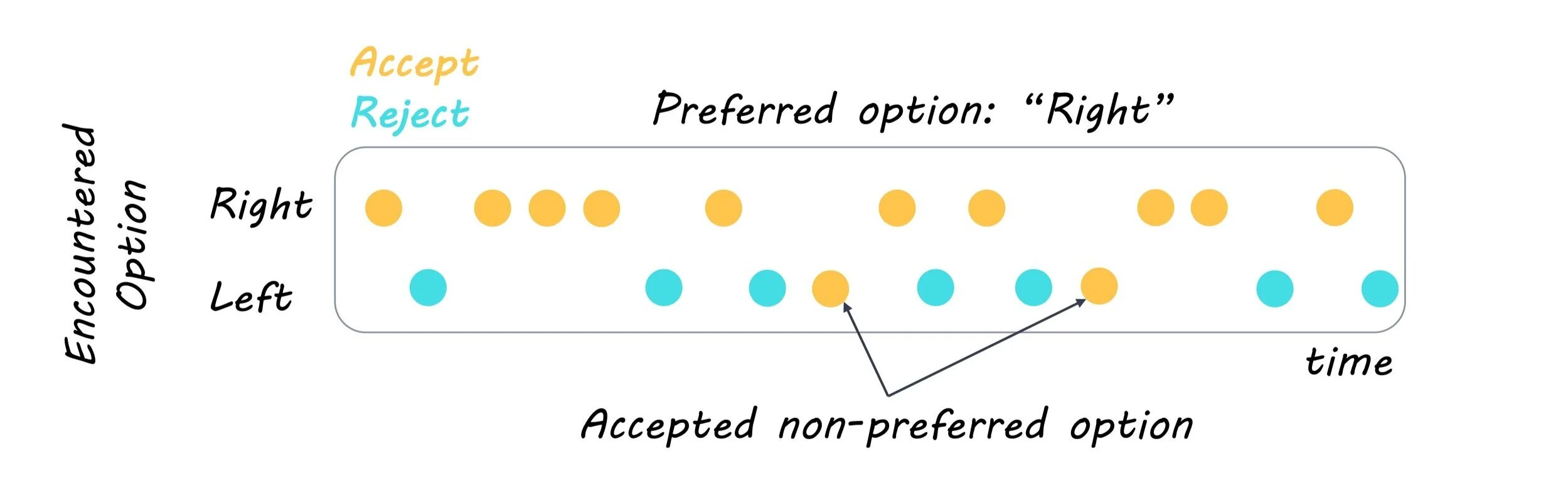
The authors trained rats on a foraging task that allowed them to dissociate strategy commitment from strategy re-evaluation. Each trial was initiated at a central nose port, from which rats would decide between two options (levers on the left or right) cued by two auditory tones that were each paired with a distinct probability of receiving a sugar reward (e.g. tone for left lever: 50% probability of reward, tone for right lever: 90%). To either accept or reject the presented option, rats would perform lever presses for possible reward or re-initiate the trial from the central nose port, respectively (see figure). The probabilities of reward for each option changed independently over time

To test the role of the ACC in two distinct computations underlying strategy arbitration, the authors used optogenetics to temporarily “silence” ACC activity either (1) during tone presentation when rats encountered and committed to an encountered option, or (2) after feedback delivery when rats re-evaluated the ongoing strategy. Extracellular recordings of ACC allowed them to observe the selective engagement of ACC during the task. In addition to silencing the entire ACC, the authors also selectively targeted two candidate ACC subcircuits—the intra-telencephalic (IT) and pyramidal tract (PT) pathways—to examine their unique contributions to either option commitment or strategy re-evaluation.

What did they find?

After training, rats were found to strongly prefer one presented option over the other, however, they would continue to occasionally pursue the available non-preferred option throughout the task. These latter trials represented transient switches away from the ongoing strategy towards an alternative. Perturbing ACC activity during option commitment (tone presentation) significantly reduced acceptance of the non-preferred option following unrewarded preferred trials. In contrast, ACC perturbation during strategy re-evaluation (feedback delivery) significantly increased acceptance of the non-preferred option. The authors found that patterns of neuronal activity in the ACC associated with acceptance of preferred versus non-preferred options were distinct and decodable, suggesting ACC is actively involved in the decision-making process.

Optogenetic manipulation of the IT pathway (an ACC subcircuit) during strategy re-evaluation (but not option commitment) increased the probability that rats would accept the non-preferred option following unrewarded preferred trials. In contrast, perturbation of the PT pathway (another ACC subcircuit) during option commitment (but not strategy re-evaluation) reduced the likelihood that rats would accept the non-preferred option. Taken together, these findings demonstrate that the two perturbation effects observed with ACC inhibition at separable time points are mediated by dissociable ACC subcircuits.

andrew (2).jpg

What's the impact?

In summary, this study demonstrates that ACC plays an active role in strategy switching. Computations involving strategy re-evaluation versus commitment to pursue an alternative option were shown to be anatomically and functionally dissociable. Critically, the authors offer causal evidence of this role by using targeted optogenetic perturbations during distinct time points and within specific ACC pathways.

Tervo et al. The anterior cingulate cortex directs exploration of alternative strategies. Neuron (2021). Access the original scientific publication here.

Connectome-Wide Differences in Brain Organization Associated with Reading Ability

Post by Elisa Guma

What's the science?

Reading requires the ability to quickly and accurately recognize and map certain language components (e.g., phonological, orthographic, and semantic) to be able to understand written text. However, as many as 10% of children exhibit reading disabilities, including dysfluent and inaccurate reading performance. These disabilities are thought to be related to differences in the structure and function of certain brain regions and networks. One way to map the network architecture of the brain is to create a connectome, or “wiring diagram,” based on the strength of white matter connections between different regions of the brain. This week in Developmental Cognitive Neuroscience, Lou and colleagues aim to investigate associations between the connectome structure of the brain reading performance in a group of children with varying reading ability.

How did they do it?

The authors recruited 73 native English-speaking school-age children (of whom 64 were retained for final statistical analysis) to participate in the study. The children performed four tasks assessing reading ability including:

1.     Sight Word Efficiency: children had to read familiar words as quickly and accurately as possible in 45s;

2.     Phonemic Decoding: children had to read pseudowords as quickly and accurately as possible in 45s;

3.     Reading comprehension: children had to read a sentence or paragraph and provide a missing word;

4.     Rapid Automatized naming: children had to name a letter from a set of 4 presented in a random grid as quickly as possible.  

In addition to these behavioural measures, the authors acquired magnetic resonance imaging data (MRI), including structural MRI (to visualize brain anatomy), and diffusion weighted MRI measuring white matter connections between brain regions. For each participant, the authors created a connectome, which describes the human brain as a network with nodes representing cortical regions, and edges representing white matter tracts that connect them to the matrix. To do so, they: 1) parcellated each participant’s structural MRI scan into 90 gray matter regions (based on the Automated Anatomical Labelling template) to act as nodes in their connectome and 2) extracted streamlines from white matter connections between regions based on diffusion weighted data, to be used as edges in the connectome. The strength of the connection, or edge weight, was determined by an estimate of the white matter fiber strength between regions. 

Next, hub brain regions regions centrally embedded in the connectome — with a higher than usual level of connectivity with other regions, were identified based on the degree of connections to other nodes. Hub regions in the brain are critical for global communication and therefore are highly connected within themselves, and also more likely to connect to each other, forming what is referred to as a “rich-club”.

Three types of connections were identified: rich club connections (connections between two hub nodes), feeder connections (connections between a hub and a non-hub node), and local connections (connections between two non-hub nodes). Additionally, the authors defined a ‘reading network’ based on brain regions identified in two meta-analyses of fMRI studies investigating reading abilities in children (with typical reading abilities and reading disabilities, respectively), and a set of regions with fewer white matter fibers identified in one previous white matter network study. Finally, reading ability scores were correlated with both the rich-club and reading connectomes overall, and separately for boys and girls.

What did they find?

The authors found that the hub regions and rich-club connectome identified were consistent with previous reports, with hubs in the bilateral superior frontal lobes, precuneus, supplementary motor area, and thalamus.

They found that the strength of feeder connections was correlated with scores on the sight word efficiency and phonemic decoding tasks, measuring familiar and nonword reading ability. Similarly, the connection strength between rich-club and reading network nodes was significantly correlated with phonemic decoding. A follow-up analysis revealed that the correlation between rich club reading network nodes and feeder connection strength with reading ability (sight word efficiency and phonemic decoding) was still present in girls, but not in boys when analyzed separately.

The authors validated their findings by adjusting the way in which fiber length and strength were calculated, to ensure that variability in the way fiber strength was captured in different participants was not the reason for their findings.  

elisa (2).jpg

What's the impact?

This study provides exciting evidence for the relationship between the network-like architecture of the brain and reading performance. Across a number of measures, there was a significant association — possibly stronger in girls than boys — between network structure and performance on reading tasks. Interestingly, white matter fibers outside the reading network also contribute to reading performance, as feeder connections were positively correlated to the sight word efficiency and phonemic decoding scores. Future work may examine the influence of various environmental factors such as socioeconomic status on the relationship between brain networks and reading ability.

connectomics_quote_april27.png

Chenglin Lou et al Rich-club structure contributes to individual variance of reading skills via feeder connections in children with reading disabilities. Developmental Cognitive Neuroscience (2021). The original scientific publication here.