
Memory Performance is Linked to Neural Repetition Effects Across the Lifespan

Post by Amanda McFarlan

What's the science?

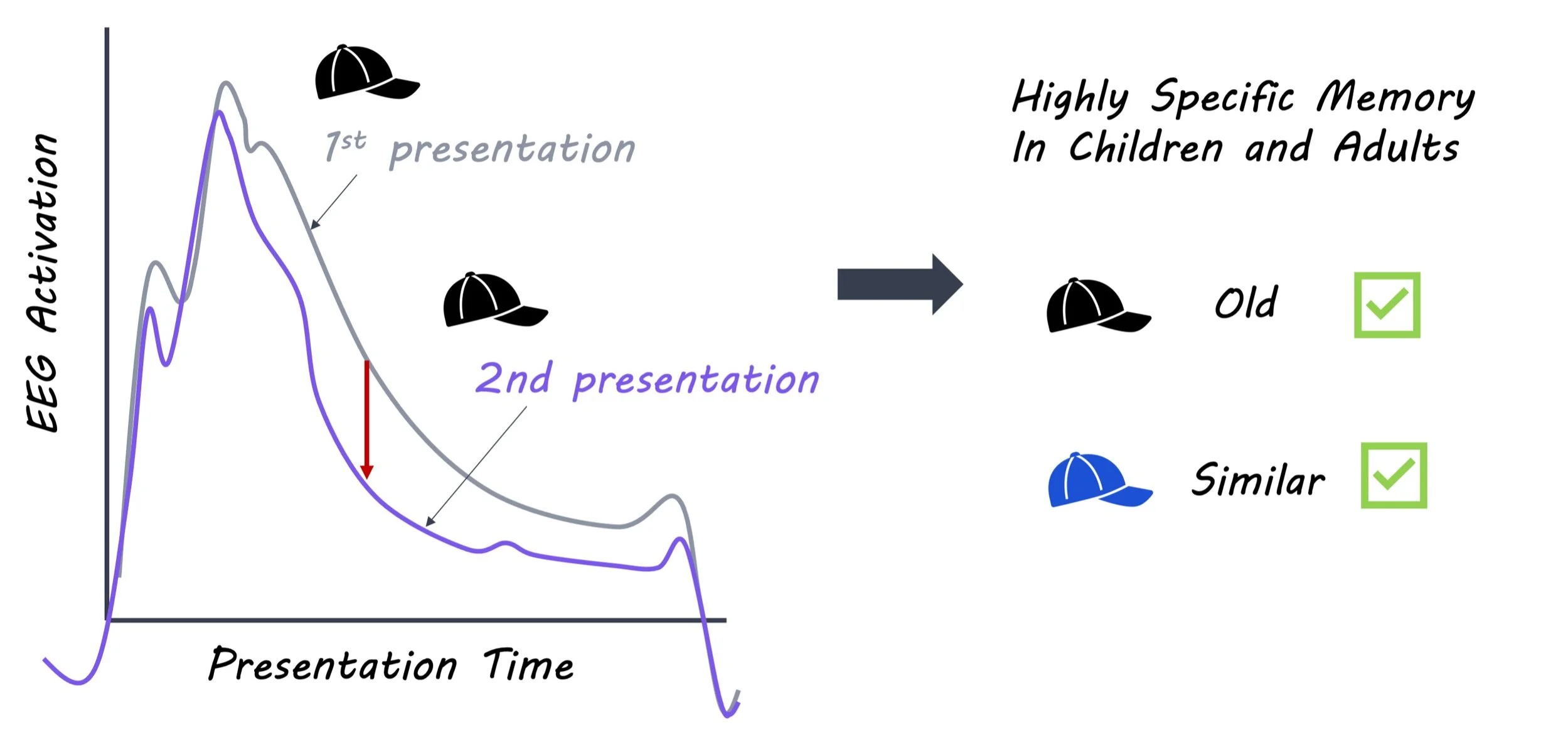
Researchers have long studied neural representations of memories to understand how memories are formed and stored in the brain. One way to do this is by investigating whether neural activity in the brain changes in response to repeated exposure to the same stimuli, known as the repetition effect. Repetition effects can be observed in two different forms: a repetition suppression effect, which occurs when neural activity is lower upon the second presentation of a stimulus, or a repetition enhancement effect, which occurs when neural activity is higher upon the second presentation of a stimulus. This week in Developmental Cognitive Neuroscience, Sommer and colleagues investigated whether memory formation, as measured by neural repetition effects, was associated with memory performance across the lifespan. 

How did they do it?

The authors recruited children (7-9 years), young adults (18-30 years) and older adults (65–76 years) to participate in their study. EEG recordings were acquired for each age group while participants performed an encoding task followed by a recognition task. During the encoding task, participants were shown pictures of objects belonging to different categories (e.g. hats, trees, guitars). The entire encoding task consisted of 720 trials for the adult groups and 360 trials for the children. After completing the encoding task, the authors surprised participants with a recognition task. Participants were not told to memorize the pictures during the encoding task and did not know that they would be tested on their memory. During the recognition task, participants were shown pictures of objects and were asked to identify whether that object was old (an image they had previously seen in the encoding task), similar (an imaging belonging to a category they had previously seen in the encoding task) or new (an image belonging to a novel category). The adult groups completed 480 trials for the recognition task, while the children completed 240.

What did they find?

The authors found that participants in all age groups were able to identify whether an image was old, similar, or new at levels above chance. They showed that children had higher specific item memory (correctly identifying whether an image was old or similar) compared to both adult groups and both children and young adults had a higher lure discrimination index (the difference between images correctly identified as similar and mistaken as old) compared to older adults. However, this finding did not persist after accounting for the fact that children performed an easier and shorter task. Next, the authors examined the EEG recordings to look for changes in neural activity related to repetition effects. They found repetition suppression effects in the posterior, frontal, and central electrode sites for all age groups. They also found a repetition enhancement effect in the frontal and temporal electrode sites for both adult groups as well as in the centro-parietal electrode sites for older adults. The repetition suppression effect (observed in all age groups) and the repetition enhancement effect (observed in adults) were positively correlated with item-specific memory performance.
Amanda_Feb16.jpg

What’s the impact?

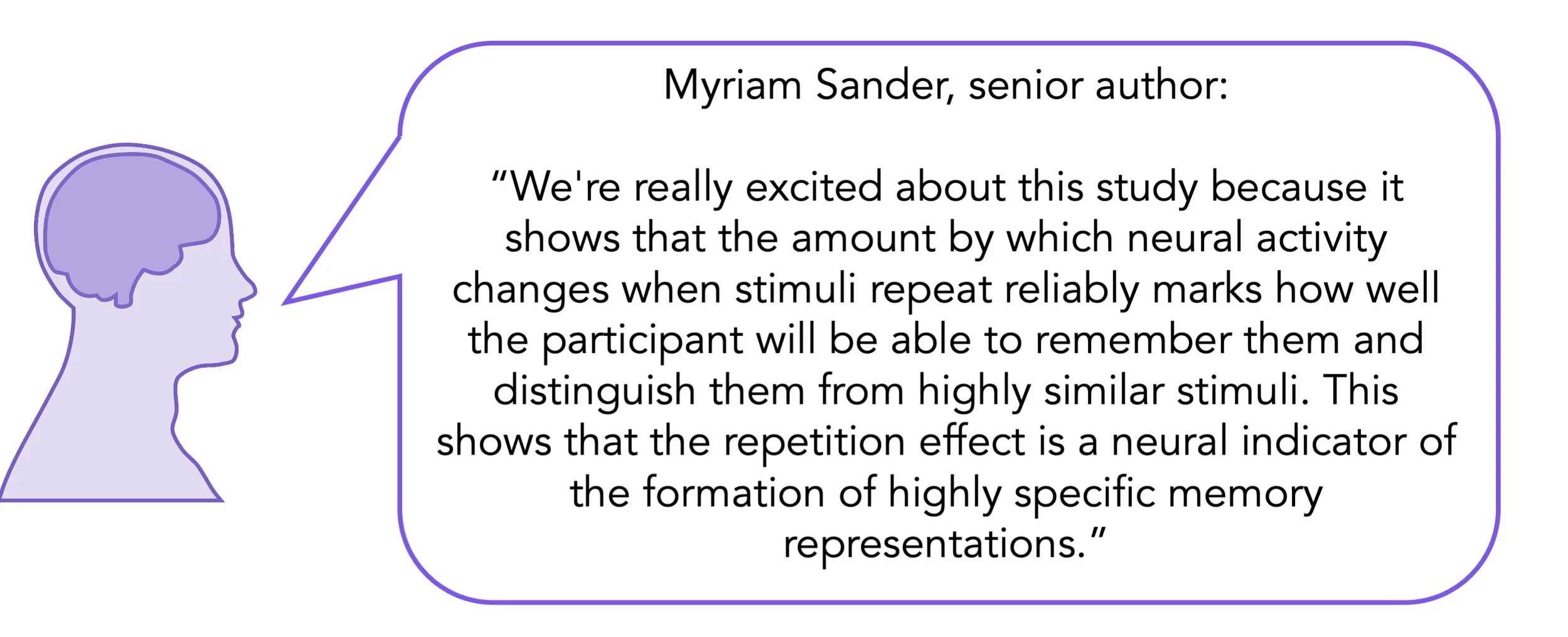
This study shows that item-specific memory performance for all ages is positively correlated with both repetition suppression effects and repetition enhancement effects. This suggests that memory encoding may have similar neural mechanisms in children and adults. Together, these findings provide evidence that neural repetition effects may be a useful neural indicator of memory encoding across the lifespan.
Sander_Feb16.jpg

Sommer et. al. Memory specificity is linked to repetition effects in event-related potentials across the lifespan. Developmental Cognitive Neuroscience (2021). Access the original scientific publication here.
Scalable Representation of Time in the Hippocampus

Post by Andrew Vo

What's the science?

Hippocampal place cells allow us to form map-like spatial representations of our environments, and these maps adaptively rescale themselves when our environments change. Whether hippocampal “time cells” can also form such scalable representations for information about time has yet to be systematically investigated. This week in Science Advances, Shimbo and colleagues examined if hippocampal CA1 activity of rats during encoding of time intervals scaled in response to expansions or contractions in elapsed time.

How did they do it?

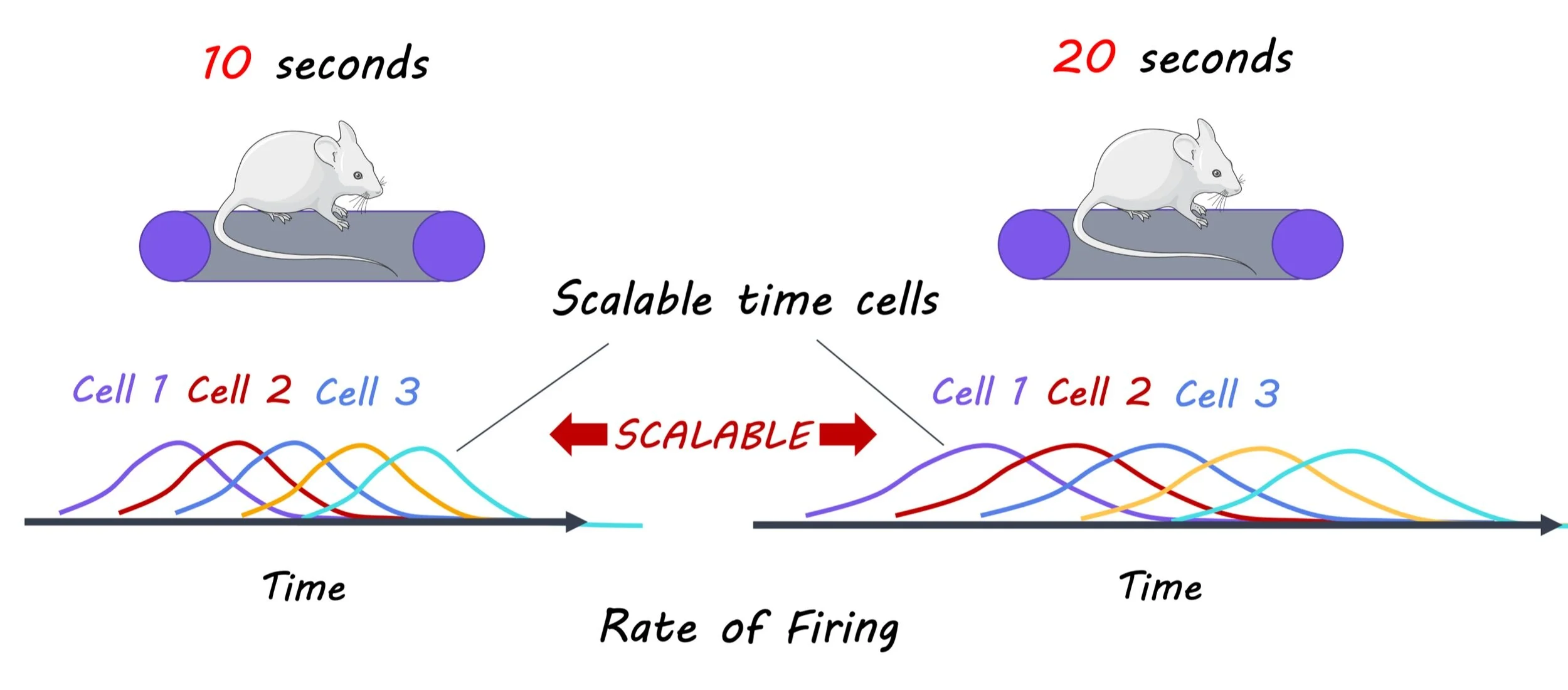
The authors trained rats to perform a task during which they ran on a treadmill for either long (e.g. 10 s) or short (e.g. 5 s) time intervals before navigating a Y-maze (shaped like a Y). The left and right arms of the maze were associated with long and short treadmill time intervals, respectively, and so the rats had to discriminate between intervals to select the correct arm and receive a reward. The rats performed three blocks of trials, across which the sets of time intervals were scaled up or down. For example, rats would discriminate between 10 (long) and 5 s (short) intervals in block 1, which were scaled up to 20 (long) and 10 s (short) intervals in block 2, before returning to their original interval durations in block 3.

During the treadmill interval periods, the authors recorded activity from hippocampal CA1 to identify time cells (i.e., neurons whose activity represented information of elapsed time). The firing activity of these cells was compared across experimental blocks using peri-event time histograms (PETHs) that quantify the rise and fall of activity over time in relation to the event. Using this method, scaling factors in response to changes in time intervals could be quantified. To test whether time cell activity was specific to a time-based task,  they trained a different set of rats on a light discrimination task that shared the same structure as their original task, except Y-maze performance was based on a light cue instead of interval times.

Next, the authors recorded theta sequences in the brain, which are patterns of neuron firing among cell assemblies that represent compressed time episodes. They also tested if these theta sequences scaled to changes in time intervals. Finally, they used a statistical method — Bayesian decoding — to decode these theta sequences and see if time cell activity predicted the rats’ Y-maze decisions.

What did they find?

The authors found that rat hippocampal CA1 activity during the treadmill interval period represented information on the elapsed time that scaled up or down depending on the expansion and contraction of the time intervals. This finding appeared to be related to task demands, as the number of time cells was significantly reduced when rats were not required to estimate time during the light discrimination task. This reduced number of time cells continued to display scalable representations of elapsed time, however. Examining the finer temporal structure of time cell ensembles, they noted the presence of theta sequences that were also scalable when time intervals were varied. The temporal information of these theta sequences could be decoded and reflected the rats’ decisions based on time estimation during test trials.

time_img_feb8.jpg

What's the impact?

In summary, this study demonstrated that time cells in the hippocampus can form scalable temporal representations of the environment, similar to how place cells code for spatial information. These findings suggest there is a common mechanism in the hippocampus underlying representations of temporal and spatial information by time and place cells, respectively. The ability to flexibly scale such representations might allow us to better navigate our complex and changing environments.

Shimbo et al. Scalable representation of time in the hippocampus. Science Advances (2021). Access the original scientific publication here.
Stress Interferes with Lateral Habenula Signaling and Reward-Seeking

Post by Deborah Joye

What's the science?

Our brains help us form goal-directed behaviors in pursuit of a reward. We know that the prefrontal cortex has a lot to do with reward-guided cognition, but we don’t know very much about how subcortical systems might regulate these aspects of behavior and cognition. What we do know is that one subcortical structure, the lateral habenula conveys both reward signals and aversive signals, like disappointment. We also know that neurons in the lateral habenula help shape decision-making and retrieval of spatial memories (e.g. “How did I get to that reward before?”) and that disrupting the lateral habenula negatively impacts the ability to make a choice during a cognitive task.

When we experience stress, changes in our brain can interfere with our ability to make reward-guided decisions. Exposure to stress promotes long-lasting changes in how our brain cells communicate with one another and can be associated with subsequent mood disorders (e.g. depression). However, it is not well understood whether neural changes in the lateral habenula and stress-driven cognitive changes are causally linked. This week in Neuron, Nuno-Perez and colleagues demonstrate that a stressful experience drives synaptic depression in the lateral habenula, which is sufficient to produce cognitive deficits in a reward task.

How did they do it?

To test how the lateral habenula is involved with reward and stress-driven brain changes, the authors designed a reward-guided task using a T-maze paradigm (shaped like a T). Mice were habituated to the maze task with a reward that could be found in one arm before they were tested. On test day, the location of the reward was switched to the other arm. Task performance was defined as the number of times mice dipped into the non-rewarded arm of the maze. To test whether a stressful experience alters performance on this task, the authors exposed some of the mice to a single session of unpredictable foot shocks, then had mice complete the task a week later. To evaluate whether specific parts of this task correlated to neuronal activity in the lateral habenula, the authors injected a virus into the lateral habenula allowing them to visualize calcium activity within cells (a marker of cellular activation) in freely-moving mice. Using this virus paired with fiber photometry the authors were able to study the activity of lateral habenula neurons in real-time as stressed and unstressed mice completed the maze task.

The authors then tested whether silencing lateral habenula neurons during the task altered task performance by injecting a red-light activated inhibitor of cellular activity into the lateral habenula. The authors recorded electrophysiological activity from the lateral habenula to measure AMPA/NMDA ratios - a proxy measure of how strong a particular neuronal response is. The authors also used electrophysiology to test whether activity changes in the lateral habenula were specific to particular brain circuits, by activating lateral habenula inputs from specific brain regions and measuring the response. Finally, to test whether changes in AMPA activation on lateral habenula neurons are causally linked to task performance, the authors used viruses that either overexpress Rab5, which reduces AMPA receptor expression and function, or Rac1, which increases AMPA expression and function. The authors used a Rac1 that can be activated by light, which means they could time the activation of AMPA increase specifically to when mice received a negative outcome (no reward).

What did they find?

The authors found that when a mouse encountered the non-rewarded arm in the maze task, neurons in the lateral habenula were recruited to encode that negative outcome. Mice that had more excitatory transmission onto lateral habenula neurons made fewer errors when looking for the reward. When mice were exposed to a stressful experience known to disrupt the lateral habenula, they made more errors when looking for the reward arm. Similarly, when the authors mimicked reduced excitatory transmission by silencing lateral habenula neurons, the mice made more errors. Exposure to stress reduced post-synaptic AMPA receptors at lateral habenula synapses, which led to decreased activation of those neurons. In summary, the authors demonstrate that exposure to a stressful experience weakened excitatory transmission onto lateral habenula neurons via a reduction in AMPA receptors. 

deb (1).jpg

The authors also found that incoming signals from a variety of brain regions were similarly weakened by AMPA reductions on lateral habenula neurons, meaning this reduction in excitatory transmission occurs regardless of where in the brain the excitatory signals are coming from and are not dependent on a particular brain circuit. When the authors mimicked weakened excitatory transmission onto lateral habenula neurons, they found that this alone was sufficient to reproduce the stress-driven increase in errors on the maze task.

What's the impact?

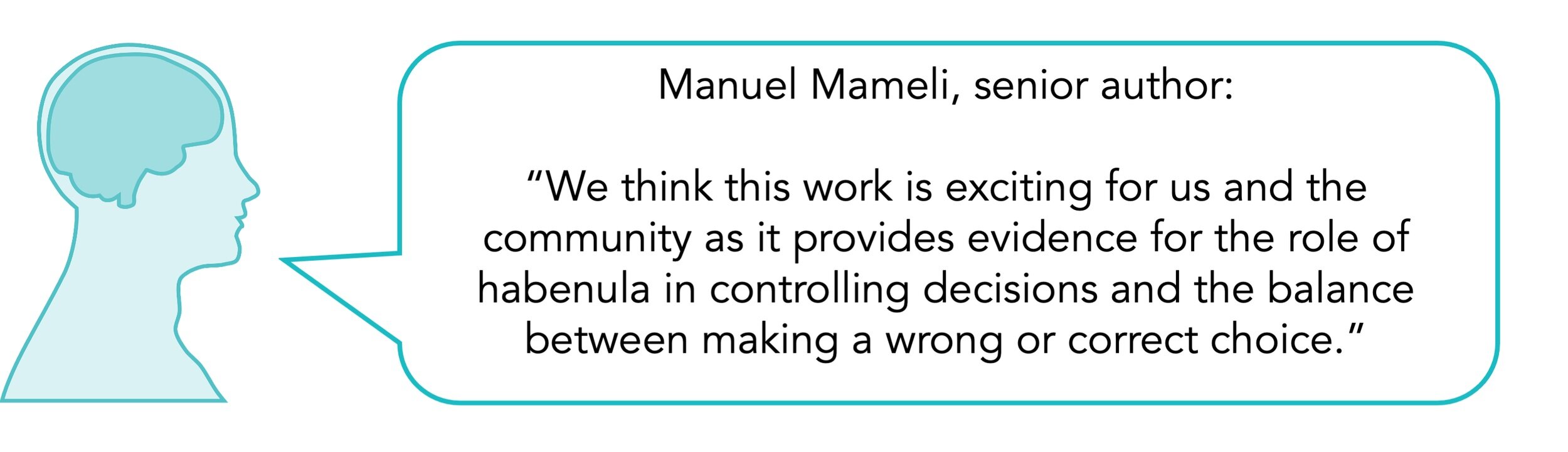
This study demonstrates that a single stressful experience can drive behavioral deficits through synaptic depression (a weakening of the connection between two neurons, in this case by decreasing excitatory transmission) in the lateral habenula. These findings support the view that stress can drive behavioral deficits by interfering with synaptic transmission. This raises interesting questions about how chronic stress may also change this lateral habenula circuit. Furthermore, this study highlights a somewhat new role for the lateral habenula, which is typically considered a “disappointment brain center.” The authors demonstrate that the “disappointment” signal from the lateral habenula is important for learning how to acquire a reward more efficiently. Finally, it’s important to note that this study uses only male mice but raises questions about how this circuit may differ in females, opening exciting avenues for future work on sex differences in this link between stress, cognition, and behavior.

Mameli_feb9.jpg

Nuno-Perez et al., Stress undermines reward-guide cognitive performance through synaptic depression in the lateral habenula (2021). Access the original scientific publication here.