Timing Differences in Neural Responses Related to Perception of Synesthetic Colors

Post by Lincoln Tracy

What's the science?

Grapheme-color synesthesia is a neurological phenomenon in which symbols, such as letters or numbers, are seen in colors. While scientists know that synesthetic experiences are not driven by direct sensory input, the neural mechanisms underlying synesthetic color experiences remain unknown. This week in PNAS, Teichmann and colleagues determined whether the neural activity associated with direct color perception also occurs during synesthetic color perception.

How did they do it?

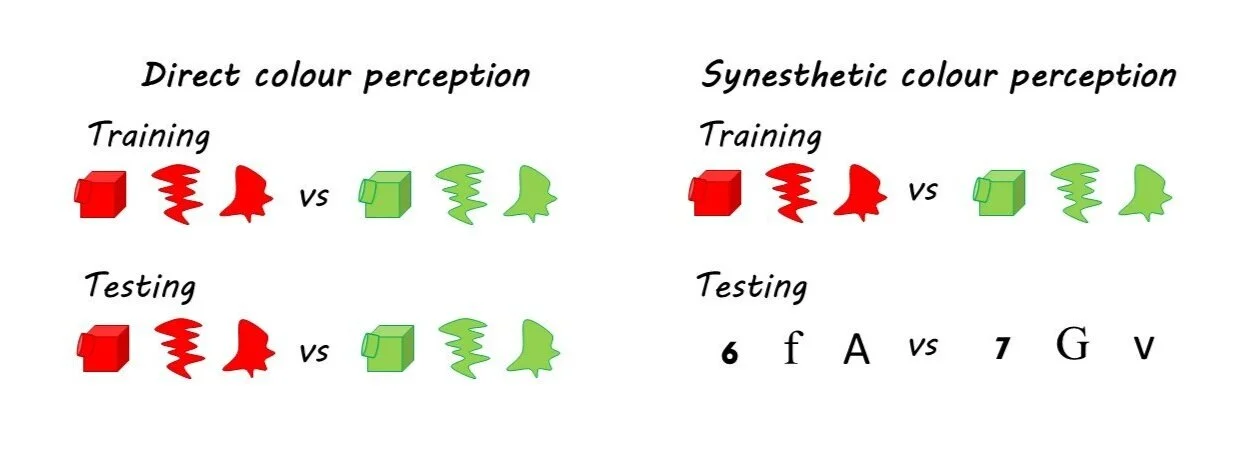
The authors recruited 18 (14 females) people with synesthesia. Initially, Online questionnaires were used to identify letters and numbers that each individual perceived as being green or red, as synesthesia-inducing symbols can be different for each synesthete. Synesthetes then completed a target-detection task while in a magnetoencephalography (MEG) scanner, which records the magnetic fields produced by the brains’ electrical activity. The target-detection task had two conditions: In the colored shapes condition, synesthetes viewed three different shapes which were red or green. Then, in the synesthetic-inducing symbol condition, synesthetes were presented with their six unique symbols that evoked red or green synesthetic colors in three different fonts with black text. The authors used linear discriminant classification models and time generalization methods to test for similar neural activity during the colored shapes and synesthetic-inducing symbol conditions. First, classification models were trained to distinguish between the red- and green-colored shapes in the colored shape trials then tested for prediction accuracy in the colored shape and synesthetic-inducing symbol trials.
lincoln+%282%29.jpg

What did they find?

The authors found that neural activity from perceiving the red or green shapes could be identified ~80 to 200ms after stimulus presentation. This activity was found to be the same in both the training and testing data sets for the colored shape conditions. This trained model was able to generalize patterns evoked by the induced synesthetic color at ~300 to 400ms, meaning that the neural similarities between color representations evoked by synesthesia occurred at a later time. In other words, the neural response to the red and green shapes and synesthetic-inducing symbols were similar but occurred later when the synesthetic-inducing symbols were presented.

What's the impact?

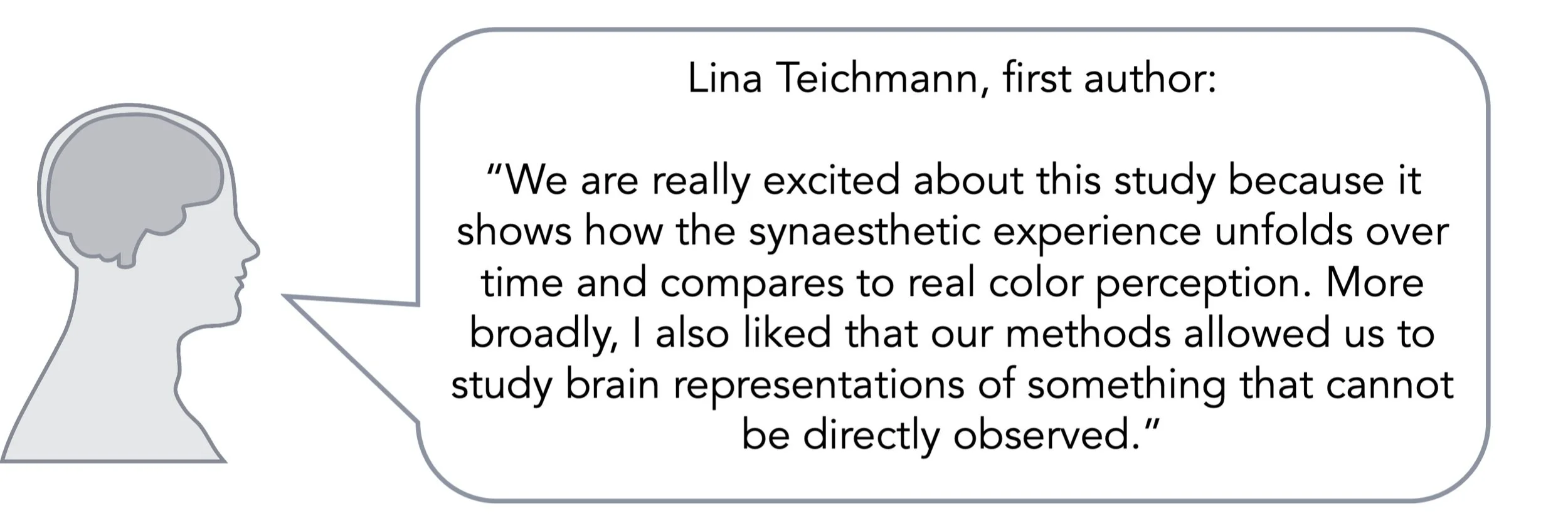
Teichmann and colleagues provide objective verification of synesthetic colors and highlight the value of time-resolved decoding methods for studying such phenomena. These findings indicate that synesthesia-inducing stimuli require considerable processing time before the synesthetic color experience is generated. These findings provide a unique insight into the timeframe of the influence of knowledge on visual perception, demonstrate a neural signature for this phenomenon, and support the role of higher-level brain processing in synesthesia.
color_quote_feb8.jpg

Teichmann et al. Temporal dissociation of neural activity underlying synesthetic and perceptual colors. PNAS (2021). Access the original scientific publication here.
Neural Predictions of Others’ Beliefs

Post by Elisa Guma

What's the science?

Humans are able to form detailed representations of others’ thoughts and beliefs that are distinct from their own. This capacity, often referred to as theory of mind, is critical to our social behaviour and ability to interact with others. While a number of brain areas, including the temporal-parietal junction, superior temporal sulcus, and dorsal medial prefrontal cortex, have been shown to support social reasoning, little is known about the mechanisms underlying theory of mind at the neuronal level. This week in Nature, Jamali and colleagues use single neuron recordings from the human dorsomedial prefrontal cortex during behavioural tasks to understand how these cells support theory of mind. 

How did they do it?

The authors used custom-made, multi-electrode arrays to record neuronal activity from 324 neurons in the dorsomedial prefrontal cortex of 15 participants as they performed an auditory version of a common theory of mind task: the false-belief task. Participants were patients undergoing surgery unrelated to study participation.

During the behavioural task, participants were presented with a series of unique narratives describing simple events, paired with questions about the events that tested their knowledge about another’s belief. For example, the narrative could be: You and Tom see a jar on the table. After Tom leaves, you move the jar to the cupboard,” followed by the question “Where does Tom believe the jar is?”. In addition to this scenario, considered a false-belief trial (i.e. the other’s belief is different than reality), participants were presented with true-belief trials, in which the other’s belief is the same as reality (i.e. leaving the jar on the table while Tom is away). To distinguish self-from other-belief representations in the brain, participants were also given trials in which their own imagined belief had to be judged as true or false. In addition to the scenario described above, a number of others were focused on another's beliefs of objects (e.g. table), containers (e.g. cupboard), foods (e.g. vegetables), places (e.g. park), animals (e.g. cat), and appearance (e.g. colour red).

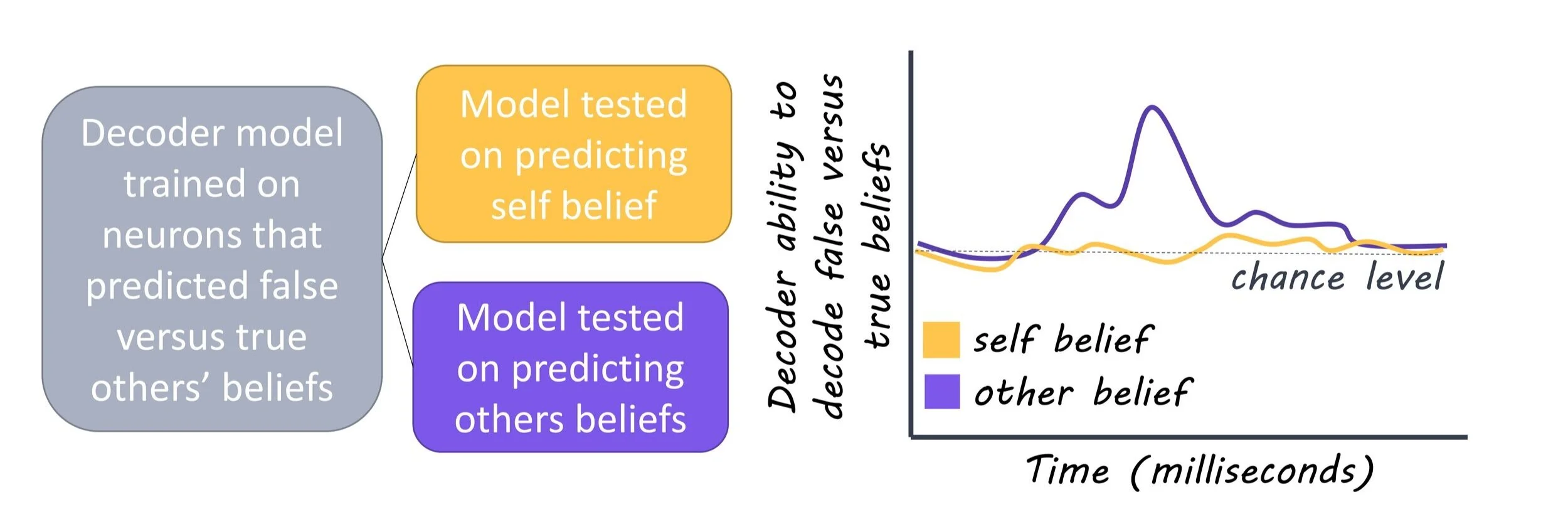
Following the alignment of trial events with neural activity, the authors used linear models that quantified whether and to what degree the activity of each recorded neuron could predict the specific trial condition (i.e. to distinguish between true- and false-belief trials or related to objects vs. non-objects) during questioning. Neuronal data were randomly divided into two subsets. One subset consisted of 80% of the trials and was used to train the model to predict the trial condition. Next, the other subset was used to test the accuracy of the model’s predictions on fresh data.

What did they find?

The authors found that many neurons (20%) in the dorsomedial prefrontal cortex responded selectively when considering another’s beliefs. Further, they found that 23% of neurons accurately predicted whether the other's beliefs were true or false. These neurons were distinct from those activated (27%) when participants had to determine whether their own imagined beliefs were true or false, confirming that a distinct class of neurons encodes and predicts beliefs other than our own. Finally, the authors observed differences in the neuronal populations activated based on the contents of the others’ beliefs (i.e. object, place, food, etc). These data indicate that these neurons encoded highly detailed information about the others’ beliefs and suggest that in order to accurately infer the beliefs of others, it is important to determine whether the beliefs are true or false as well as the specific beliefs being considered.

elisa+%281%29.jpg

What's the impact?

By leveraging single cell recordings in the human dorsomedial prefrontal cortex, the authors identified neurons that encode information about others’ beliefs, distinct from their own beliefs, across richly varying scenarios. They show that there is high specificity between cells based on the content of the others’ beliefs and that they are able to accurately predict whether these beliefs are true or false. These findings provide great insight into the cellular underpinnings of how the human brain is able to represent others’ beliefs.  Future work may investigate whether these neurons are affected in individuals with psychiatric disorders known to affect social cognition and theory of mind.

Williams_feb2.jpg

Jamali et al. Single-neuronal predictions of others’ beliefs in humans. Nature (2021). Access to the original publication can be found here.

“Circuit Motifs” Underlying Short-Term Memory

Post by Lani Cupo

What's the science?

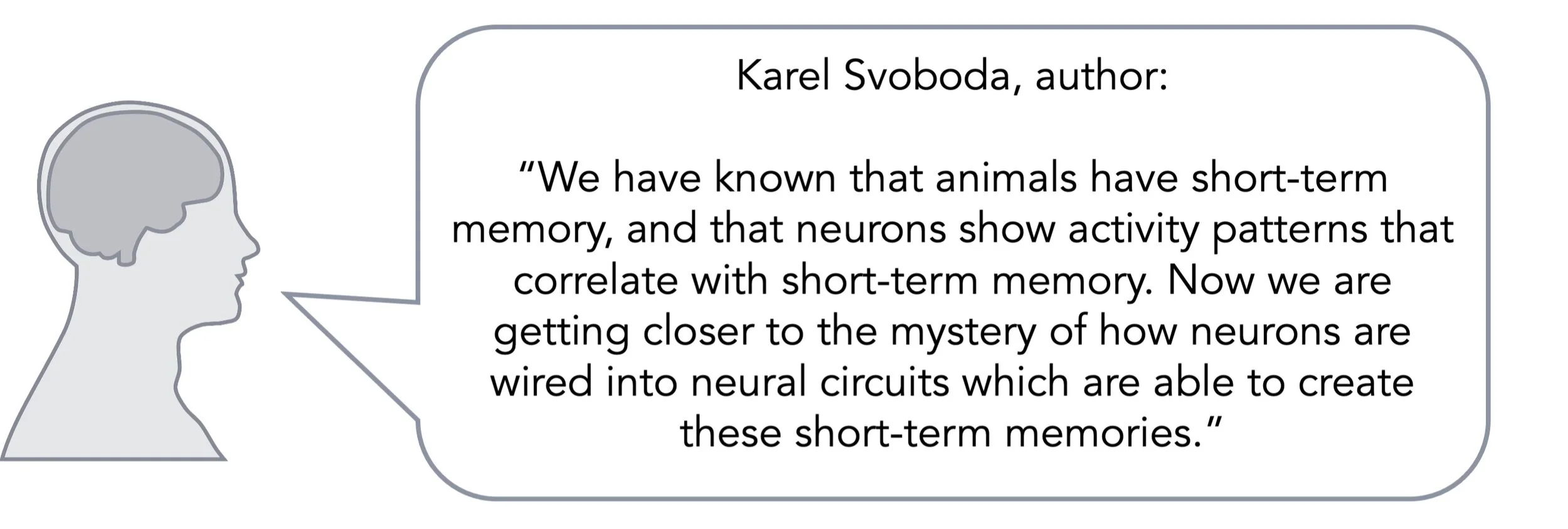
Neurons generally fire briefly in response to stimuli that activate them. However, the neurons that underlie short-term memory are arranged in “circuit motifs,” or interconnected groups of neurons that continue to activate one another. This pattern of activation allows neurons to maintain a signal after the initial stimulus has ended, forming the basis of short-term memory. Circuits can take many forms in terms of the way they are connected and the strength of their connections. It is still unclear what role these different forms of motifs play in short-term memory. This week in Nature Neuroscience, Daie and colleagues investigated circuit motifs of short-term memory by using lasers (photostimulation) to stimulate neurons in the anterolateral motor cortex, an area of the brain that stores short-term memories for upcoming planned movements.

How did they do it?

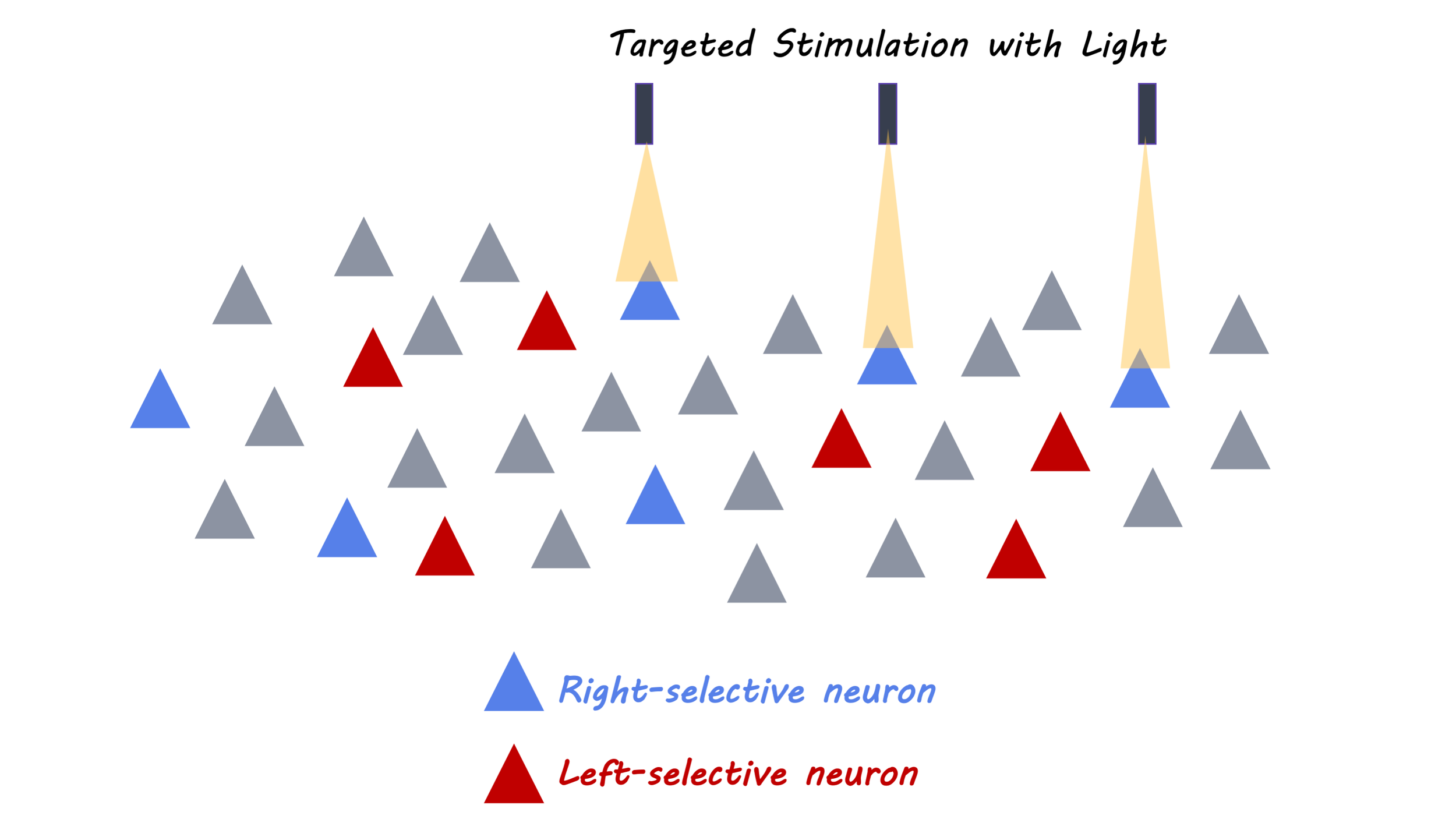
The authors used data from adult mice that expressed genes allowing the authors to activate neurons with light and record activation as fluorescence. They imaged neuron activation while the animals behaved freely using two-photon microscopy. The mice were trained to distinguish between two different auditory stimuli, responding either “right” or “left” for a reward. By imaging neuron activity while they performed this task, the authors could identify which specific neurons were selective for left and right movement directions. 

photostim_feb2.png

Next, in order to better understand circuit motifs, the authors directly stimulated entire groups of neurons at the same time. They then measured the activity in neurons that were greater than 30 micrometers away from the directly targeted neurons. By activating these groups of neurons within a network, the authors could test whether other nearby neurons would also respond to this activation, or in other words, whether they were ‘coupled’ with this circuit. Using the activation patterns, they were able to calculate the connection strength between stimulated and unstimulated neurons in the same circuit, as well as the duration of activity in the circuit. Furthermore, they examined the activity of neurons selective for “left” and “right” responses in the behavioral task following stimulation. 

What did they find?

The authors found that stimulating small groups of neurons altered activity in other nearby neurons, demonstrating that they were ‘coupled’ with that circuit. These ‘coupled’ neurons that were indirectly activated also showed persistent activity lasting well beyond the duration of the light stimulation. This finding demonstrates evidence for circuits composed of strongly-connected subnetworks that produce persistent activity which may underlie short-term memory. The authors also found that neurons with similar directional selectivity (i.e. ‘right’ or ‘left’ in the behavioural task) were more likely to be coupled. When the authors stimulated neurons that were selective for the ‘right’ direction or ‘left’ direction in the behavioural task, they found that this stimulation reliably biased behaviour in the task to a greater degree than would be expected by chance. However, the direction of movement did not necessarily correspond with the selectivity of the neuron (e.g., right activation did not always result in a rightwards movement). The authors concluded that the activation of a small group of neurons reliably predicted neural activity and behaviour (i.e. movement direction).

What's the impact?

This study found that brief stimulation of groups of neurons resulted in long-lasting, persistent activity in a network of neurons. Further, the authors demonstrated that the stimulation indirectly activated nearby ‘coupled’ neurons, suggesting that these circuits are composed of subnetworks or modules. The persistent activity in these networks was directly related to short-term behavioural outcomes. These findings provide insight into the mechanisms of short-term memory at the circuit level. Future research is needed to further investigate the structure and activity of these modular networks and how they impact short-term memory and behaviour.

Svoboda_Feb2.jpg

Daie et al. Targeted photostimulation uncovers circuit motifs supporting short-term memory. Nature Neuroscience (2021). Access the original scientific publication here.