
Non-Invasive Electrical Brain Stimulation Reduces Obsessive-Compulsive Behaviours

Post by D. Chloe Chung

What's the science?

Obsessive-compulsive (OC) behaviours are characterized by excessive, unreasonable thoughts and repetitive behaviours. While the exact underlying mechanisms are unclear, OC behaviours may result from excessive habit learning. Habit learning involves the brain’s medial orbitofrontal cortex (OFC) which is connected to the brain’s reward network. This week in Nature Medicine, Grover and colleagues show that non-invasive OFC stimulation, using a high-frequency current to target the high-frequency neural activity associated with reward processing, can modulate OC behaviours.

How did they do it?

In the first experiment, the authors wanted to determine the role of high-frequency, beta-gamma rhythms in reward learning. To do this, they selected a monetary reinforcement learning task that included two trial types – “reward trials” in which the participants earn money (versus not earning any) upon making an optimal choice (choosing the correct image), and “punishment trials” in which the participants lose money (versus not losing any) upon making an incorrect choice (choosing the wrong image). Before the actual task, beta-gamma frequency band activity was measured for 60 participants using electroencephalography (EEG), while the participants learned how to associate visual stimuli with monetary gain and loss. Next, the participants randomly received either control (“passive” sham or “active” alpha frequency of ~10Hz) or personalized beta-gamma neuromodulation (~27Hz on average) and completed the reinforcement learning task for 30 minutes each before, during, and after the neuromodulation (90 minutes total). 

In the second experiment, the authors aimed to evaluate whether chronic beta-gamma neuromodulation of the OFC can impact OC behaviours. To test this, 64 participants first completed a self-assessment of their OC behaviours and then received either control, alpha frequency, or personalized beta-gamma frequency for 5 days (30 minutes per day). The participants self-assessed their OC behaviours right after the last neuromodulation, as well as 1, 2, and 3 months post-neuromodulation. After these two experiments, the authors analyzed the relationship between intrinsic beta-gamma rhythms and a) changes during the reward learning and b) OC behaviours caused by beta-gamma neuromodulation.

What did they find?

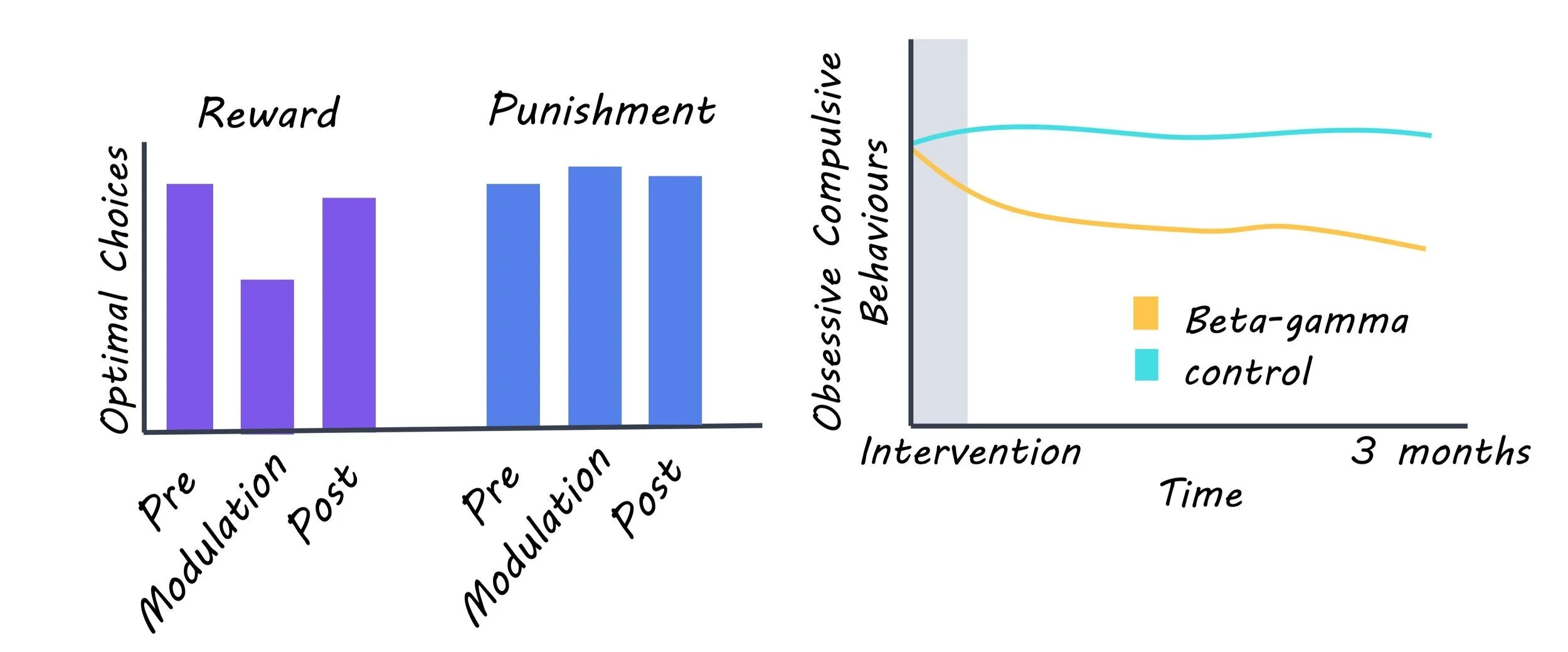
In the first experiment, the authors observed that the reward behaviour was altered upon personalized beta-gamma neuromodulation targeting the OFC. Participants made fewer optimal choices during the reward trials of the monetary reinforcement learning task, while no change was observed in either control condition. Importantly, beta-gamma neuromodulation changed behaviours during the reward trials but not during the punishment trials, indicating that beta-gamma frequency specifically modulates reward-related behaviours. These neuromodulation-induced changes in the reward behaviour were found to be reversible, as the participants showed a similar rate of making optimal choices both before and after the neuromodulation. 
chloe+%282%29.jpg

In the second experiment, the authors found that the 5-day beta-gamma neuromodulation successfully reduced obsessive-compulsive behaviours for three months (based on self-assessment). Interestingly, participants with more severe OC symptoms displayed a more drastic reduction in their compulsive behaviours after neuromodulation. Lastly, by comparing the two experiments, the authors found that convergent mechanisms exist between both neuromodulation-regulated reward and OC behaviours.

What’s the impact?

This study demonstrates that high-frequency neuromodulation can effectively regulate reward learning. Further, this work supports the link between reward learning and OC behaviours by highlighting shared mechanisms between the two. Findings from this study strongly suggest potential clinical benefits of personalized neuromodulation for obsessive-compulsive disorder (OCD) patients. It will be interesting for future studies to use additional methodologies, such as neuroimaging, to discover how neural processes are altered by beta-gamma neuromodulation.
chloe_jan26.jpg

Grover et al. High-frequency neuromodulation improves obsessive-compulsive behavior. Nature Medicine (2021). Access the original scientific publication here.

The Effect of Nucleus Accumbens Medium Spiny Neuron Subtypes on Stress-Induced Sleep Changes

Post by Lincoln Tracy

What's the science?

Stress is a key contributor to both major depressive disorder and post-traumatic stress disorder. These two conditions have common symptoms, including diminished motivation and sleep dysregulation. Chronic social defeat stress (CSDS) is commonly used to study altered motivation in rodents. Medium spiny neurons within the nucleus accumbens (NAc) release dopamine and contribute to altered motivation in CSDS. Although CSDS can disrupt sleep in mice, the NAc cells’ role in sleep disruption is unknown. This week in Biological Psychiatry, McCullough and colleagues used chemogenetics (the use of chemicals to activate or deactivate certain cells) to selectively manipulate the function of the two dopamine-expressing, medium spiny neuron populations in the NAc to explore the neural mechanisms responsible for the effects of stress on sleep in mice.

How did they do it?

The authors infused viral vectors into the NAc, which would later be activated through clozapine administration in drinking water. Electroencephalography (used to measure brain activity) and electromyography (used to measure muscle activity) wires were attached to the skull and sutured into the trapezius muscle (respectively), while transmitters were implanted into the abdomen of mice to quantify sleep, locomotion, and body temperature. After recovery, mice underwent 10 days of CSDS. Two cohorts of mice were used: one to assess sleep, and the other to assess stress susceptibility. The effects of activating or inhibiting two NAc medium spiny neuron subtypes, D1 and D2 receptor-expressing neurons, were examined over a 10-day period in the former cohort. The latter cohort underwent a battery of behavioral tests: social interaction tests, open field tests, and elevated plus maze tests.   

What did they find?

First, the authors found that chronic inhibition or excitation of medium spiny neurons expressing D1 or D2 receptors in the NAc had unique effects on sleep. Inhibition of medium spiny neurons expressing D1 receptors mimicked the effects of CSDS on rapid eye movement (REM) sleep (i.e., it disrupted sleep) without affecting slow-wave sleep. Activation of the D1-medium spiny neurons had the opposite effect. Conversely, activation of D2-medium spiny neurons increased the time spent in slow-wave sleep. There was no effect of D2-medium spiny neuron activation or inhibition on any of the REM sleep metrics. Taken together, the combined effects of inhibiting D1-medium spiny neurons and activating D2-medium spiny neurons on sleep mirror that of CSDS. They also found that, while activating or inhibiting D1-medium spiny neurons did not reliably alter the daily rhythms in body temperature, activating D2-medium spiny neurons decreased average body temperature. Finally, behavioral testing revealed that D1-medium spiny neuron inhibition increased susceptibility to stress, while D1-medium spiny neuron activation promoted stress resilience, suggesting that they have opposing behavioral effects. 

Lincoln_Jan19.png

What's the impact?

McCullough et al. have identified novel information about how stress changes neuronal circuits and leads to numerous diagnostic features of psychiatric illnesses. These findings have translational relevance, as sleep can be defined and measured consistently in both mice and humans. An enhanced understanding of the neural mechanisms underlying the common symptoms of major depressive and post-traumatic stress disorders may improve diagnoses and assist in developing novel treatments that target specific NAc neuronal populations to relieve stress-related illnesses.

McCullough et al. Nucleus accumbens medium spiny neuron subtypes differentially regulate stress-associated alterations in sleep architecture. Biological Psychiatry (2021). Access the original scientific publication here.

Musical Memory in Autism and Williams Syndrome

Post by Anastasia Sares

What's the science?

Music has been called a “human universal,” as its presence has been found in almost every known culture. While musical instruments have an important place, the human voice is one of the most primal music-makers. In fact, people tend to remember melodies better when they are sung than when they are played on instruments: this is sometimes called the voice advantage. The voice advantage has been observed in neurotypical populations, but until now it was uncertain whether it extended to people with Autism or Williams syndrome. One of the primary diagnostic criteria for Autism is problems with communication, while people with Williams syndrome are often hyper-communicative. This week in Autism Research, Weiss and colleagues showed that, despite these differences in response to social cues in general, people with Autism and Williams syndrome still have a voice advantage for remembering melodies, just like neurotypicals.

How did they do it?

The authors performed a simple memory test in three groups of people: one typically developing group, one group with Autism, and another group with Williams syndrome. The groups were matched for mental age, so that their memory for the melodies could be compared. Each group was exposed to a variety of melodies, some played on the piano, some played on marimba, and some performed vocally. They were asked to rate how much they liked each melody. After the initial exposure task, they were exposed to more melodies, some repeated and some new, and asked if they remembered them.

What did they find?

The authors compared the “hit rate” (the number of old melodies correctly identified as old) with the “false alarm rate” (the number of new melodies incorrectly identified as old). This technique is part of signal detection theory, which accounts for some people’s tendency to say they remembered something even when they didn’t. As long as the hit rate was greater than the false alarm rate, the researchers would assume that the participants were not answering randomly and that their participants did have some memory of the melodies. All the groups had more hits than false alarms.

voice_jan19.jpg

However, the difference between hits and false alarms was greater for vocal melodies, an indication of the voice advantage. This was present in all of the groups, not just the typically developing group.

What's the impact?

When researching conditions like Autism and Williams syndrome, it’s important to acknowledge what skills are intact, instead of just looking for differences. This research shows that the voice advantage generalizes to non-neurotypical populations. It also suggests that it might be possible to use vocal music therapeutically in these groups, especially in Autism to help with verbal communication.

Weiss et al. Enhanced Memory for Vocal Melodies in Autism Spectrum Disorder and Williams Syndrome. Autism Research (2021). Access the original scientific publication here.