
How Do the Blind See?

Post by Elisa Guma

What's the science?

At rest — independent of external stimulation — the brain generates spontaneous activity. Our knowledge about the functional role of this brain activity is limited. However, scientists hypothesize that it generally underlies unprompted, internally-generated behaviours, including hallucinatory experiences. This week in Brain, Hahamy and colleagues investigated whether spontaneous brain activity evokes unprompted cognitive behaviours by observing the neural correlates of visual hallucinations in the visually impaired. 

How did they do it?

To investigate the relationship between spontaneous activity in the brain’s visual cortex and participants’ visual hallucinations, the authors recruited five individuals with Charles Bonnet syndrome (CBS), a rare condition characterized by the development of complex visual hallucinations following the onset of visual impairments or vision loss.

During functional magnetic resonance imaging (fMRI), CBS participants were instructed to provide verbal reports of their hallucinations. The authors then used these reports, along with reported post-hoc details about the content of the hallucinations, to create movies simulating the hallucinatory streams. To compare the neural activity associated with the internally-generated hallucinations, the authors showed these videos (external stimulation) to thirteen sighted controls during fMRI scanning. Finally, the 5 CBS participants, 13 sighted controls, and an additional group of 11 late-onset blind individuals not experiencing visual hallucinations underwent a cued visual imagery task during fMRI scanning where they were asked to imagine faces, houses, objects, and patterns, to serve as cued, internally-generated vision.

The authors extracted the blood oxygenation level-dependent (BOLD) brain activity from participants’ fMRI scans and used nonparametric statistics to identify the brain regions associated with a) hallucinations in the CBS group, b) the external stimulation (video of hallucinations) in the sighted controls, and c) the internally-generated, cued visual imagery task in all groups. Additionally, the authors compared the temporal dynamics of brain activity (as measured by BOLD) during hallucinatory events and visual stimulation to identify whether any changes in BOLD preceded the onset of visual experiences.

What did they find?

CBS participants’ brains showed significant activation across the entire visual cortex during hallucinations. Similar effects were observed in sighted controls during simulated hallucinations (i.e., watching the videos). Next, the authors compared brain activity during hallucinations to that of cued imagery, both of which are internally generated, but only hallucinations were unprompted. During the visual imagery task, sighted controls tended to activate high-order visual areas while deactivating mid-level areas, whereas CBS and blind control groups showed activations across the entire visual system, with very similar spatial patterns as those found during hallucinations.

elisa.jpg

Investigation of the temporal dynamics of the BOLD signal revealed BOLD signal increases during hallucinations in the CBS group and during simulated hallucinations in the sighted controls. Interestingly, the signal in the CBS group increased before the onset of hallucinations in early visual areas and then spread to higher-order areas, providing some evidence that the hallucinations may be a result of a buildup in spontaneous activity in the visual cortex. Importantly, no differences in dynamics were observed in the cue-driven visual imagery scans.

What's the impact?

The findings presented here show that, unlike other visual experiences, visual hallucinations may arise due to a buildup of neural activity in the early visual cortex, which then spreads to higher-order visual areas. This provides a plausible mechanism for the emergence of visual hallucinations in CBS. More broadly, these findings highlight the possible role of spontaneous brain activity in evoking visual hallucinations following visual deprivation. Future work may further investigate the relationship between spontaneous brain activity and other internally-generated behaviours, such as dreaming.     

Hahamy et al. How do the blind ‘see’? The role of spontaneous brain activity in self-generated perception. Brain (2020). Access the original scientific publication here.
Attention is Enhanced Prior to Anticipated Emotional or Neutral Stimuli

Post by Amanda McFarlan

What's the science?

We encounter many stimuli in our daily lives and must choose to attend to relevant stimuli while filtering out irrelevant ones. This is not always an easy task, especially in distracting environments. Researchers have focused on studying how distractions affect ensuing behaviour, but little is known about how we prepare for a distraction that we know is coming. This week in Psychological Science, Makovski and Chajut investigated how individuals prepare for anticipated distractions and whether they prepare differently depending on the distraction type.

How did they do it?

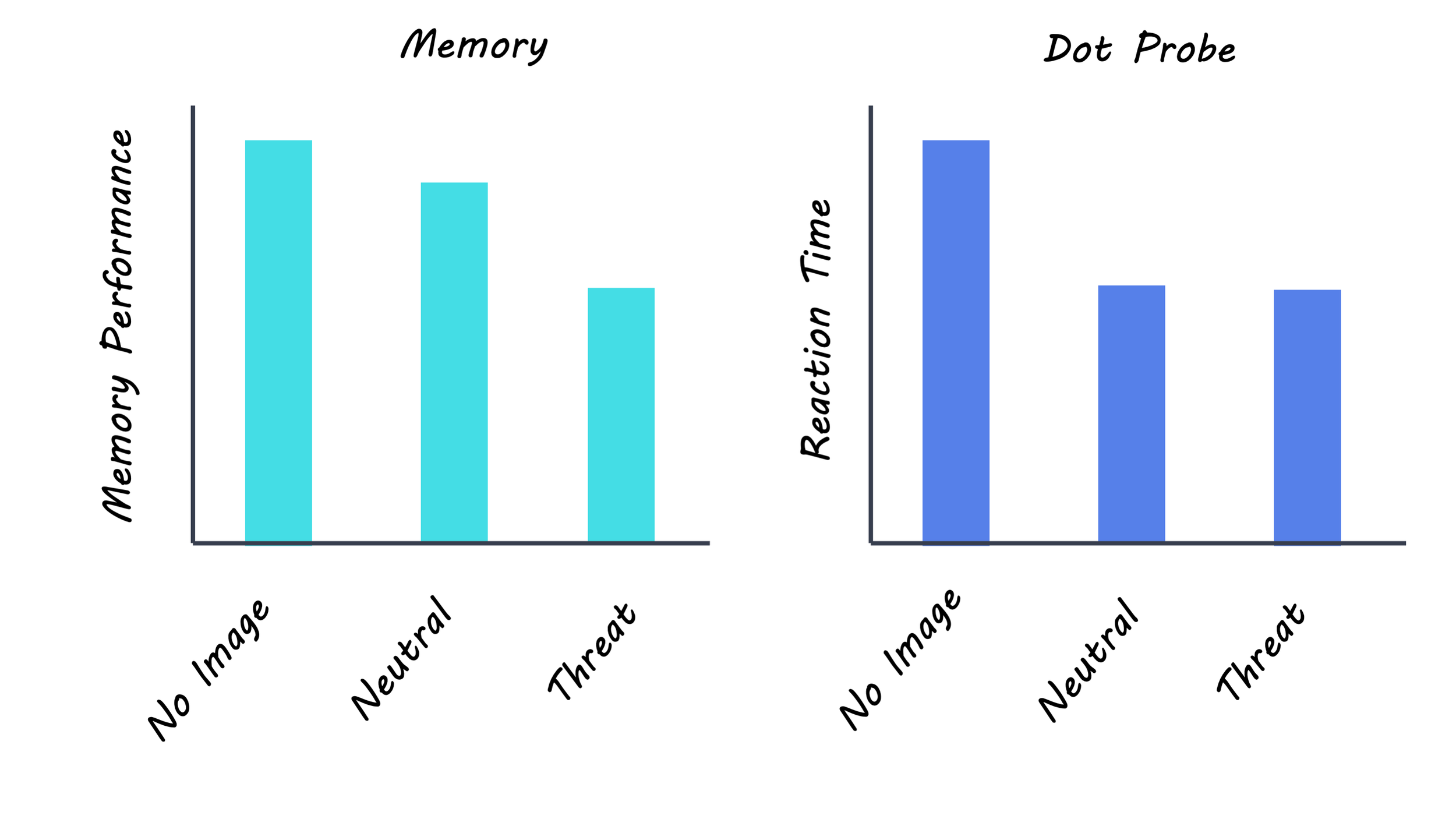
In the first experiment, participants performed a memory task, in which they were briefly shown an array with four differently coloured circles and asked to memorize it. This was followed by a designated period of retention during which participants were shown either a) no image at all or b) a neutral or threatening image, which they were instructed to ignore. Then, participants were presented with a colour probe and had to identify whether it was in the same position as it was in the memory array. In a subset of trials, a very small grey dot (‘dot probe’) appeared instead of the anticipated neutral or threatening image, and participants were asked to indicate when they detected the dot. 

In the second experiment, the methods remained mostly unchanged, except the dot probe appeared after the neutral or threatening images rather than before. Then, in a third experiment, the neutral and threatening images were exchanged for joyful and disgusting images respectively. Participants’ anxiety levels were measured prior to experiments 1 and 3 using the State-Trait Anxiety Inventory questionnaire.

What did they find?

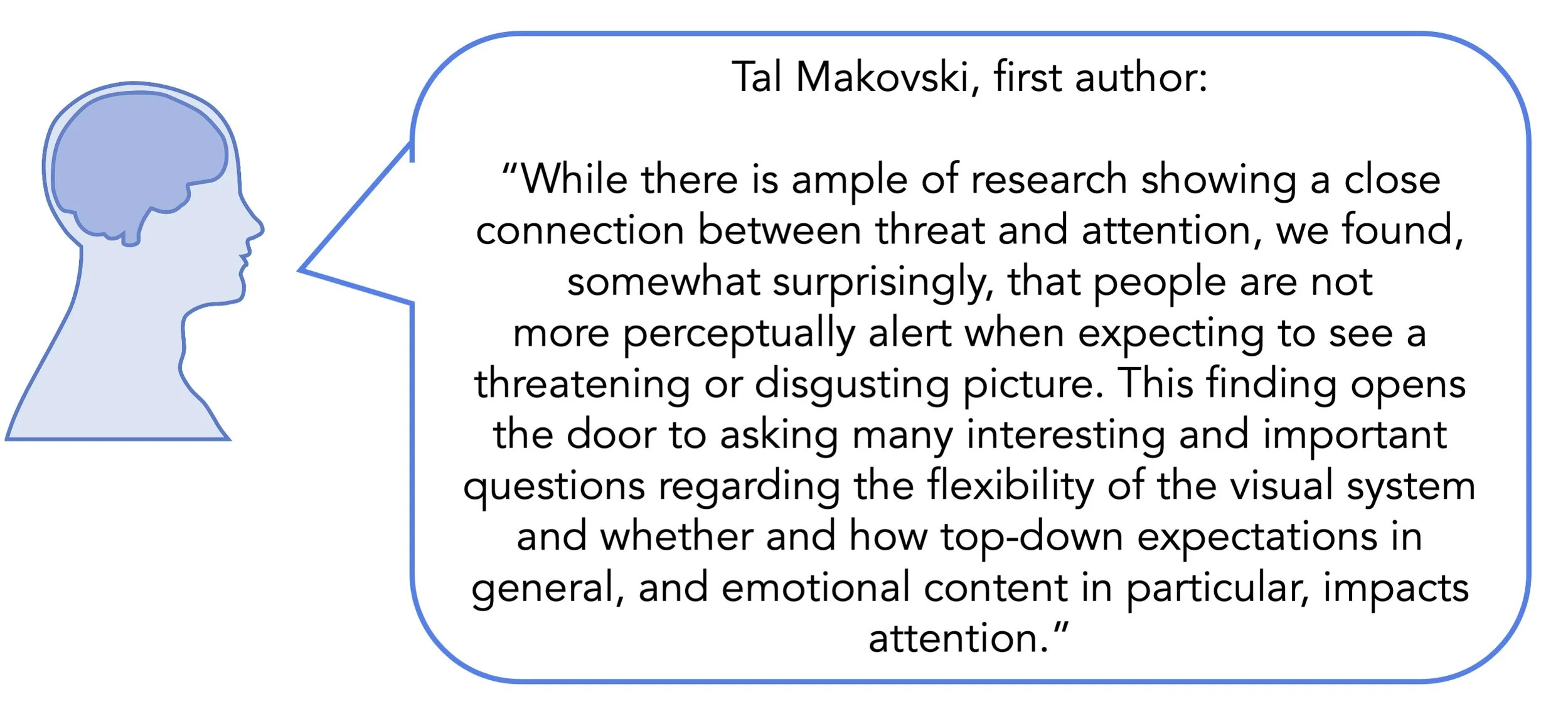
The authors determined that memory performance was worse in the threatening image condition (compared to the no image and neutral image condition). However, participants were faster at detecting the dot probe when they anticipated being shown an image, regardless of the image category (neutral or threatening, joyful or disgusting). Although there was a trend suggesting that people with high anxiety suffered more from the threatening images compared to people with low anxiety, overall, anxiety levels did not influence the response time for detecting the dot probe. In experiment 2, the authors found that response time was greatly impaired when the dot probe appeared after a threatening image (instead of before) compared to after a neutral image or no image. Together, these findings suggest that, despite the effects of image contents (threatening versus non-threatening) on memory performance, preparation was unaffected by image contents.  

amanda_img_jan12.png

What’s the impact?

This study shows that participants were more attentive when they anticipated any type of  stimulus compared to when they were not anticipating a stimulus at all. This suggests that people prepare the same way for an anticipated stimulus regardless of the type of stimulus. Although emotional valence associated with the stimulus (e.g., threatening) and corresponding anxiety levels can have an impact on behavioural performance after the stimulus is presented, they do not affect the way we prepare for a stimulus before it is presented.

Makovski_jan12.jpg

Makovski and Chajut. Preparing for the Worst: Attention is Enhanced Prior to Any Upcoming Emotional or Neutral Stimulus. Association for Psychological Science (2021). Access the original scientific publication here.
How Should We Think About the Brain’s Response to Threat?

Post by Kasey Hemington

What's the science?

A threat is something with a high probability of causing either mental or physical damage. When we encounter a threat, many related processes occur in the brain, such as detecting the threat, learning to associate a cue with the impending threat, remembering what cues (and in what contexts) predict the threat, updating how or whether certain cues predict the threat over time, and deciding on the best behavioural response. These processes are typically studied independently and are each considered to be disrupted as distinct entities in threat-related disorders like anxiety and post-traumatic stress disorder (PTSD). This week in Trends in Cognitive Sciences, Levy and Schiller reviewed the neural basis of threat and proposed that we aim to understand threat in a more holistic manner; by studying the processes that make up the threat experience as interconnected phases of threat with common underlying neural computations.

What do we already know?

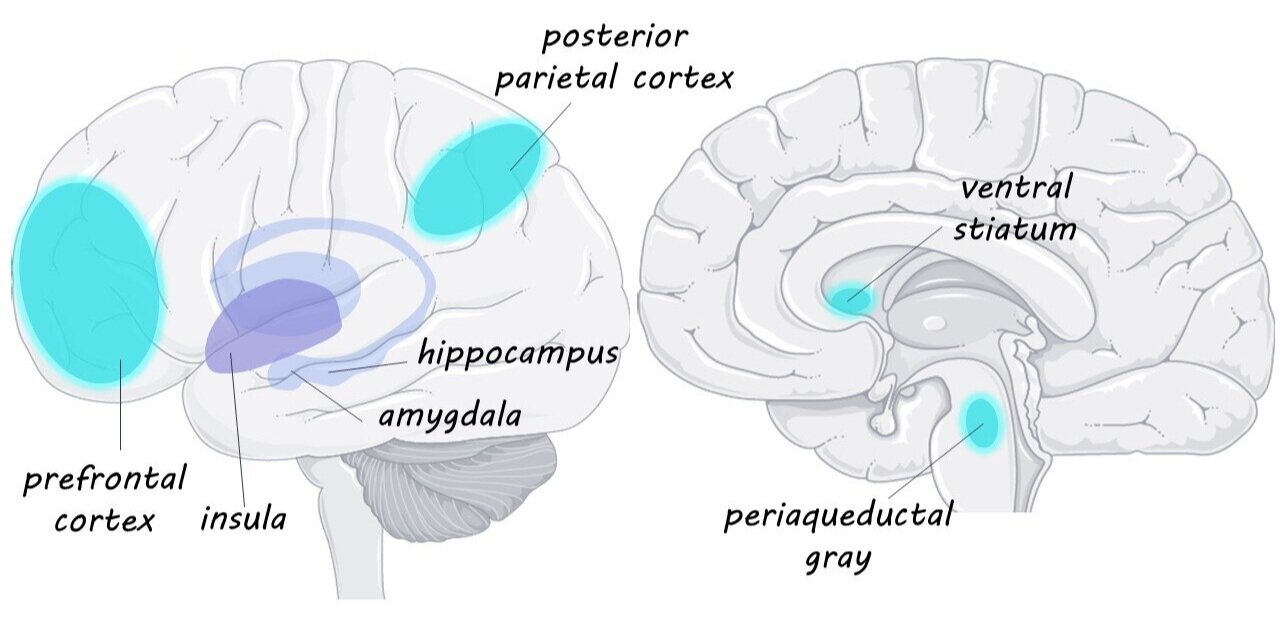
Though scientists often attempt to study them separately, it can be difficult to isolate the neural correlates of each aspect of the threat experience because each brain region known to be involved in these processes is involved in multiple processes. For example, the hippocampus, amygdala, and ventral striatum are involved not only in associative learning but also in decision-making, while areas of the prefrontal and parietal cortices are involved in decision-making but also learning. The insula is known to be involved in decision-making and learning, in addition to physiological reactivity, while the periaqueductal grey also plays a role in physiological reactivity, alongside providing threat-related signals to the amygdala. When it comes to understanding the brain’s response to threat, it may be more accurate to refer to the aforementioned regions as being part of one unified, global brain network.

What’s new?

Instead of studying each threat-related-process separately, the authors consider how different brain regions play a role in different ‘phases’ of the threat experience while asking the same neural computation-related question at each phase: in an uncertain and volatile environment, how does the brain use cues to predict outcomes?

For example, consider a person who witnesses a threatening event; the explosion of a blue car at close range. The authors divide this experience into five phases: 1) initial encounter (witnessing the explosion), 2) learning (that a blue car could signal danger), 3) post-association learning (e.g. learning whether the association should be generalized to cars of all colours), 4) memory retrieval and potential updating (remembering the danger in response to seeing another blue car, potentially stabilizing or destabilizing the threatening memory depending on the events and perception at the time of retrieval) and 5) decision making (e.g. choosing between whether to drive a car or ride a bicycle).  

kasey.jpg

The authors consider the neural correlates and clinical implications (for threat-related disorders) at each phase. 

Phase 1: As a threat becomes more imminent (for example, a predator moving into the field of view of its prey) there is a shift in brain activity from the prefrontal cortex to midbrain areas, and a corresponding shift in behavioural response from anxiety and fear to panic, freezing or fleeing. This pattern is mirrored in individuals with anxiety or PTSD; high anxiety is often experienced during anticipation of a threat before it is imminent. 

Phase 2: Learning the association between a cue and a threat occurs via prediction error in the brain; there is a difference between the expected and observed outcomes predicted by a cue, so the brain learns to update predictions. Synaptic plasticity in the amygdala results in the storage of threat memories. In individuals with anxiety disorders, learning may be overgeneralized in a maladaptive way to include cues that do not predict threat.

Phase 3: Extinction learning can counteract threat conditioning. It’s when repeated exposures elicit smaller and smaller responses to a stimulus over time. In the brain, the ventral tegmental area helps to compute a prediction error between expected and observed outcomes and sends a signal to other brain areas including the amygdala in order to update the memory with new extinction memories. In PTSD, defensive responses can linger following a threat for longer than they typically would.

Phase 4: When a memory is reactivated, this provides an opportunity to destabilize the memory (a cascade of cellular and molecular processes that put it in an unstable state) and potentially modify it in this unstable state. A clinical goal for PTSD and anxiety is to modify these threatening memories long-term, by reactivating the memory, alternating the memory to include a more adaptive emotional response, and ultimately altering the way an individual engages with the world. 

Phase 5: Decisions such as avoidance of a cue indicative of a threat are made based on subjective valuation of a potential outcome, for which the ventromedial prefrontal cortex and ventral striatum, in particular, are responsible. The uncertainty of the potential outcome is also encoded in the brain, including the ventral striatum, posterior parietal cortex, and anterior insula among other regions. Finally, the expected risk or reward and an individual’s overall tolerance for ambiguity are also weighed in the decision-making process. In PTSD and anxiety disorders, a decreased tolerance for ambiguity is observed.

What's the bottom line?

This review highlights learning, memory, and decision-making together as they relate to threat experiences and threat-related disorders. At the neural level, a response to threat can be thought of as computations that predict outcomes from cues. New associations become memories, which can be updated as behaviour and environments change. Finally, decisions can be made that incorporate these associations. This way of thinking about threats and related processes can help us to study the neural correlates of threat-related disorders like anxiety disorders and PTSD more holistically.

Levy and Schiller. Neural Computations of Threat. Trends in Cognitive Sciences (2020). Access the original scientific publication here.