Close Relationships Facilitate Efficient Performance of Social Goals

Post by Lincoln Tracy

What's the science?

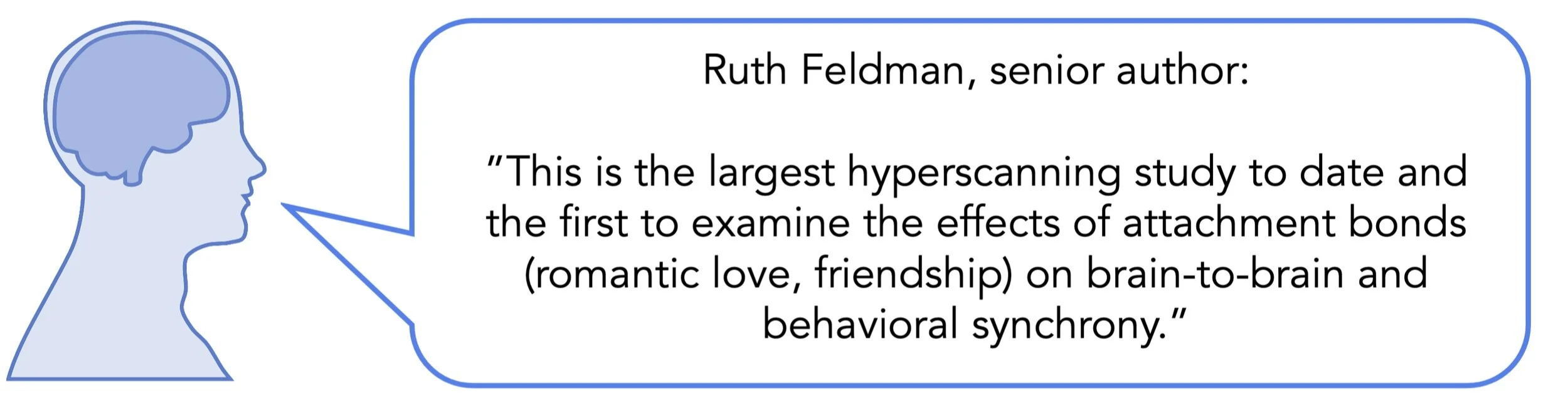
Humans are inherently social creatures with complex social skills. Neuroscientific models hypothesize that our brain has undergone substantial changes as we have evolved to become more social. The extent to which social behaviors are embedded in the human brain suggests that the brain operates by responding to natural and dynamic social exchanges to a greater degree than static or non-social stimuli. Consequently, social neuroscience research is focusing more on how brains synchronize during naturalistic social moments to achieve specific goals. Specifically, modern research utilizes hyperscanning, a method where data is collected simultaneously from two or more brains to measure synchronous activity. This week in NeuroImage, Amir Djalovski, A Ph.D. student at Ruth Feldman's lab sought to test how different types of relationships affect neural synchronization, by using electroencephalography (EEG) hyperscanning while partners completed various tasks. 

How did they do it?

The authors recruited 158 adults (79 male-female pairs) organized into one of three groups: couples (long-term romantic partners who had been living together for at least a year), friends (close friends), or strangers (demographically matched individuals who did not know each other). Both participants had an EEG cap placed on their heads for simultaneous recording of brain activity. Participants then engaged in two naturalistic interactions: a motor task and an empathy giving task. First, participants were given an “Etch a Sketch” and asked to draw predefined pictures while only being allowed to twist one nob each. Then, participants took turns sharing a distressing or troubling experience. After completing the tasks, participants rated how comfortable they felt in each task, and how empathic and helpful they felt their partner was. EEG data was bandpassed to assess brain synchrony in the alpha, beta, and gamma frequency bands. Electrodes on the EEG cap were divided into pre-defined brain areas of interest: left temporal, right temporal, and central. The level of behavioral synchronicity (i.e., social interactions) was assessed for behaviors such as a positive and relaxed mood and the reciprocity of interaction.

What did they find?

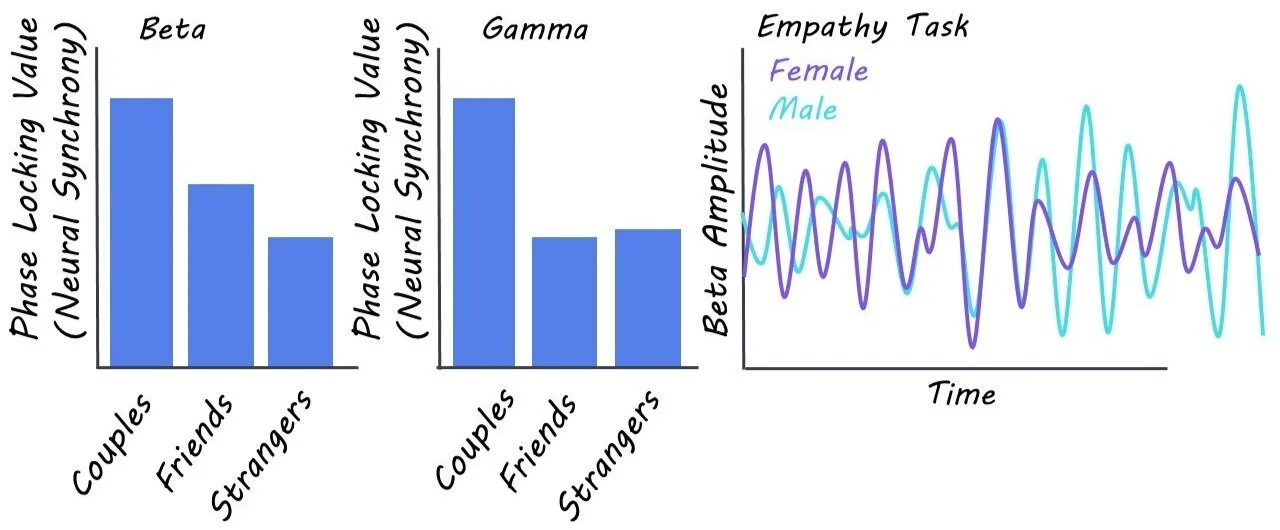
Couples displayed higher behavioral synchronicity, higher interbrain synchronicity, and task performance on the motor task compared to friends and strangers. Importantly, the relationship between behavioral and neural synchrony was only moderated by attachment bonds in couple pairs. That is, the greater the behavioral synchrony the higher the neural synchrony (in couples). In the empathy giving task, couples again displayed higher behavioral synchrony compared to strangers. Couples showed the lowest interbrain synchrony during the empathy giving task, while strangers exhibited the highest. However, strangers felt much less supported than couples or friends during the empathy giving task.
lincoln.jpg

What's the impact?

This study shows that natural social processes in the brain are shaped by attachment bonds and sustained by behavioral coordination. Specifically, romantic partners who lived together displayed the most efficient two-brain-two-behavior balance toward best performance. This highlights how attachment bonds shape interpersonal brain processes, and that differences between romantic partners and strangers are not simply the result of familiarity. Rather, other aspects of long-term romantic love contribute to these differences. While the hyperscanning literature is rapidly growing and more research is needed, this study underscores the importance of looking at interbrain processes in order to understand how two brains synchronize during real-life social interactions.   
hyperscanning_quote_dec8.jpg

Djalovski et al. Human attachments shape interbrain synchrony toward efficient performance of social goals. NeuroImage (2021). Access the original scientific publication here.
Behavioral and Neural Correlates of Stress in Response to Threat In Virtual Reality

Post by Cody Walters 

What’s the science?

It has been challenging to study fear and anxiety in humans owing to the limited number of experimental paradigms that mimic naturalistic threat scenarios in a lab setting. This week in Current Biology, Balban et al. utilized a novel virtual reality task to study the behavioral, physiological, and neural correlates of visually evoked threat in human subjects.

How did they do it?

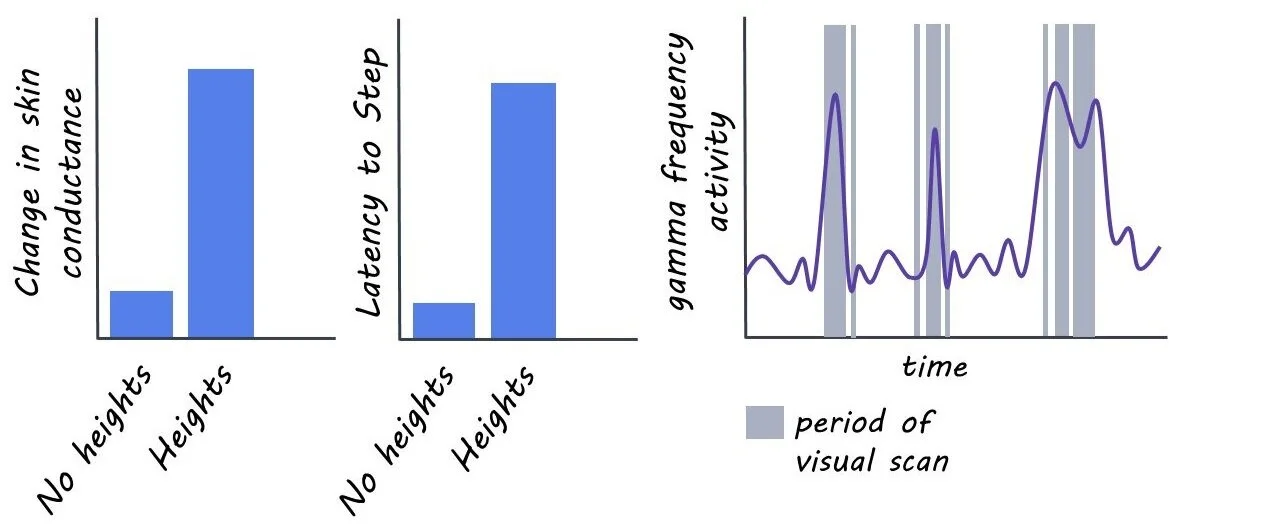
Subjects wore a virtual reality (VR) headset that realistically depicted the laboratory room where the experiment was being conducted. While wearing the headset, subjects were instructed to complete a cognitive task using a virtual panel on the wall, then 1 minute into the task the panel would move to the other end of the virtual room. At the moment of the panel transition, the VR room would undergo one of two possible modifications: a ‘no heights’ stimulus (during which the walls and ceiling were removed to reveal a gray background) and a ‘heights’ stimulus (during which the walls, ceiling, and parts of the floor were removed to reveal a 150 ft above-the-ground skyscraper landscape). 

During the heights stimulus, participants navigated across a plank to reach the panel on the other side of the room and complete the cognitive task, eliciting a height-induced visual threat response. While subjects performed the task the authors recorded their heart rate, skin conductance levels, eye movements, and respiration. Additionally, the authors ran a similar experiment in a cohort of epilepsy patients fitted with intracranial electroencephalography (iEEG) for seizure localization, thus allowing for the recording of neural data in tandem with skin conductance and eye tracking metrics in this group. 

What did they find?

The authors found that the participants’ skin conductance, heart rate, and respiration all increased upon seeing the heights stimulus. During the heights condition, visual scans surrounding the plank positively correlated with skin conductance levels and latency to step out onto the plank (a measure of behavioral inhibition). These data indicate that the virtual heights stimulus triggered a physiological threat response. The authors observed that participants in the control condition exhibited less physiological arousal, fewer visual scans, and a reduction in the latency to approach the opposite side of the room compared to the heights condition. Individuals with anxiety disorders experience heightened levels of physiological arousal, yet it remains unclear how it affects their threat reactivity. To explore this question, the authors recruited a cohort of subjects who scored high in generalized or trait anxiety to perform the task. Relative to control subjects, anxious individuals (1) experienced an elevated skin conductance response (the fast-changing component of the galvanic skin response), (2) performed more visual scans, and (3) exhibited a significantly greater latency to step out onto the plank. Interestingly, there were sex differences among the anxious subjects, with females exhibiting a greater degree of behavioral inhibition than males. 

cody.jpg

In order to relate these behavioral and peripheral measures of arousal with neural signals, the authors recorded iEEG data from the insula and orbitofrontal cortex in epilepsy patients while they performed the task. They found that gamma activity in the insula positively correlated with skin conductance response during the heights stimulus, with high gamma activity preceding an elevated skin conductance response by approximately 8 seconds. Additionally, the authors found that there was elevated gamma activity in the insula during moments of threat-induced visual scanning. In the orbitofrontal cortex, on the other hand, theta activity negatively correlated with skin conductance response during the heights stimulus.

What’s the impact?

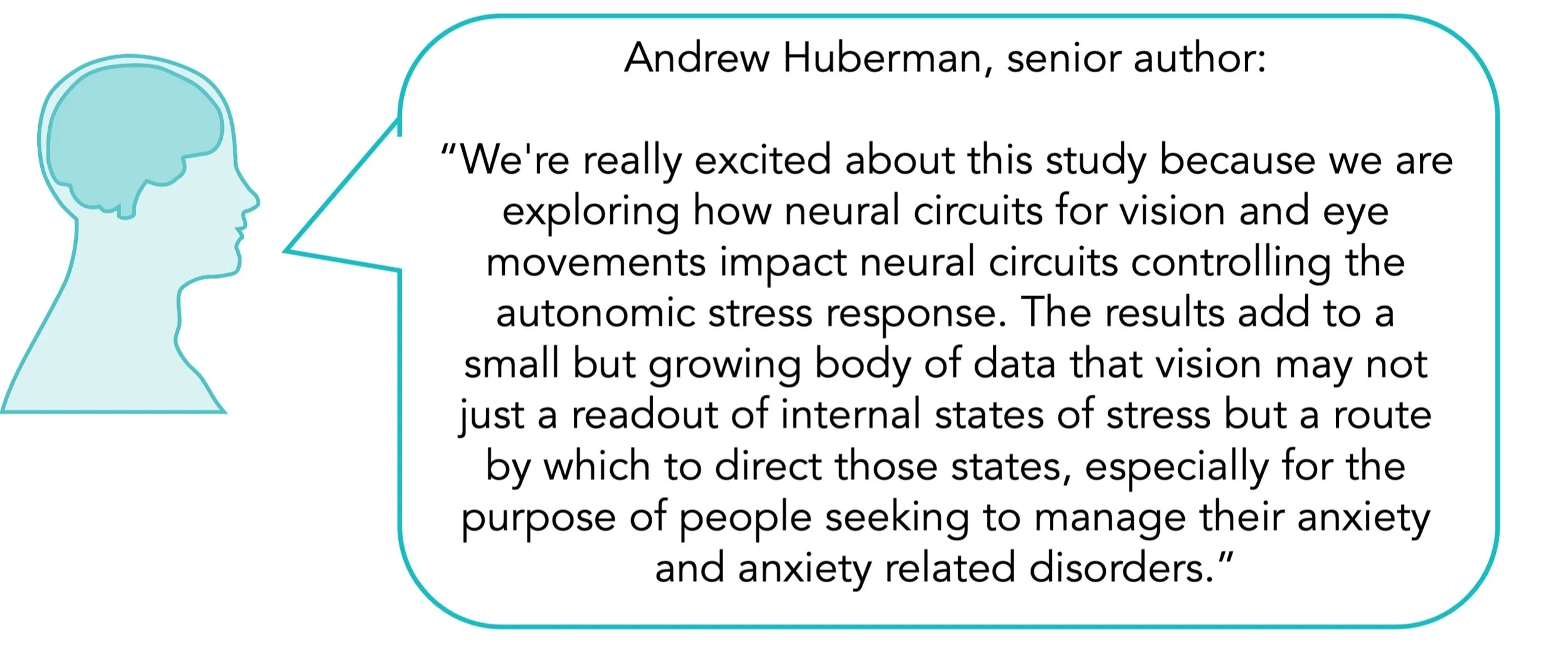
This study showed that increased visual scanning is a behavioral correlate of anxiety, and that brain activity is altered prior to sympathetic arousal induced by visual threat. Altogether, this study used a novel virtual reality paradigm to identify behavioral, physiological, and neural correlates of human stress in response to a semi-naturalistic threat scenario. 

threat_quote_dec8.jpg

Balban et al. Human Responses to Visually Evoked Threat. Current Biology (2020). Access the publication here.

Genetics Underlying Antidepressant Treatment Response

Post by Anastasia Sares

What's the science?

Depression is one of the most common psychiatric diseases in the world, and is growing in prevalence: major depressive disorder currently affects about 7% of adults in the USA and around 264 million people worldwide. A large percentage of people go untreated, and of those who do receive medication, not everyone responds to it. We still don’t fully understand how SSRIs, one of the most common depression medications, act to relieve depression in some people. We know SSRIs change the levels of the neurotransmitter serotonin in the brain, but how they relieve symptoms remains poorly understood. Advances in genetic research may help us better understand how they work and predict which people will respond to SSRI treatment. This week in Molecular Psychiatry, Liu and colleagues investigated a gene called ERICH3, showing that it plays a role in serotonin transport and storage, and could be involved in the brain’s response to SSRIs.

How did they do it?

The authors had identified ERICH3 as a gene of interest in a previous genome-wide study in individuals with depression. They found that expression of this gene correlated with levels of serotonin in these individuals, and that it was also associated with their responsiveness to SSRI treatment. They wanted to characterize this gene in more detail, see what kinds of proteins it codes for, and describe how these proteins behave. When a gene is being turned into a protein that can act in the body, not all of the material in the gene is used. Sections of the gene are transcribed into messenger RNA in the nucleus of the cell, and these messenger RNAs leave the nucleus and are translated into proteins. More than one sequence of messenger RNA can be created by reading different sections of the gene. So, the first step to characterizing a gene is to figure out what messenger RNAs are being made. The authors used published data— RNA material collected directly from individual brain cells during surgery— to see which messenger RNAs were present in the human brain.

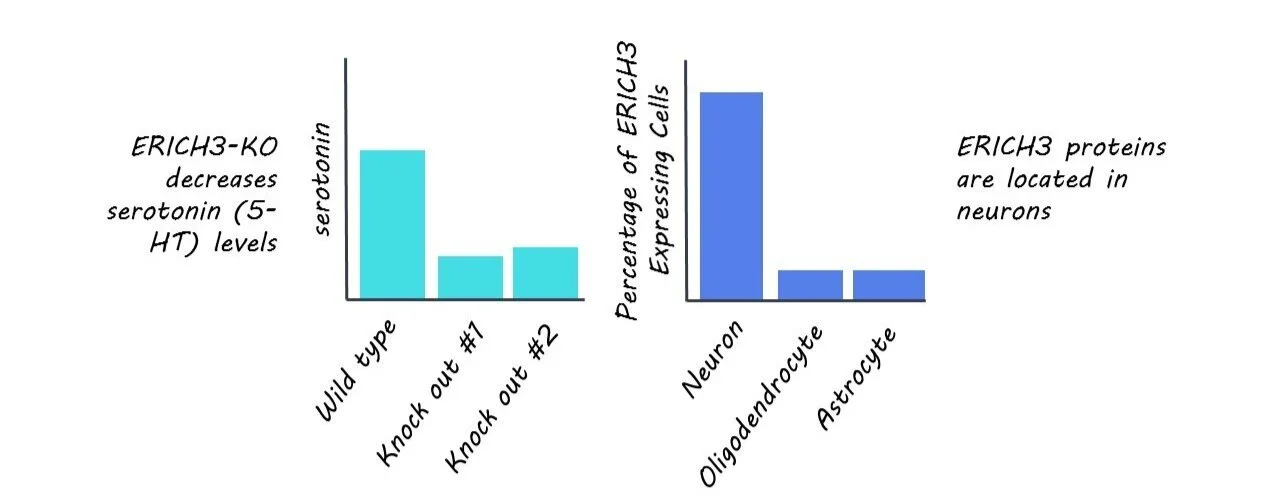
The next step was to look at the proteins—the functional molecules—coded for by these RNA sequences. For this step, the authors used cell culture: they inserted genetic material derived from their RNA into a dish of living cells. The cells translated this material into proteins, which could then be isolated and analyzed. The authors also decided to knock out the ERICH3 gene in a different set of cells and monitor the effects on serotonin production. The final step was to verify that specific variants of this gene actually affected people’s response to antidepressants in an independent sample. Since the gene had been originally identified by a similar correlation, it was important to show that it could be replicated in a new group of people, and wasn’t due to random chance.

What did they find?

There were 3 predominant sequences of RNA produced by the ERICH3 gene, and these were most prevalent in neurons. The proteins created from the RNAs were located in the cytosol (outside the cell’s nucleus), and associated with vesicle-like structures (vesicles are little packets of chemicals, including neurotransmitters, surrounded by a spherical membrane). The authors discovered that ERICH3 proteins would also bind to other molecules known to interact with vesicles. This finding suggests that ERICH3 might be involved in releasing and recycling serotonin—a process that SSRI drugs interfere with. When ERICH3 function was blocked, serotonin levels did indeed decrease. Finally, in an independent sample, the authors found that an individual’s genetic sequence in the ERICH3 gene was associated with their SSRI response.

Anastasia.jpg

What's the impact?

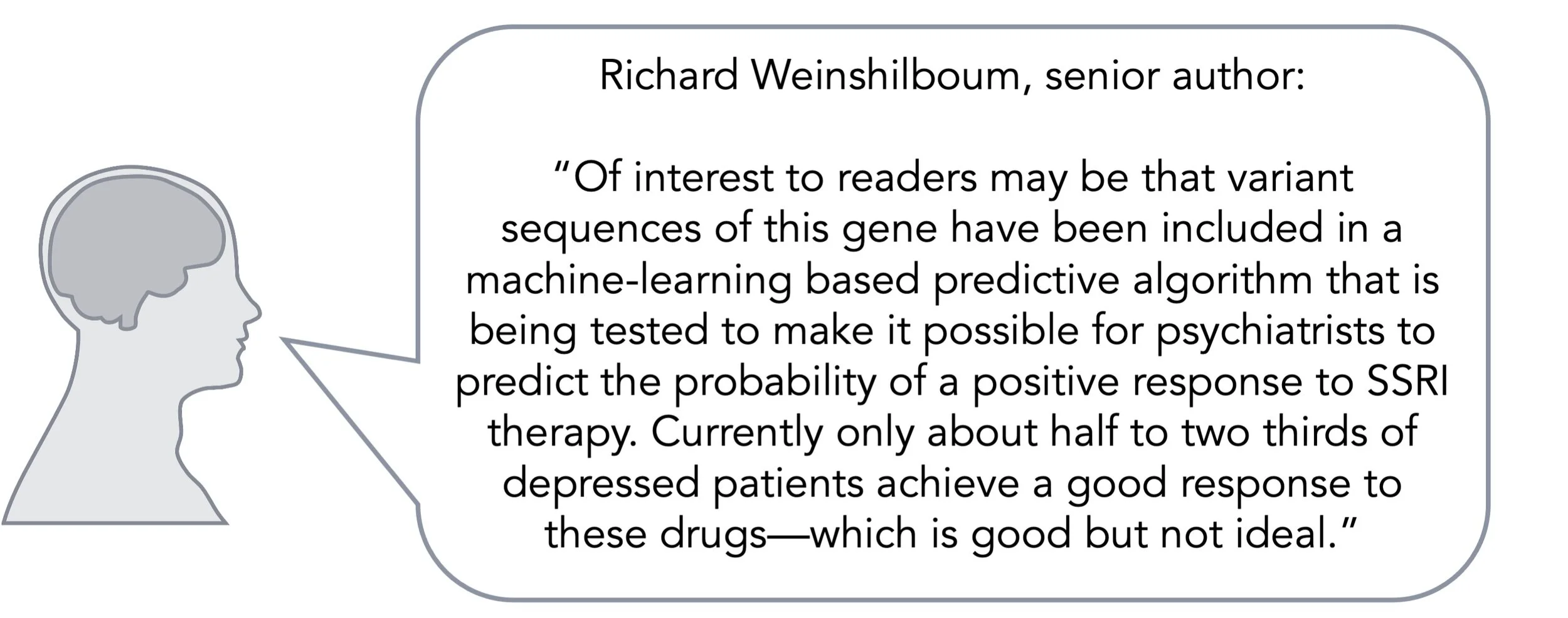
This work is crucial for our understanding of SSRIs and will help us understand which people are likely to respond to them, making it easier for psychiatrists to find the right medication for their patients sooner. That being said, medication is not the only way to tackle depression; psychotherapy and other lifestyle changes like regular exercise may also help, and combining approaches may be even more beneficial.

SSRI_quote_nov30.jpg

If you think you are experiencing symptoms of depression, don’t be afraid to reach out and get help. Do a quick internet search for mental health resources in your area, or try the following links:

United States

Canada

International

Liu et al. ERICH3: vesicular association and antidepressant treatment response. Molecular Psychiatry (2020). Access the original scientific publication here.