Surprise During Sports Viewing is a Predictor of Behavioural, Physiological and Neuronal Changes

Post by Amanda McFarlan

What's the science?

Event segmentation theory suggests that humans break down the continuous flow of new experiences into discrete segments that can be used as internal models for predicting future events. When these predictions of future events turn out to be wrong, we often experience surprise. Researchers have proposed that surprises may occur at the boundaries between these discrete event segments, which are reflected by behavioural and physiological changes like pupil dilation and increased neuronal activity. Surprise is also thought to be critical for learning and memory in order to update past beliefs with new information. Yet, scientific methods to measure naturalistic surprise are lacking. This week in Neuron, Antony and colleagues investigated how behavioural and physiological changes associated with discrete event segments relate to surprise during naturalistic sports viewing.

How did they do it?

The authors developed and validated a computational model that computes the probability of a given team winning after each change in possession of the ball during a basketball game. Using this model, they computed surprise as ‘the absolute value (either positive or negative) of the change in win probability at each possession boundary’. The authors tracked eye movements and performed functional MRI (fMRI) scans in participants while they watched the last 5 minutes of 9 different basketball games from the National Collegiate Athletic Association college basketball tournament. To study surprise in these participants, the authors created two constructs: belief-consistent surprise (surprise associated with a change in win probability that makes the team with the higher win probability even more likely to win) and belief-inconsistent surprise (surprise associated with a change in win probability that makes the team with the higher win probability less likely to win). Then, they tested the correlation between the proportion of perceived possession boundaries recalled by the participants with belief-consistent and belief-inconsistent surprise at those boundaries.

Next, the authors used hidden Markov models (HMMs; a type of statistical model that captures how the probability of a state depends on a previous state) to analyze the participants’ blood-oxygen-level-dependent (BOLD) responses from the fMRI scan in an attempt to identify discrete segments of neural activity that occurred while watching the basketball game. They investigated whether transitions between HMM-identified segments correlated with changes in possession of the ball, with belief-consistent and belief-inconsistent surprise, and with pupil dilation. Finally, the authors looked at neural activity in two brain areas associated with reward, the nucleus accumbens, and the ventral tegmental area, to determine whether a participant’s preference for one team over the other had an effect on neural activity in these regions depending on whether outcomes were positive or negative for their preferred team.   

What did they find?

The authors found that the proportion of perceived possession boundaries endorsed by the participants was significantly correlated with belief-inconsistent surprise, but not belief-consistent surprise, suggesting that segmentation of events is more robust when new and old information is conflicting. Then, the authors determined that the transitions between HMM-identified neuronal activity segments in the visual cortex and to a lesser extent, in the precuneus and medial prefrontal cortex, were significantly correlated with the true changes in possession during the game. These transitions were also significantly correlated with surprise across possessions in the medial prefrontal cortex and with belief-inconsistent surprise in all three areas. Together, these findings suggest that the visual cortex and precuneus are activated with small to moderate time scale changes like possession turnovers while the medial prefrontal cortex is activated during larger time scale events when there is a greater surprise.

sports_image_nov30.jpg

Additionally, the authors showed that changes in pupil dilation were significantly predicted by both belief-consistent and belief-inconsistent surprise. Finally, the authors found that neuronal activity in the nucleus accumbens had a marginally significant correlation with surprise when positive outcomes occurred for the subject’s preferred team, but not for surprise in general. Neuronal activity in the ventral tegmental area was significantly correlated with both overall surprise (regardless of whether the participant had a preferred team) and surprise indicating positive outcomes for the preferred team.

What’s the impact?

This study demonstrates that surprises that contradict a current belief (i.e. which team will win) predicted both behavioural and neuronal activity segmentation as shown by an increased perception of possession boundaries, and changes in neural activity. Additionally, the authors found that surprise correlated with increased pupil dilation and activity in areas of the brain associated with reward, suggesting that humans may have evolved to enjoy unpredictability when it is not critical for survival. Together, these findings provide insight into a novel way to investigate surprise using naturalistic stimuli.

Antony_quote_nov30.jpg

Antony et al. Behavioural, Physiological, and Neural Signatures of Surprise during Naturalistic Sports Viewing. Neuron (2020). Access the original scientific publication here.

The Anterior Cingulate Cortex is Involved in Both Visual Processing and Action Selection

Post by Shireen Parimoo

What's the science?

The prefrontal cortex controls which information from the environment is processed and selects the appropriate response to act on that information. One region in the prefrontal cortex in particular – the anterior cingulate cortex (ACC) – has been implicated in both the processing of visual information as well as motor functioning. Previous research suggests that projections from the ACC to the visual cortex (ACC-VC) and to the superior colliculus (ACC-SC), might be differentially involved in visual processing and motor responding, respectively. However, this prediction has not yet been empirically tested. This week in Nature Communications, Huda and colleagues used optogenetics and two-photon imaging to investigate the contribution of distinct populations of ACC neurons to visuomotor processing.

How did they do it?

Mice were trained on a visually guided task in which a visual stimulus was presented on one side of a screen and mice rotated a trackball to move the stimulus across the screen. In the inward task, mice rotated the trackball to the left or the right in order to move the stimulus toward the center of the screen, whereas in the outward task, the objective was to move the stimuli toward the opposite edge of the screen. Actions were labelled as ipsiversive (toward) or contraversive (away from) relative to activity in the left hemisphere of the brain. Task performance was based on several measures, including the rate of incorrect responses and the timeout rate (i.e. did not move the trackball within the allotted time).

The authors injected viral vectors and performed retrograde and anterograde tracing to identify neuronal projections between the ACC and the superior colliculus and the visual cortex. They then used 2-photon microscopy to examine the activation of these neurons in response to the visual stimulus and during motor responding in the visually guided task. To rule out the involvement of other, unlabeled ACC neurons in task performance, they also trained a type of statistical model — a linear classifier — to predict the action chosen by the mice based on the activation of unlabeled and labelled neurons. Lastly, the authors optogenetically inhibited ACC-SC and ACC-VC neurons while mice performed the task. They recorded task performance in response to the visual stimuli (right or left presentation) and the required action (ipsiversive or contraversive), which allowed them to identify the contribution of these regions to visual and motor processing.

What did they find?

Neurons in the visual cortex projected to the ipsilateral caudal ACC, providing visual information from the contralateral visual hemifield. In turn, neurons in the caudal ACC projected ipsilaterally to the superior colliculus. The caudal ACC received visual information from the ipsilateral hemifield via the corpus callosum, which connected the ACC between the two hemispheres. Importantly, distinct populations of neurons in the ACC were connected to the visual cortex and the superior colliculus. Thus, the anatomical organization of input and output pathways of the ACC did not overlap between the superior colliculus and the visual cortex.

shireen.jpg

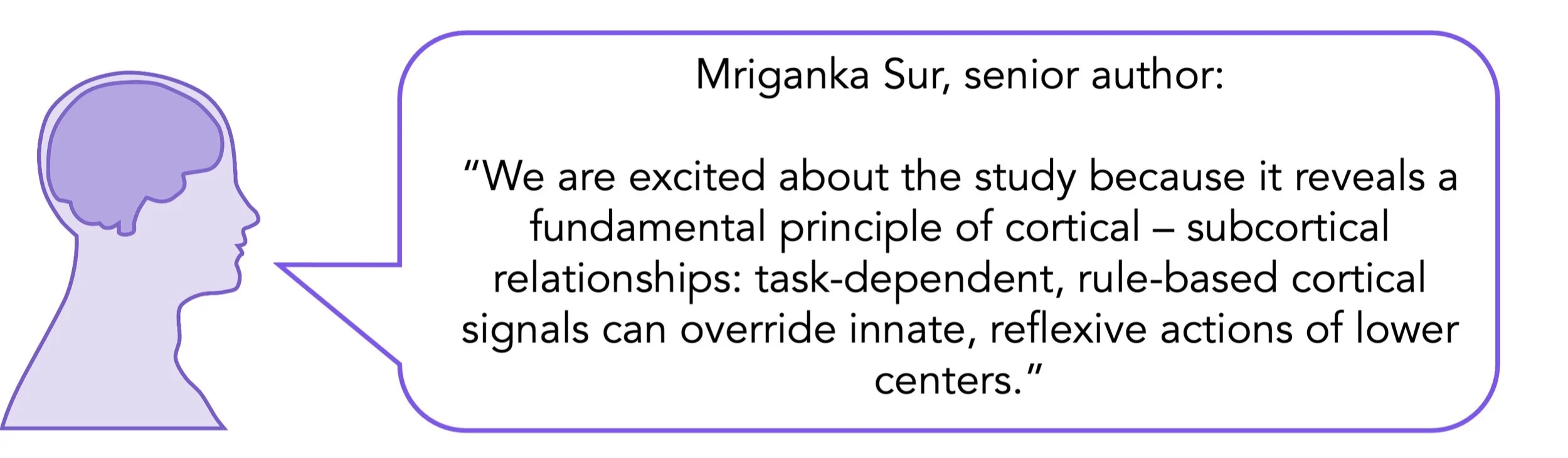
During the visually guided task, optogenetic inhibition of ACC-VC projections increased errors on the task, particularly in response to stimuli presented on the contralateral hemifield. In contrast, inhibiting ACC-SC neurons impaired performance on trials requiring ipsiversive actions, irrespective of which side the stimuli were presented on. Moreover, activation of ACC-SC neurons reliably predicted the selected action better than other ACC neurons, suggesting that ACC projections to the superior colliculus are involved in the selection of ipsiversive motor responses. Overall, these results indicate that the ACC-VC pathway is involved in visual processing whereas the ACC-SC pathway plays a role in action selection.

What's the impact?

This study is the first to demonstrate that distinct populations of neurons in the mouse ACC are involved in the processing of visual information and motor functioning via connections to the visual cortex and the superior colliculus, respectively. These results provide a greater understanding of both the anatomical organization of the ACC as well as its contribution to visual sensorimotor behavior.

Sur_quote_nov30.jpg

Huda et al. Distinct prefrontal top-down circuits differentially modulate sensorimotor behavior. Nature Communications (2020). Access the original scientific publication here.
Sleep Features Predict Cognitive Performance in Older Adults

Post by Deborah Joye

What's the science?

Sleep is an important feature of our lives that is crucial for the health of our brain and body. Not getting enough sleep can leave us sluggish and forgetful. Chronic sleep problems can make it difficult, perhaps impossible, to maintain our health and as we get older, sleep problems become increasingly likely. Cognitive difficulties also become more and more likely as we get older. One possibility is that age-related decreases in sleep and cognitive performance are associated with one another. Are there systematic changes in sleep features that can predict better or worse cognitive performance as we age? This week in Nature Human Behavior, Djonlagic and colleagues demonstrate that multiple aspects of brain function during sleep are associated with underlying age-related elements of cognitive and physical health in older adults.

How did they do it?

To investigate which aspects of brain function during sleep are associated with cognitive performance in older adults, the authors first analyzed data from the Multi-Ethnic Study of Atherosclerosis (MESA) – a diverse sample that included self-reported sleep measures from late-middle aged and elderly adults across the US. A subset of MESA participants also underwent polysomnography, which measures various features of brain and body function during sleep. To test whether their findings generalized to other samples of older adults, the authors repeated their analysis in another large independent dataset, the Osteoporotic Fractures in Men Study (MrOS) – a study of men 65 years or older who also underwent polysomnography. In both datasets, participants also completed measures of global cognitive function, processing speed, working memory, attention, and psychomotor ability, allowing direct comparison of objective sleep measures and cognitive performance. The two independent cohorts total almost 4000 older adults, both men and women.

What did they find?

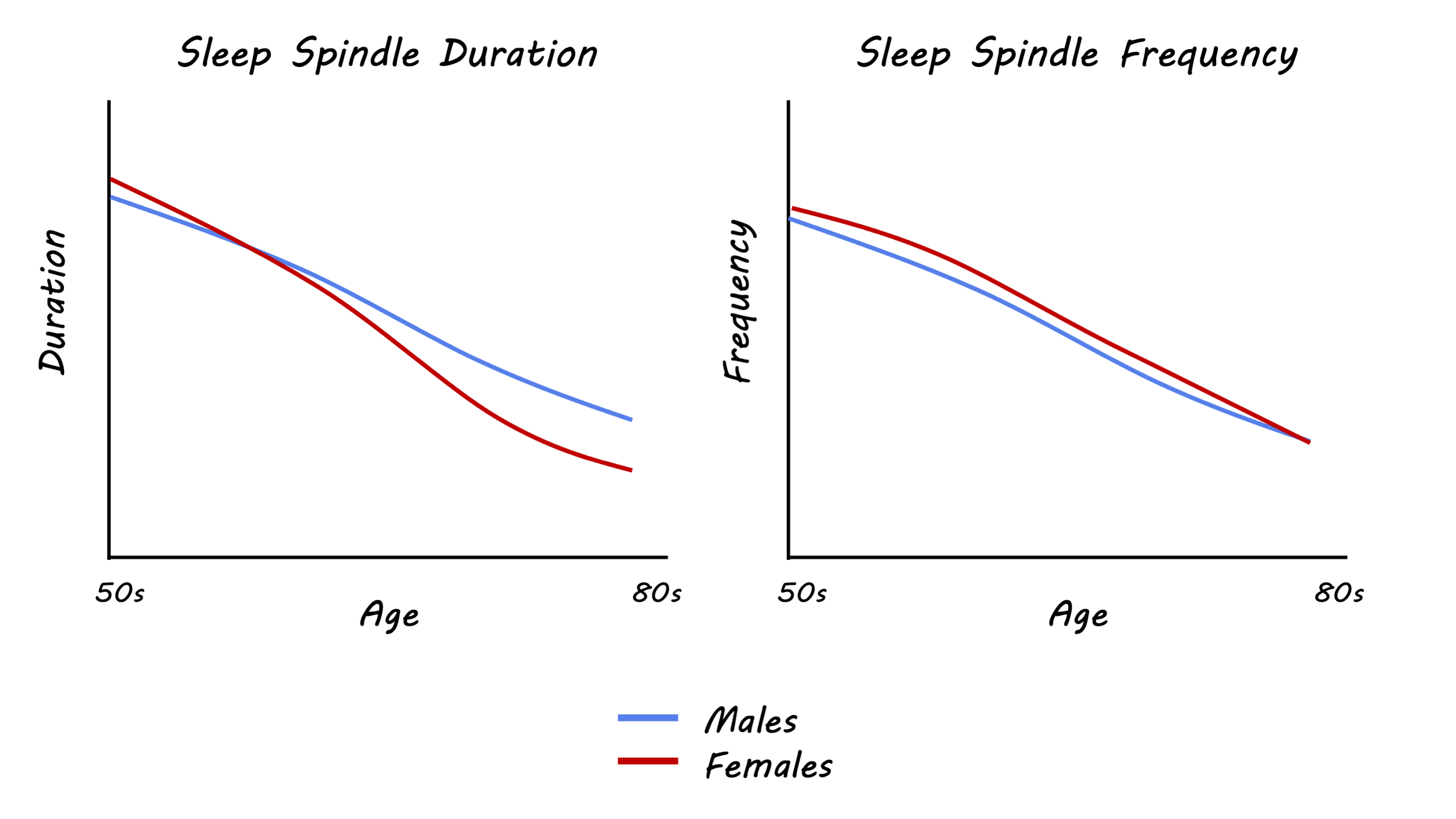
The authors first found that, as expected, quite a few sleep measures changed with age. Briefly, older people tended to wake up more after going to sleep and have lower sleep efficiency (meaning less of the total time spent in bed is spent sleeping). Older people also exhibited reductions in sleep spindle frequency and intensity, as well as changes in the timing of unique sleep spindle features. Sleep spindles are short bursts of high-intensity, high-amplitude neural activity that occur during very slow brain activity (“slow oscillations”) during sleep and are thought to be important for benefits like memory consolidation and synaptic plasticity.

Next, the authors found that from roughly 170 sleep measures used in both datasets, 23 predicted processing speed and grouped into three broad areas: 1) sleep time and the ability to stay asleep; 2) the frequency and timing of sleep spindles, and 3) slow wave activity. First, better cognitive performance was associated with more time spent in REM sleep, higher sleep efficiency, and fewer times waking after falling asleep. Second, the authors found that more frequent and more intense sleep spindles (both fast and slow types) were associated with better cognitive performance. Finally, the authors observed several measures of slow wave activity that were associated with better cognitive performance including shorter slow oscillation duration and a stronger relationship between the timing of sleep spindles during a slow oscillation.

Sleep_image_nov24.png

The author’s rigorous and multi-level analysis also revealed that regardless of chronological age, people who performed better cognitively had sleep measurement profiles that looked more like those in younger, healthier people. Perhaps even more interesting, the authors found that participants with diabetes/hypertension tended to have sleep measurements that looked like those seen in older (but healthier) individuals. Importantly, the authors note that subjective measures of sleep collected by self-report (which is a frequent tool of sleep study design) were only loosely associated with objective measurements gathered through polysomnography, providing a cautionary reminder when relying solely on the interpretation of self-report data.

What's the impact?

This study demonstrates that sleep features in older adults undergo age-related changes and that some features can reliably predict cognitive performance. Associations between sleep and cognitive performance have been reported before, but the present study significantly increases the scope of sleep features comprehensively tested and analyzed. A more detailed understanding of how sleep features change with age may allow the development of a “brain age” index that can compare an individual’s sleep features with their chronological age to determine possible pathology. Sleep behavior and brain activity are also modifiable, suggesting future treatment routes for age-related cognitive problems.

Purcell_quote_Nov23.jpg

Djonlagic et al., Macro and micro sleep architecture and cognitive performance in older adults, Nature Human Behavior (2020). Access the original scientific publication here.