Mis-Localization of LSD1 Underlies Tau-Mediated Neurodegeneration

Post by Shireen Parimoo

What's the science?

One of the hallmarks of Alzheimer’s disease is the presence of neurofibrillary tangles made up of misfolded tau proteins. The neurofibrillary tangles initially accumulate in regions of the medial temporal lobe, such as the hippocampus, before spreading to the rest of the brain, resulting in neuronal death. LSD1 is an enzyme that is typically found in the nucleus of cells and is important for neuronal survival. In the presence of tau pathology, however, LSD1 is mislocalized to the cell cytoplasm along with the neurofibrillary tangles. The Deletion of LSD1 from neurons also leads to neurodegeneration, suggesting that it might contribute to tau-related disorders like Alzheimer’s disease. This week in PNAS, Engstrom and colleagues used histological and RNA sequencing techniques to investigate the mechanistic role of LSD1 in tau-mediated neurodegeneration.

How did they do it?

The authors used wild-type and PS19-Tau transgenic mice that exhibited tau pathology in the brain, beginning in the temporal lobes at approximately 8 months old (Tau mice). First, they used immunofluorescence to compare the localization of LSD1 in hippocampal and cortical neurons of the Tau and wild-type mice. They then bred mice with an Lsd1 gene deletion (control mice) with the Tau mice (Tau-Lsd1 mice) to explore the interaction between tau and LSD1. Heterozygous deletion of the Lsd1 gene reduces the expression of the LSD1 enzyme. In addition to recording motor function and survival of the Tau-Lsd1 mice, the authors used immunohistochemistry to assess neurodegeneration and the localization of LSD1 in hippocampal cells. Next, they identified the molecular pathways that are altered in the presence of tau pathology using RNA sequencing, which allowed them to compare the gene expression profiles of the Lsd1, Tau, and Tau-Lsd1 mice. Finally, they injected LSD1 into hippocampal neurons of 8-month-old Tau mice and assessed the effects of LSD1 overexpression three months later.

What did they find?

LSD1 was localized to the nucleus of hippocampal and cortical neurons in wild-type mice. In contrast, LSD1 was found in both the nucleus and cytoplasm of Tau mice, and this shift to the cytoplasm was exacerbated in the Tau-Lsd1 mice. Both the Tau and Tau-Lsd1 mice exhibited signs of motor dysfunction around 6 months old after tau pathology was evident, but in contrast to the Tau mice, the Tau-Lsd1 mice were severely paralyzed by 12 months old. Similarly, Tau-Lsd1 mice had greater hippocampal neurodegeneration at 10 months old and lower rates of survival as compared to the Tau mice. Thus, the reduced expression and mislocalization of LSD1 occurs in the presence of pathological tau and accelerates the onset of death.

shireen (1).png

The gene expression profiles of Tau-Lsd1 mice were markedly different compared to control mice. Tau-induced gene expression changes were more severe when LSD1 was reduced. Overexpressing LSD1 in the hippocampus of Tau mice further led to gene expression changes in the opposite direction to the Tau-Lsd1 mice, as well as lower cell death. However, LSD1 overexpression did not rescue motor function and the mice still developed paralysis. Overall, these findings suggest that the interaction between Tau and LSD1 results in neurodegeneration and paralysis by altering the expression of cellular proteins, which can be partially rescued by overexpressing LSD1.

What's the impact?

This is the first study to demonstrate the mechanism by which tau accumulation in neurons interacts with the LSD1 enzyme, providing deeper insight into how neurodegeneration occurs in tauopathies. The finding that some of the adverse effects of pathological tau can be mitigated by overexpressing LSD1 is particularly exciting. This discovery paves the way for future research to further explore whether motor function can also be rescued by altering LSD1 expression in other regions of the brain and raises the possibility that tauopathies such as Alzheimer’s disease can be targeted therapeutically through the LSD1 pathway.

Katz_quote_nov9.jpg

Engstrom et al. The inhibition of LSD1 via sequestration contributes to tau-mediated neurodegeneration. PNAS (2020).Access the original scientific publication here.

Natural Connection Patterns Drive Brain Development

Post by Lincoln Tracy 

What's the science?

Different areas of our brains are responsible for different functions. Some are responsible for our vision, others are responsible for our movement, while others are responsible for our ability to talk. However, the underlying mechanisms driving the functional specialization of these different brain regions are unknown. This week in Scientific Reports, Li and colleagues tested the hypothesis that intrinsic connectivity patterns between brain regions provide a scaffold for functional specialization to occur at a later point in time. To test this hypothesis, they explored whether the visual word form area (VWFA - the part of our brain responsible for identifying words and letters from shapes prior to their association with semantics) is connected to other language areas in infants less than a week old.

How did they do it?

The authors used data released by the Developing Human Connectome Project and the Human Connectome Project. Specifically, they analyzed high-resolution functional magnetic resonance imaging (fMRI) data for 40 newborns less than one week old and 40 adults aged 22-36 years old (15 females in each group). The authors were particularly interested in functional connectivity (FC) – the similarity between spontaneous brain signals arising from two different regions – of the VWFA to other brain regions. They examined whether the VFWA of week-old infants displayed established connections with other language regions of the brain.

What did they find?

The authors found that week-old infants have similar FC patterns when compared to adults, with the greatest connectivity between the VFWA and other language regions of the brain. Infants and adults displayed similar connectivity in the language network of the brain, but infants displayed a lack of connectivity between the VWFA and typical language network regions observed in adults. The authors also observed that the VFWA in both infants and adults displayed greater connectivity with language regions compared to  non-language regions that were adjacent to key language network regions. Some differences were observed, where infants displayed less differentiation of the VWFA and adjacent visual object processing regions than adults These results suggest that the connectivity between the different brain regions involved in the language network is enhanced and refined as we gain literacy.

VWFA_nov9.jpg

What's the impact?

This study provides support for the hypothesis that intrinsic connections between brain regions help guide further brain development as we age. Many research questions remain unanswered, such as how reading changes connections between regions within the developing brain, and how connection patterns arise prenatally. Further advances in developmental neuroimaging will make it possible to begin to answer these questions.   

Saygin_quote_nov9.jpg

Li et al. Innate connectivity patterns drive the development of the visual word form area. Scientific Reports (2020).Access the original scientific publication here.
Lapses in Attention Predict Memory Failure

Post by Elisa Guma

What's the science?

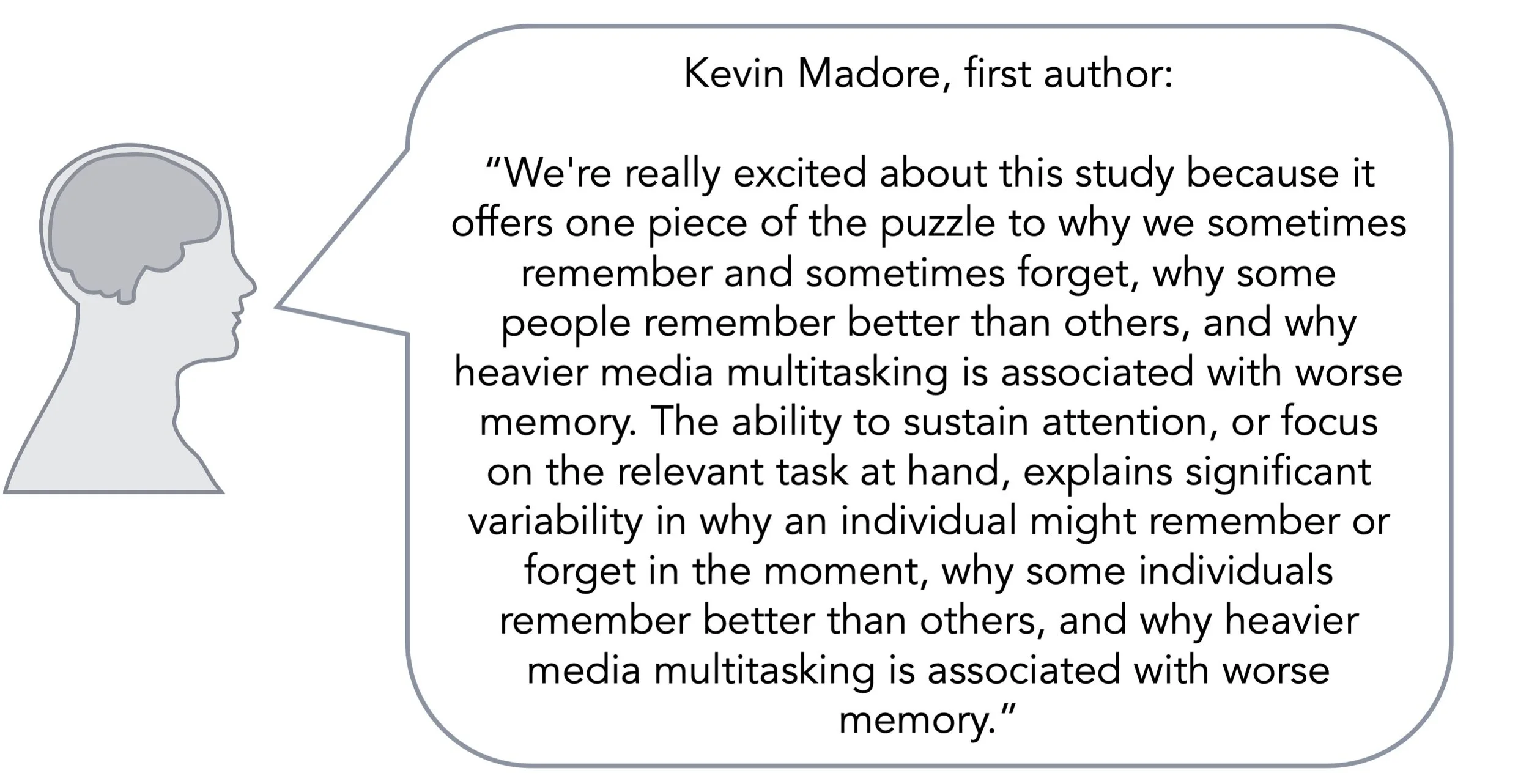
Spontaneous lapses or fluctuations in attention are thought to, in part, account for individual differences in memory function. Infinite access to digital media and technologies provides an unlimited source of distraction in our daily lives. This week in Nature, Madore and colleagues investigated whether lapses in attention affected performance on memory and attention tasks in healthy young adults and whether the degree of ‘multimedia multitasking’ was related to differences in attention and performance.     

How did they do it?

In order to assess how memory was affected by attentional lapses, the authors recorded electroencephalography (EEG) and pupillometry (i.e. pupil diameter measurement) as eighty young adults completed a goal-directed episodic encoding and retrieval memory task. Power in the alpha frequency band was recorded from the parietal cortex (using EEG) as tonic pre-stimulus increases in the signal from this brain region have been associated with lapses in attention, as has a decrease in pupil diameter. The memory task consisted of encoding and retrieval portions. In the encoding portion, participants had to classify a series of objects (168) based on a goal cue: size (big vs. small) or pleasantness (pleasant vs. unpleasant) of the object. In the retrieval phase, participants viewed a series of objects (168 studied and 84 new) and were asked to determine whether they had seen them already, and under which category they had been placed (bigger/smaller, pleasant/unpleasant). The authors further quantified trait-level attention using a sustained attention task and questionnaires aimed at assessing their likelihood of engaging in multimedia multitasking (e.g. watching TV while texting).

What did they find?

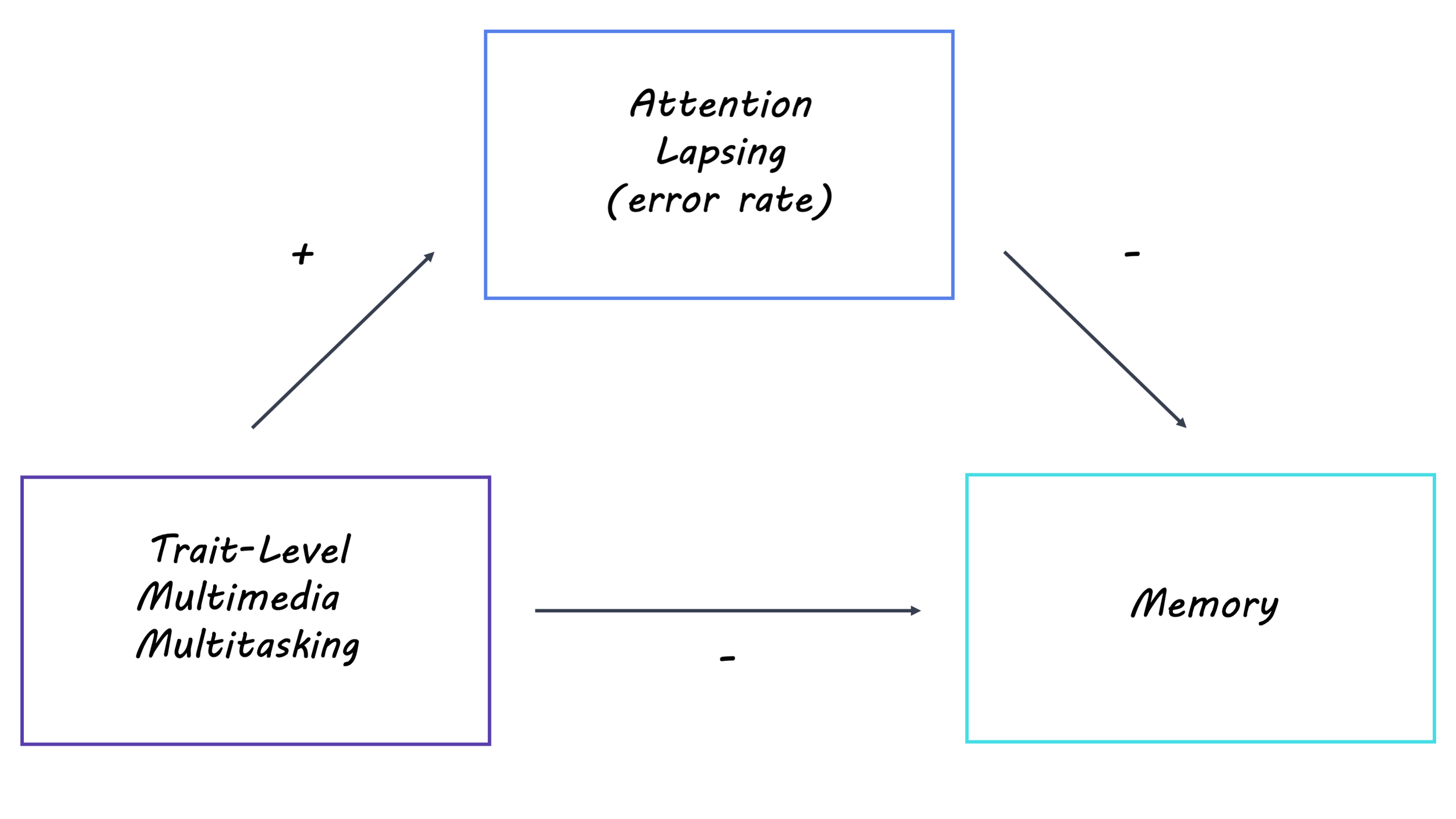
The authors found that increases in pre-goal alpha power and decreases in pupil diameter just prior to goal-cue presentation in the retrieval portion of the task were correlated with a greater likelihood of memory failure (misses) compared to successes (hits), suggesting that fluctuations in attention may be related to fluctuations in recollection. Using the sustained attention task, the authors found that a greater number of errors and greater response time variability (accepted as markers for attention lapsing) was related to differences in alpha power and pupil distance collected in the previous task, and negatively correlated with task performance. Finally, the authors found that higher scores on the multimedia multitasking questionnaire were associated with higher pre-goal alpha power and greater pupil diameter variability during the memory task, as well as more errors and response time variability during the sustained attention task. Higher multimedia use was also related to traits of attention-deficit/hyperactivity disorder and attentional impulsivity based on the trait-level questionnaire.

attention_img_nov3.png

What's the impact?

The results presented here suggest that attention is critical for memory formation. Further, interindividual differences in task performance were related both to their engagement with multimedia multitasking and with trait levels of attention and impulsivity. This study also highlights how multimodal approaches can advance our understanding of the role of attention in memory both during task performance and at the trait level. Future work is needed to further investigate a causal relationship between multimedia use, attention, and memory. 

Madore_quote_nov3.jpg

Madore et al. Memory failure predicted by attention lapsing and media multitasking. Nature (2020). Access the original scientific publication here.