
Natural Connection Patterns Drive Brain Development

Post by Lincoln Tracy 

What's the science?

Different areas of our brains are responsible for different functions. Some are responsible for our vision, others are responsible for our movement, while others are responsible for our ability to talk. However, the underlying mechanisms driving the functional specialization of these different brain regions are unknown. This week in Scientific Reports, Li and colleagues tested the hypothesis that intrinsic connectivity patterns between brain regions provide a scaffold for functional specialization to occur at a later point in time. To test this hypothesis, they explored whether the visual word form area (VWFA - the part of our brain responsible for identifying words and letters from shapes prior to their association with semantics) is connected to other language areas in infants less than a week old.

How did they do it?

The authors used data released by the Developing Human Connectome Project and the Human Connectome Project. Specifically, they analyzed high-resolution functional magnetic resonance imaging (fMRI) data for 40 newborns less than one week old and 40 adults aged 22-36 years old (15 females in each group). The authors were particularly interested in functional connectivity (FC) – the similarity between spontaneous brain signals arising from two different regions – of the VWFA to other brain regions. They examined whether the VFWA of week-old infants displayed established connections with other language regions of the brain.

What did they find?

The authors found that week-old infants have similar FC patterns when compared to adults, with the greatest connectivity between the VFWA and other language regions of the brain. Infants and adults displayed similar connectivity in the language network of the brain, but infants displayed a lack of connectivity between the VWFA and typical language network regions observed in adults. The authors also observed that the VFWA in both infants and adults displayed greater connectivity with language regions compared to  non-language regions that were adjacent to key language network regions. Some differences were observed, where infants displayed less differentiation of the VWFA and adjacent visual object processing regions than adults These results suggest that the connectivity between the different brain regions involved in the language network is enhanced and refined as we gain literacy.

VWFA_nov9.jpg

What's the impact?

This study provides support for the hypothesis that intrinsic connections between brain regions help guide further brain development as we age. Many research questions remain unanswered, such as how reading changes connections between regions within the developing brain, and how connection patterns arise prenatally. Further advances in developmental neuroimaging will make it possible to begin to answer these questions.   

Saygin_quote_nov9.jpg

Li et al. Innate connectivity patterns drive the development of the visual word form area. Scientific Reports (2020).Access the original scientific publication here.
Lapses in Attention Predict Memory Failure

Post by Elisa Guma

What's the science?

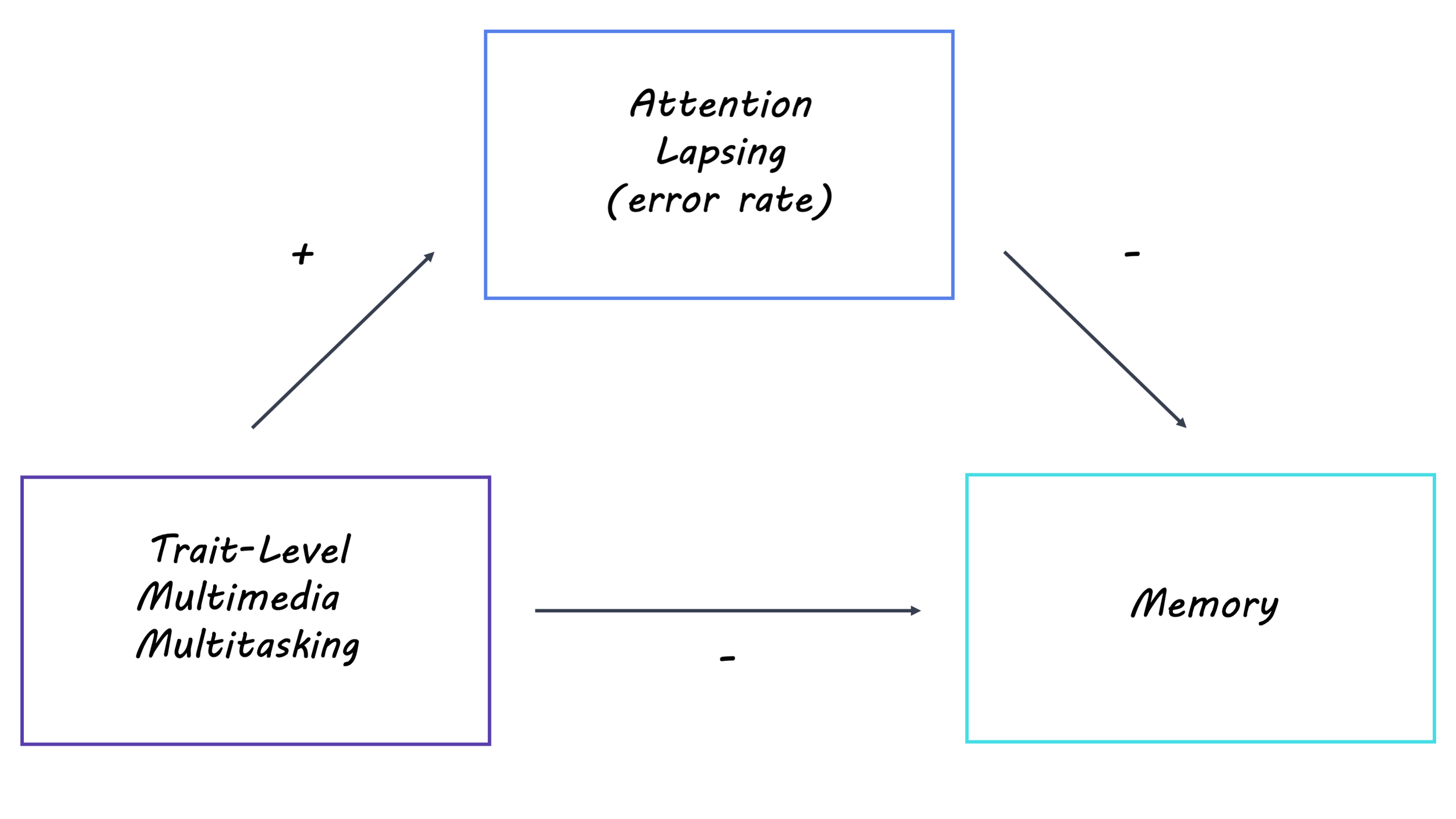
Spontaneous lapses or fluctuations in attention are thought to, in part, account for individual differences in memory function. Infinite access to digital media and technologies provides an unlimited source of distraction in our daily lives. This week in Nature, Madore and colleagues investigated whether lapses in attention affected performance on memory and attention tasks in healthy young adults and whether the degree of ‘multimedia multitasking’ was related to differences in attention and performance.     

How did they do it?

In order to assess how memory was affected by attentional lapses, the authors recorded electroencephalography (EEG) and pupillometry (i.e. pupil diameter measurement) as eighty young adults completed a goal-directed episodic encoding and retrieval memory task. Power in the alpha frequency band was recorded from the parietal cortex (using EEG) as tonic pre-stimulus increases in the signal from this brain region have been associated with lapses in attention, as has a decrease in pupil diameter. The memory task consisted of encoding and retrieval portions. In the encoding portion, participants had to classify a series of objects (168) based on a goal cue: size (big vs. small) or pleasantness (pleasant vs. unpleasant) of the object. In the retrieval phase, participants viewed a series of objects (168 studied and 84 new) and were asked to determine whether they had seen them already, and under which category they had been placed (bigger/smaller, pleasant/unpleasant). The authors further quantified trait-level attention using a sustained attention task and questionnaires aimed at assessing their likelihood of engaging in multimedia multitasking (e.g. watching TV while texting).

What did they find?

The authors found that increases in pre-goal alpha power and decreases in pupil diameter just prior to goal-cue presentation in the retrieval portion of the task were correlated with a greater likelihood of memory failure (misses) compared to successes (hits), suggesting that fluctuations in attention may be related to fluctuations in recollection. Using the sustained attention task, the authors found that a greater number of errors and greater response time variability (accepted as markers for attention lapsing) was related to differences in alpha power and pupil distance collected in the previous task, and negatively correlated with task performance. Finally, the authors found that higher scores on the multimedia multitasking questionnaire were associated with higher pre-goal alpha power and greater pupil diameter variability during the memory task, as well as more errors and response time variability during the sustained attention task. Higher multimedia use was also related to traits of attention-deficit/hyperactivity disorder and attentional impulsivity based on the trait-level questionnaire.

attention_img_nov3.png

What's the impact?

The results presented here suggest that attention is critical for memory formation. Further, interindividual differences in task performance were related both to their engagement with multimedia multitasking and with trait levels of attention and impulsivity. This study also highlights how multimodal approaches can advance our understanding of the role of attention in memory both during task performance and at the trait level. Future work is needed to further investigate a causal relationship between multimedia use, attention, and memory. 

Madore_quote_nov3.jpg

Madore et al. Memory failure predicted by attention lapsing and media multitasking. Nature (2020). Access the original scientific publication here.
Brain Activity Associated with Positive Patient-Clinician Interaction

Post by D. Chloe Chung

What's the science?

Interaction between a patient and clinician can substantially impact therapeutic outcomes. For example, an unsatisfactory interaction can prevent patients from seeking medical care, but a positive patient-clinician interaction can actually lead to psychological relief of patients’ symptoms such as pain, amplifying benefits from the actual medical treatment. While it remains unclear what mechanisms underlie such phenomenon, several studies have emphasized the importance of synchronized behaviors and neural activity in social interactions such as bonding. This week in Science Advances, Ellingsen and colleagues used functional magnetic resonance imaging (fMRI) to demonstrate that social interaction between patients and clinicians can improve clinical outcomes by mirroring their behaviors and harmonizing neural activity in brain regions that regulate empathy.

How did they do it?

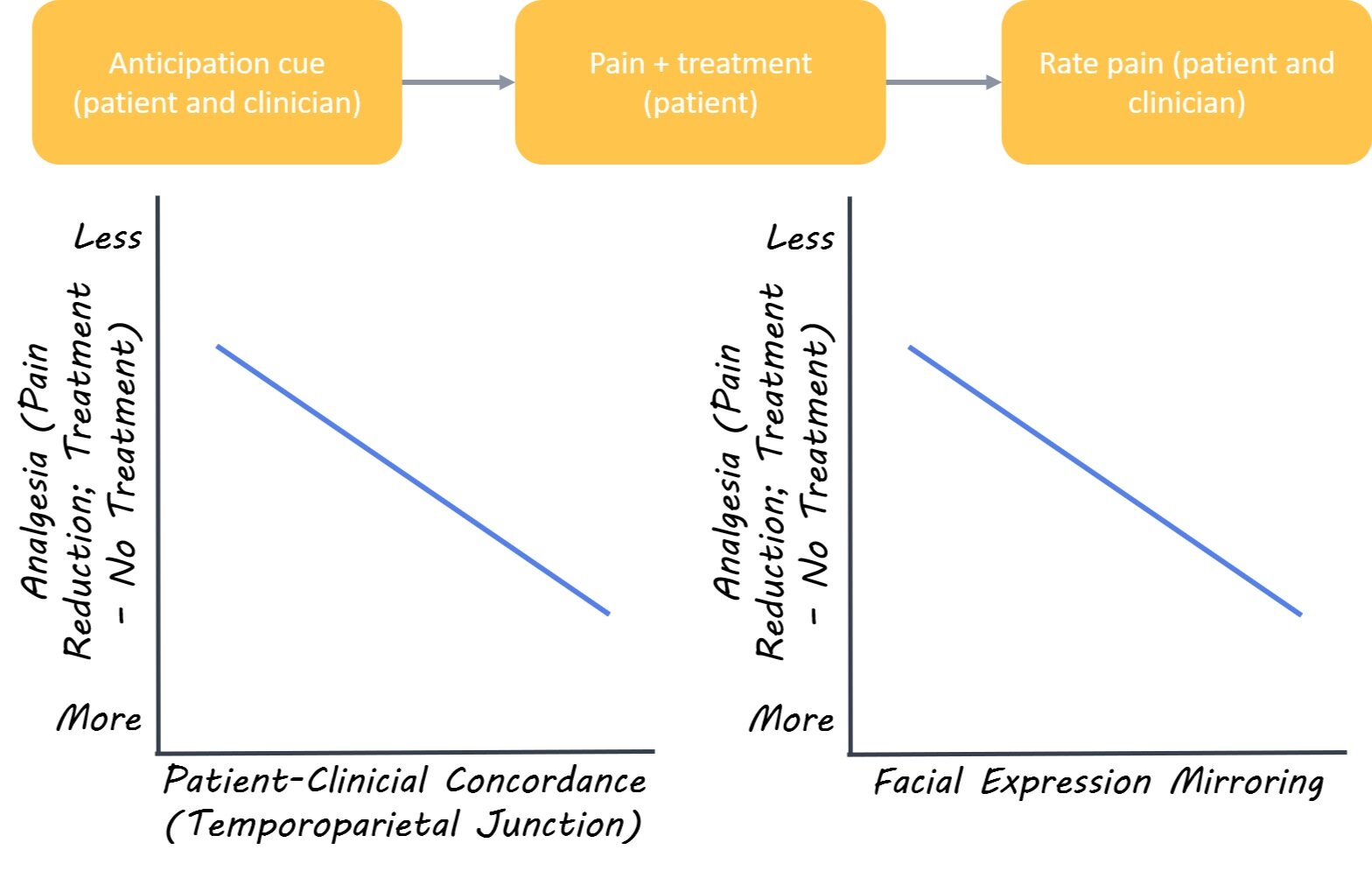
The authors recruited 23 fibromyalgia patients with chronic pain (all females) and 22 acupuncture clinicians (15 females) and matched them into 40 unique pairs. In the “clinical interaction” condition, the pair first established a rapport before the experiment (pain treatment) as the clinician gave consultation to the patient. In contrast, the pair in the “no interaction” control condition skipped the consultation and was only briefly introduced to each other before the experiment. On the day of the pain treatment, the patient and the clinician were placed in separate MRI scanners but were able to communicate with one another using facial expressions via video camera. Both participants received a visual cue to anticipate whether the patient would receive either a) treatment or b) no treatment following a moderate pressure pain evoked in the patient’s leg. Next, the clinician could press a button to give either real acupuncture treatment or a sham treatment to the patient’s leg. Both the clinician and patient were blind to whether a real treatment was given. After the trial, the pair were asked to rate the intensity of pain. The pair underwent 12 trials while their brain activity was scanned using fMRI

What did they find?

Both patients and clinicians reported less pain when the treatment was given, regardless of it being real or sham. Interestingly, video analysis of facial expressions revealed that patients tended to experience greater pain relief and stronger rapport with the clinician when the patients and the clinicians mirrored each other’s facial expressions. This suggests that social mirroring is linked to enhanced clinical outcomes. When the authors compared brain activity between groups they found that pairs from the “clinical interaction” group showed increased dynamic coupling of brain activity in the circuitry involved in social mirroring. In other words, the brain regions implicated in empathy were activated at the same time (i.e. concordant) in clinicians and patients if they already established a rapport prior to the pain treatment. Specifically, a brain area called the temporoparietal junction was activated at the same time in both pair members when they received an anticipation cue for treatment options. Upon further analysis, the authors found that concordance (co-activation between patient and clinician) of this brain region also led to greater pain relief via increased activity in a second brain region in the empathy neural circuitry that can also modulate pain.

Chloe+%281%29.jpg

What’s the impact?

This work sheds light on the neural circuitry involved in positive interactions between clinicians and patients. Further, this research demonstrates that positive patient-clinician interactions can improve clinical outcomes. The role of empathy in social interaction has been previously discussed in many studies, but this is the first to simultaneously monitor neural activity of two people who are interacting with each other in a clinical setting. Findings from this study may help guide clinicians in their interactions with patients to enhance clinical outcomes for patients.

ellingsen_quote_nov3.jpg

Ellingsen et al. Dynamic brain-to-brain concordance and behavioral mirroring as a mechanism of the patient-clinician interaction. Science Advances (2020). Access the original scientific publication here.