
The Occipital Cortex and Visual Memory Development

Post by Amanda McFarlan

What's the science?

The study of learning and memory commonly focuses on brain regions such as the hippocampus and the prefrontal cortex, however, recent studies have provided evidence to suggest that the occipital cortex may be involved in visual memory development. Indeed, age-related differences in cortical thickness indicate that the occipital cortex matures well into adolescence. Researchers postulate that synaptic pruning may occur throughout this maturation process as a way of enhancing visual processing. This week in Neuropsychologia, Yin and colleagues investigated whether the maturation of the occipital cortex played a role in enhancing memory formation of visual stimuli.

How did they do it?

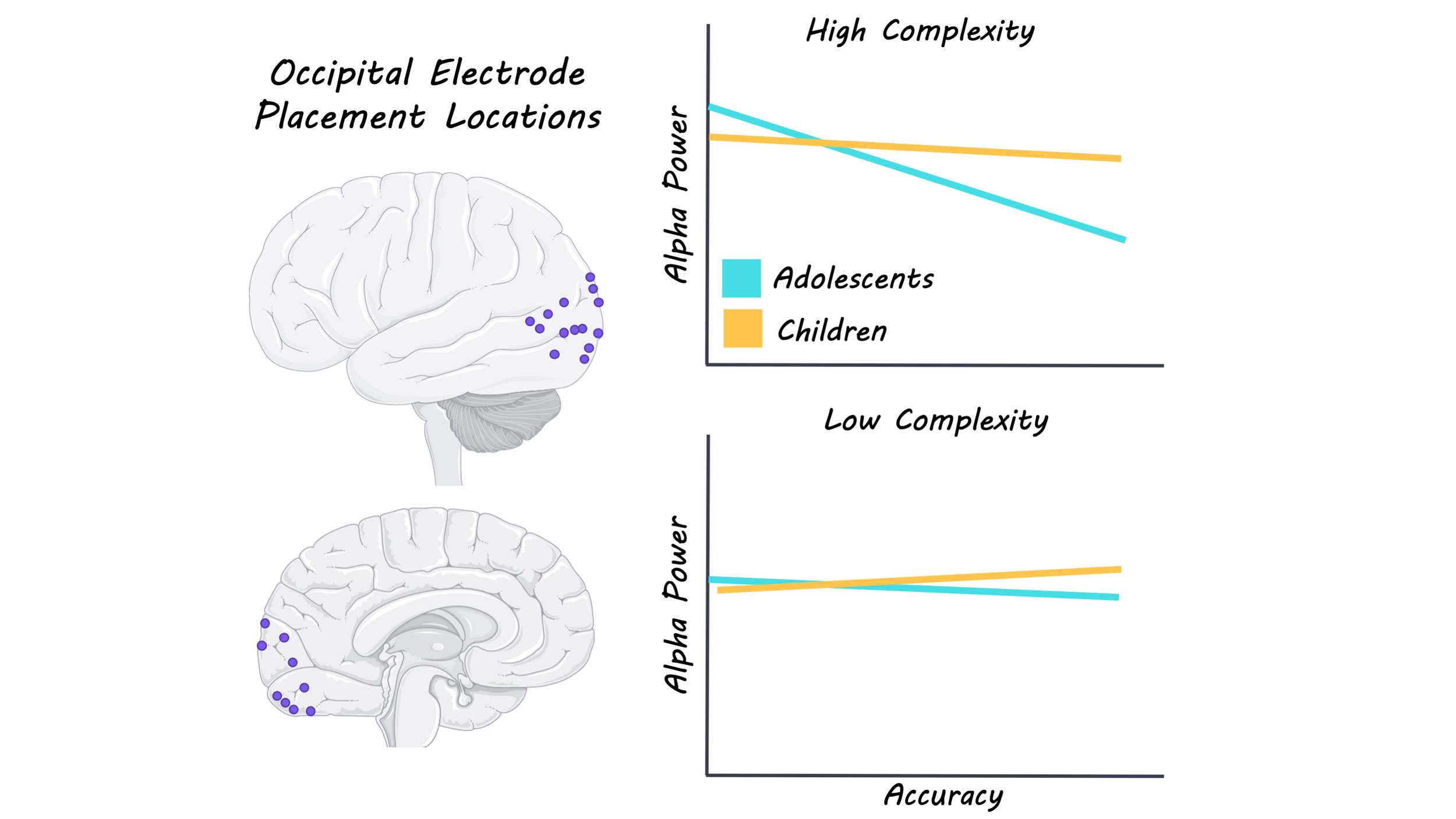
The authors used electrocorticographic recordings (electrodes placed directly on the surface of the brain) to measure brain activity in the occipital cortex in 24 children (6-13 years) and adolescents (13- 20 years) while performing a memory task. The memory task consisted of two parts: the “study” part and the “test” part. During the study part of the memory task, participants were presented with 40 scenic images of both high and low complexity (defined by the number of object categories in the image) and were asked to decide whether the image was of an indoor scene or an outdoor scene. Then, during the test part of the task, the participants were presented with the same 40 scenic images and 20 new scenic images. The participants were asked to classify the scenic images as “old” (ones they had previously studied) or “new” (ones they had not studied). The participants’ brain activity in the occipital cortex during the two parts of the memory task was recorded. To further investigate how visual processing in the occipital cortex might contribute to memory formation, the authors analyzed brain recordings during the study part, focusing on oscillations in the alpha range (7-14 Hz) since these are known to be important in visual processing. Specifically, they measured alpha power, which has been shown to decrease with increased neural activity and memory formation, and instantaneous alpha frequency which have been shown to increase with a higher temporal resolution of perception. 

What did they find?

The authors found that the recognition accuracy for high-complexity scenes was greater for adolescents compared to children, which suggests that memory formation for complex visual scenes improves during development. Additionally, decreased alpha power was found to be a predictor of recognition accuracy for high-complexity scenes in adolescents. Next, the authors determined that only high-complexity scenes were associated with both an age-related decrease in alpha power and an increase in instantaneous alpha frequency, suggesting that visual processing in the occipital cortex that is involved in memory formation improves in an age-dependent manner for complex scenic stimuli. Finally, the authors determined that there were no age-related differences in alpha power or frequency for scenes that were later incorrectly identified “new”, which suggests that age-related differences in alpha power and frequency may be predictive of memory formation, but not visual perception as a whole.
occipital_sept29.png

What’s the impact?

Using electrocorticographic recordings in children and adolescents, this study showed that developmental changes in the occipital cortex are associated with enhanced memory formation for complex scenic stimuli. The authors found that adolescents were better at recognizing high, but not low-complexity scenes compared to children. Additionally, they found that decreased alpha power was predictive of memory formation for high-complexity scenes in an age-dependent manner. In all, these findings highlight the importance of occipital cortex maturation in the enhancement of visual memory formation.
Ofen_quote_sep29.jpg

Yin et al. Direct brain recordings reveal occipital cortex involvement in memory development. Neuropsychologia (2020). Access the original scientific publication here.
Deactivation of Anterior Thalamic Nuclei Underlies Associative Memory Encoding

Post by Shireen Parimoo

What's the science?

Associative memory refers to memory for multiple pieces of information (e.g., a face and a name) and is a critical component of episodic memory. The involvement of regions in the medial temporal lobe (MTL) cortex – such as the hippocampus – in episodic memory has been well-established. The thalamus is a subcortical brain region made up of several nuclei that has structural connections to the MTL and is also implicated in the formation and retrieval of memories. However, the precise role of thalamic nuclei, particularly the anterior and mediodorsal nuclei, in associative memory is not clear. This week in Neuropsychologia, Geier and colleagues used functional magnetic resonance imaging (fMRI) to investigate the contribution of thalamic nuclei and their connectivity to the hippocampus and MTL regions in associative memory encoding and retrieval.

How did they do it?

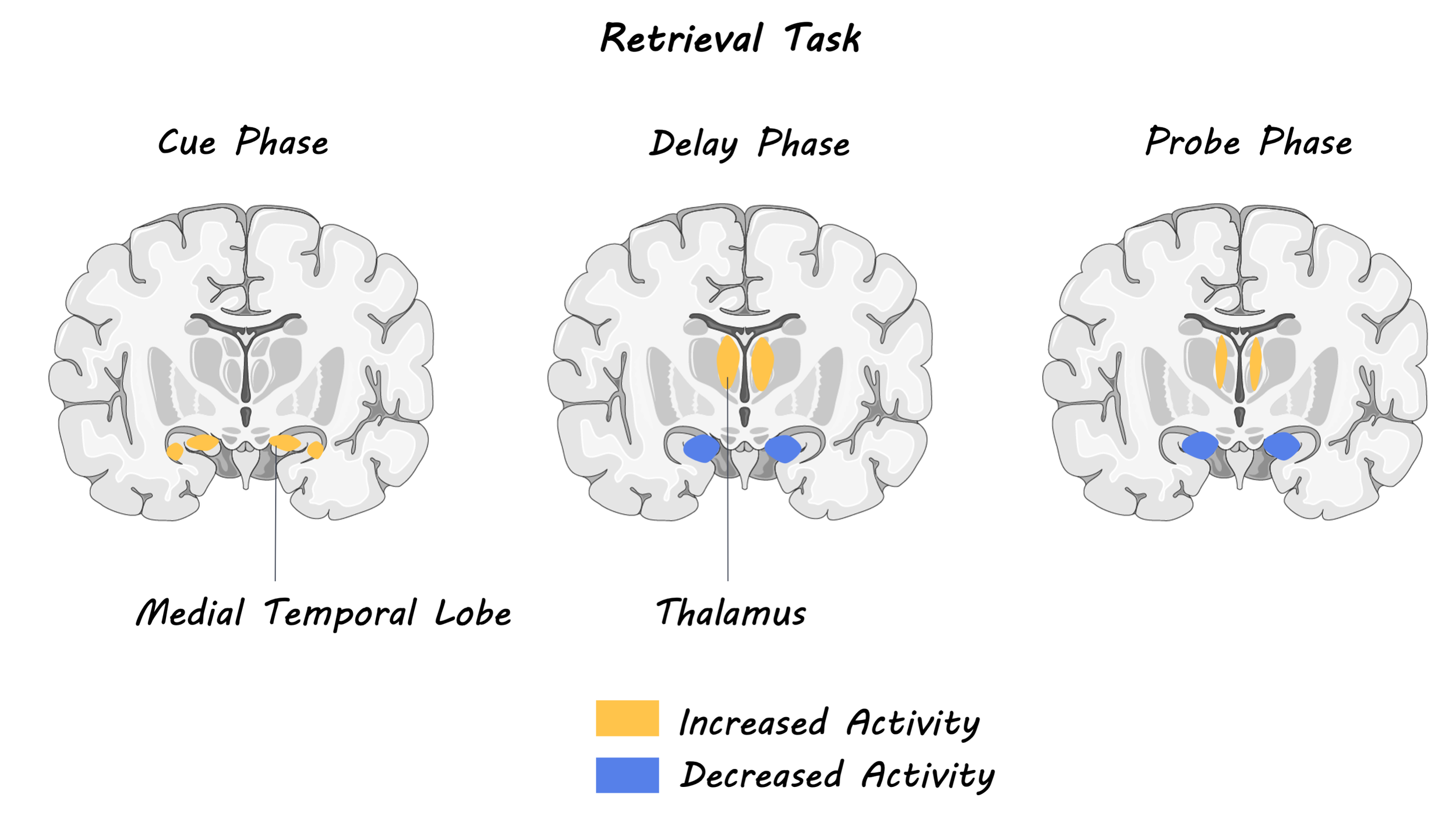
Twenty-seven young adults completed an associative memory task while undergoing fMRI scanning. In the encoding phase, they were shown a scene overlaid with a face, and participants made plausibility judgments about the face-scene pairs. The retrieval task consisted of three phases: (i) a cue phase in which a scene image was presented, followed by (ii) a delay phase, during which participants were instructed to mentally recall the face that was previously paired with the scene, and (iii) a probe phase in which three faces were presented with the scene and participants performed a memory judgment for the previously paired face.

The authors examined activity in the thalamus and MTL during memory encoding and the three memory retrieval phases. They also investigated how the time course of activation in each task phase was related to memory performance. That is, how did activity in the anterior and mediodorsal thalamic nuclei, as well as the anterior and posterior hippocampus, differ for correctly and incorrectly remembered faces? Finally, they assessed functional connectivity between thalamic nuclei and the MTL in associative memory and additionally compared the connectivity profiles of the anterior and mediodorsal thalamic nuclei to the MTL.

What did they find?

Thalamic activity significantly decreased during the encoding phase, whereas MTL regions like the hippocampus exhibited a nominal increase in activation. In particular, activation of the anterior hippocampus during memory encoding was associated with better face-scene memory performance. Conversely, reduced activation of the anterior thalamus at encoding was related to memory accuracy, while the mediodorsal thalamus showed little change across correct and incorrect trials. Interestingly, the opposite pattern of activation was observed at retrieval, with greater activation of the thalamus during the delay and probe phases but reduced delay-phase activation in the MTL. However, retrieval-phase activity in the hippocampus or thalamus was not significantly related to memory performance. These results indicate that the successful formation of associative memories is related to the increased involvement of the anterior hippocampus but deactivation of the anterior thalamus. Finally, the mediodorsal thalamus showed greater connectivity with the MTL compared to the anterior thalamus. However, differences in functional connectivity between the thalamic nuclei and the MTL were not related to memory performance.

encoding_img_sept22.png

What's the impact?

This study characterized the involvement of thalamic nuclei in memory and used neuroimaging to demonstrate the complementary role of the anterior thalamic nuclei in associative memory formation. Although patient and neuroimaging studies have shown that the thalamus is important for memory, we now know how specific nuclei in the thalamus are involved in the formation of associative memories, specifically. These results pave the way for future work that can further reveal how thalamic nuclei communicate with other regions of the brain to support memory encoding and retrieval.

memory_quote_sep22.jpg

Geier et al. The role of anterodorsal thalamus in associative memory encoding and retrieval. Neuropsychologia (2020). Access the original scientific publication here.
A Brain Rhythm Underlying Detachment from Reality

Post by D. Chloe Chung

What's the science?

Dissociation is an altered mental state in which a person feels disconnected from their body and the physical world. Dissociation can happen not only with the use of dissociative drugs like ketamine, but also with certain neuropsychiatric conditions such as epilepsy and trauma. While the underlying neural mechanisms of this subjective experience have been largely unknown previously, advanced imaging technologies allow for scanning the whole brain for neural activity with high spatial and temporal resolution. This week in Nature, Vesuna, Kauvar, and colleagues utilized such technologies to identify oscillations in the specific locations of the brain that underlie dissociation.

How did they do it?

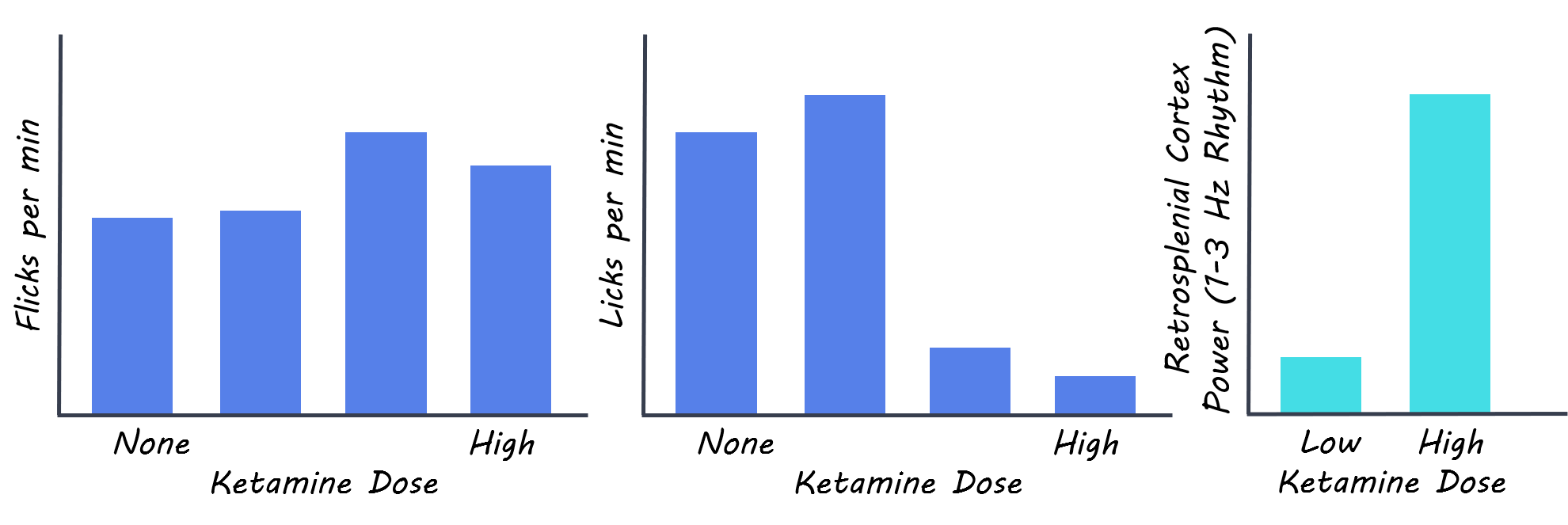
The authors used a mouse model that is genetically modified so that neuronal activity in the cortex can be visualized under the green light. These mice were injected with a low dosage of ketamine or other drugs (dissociative or non-dissociative), and their whole brains were monitored to identify the location of neuronal activity. The firing patterns of hundreds of neurons were also recorded using probes throughout the brain to investigate oscillations in brain regions that were not accessed by imaging. Since mice cannot report their subjective mental state, the authors indirectly determined whether ketamine-injected mice were experiencing something similar to dissociation by placing them on a moderately hot plate. Paw-flicking indicated that mice can feel the heat from the plate and reflexively react to it, while paw-licking indicated instead that mice were “emotionally” behaving to protect their paws from heat. To test whether rhythm in a specific brain location can cause a dissociation-like state and related behaviors in mice, the authors used an optogenetics approach to rhythmically activate the brain region of interest and observed changes in their behaviors during the hot plate test. For clinical relevance, the authors examined the neural activity of an epilepsy patient who received electrode implantation in the brain after experiencing seizure and dissociation.

What did they find?

After being injected with ketamine, mice showed an oscillation of 1-3 Hz (1-3 cycles per second) localized to the retrosplenial cortex (RSP). This brain rhythm appeared to be specifically induced by dissociative drugs as it was not observed when mice received drugs without dissociative properties. Further examination of the whole brain revealed that, among thalamic nuclei neighboring the RSP, the ones connected to the RSP entered a similar oscillation phase with the RSP while the others went out of phase, defining a brain circuitry responsive to dissociative drugs. Also, ketamine-injected mice on the hot plate were found to be able to detect the stimulus (heat) but fail to have an emotional response to it, as they flicked their paws but did not lick them to cool off. The authors interpreted these behaviors to mean that mice were having dissociation-like experiences under the influence of ketamine. Importantly, optogenetic stimulation of RSP similarly reduced paw-licking responses in mice, suggesting that oscillation in the RSP is responsible for a dissociation-like state. The authors expanded upon this observation in humans by confirming that, when an epilepsy patient experiences seizure-related dissociation, oscillations similar to those that occurred in the mouse RSP-equivalent brain region were present. Electrode stimulation in this brain region also induced a dissociative experience in the patient, which further emphasized the causal link between this brain rhythm and dissociation, mirroring that found in mouse experiments.

Chloe.png

What’s the impact?

Our understanding of the biological basis of dissociation has been rather poor, as it is highly challenging to investigate a dissociative state of mind given its subjective and complex nature. This work is the first study to reveal that oscillations in a specific brain region can be responsible for dissociation. From this study, we can now better understand how drugs like ketamine work to exert dissociative effects. Also, findings from this study may help the development of clinical strategies that can effectively modulate neurological conditions accompanied by dissociation.

Vesuna, Kauvar et al. Deep posteromedial cortical rhythm in dissociation. Nature (2020). Access the original scientific publication here.