
The Role of Group Identity in Social Influence

Post by Lincoln Tracy

What's the science?

Social influence refers to the change in behavior (either intentionally or unintentionally) a source (e.g. a person) causes in a target (e.g. another person). This is a broad notion that covers a range of phenomena, one aspect of which is group influence. Individual influence frequently contrasts with group influence. Such topics are normally addressed separately in introductory textbooks. Furthermore, earlier reviews have not fully explored the group identity approach to influence. This week in Annual Reviews of Psychology, Spears summarizes recent research about group identity while also reappraising classical research, aiming to provide an integrated overview of group identity in social influence.

What do we already know?

Group influence research has been heavily influenced by Deutsch and Gerard’s dual-process model, first proposed in 1955. This model identifies the two psychological needs that lead humans to conform: informational influence (the need to be right) and normative social influence (the need to be liked). While normative influence is a form of group influence, personal identity and interpersonal dynamics are implicated in normative influence. Deutsch and Gerard’s model is one of many early theories to distinguish different forms of influence. The concept of group identity had not been developed at this point. Consequently, group influence retained an element of external pressure as there was no concept of group identity to internalize this process. A theoretical shift was required to see the group as part of the self. Such a shift would allow for the possibility that true group influence may lead to private acceptance. Using network approaches to account for the spread of influence throughout a group offers some potential. But one challenge with many network models is that the process of how influence operates is not always clear, even if we can model and predict the spread of influence.

What’s new?

Research primarily focusing on the theoretical underpinnings of group identity-based influence has waned in recent times. Despite this decline, the principles underlying group identity-based influence are still sources of inspiration for not only more recent research, but also for reviewing classic findings. However, there has been an emergence of other research that has shifted focus somewhat and brings a different approach to considering social norms. A major theoretical development occurred following the differentiation of descriptive and injunctive norms (behaviours everyone else is doing and behaviours you feel you are supposed to do, respectively). These concepts have been widely adopted by the social norm literature, and research from theorists of morality have made the case that as group identity frames values and prescribes norms, group identity also implies group morality. This notion prefaces a wide-ranging discussion of the association between norms, motivation, and morality. This discussion confirms that there is no “generic” norm, but that the relevant group priority is flexible. This resonates with the argument that group identities are variable and contested, rather than dominant or assigned. Prototypicality, group identification, salience and identity threat, social isolation, and anonymity are identified as moderators of group identify-based influence.  
group_identity_dep22.png

What’s the bottom line?

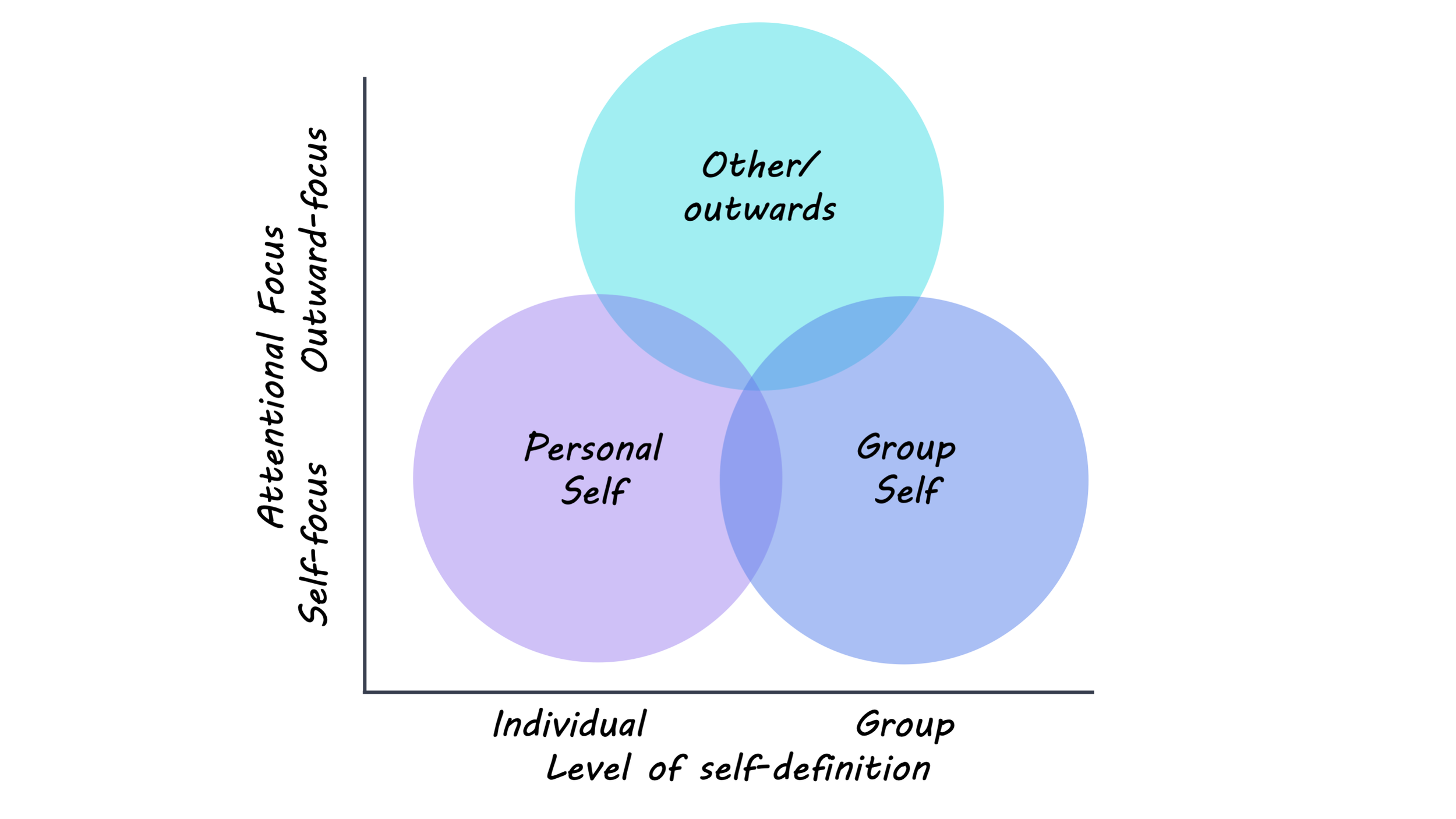
Spears provides a case for group identity-based social influence and argues that this may be more persuasive than first thought. Group identity can be distinguished from other forms of social and group influence. Group identity serves as the foundation for much of our being and behavior. Further exploration of the relationships between the personal self, the group self, and the outwards facing self is required.  

Spears. Social influence and group identity. Annual Reviews of Psychology. Access the original scientific publication here.
Tackling COVID-19: The Behavioural Consequences of Face Mask Policies

Post by Flora Moujaes 

What's the science?

Wearing face masks to curb local outbreaks of COVID-19 or reduce transmission in future waves of the pandemic has already become a contentious issue worldwide. For example, in the US in May 2020 an employee was shot after telling a customer her daughter was required to wear a face mask, while in France a bus driver was stabbed to death after asking three passengers to wear face masks. Despite its potential to generate conflict, wearing face masks is currently believed to be the most effective way to stop the transition of COVID-19. In addition, as mask wearing protects others from contracting the virus, but does not protect the wearers themselves as much, a high level of compliance is needed for the method to be effective. It is therefore imperative to explore the behavioural and social consequences of different types of mask wearing policies. This week in PNAS, Betsch and colleagues explored the social and behavioural consequences as well as compliance levels of voluntary vs. mandatory mask policies.

How did they do it?

To assess the behavioural consequences of mandatory vs. voluntary mask policies, the researchers first gathered data from 7000 German participants using an online weekly cross-sectional survey. They found that after mask wearing became mandatory in public shops and on transport in Germany in April 2020, mask wearing increased steeply from 30% to 80% over a two-week period. They also found that people who wore masks were much more likely to wash their hands, avoid handshakes, and keep their physical distance. This implies that mandatory mask wearing policies are (1) effective and (2) that individuals wearing masks exhibit other protective behaviours more often. 

In order to explore the social and behavioural consequences of mandatory and voluntary mask policies, the researchers then conducted an experiment in which 925 participants were asked to imagine that they were in the fruit section of their local supermarket with one other person. They were randomly assigned to a scenario involving either a mandatory or voluntary mask policy where the other person was either wearing a face mask or not wearing a face mask.   

What did they find?

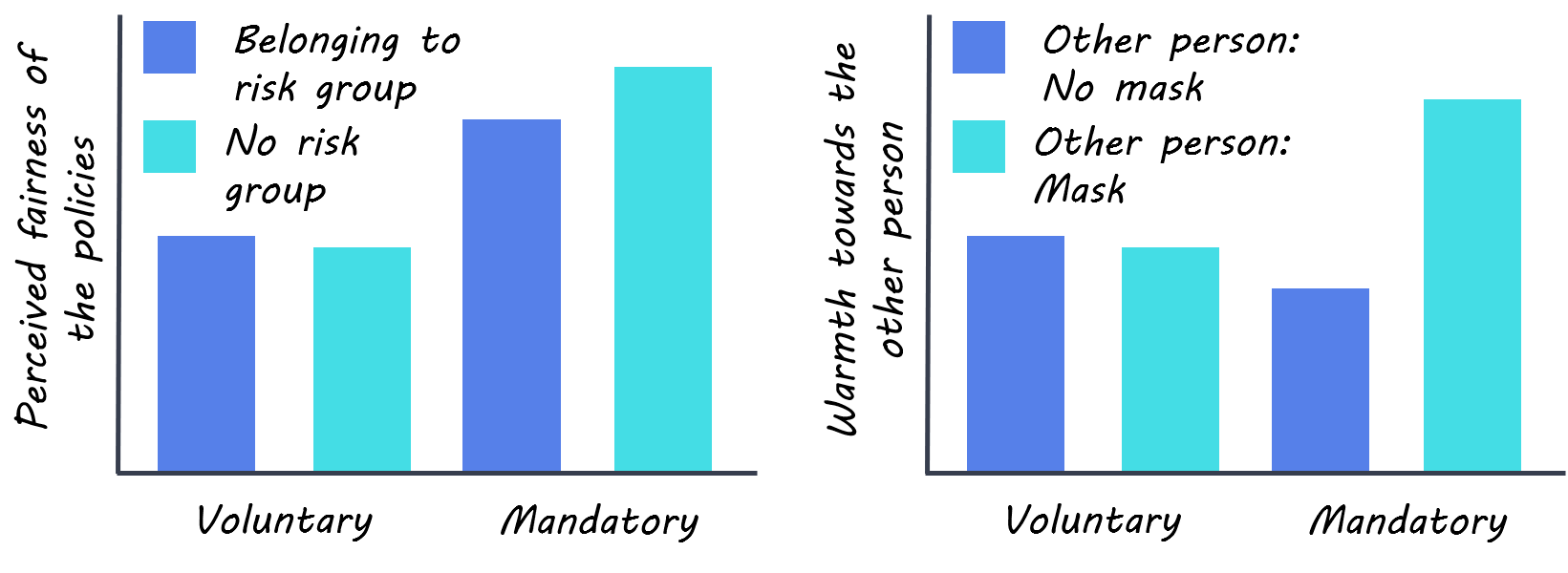
Perception of Mask Wearers: Overall, regardless of whether the mask-wearing policy was mandatory or voluntary, others wearing masks were perceived as more prosocial. People who reported wearing a mask frequently themselves in everyday life perceived greater warmth toward others who also wore masks compared to those who didn’t. Mask wearing was therefore perceived as a social contract, as those who complied with it socially ‘rewarded’ each other but ‘punished’ others who did not wear a mask. Finally, both those who were low risk and high risk for contracting COVID-19 reported feeling more at risk when the other person did not wear a mask.

flora.png

Voluntary vs. Mandatory Mask-Wearing Policies: Fewer people were likely to wear a mask themselves when the mask-wearing policy was voluntary (77% compliance under a voluntary policy vs. 96% under a mandatory policy). The mandatory mask policy was judged fairer than the voluntary policy, especially by participants belonging to a risk group. In addition, the voluntary mask policy resulted in stigmatization, as others wearing a mask were judged as belonging to a risk group, though they were not judged as more likely to be infected with COVID-19.

What's the impact?

Understanding the social and behavioural consequences of mask-wearing policies is important (1) to ensure high compliance for effectiveness  (2) to avoid it becoming a socially contentious issue. Overall, this study suggests that mandatory mask-wearing policies are necessary in order to ensure a sufficient number of people to wear masks. Furthermore, this study suggests that mandatory policies are preferable as voluntary policies may increase the amount of stigmatization associated with mask wearing, and increase the potential for polarization within society. This study also highlights the importance of communicating to the public not only the benefits of mask wearing (e.g. risk reduction, mutual protection, positive social signaling), but also the benefits of mandatory policies (e.g. fairness, less stigmatization, and higher effectiveness).

mask_quote_sep15.jpg

Betsch et al. Social and behavioral consequences of mask policies during the COVID-19 pandemic. PNAS (2020). Access the original scientific publication here.

Prediction Errors Bias Time Perception

Post by Cody Walters

What’s the science?

Dopaminergic neurons in the striatum (nuclei deep in the brain) have been implicated in both time perception and in prediction errors. Prediction errors are learning signals in the brain that convey information about the difference between expected and experienced outcomes. Despite their shared striatal circuitry, it is unclear whether time perception and prediction errors influence one another. Recently in Nature Neuroscience, Toren et al. provided evidence in support of the view that prediction errors distort time perception. 

How did they do it?

The authors used a two-alternative forced-choice task in which participants were presented with two white squares displayed sequentially on a screen. One was always presented for 500 milliseconds (the ‘reference’) while the other was displayed anywhere from 367 to 633 milliseconds. The participants’ task was to determine which square was displayed for a longer duration. Additionally, there was a number on the center of each screen: the first screen always displayed ‘0’ while the second screen ranged between -5 and +5 (in 0.5 increments). The difference between the first number (0) and the second number reflected monetary gains (if the difference was positive (e.g. 0 and +3) and losses if the difference was negative (e.g. 0 and -2) that the subject would receive at the end of the session. The second number therefore generated a prediction error. The prediction errors could be either positive (if the second number was greater than zero), neutral (if the second number was also zero), or negative (if the second number was less than zero). Participants participated in either a behavior-only group or a brain imaging group in which they performed the above task while undergoing functional magnetic resonance imaging (fMRI).

What did they find?

The authors found that participants made more time-discrimination errors on short-long trials (i.e., trials in which the first square was displayed for a shorter duration than the second square) with negative prediction errors (PE-). Similarly, they found that participants made more time-discrimination errors on long-short trials with positive prediction errors (PE+). These data suggest that negative prediction errors decrease the perceived stimulus duration while positive prediction errors increase the perceived stimulus duration.

Next, the authors designed a reinforcement learning model to predict trial-by-trial outcomes for individual subjects. The model had three key parameters: the objective time difference, the bias resulting from the prediction error, and the time-order error (a well-known phenomenon in which the ordering of sequential stimuli affects their perceived durations). The model accurately captured each subject’s time-discrimination performance. The authors then showed that fMRI activity in the ventral striatum, midbrain, and dorsal anterior cingulate cortex (structures that are known to be involved in prediction error encoding) correlated with trial-by-trial prediction errors.

time_image_sep14.png

The authors conducted a whole-brain analysis to identify regions whose activity correlated with the time perception bias. They found that there was increased activity in the putamen on positive prediction error  trials during incorrect discriminations (relative to correct discriminations). The opposite pattern was observed in the dorsal anterior cingulate cortex, where there was decreased activity on positive prediction error trials during incorrect discriminations. Lastly, the authors demonstrated that putaman activity was significantly correlated with subjects’ prediction error-induced time perception bias.

What’s the impact?

Much of learning and memory formation is driven by prediction error signaling, and time perception is critical in nearly every facet of daily life. The data presented in this study suggest that these two fundamental processes, traditionally considered to be independent of one another, are in fact deeply intertwined, with signed prediction errors bidirectionally biasing time perception. These results provide a novel insight into how the brain learns, forms memories, and perceives the passage of time.

Toern, et al. Prediction errors bidirectionally bias time perception. Nature Neuroscience (2020). Access the publication here.