Prediction Errors Bias Time Perception

Post by Cody Walters

What’s the science?

Dopaminergic neurons in the striatum (nuclei deep in the brain) have been implicated in both time perception and in prediction errors. Prediction errors are learning signals in the brain that convey information about the difference between expected and experienced outcomes. Despite their shared striatal circuitry, it is unclear whether time perception and prediction errors influence one another. Recently in Nature Neuroscience, Toren et al. provided evidence in support of the view that prediction errors distort time perception. 

How did they do it?

The authors used a two-alternative forced-choice task in which participants were presented with two white squares displayed sequentially on a screen. One was always presented for 500 milliseconds (the ‘reference’) while the other was displayed anywhere from 367 to 633 milliseconds. The participants’ task was to determine which square was displayed for a longer duration. Additionally, there was a number on the center of each screen: the first screen always displayed ‘0’ while the second screen ranged between -5 and +5 (in 0.5 increments). The difference between the first number (0) and the second number reflected monetary gains (if the difference was positive (e.g. 0 and +3) and losses if the difference was negative (e.g. 0 and -2) that the subject would receive at the end of the session. The second number therefore generated a prediction error. The prediction errors could be either positive (if the second number was greater than zero), neutral (if the second number was also zero), or negative (if the second number was less than zero). Participants participated in either a behavior-only group or a brain imaging group in which they performed the above task while undergoing functional magnetic resonance imaging (fMRI).

What did they find?

The authors found that participants made more time-discrimination errors on short-long trials (i.e., trials in which the first square was displayed for a shorter duration than the second square) with negative prediction errors (PE-). Similarly, they found that participants made more time-discrimination errors on long-short trials with positive prediction errors (PE+). These data suggest that negative prediction errors decrease the perceived stimulus duration while positive prediction errors increase the perceived stimulus duration.

Next, the authors designed a reinforcement learning model to predict trial-by-trial outcomes for individual subjects. The model had three key parameters: the objective time difference, the bias resulting from the prediction error, and the time-order error (a well-known phenomenon in which the ordering of sequential stimuli affects their perceived durations). The model accurately captured each subject’s time-discrimination performance. The authors then showed that fMRI activity in the ventral striatum, midbrain, and dorsal anterior cingulate cortex (structures that are known to be involved in prediction error encoding) correlated with trial-by-trial prediction errors.

time_image_sep14.png

The authors conducted a whole-brain analysis to identify regions whose activity correlated with the time perception bias. They found that there was increased activity in the putamen on positive prediction error  trials during incorrect discriminations (relative to correct discriminations). The opposite pattern was observed in the dorsal anterior cingulate cortex, where there was decreased activity on positive prediction error trials during incorrect discriminations. Lastly, the authors demonstrated that putaman activity was significantly correlated with subjects’ prediction error-induced time perception bias.

What’s the impact?

Much of learning and memory formation is driven by prediction error signaling, and time perception is critical in nearly every facet of daily life. The data presented in this study suggest that these two fundamental processes, traditionally considered to be independent of one another, are in fact deeply intertwined, with signed prediction errors bidirectionally biasing time perception. These results provide a novel insight into how the brain learns, forms memories, and perceives the passage of time.

Toern, et al. Prediction errors bidirectionally bias time perception. Nature Neuroscience (2020). Access the publication here.
Discovery of a New Taste Receptor

Post by Anastasia Sares

What's the science?

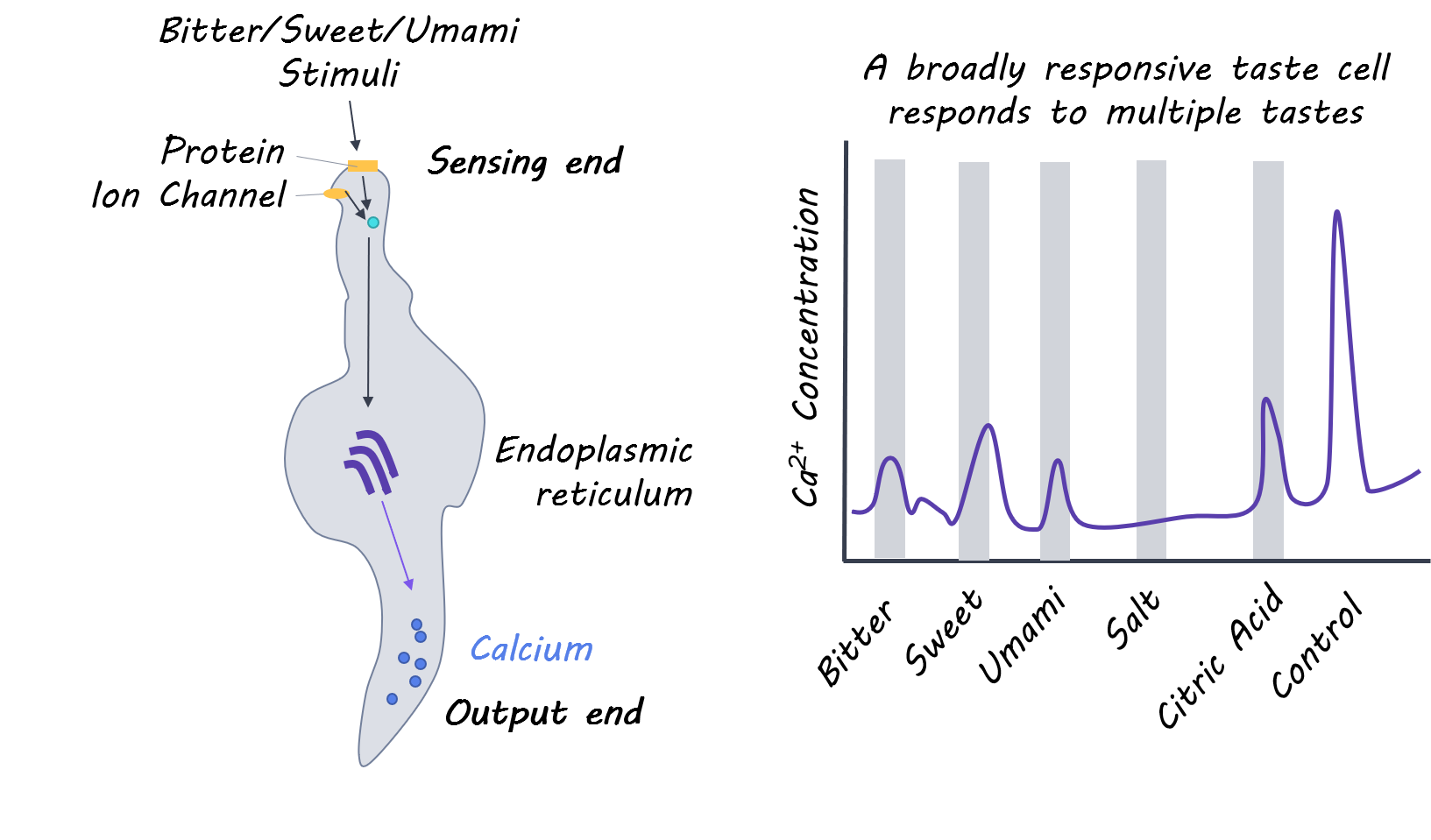
Our sense of taste allows us to gain useful information about food and what it offers us nutritionally. A sweet taste signals the presence of quick energy in the form of sugars, and umami indicates proteins, while bitter foods are potentially toxic. So far, scientists have found that there is a dedicated receptor cell for each kind of taste (with the exception of some cells that detect both sour and salty elements). However, recently in PLOS Genetics, Banik and colleagues identified a brand new type of taste receptor: a broadly responsive (BR) cell that can detect more than one type of taste compound, and sometimes many at once.

How did they do it?

The authors had observed in a previous study that BR cells seemed to respond to multiple tastes. Taste cells can be tested using calcium imaging, because the cell releases calcium internally as part of its signaling process. First, a taste cell is isolated and suspended in a fluid that keeps it alive, and a dye is injected that binds to calcium. Under a special microscope (a confocal microscope), it is exposed to a laser that excites the dye, causing it to give off light that the microscope can detect. Then, the cell is exposed to different taste compounds (sugar, acid, salt, etc). If it responds by releasing calcium, the image will get brighter. Once they confirmed that these kinds of cells exist, the authors also performed a number of tests to understand how they work. By using genetically engineered mice with different proteins knocked out (or removed from the animal’s genetic code), they could determine the inner workings of the BR cell.

What did they find?

Previously-identified cells come in two main varieties: type III cells, which detect salt and acidity, and type II cells, which each detect one of either bitter, sweet, or umami tastes. Because saltiness and acidity are both the result of ions in solution, type III cells have ion channels at their surfaces to detect these tastes. Type II cells are a bit more complicated, each one with a specialized protein on their surface to detect a single sweet, bitter, or umami compound.

Anastasia (3).png

So how could some BR cells detect bitter, umami, sweet, and sour all at once? The BR cells seem to be a subset of type III cells that have both ion channels and complex proteins at their surface. Their mechanism depends on a protein called phospholipase Cβ3. When this protein was removed from the genes of mice, they responded much less to bitter, sweet and umami tastes, even with type II cells left intact.

What's the impact?

This work highlights the fact that taste perception is an evolving field: we still haven’t discovered even the most basic cells that contribute to our sensory abilities. It also reinforces an important idea that has proven true for other senses like vision and audition: we use a combination of highly specialized receptors and other “generalist” receptors to help us perceive the world around us.

Medler_quote_sep14.jpg

Banik et al. A subset of broadly responsive Type III taste cells contribute to the detection of bitter, sweet and umami stimuli. PLOS Genetics (2020). Access the original scientific publication here.

The Role of The Medial Prefrontal Cortex In Exploring New Options

Post by Deborah Joye

What's the science?

In our daily life, we constantly make the choice to exploit an ongoing familiar plan or to abandon that plan and explore alternative options. But how exactly does our brain resolve this exploitation-exploration dilemma? One view is that the brain might resolve this dilemma by considering feedback from action outcomes. But, it has also been suggested that the brain might resolve this dilemma with predictive encoding. Predictive encoding occurs in perceptual systems such as the visual system, where an observer’s prior beliefs about a scene alter how they perceive it. In the case of the exploration-exploitation dilemma, predictive encoding might mean that how we interpret outcome feedback is shaped by our beliefs about our own behavior. Previous research has revealed that the resolution of the exploitation-exploration dilemma involves the medial prefrontal cortex, an important brain region for executive function; however, the exact neural mechanisms that underlie this process remain unknown. This week in Science, Domenech and colleagues demonstrate that the medial prefrontal cortex resolves the exploitation-exploration dilemma through a two-stage predictive encoding process involving both the ventromedial and dorsomedial prefrontal cortex.

How did they do it?

To investigate the exploitation-exploration dilemma, the authors used electroencephalography to record neural activity in the ventromedial and dorsomedial prefrontal cortex of 6 epilepsy patients. The authors had the participants perform a sequential number task that forced them to continuously choose whether to maintain an ongoing action plan or switch toward exploring alternative responses. To determine how the brain activity changed specifically when participants switched from “exploit” to “explore”, the authors analyzed neural activity in the ventromedial and dorsomedial prefrontal cortex over successive trials. In “stay” trials, the participants received feedback reinforcing their current action plan and ultimately maintained their ongoing plan while using the feedback to slightly adjust their strategy. In “switch” trials, feedback and action outcomes led participants to switch away from their ongoing plan and instead explore new plans in the following trials. Analysis of brain activity across different combinations of trials allowed the authors to determine how brain activity in two distinct regions of the medial prefrontal cortex changed over time across different combinations of trials.

What did they find?

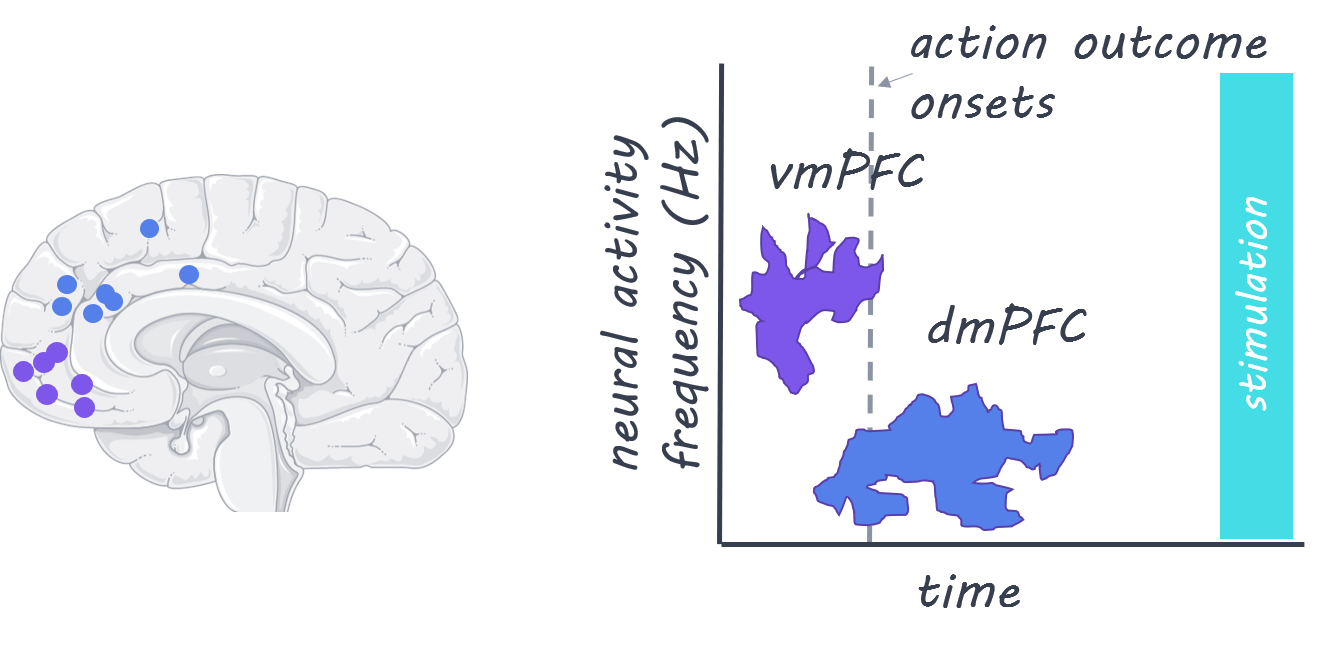
The authors found that the medial prefrontal cortex resolves the dilemma of exploitation versus exploration through a two-stage process that relies on predictive encoding to proactively alter the significance of incoming information. In the first stage, the ventromedial prefrontal cortex either signals that the ongoing action plan has been reliable and should be exploited or that it may be unreliable, and new plans should be explored. To signal that the ongoing action plan is reliable the ventromedial prefrontal cortex increases gamma activity, which are fast brainwaves (> 50 Hz) thought to indicate local neural processing. Conversely, to signal that the action plan should be abandoned and alternative plans explored, the ventromedial prefrontal cortex increases brain activity in the beta range, which are slower brain waves (13-30 Hz) associated with focused concentration. Activity changes in the ventromedial prefrontal cortex occurred before feedback occurred, rather than in direct response to incoming information. This suggests that the ventromedial prefrontal cortex proactively flags incoming information either as a signal to adjust the current plan through reinforcement learning or as a trigger to explore alternative strategies.

deb (1).png

In the second stage of exploitation-exploration resolution, the authors found that the dorsomedial prefrontal cortex responded to action outcomes based on the expectations provided by the ventromedial prefrontal cortex. For example, when the ventromedial prefrontal cortex signals that the current plan should be exploited, the dorsomedial prefrontal cortex also signals reinforcement learning through high gamma activity. However, when the ventromedial prefrontal cortex signals that the plan should be abandoned, the dorsomedial prefrontal cortex reconfigures its activity into the alpha range, which are slower brain waves (8-12 Hz) associated with the inhibition of information irrelevant to ongoing behavior. The decrease of alpha waves in the dorsomedial prefrontal cortex thus reflects the release of inhibition of alternative action plans. The increased alpha activity also disrupts the high gamma activity in both the ventromedial and dorsomedial prefrontal cortex that would otherwise signal reinforcement learning. This presumably helps to keep the “keep going with this plan” and “let’s explore other options” signals distinct from one another. Altogether these two regions of the medial prefrontal cortex work together to predict the functional value of incoming information and make decisions about it.

What's the impact?

This work is the first to demonstrate some of the underlying neural processes that resolve the exploitation-exploration dilemma. The authors reveal that the ventromedial prefrontal cortex can proactively change the functional significance of incoming feedback, adding support to the idea that predictive encoding is not limited to perceptual systems but is also utilized in executive function systems. The finding that predictive encoding is important in both perceptual and executive systems, suggests that it serves as a general mechanism used across the cerebral cortex to process incoming information.

exploration_quote_sept7.jpg

Domenech et al., Neural mechanisms resolving exploitation-exploration dilemmas in the medial prefrontal cortex, Science (2020). Access the original scientific publication here.