Blood Factors Can Transfer the Benefits of Exercise to the Aged Brain

Post by Elisa Guma

What's the science?

Exercise has been shown to be a promising intervention to mitigate age-related cognitive decline, and vulnerability to age-related neurodegenerative diseases, however it is not accessible to all elderly individuals due to poor health or physical frailty. Animal studies have shown that exercise can reverse age related decline in adult neurogenesis (the formation of new neurons) in the hippocampus and improve cognitive function. Interestingly, the transfer of blood from young mice to old has also been found to improve regeneration and cognitive function. This week in Science, Horowitz, Fan and colleagues tested the effects of systemic plasma administration derived from mice that exercise on regenerative and cognitive function in the aged brain.

How did they do it?

Blood was collected and plasma was isolated from aged 18-month-old mice who had exercised (i.e. had access to a running wheel for 6 weeks) and aged sedentary mice. The isolated plasma was injected into a separate cohort of aged mice. Following administration, hippocampal-dependent learning and memory were tested (using the radial arm water maze and contextual fear conditioning) and immunohistochemistry was performed to look for evidence of neurogenesis in the hippocampus. The authors also investigated whether the benefits of exercise observed in mice at younger ages could also be transferred to the aged mice through circulating blood factors.

Next, the authors measured soluble protein levels in the plasma of exercised and sedentary mice to try to understand what might be driving the beneficial effects of exercise. Once their protein of interest was identified, they characterized its expression levels in various organs of the body, including the liver, lung, fat, spleen, skin kidney, heart, muscle, cortex, hippocampus, and cerebellum. They then overexpressed the peptide in the liver (using hydrodynamic tail vein injection) and tested its ability to improve neurogenesis and cognitive performance in aged mice. In order to gain further mechanistic insight, the authors investigated the ability of the peptide to cross the blood-brain barrier, as well as the importance of enzymatic activity associated with the peptide in effects on cognition and neurogenesis.

What did they find?

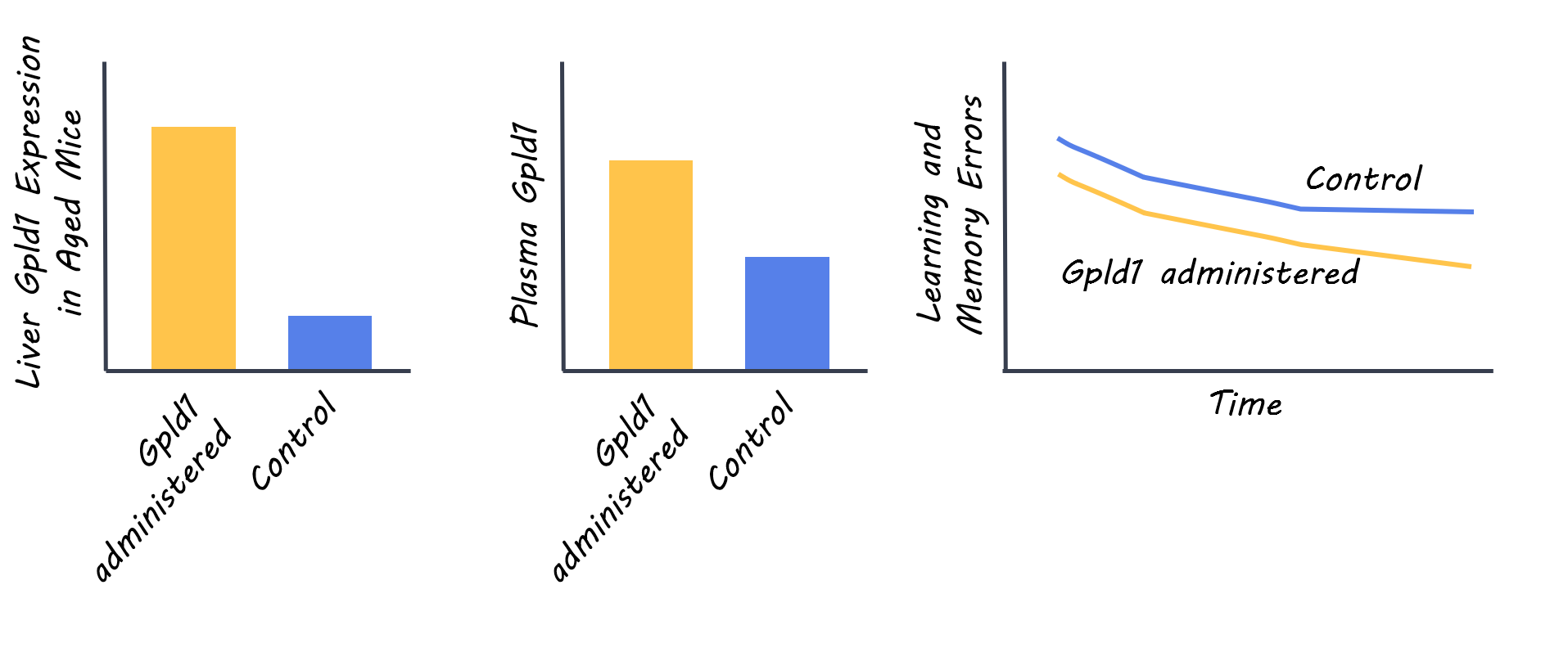
When plasma from exercised mice was given to sedentary mice, there was an increase in newly born neurons and improved performance in hippocampal-dependent learning. These data indicate that plasma from exercised aged animals can transfer the beneficial effects of exercise to the regenerative capacity of the aged hippocampus and hippocampal-dependent learning and memory. They observed similar improvements when plasma from exercised mature mice (6-7 months) was administered to aged mice.
Elisa.png

Analysis of plasma identified 30 factors in the exercised aged mice and 33 in the exercised mature mice that had greater expression than in the sedentary mice, of which 63% and 67% respectively were expressed in the liver. They identified two proteins that were overrepresented, but chose to focus on one — glycosylphosphatidylinositol (GPI)l-specific phospholipase D1 (Glpd1) (an enzyme in the liver that cleaves GPI) — as it hadn’t previously been associated with aging, neurogenesis, or cognition. The authors confirmed that Gpld1 was increased in exercised mice and that its expression levels were correlated with improved cognitive performance. Further, they demonstrated that its overexpression in the liver of aged animals improved adult neurogenesis and cognitive function. Gpld1 was found not to cross the blood-brain barrier readily, and to have low expression levels in the brain. Finally, the authors demonstrated that the peptide must be catalytically active and cleave GPI in order to induce beneficial effects on neurogenesis and cognition.

What's the impact?

The authors identified a novel role for the liver-derived factor Gpld1 as a mediator for the beneficial effects of exercise on the aged mouse brain. This provides exciting evidence for a potential liver-to-brain axis in which circulating blood factors transmit the beneficial effects of exercise to the brain. Finally, these data point to promising avenues for intervention in the aging population, as the beneficial effects of exercise could be distributed broadly across tissues via circulating blood factors.

Horowitz & Fan et al. Blood factors transfer beneficial effects of exercise on neurogenesis and cognition to the aged brain. Science (2020). Access the original scientific publication here.
Using Psychophysics and Signal Detection Theory to Improve Eyewitness Testimony

Post by Cody Walters 

What’s the science?

Eyewitness testimony plays a major role in the criminal justice system, yet 70% of those who are wrongfully convicted are imprisoned, in large part, on the basis of witness misidentification. While some research has been done to try to find ways to improve eyewitness performance, the fact remains that traditional police lineups are prone to various forms of decisional bias. This week in Nature Communications, Gepshtein and colleagues explored a more nuanced lineup methodology that avoids the pitfalls associated with traditional lineups and provides finer-grain metrics for gauging eyewitness reliability. 

How did they do it?

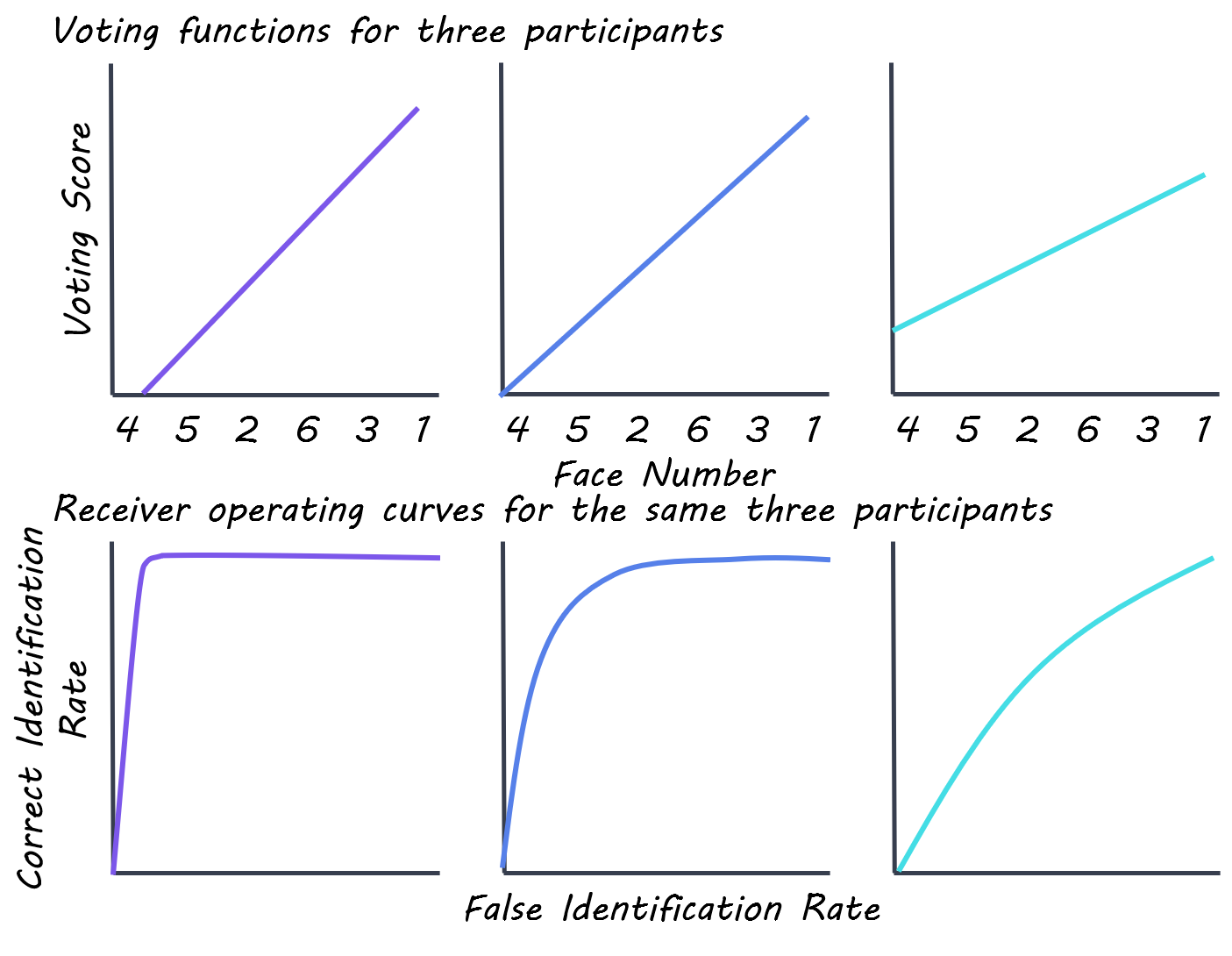
Simultaneous and sequential lineups have been traditionally used by law enforcement and involve the participant either being presented with all the suspects at once or one at a time, respectively. The authors introduced a third lineup type: the paired comparison design. Each participant watched a brief movie clip depicting a crime being committed. The following day, participants were shown the same six faces and told that the perpetrator (called the ‘target’) may or may not be present in the current lineup. During the paired comparison lineup, participants viewed two suspect photographs at a time and were asked to indicate which of the two more closely resembled the perpetrator. This method of relative judgment between two stimuli is a well-established technique in the field of psychophysics (i.e., the study of the relationship between physical stimuli and perception). The authors then fit a line to these voting data and constructed a voting function, where the slope of the line was used to quantify voting consistency: a voting function with a slope of zero would indicate that each face in the lineup was voted for equally often (indicating low voting consistency), whereas a large slope would indicate that each face in the lineup was not voted for equally often (indicating high voting consistency).

Lastly, the authors used receiver operator characteristic (ROC) curves to quantify the voting distribution data. To provide a simple example of how to construct an ROC curve, assume you have two partially overlapping distributions representing votes for face 1 (the perpetrator) and votes for face 2 (a filler), with the voting score represented along the x-axis. You can set an arbitrary cutoff (i.e. a decision criterion) in between those two distributions, meaning that a classifier will consider all vote scores to the right of that cutoff as a vote for the rightmost category. However, since the distributions are overlapping, this necessarily means that there will be misclassifications. Multiple such cutoffs can be positioned at varying positions along the two distributions, and the ‘hit-to-miss’ ratio for each cutoff is plotted to form a curve. The area under the ROC curve can then be used as a metric for classification accuracy.

What did they find?

The authors found that the paired comparison lineup resulted in the same rate of target identification as traditional lineups with the added benefit of having a lower lineup rejection rate (which results from participants failing to select a suspect). An additional advantage of the paired comparison design is that it provides access to information about the consistency with which each face is selected as well as the strength of participants’ recognition memory (i.e., the degree to which a given face matches their memory of the perpetrator). This is because the consistency of a participant’s votes over multiple rounds of paired comparisons is inversely proportional to the variance of the recognition memory.

The authors plotted the average voting scores for each lineup face split by subjects whose highest voting score either correctly or incorrectly identified the perpetrator. Unsurprisingly, the voting score distribution for the perpetrator was significantly above the voting score distributions for the other lineup faces among participants who correctly identified the perpetrator. However, the voting score distribution for the perpetrator was (counterintuitively) also significantly above the voting scores for the other lineup faces among subjects that incorrectly identified the perpetrator. This result is explained by the consistency with which subjects voted: though the highest voting scores among the incorrect subjects were for non-target faces, they often ranked the target face as their second choice. This unique feature of the paired comparison lineup provides access to the hidden structure of recognition memory, allowing experimenters to infer the target face from aggregate voting data even when it was not the top-ranked face among individual subjects.

cody (1).png

The authors generated ROC curves derived from simultaneous and sequential lineup data and showed that the paired comparisons ROC curve matches (and potentially outperforms) the data from simultaneous and sequential lineups in terms of classification accuracy without the bias that comes from subjects having to make a definitive identification. Importantly, the paired comparison lineup method allows for experimenters to create ROC curves for individual subjects, an option that is unavailable when using traditional lineups.

What’s the impact?

The authors studied a novel lineup design that leverages principles from psychophysics and analyses from signal detection theory. This new approach provides a method for determining the strength of either individual or aggregate eyewitness recognition memory in a probabilistic manner, an improvement on existing methods that require definitive decision criterion. This work has the potential to pave the way for a more effective, science-based approach to eyewitness testimony.

Gepshtein et al. A perceptual scaling approach to eyewitness identification. Nature Communications (2020). Access the publication here.

The Effect of Pro-Diversity Social Norms Messaging on Social Inclusion and the Achievement Gap

Post by Stephanie Williams 

What's the science?

Despite the urgency of creating an inclusive social climate at universities, few effective methods have been developed and implemented. Recent meta-analyses of currently implemented methods — such as diversity workshops and implicit bias training — have shown that many of these methods are ineffective, have little impact on discriminatory behaviors, and may lead to backlash effects. One underexplored approach, coined social norms messaging, involves broadcasting a message about what is socially normative and acceptable. The underlying idea is that observing socially acceptable behaviours will encourage individuals to align their own attitudes and behaviour with these standards. Although there is substantial evidence that social norms can influence behaviours, it is unclear if it would be effective in changing social behaviours in college and university settings. This week in Nature Human Behavior, Murrar, Campbell and Brauer tested whether broadcasting salient pro-diversity norms within a college can change an institution’s climate, or alter academic performance differences between privileged and marginalized social groups.

How did they do it?                             

The authors performed six, randomized controlled experiments at the University of Wisconsin-Madison in the United States. They developed two social norms interventions with the intention of promoting positive attitudes towards social outgroups. The first intervention was a social norms poster displaying pictures of students from different ethnic backgrounds, a statement about valuing diversity, and statistics that reflected how many students agreed with the content on the poster. The poster, based on previous studies, said that 93% of students agreed with the message on the poster, and 84% of students agreed to have their picture on the poster. In the first experiment, participants were exposed to either a neutral poster about getting a flu vaccine or the social norms poster, while they sat in a waiting room for 5-7 minutes. Afterward, participants completed a filler memory task and then filled out surveys that had questions related to the social climate and to intergroup attitudes. In the second experiment, the authors put up four to six social norms posters in some classrooms during the first 5 weeks of the university semester. For each classroom, posters were put up 10-30 minutes before class started, and taken down 5 minutes after everyone had left the room. At the end of the semester (weeks 10-12), the authors asked students to complete surveys that assessed their appreciation of diversity, how positive they felt about social outgroups, how welcoming the classroom climate was, the extent to which they felt belonging, and warmth ratings of feelings towards Black, Hispanic, Arab, and gay individuals

The second intervention was a 5-minute video that conveyed the general message that the university community welcomed people from all backgrounds. The videos consisted of scenes of 1) interviews with students who expressed appreciation for diversity on campus and 2) scientists and diversity specialists who reported evidence that most students on campus behaved in an inclusive and non-prejudiced manner. In experiment 3, the authors randomized students to either watch or not watch the social norms videos on the first day of the semester. The authors repeated this study with an additional video on bias and microaggressions (experiment 5), to ensure that any effects were driven by the content of the video and not the video itself. In a fourth experiment, the authors tested the same social norms video online to examine if the same effects could be seen in the virtual setting. Participants filled out an additional survey that assessed the participant’s perceptions of their peers’ norms, their perceptions of their university’s commitment to diversity, and their interest in several campus programs (e.g. social justice). In a final experiment, the authors were interested in understanding how the short videos could influence academic achievement, which they measured with student grade information collected at the end of the semester. The authors recruited science, technology, engineering, and mathematics (STEM) professors to show the social norms video to half of their sections on the first day of class. The other half did not watch the social norms video but instead saw a short diversity statement on the class syllabus. 

What did they find?

The authors found that their social norms interventions had positive effects on pro-inclusive attitudes across all six experiments. In experiment 1, the authors found an effect of the poster on participant’s inclusive climate scores (which consisted of an average of standardized scores from questions about positive traits, modern racism, internal motivation to respond without prejudice, rejection of racism, and attitudes toward minorities). When the authors compared this effect across privileged (defined in this experiment as Caucasian participants who were Christian or had no religion) and marginalized groups, they found that the effect was not moderated by privilege, and that both groups were equally affected by the posters.

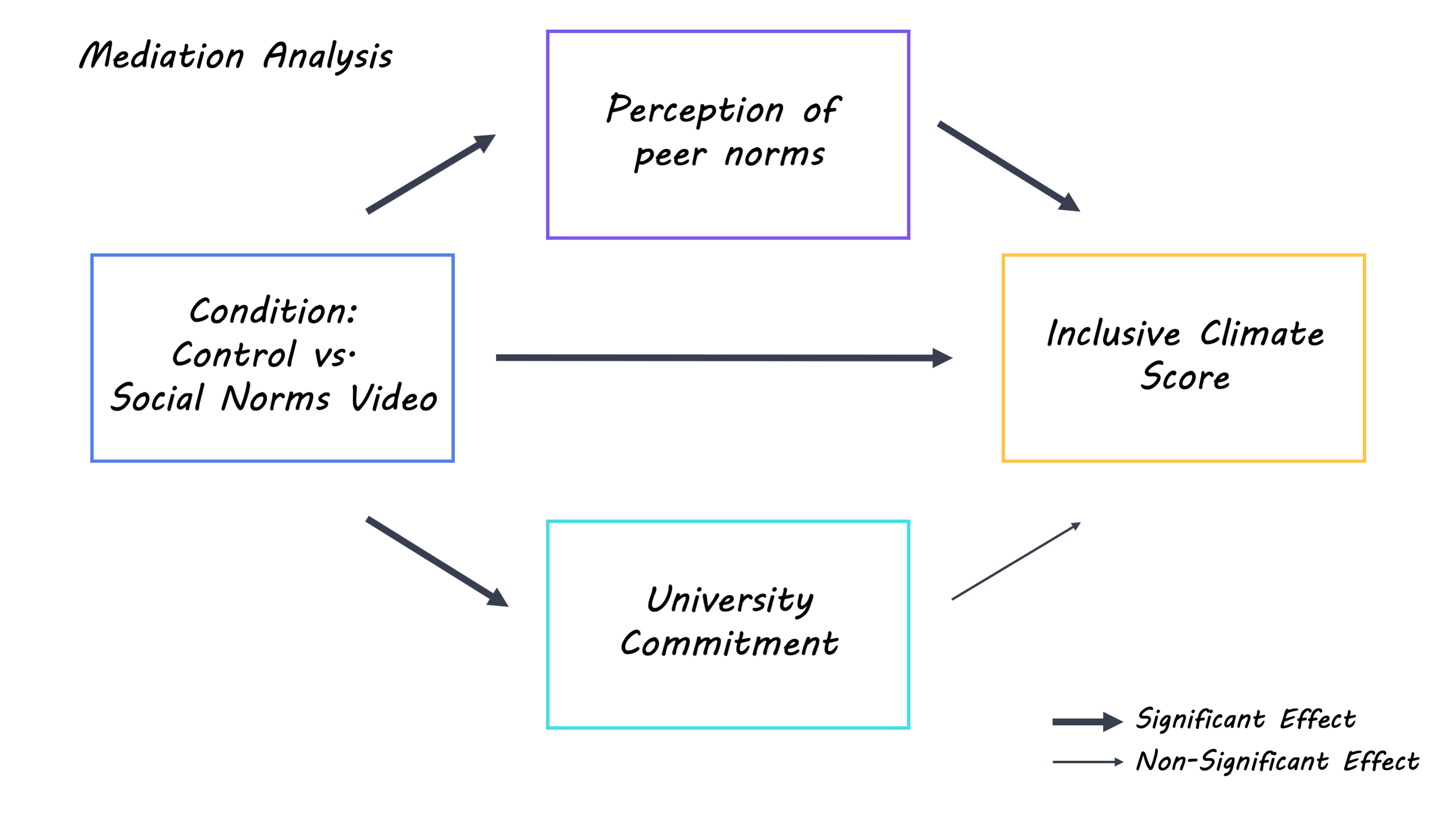
Participants who were exposed to the social norms poster showed higher inclusive climate scores than participants who saw the neutral posters. Although significant, the observed effect was small. The authors note that participants in the experimental condition may not have noticed the poster, and that the outcomes were collected 5 to 7 weeks after the students were last exposed to the posters. In experiment 3, the authors found that participants who saw the social norms video on the first day of class had higher inclusive climate scores than participants in the control condition. In experiment 4, the authors observed that there was a difference between those who had seen the video and those who did not. Participants who saw the video showed more positive attitudes toward outgroups, appreciated “diversity” more, and reported an increased sense of belonging. The authors also found that there was a stronger effect on the inclusive climate score for privileged students than for marginalized students. Analyses revealed that a shift in attitude was driven by the participant’s perceptions of their peers’ inclusiveness, and not by their university’s commitment to diversity. 

mediation_img_Jul14.png

In experiment 5, the authors found that the social norms video had a strong positive effect on inclusive climate scores for individuals from marginalized backgrounds - they reported that their peers behaved more inclusively. Finally, in experiment 6, the authors found that marginalized students showed lower grades (mean 83.69, s.d. 10.78) than students categorized as privileged (mean 86.77, s.d. 8.35) within the control group. In the social norms video group, however, there was no significant grade gap between the two groups, suggesting that the social norms intervention mitigated the achievement gap in STEM classes.

What's the impact?

This study provides evidence from randomized controlled trials that shows emphasizing peers’ pro-diversity values and behaviors can have a positive impact on the social climate and reduce the achievement gap at a large midwestern university. These findings demonstrate the importance of directing attention towards peers’ pro-diversity values as a strategy for generating positive change that could be applied and tested in a variety of social environments. Further, the interventions used in this study are easily scalable, and can be implemented using a variety of channels to communicate the same message.

Murrar_quote_Jul14.jpg

Murrar, S., Campbell, M., and Brauer, M. Exposure to peer’s pro diversity attitudes increases inclusion and reduces the achievement gap. Nature Human Behavior. (2020). Access the original scientific publication here.