
The Effect of Pro-Diversity Social Norms Messaging on Social Inclusion and the Achievement Gap

Post by Stephanie Williams 

What's the science?

Despite the urgency of creating an inclusive social climate at universities, few effective methods have been developed and implemented. Recent meta-analyses of currently implemented methods — such as diversity workshops and implicit bias training — have shown that many of these methods are ineffective, have little impact on discriminatory behaviors, and may lead to backlash effects. One underexplored approach, coined social norms messaging, involves broadcasting a message about what is socially normative and acceptable. The underlying idea is that observing socially acceptable behaviours will encourage individuals to align their own attitudes and behaviour with these standards. Although there is substantial evidence that social norms can influence behaviours, it is unclear if it would be effective in changing social behaviours in college and university settings. This week in Nature Human Behavior, Murrar, Campbell and Brauer tested whether broadcasting salient pro-diversity norms within a college can change an institution’s climate, or alter academic performance differences between privileged and marginalized social groups.

How did they do it?                             

The authors performed six, randomized controlled experiments at the University of Wisconsin-Madison in the United States. They developed two social norms interventions with the intention of promoting positive attitudes towards social outgroups. The first intervention was a social norms poster displaying pictures of students from different ethnic backgrounds, a statement about valuing diversity, and statistics that reflected how many students agreed with the content on the poster. The poster, based on previous studies, said that 93% of students agreed with the message on the poster, and 84% of students agreed to have their picture on the poster. In the first experiment, participants were exposed to either a neutral poster about getting a flu vaccine or the social norms poster, while they sat in a waiting room for 5-7 minutes. Afterward, participants completed a filler memory task and then filled out surveys that had questions related to the social climate and to intergroup attitudes. In the second experiment, the authors put up four to six social norms posters in some classrooms during the first 5 weeks of the university semester. For each classroom, posters were put up 10-30 minutes before class started, and taken down 5 minutes after everyone had left the room. At the end of the semester (weeks 10-12), the authors asked students to complete surveys that assessed their appreciation of diversity, how positive they felt about social outgroups, how welcoming the classroom climate was, the extent to which they felt belonging, and warmth ratings of feelings towards Black, Hispanic, Arab, and gay individuals

The second intervention was a 5-minute video that conveyed the general message that the university community welcomed people from all backgrounds. The videos consisted of scenes of 1) interviews with students who expressed appreciation for diversity on campus and 2) scientists and diversity specialists who reported evidence that most students on campus behaved in an inclusive and non-prejudiced manner. In experiment 3, the authors randomized students to either watch or not watch the social norms videos on the first day of the semester. The authors repeated this study with an additional video on bias and microaggressions (experiment 5), to ensure that any effects were driven by the content of the video and not the video itself. In a fourth experiment, the authors tested the same social norms video online to examine if the same effects could be seen in the virtual setting. Participants filled out an additional survey that assessed the participant’s perceptions of their peers’ norms, their perceptions of their university’s commitment to diversity, and their interest in several campus programs (e.g. social justice). In a final experiment, the authors were interested in understanding how the short videos could influence academic achievement, which they measured with student grade information collected at the end of the semester. The authors recruited science, technology, engineering, and mathematics (STEM) professors to show the social norms video to half of their sections on the first day of class. The other half did not watch the social norms video but instead saw a short diversity statement on the class syllabus. 

What did they find?

The authors found that their social norms interventions had positive effects on pro-inclusive attitudes across all six experiments. In experiment 1, the authors found an effect of the poster on participant’s inclusive climate scores (which consisted of an average of standardized scores from questions about positive traits, modern racism, internal motivation to respond without prejudice, rejection of racism, and attitudes toward minorities). When the authors compared this effect across privileged (defined in this experiment as Caucasian participants who were Christian or had no religion) and marginalized groups, they found that the effect was not moderated by privilege, and that both groups were equally affected by the posters.

Participants who were exposed to the social norms poster showed higher inclusive climate scores than participants who saw the neutral posters. Although significant, the observed effect was small. The authors note that participants in the experimental condition may not have noticed the poster, and that the outcomes were collected 5 to 7 weeks after the students were last exposed to the posters. In experiment 3, the authors found that participants who saw the social norms video on the first day of class had higher inclusive climate scores than participants in the control condition. In experiment 4, the authors observed that there was a difference between those who had seen the video and those who did not. Participants who saw the video showed more positive attitudes toward outgroups, appreciated “diversity” more, and reported an increased sense of belonging. The authors also found that there was a stronger effect on the inclusive climate score for privileged students than for marginalized students. Analyses revealed that a shift in attitude was driven by the participant’s perceptions of their peers’ inclusiveness, and not by their university’s commitment to diversity. 
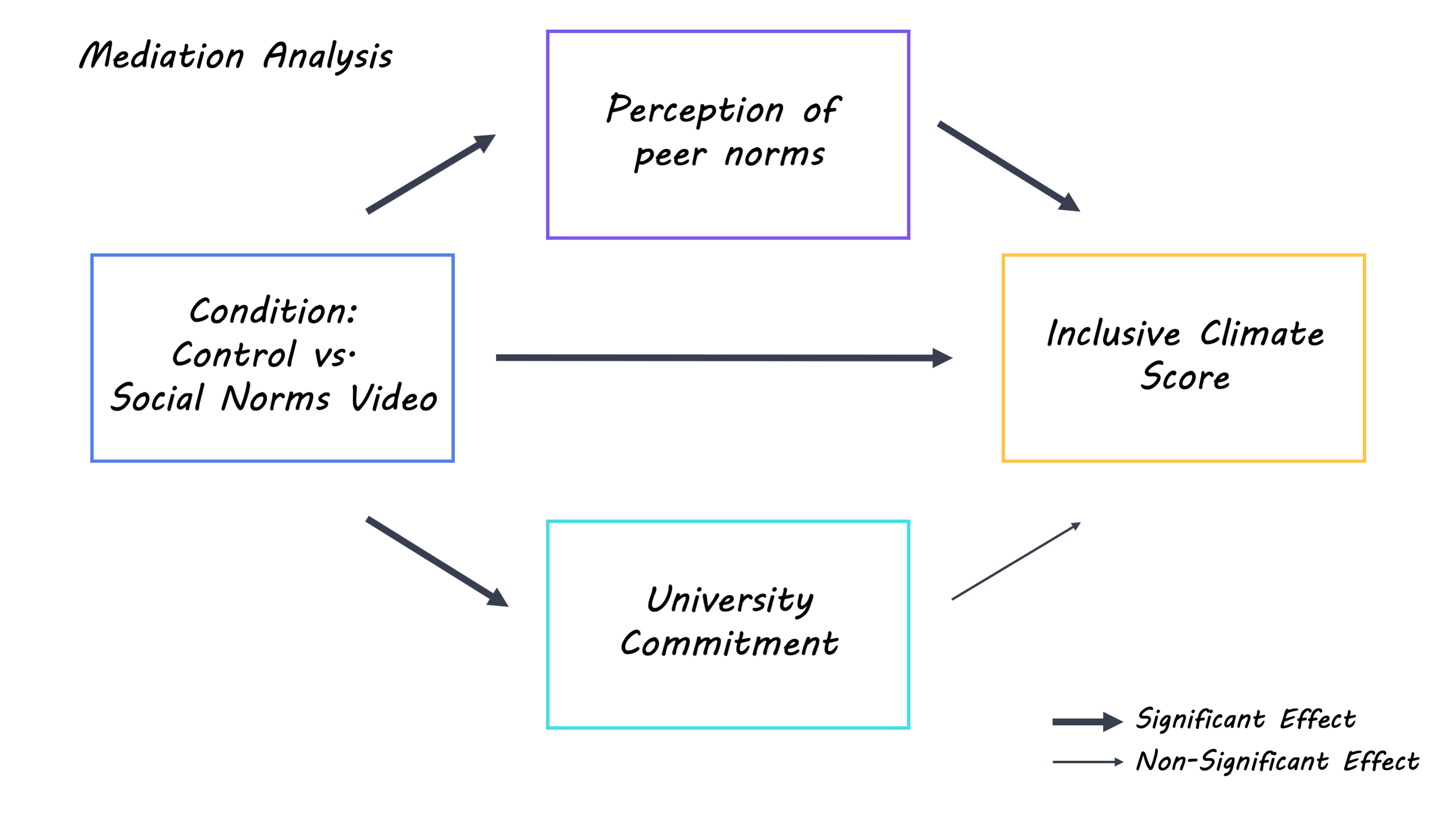
mediation_img_Jul14.png

In experiment 5, the authors found that the social norms video had a strong positive effect on inclusive climate scores for individuals from marginalized backgrounds - they reported that their peers behaved more inclusively. Finally, in experiment 6, the authors found that marginalized students showed lower grades (mean 83.69, s.d. 10.78) than students categorized as privileged (mean 86.77, s.d. 8.35) within the control group. In the social norms video group, however, there was no significant grade gap between the two groups, suggesting that the social norms intervention mitigated the achievement gap in STEM classes.

What's the impact?

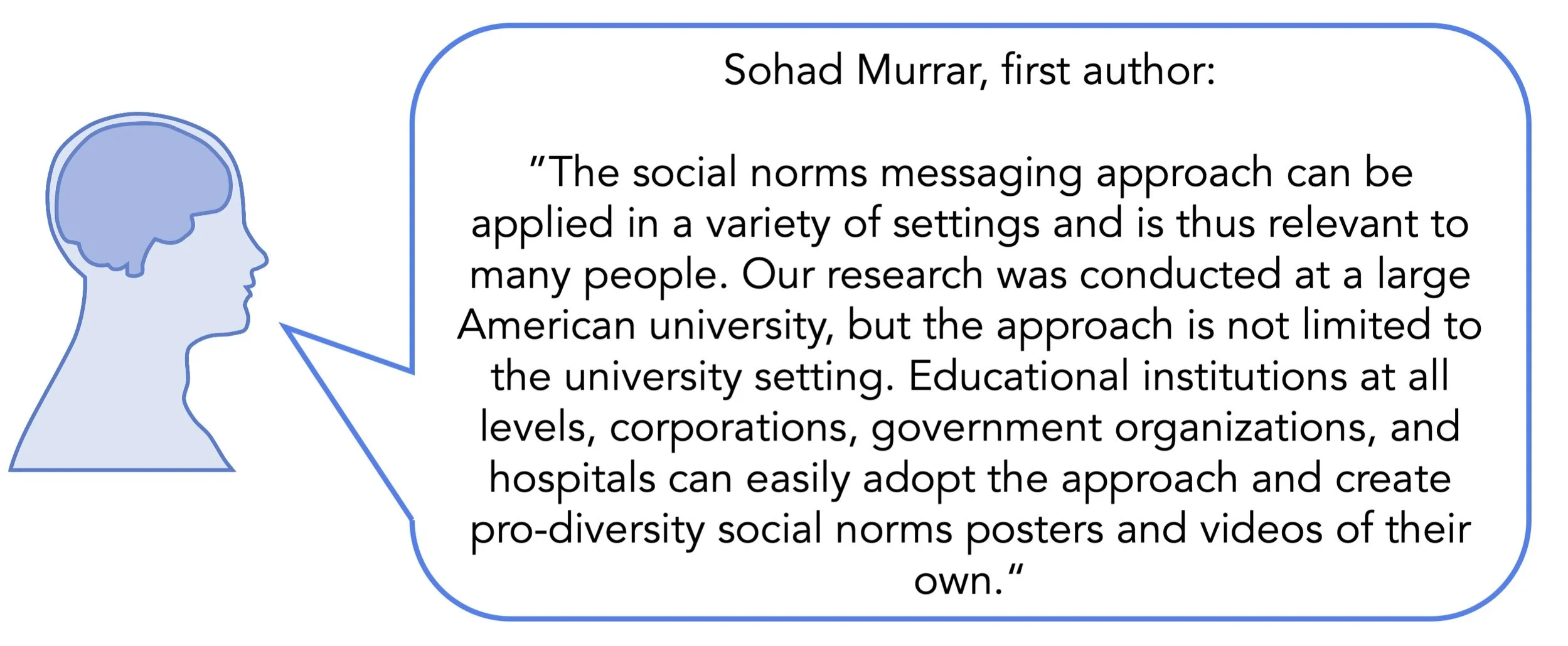
This study provides evidence from randomized controlled trials that shows emphasizing peers’ pro-diversity values and behaviors can have a positive impact on the social climate and reduce the achievement gap at a large midwestern university. These findings demonstrate the importance of directing attention towards peers’ pro-diversity values as a strategy for generating positive change that could be applied and tested in a variety of social environments. Further, the interventions used in this study are easily scalable, and can be implemented using a variety of channels to communicate the same message.
Murrar_quote_Jul14.jpg

Murrar, S., Campbell, M., and Brauer, M. Exposure to peer’s pro diversity attitudes increases inclusion and reduces the achievement gap. Nature Human Behavior. (2020). Access the original scientific publication here.
Olfactory Support Cells, Not Primary Neurons, Are Targeted in COVID-19

Post by Lincoln Tracy

What's the science?

The most common neurological symptom of the coronavirus disease 2019 (COVID-19) is the partial or complete loss of smell and/or taste. This finding has resulted in researchers developing simple smell tests (like scratch-and-sniff stickers) that can be used to screen for COVID-19. But how does SARS-CoV-2 (the virus that causes COVID-19) affect the cells and circuits that allow us to smell and taste? This week in Neuron, Cooper and colleagues speculate on the pathophysiological mechanisms of SARS-CoV-2 on the olfactory system.

What do we already know?

Previous research has shown that coronaviruses infect the upper airways and cause the common cold, which is associated with short- and long-term changes in smell and taste. Researchers have proposed several different mechanisms for these changes in smell, including increased mucus production and direct damage to olfactory neurons that detect odors. Damaged olfactory neurons can be replaced over time, which may cause distortions in our sense of smell. However, the history behind the loss of smell associated with COVID-19 suggests that SARS-CoV-2 affects the olfactory system in a different way compared to the less severe and more common coronaviruses. 

What’s new?

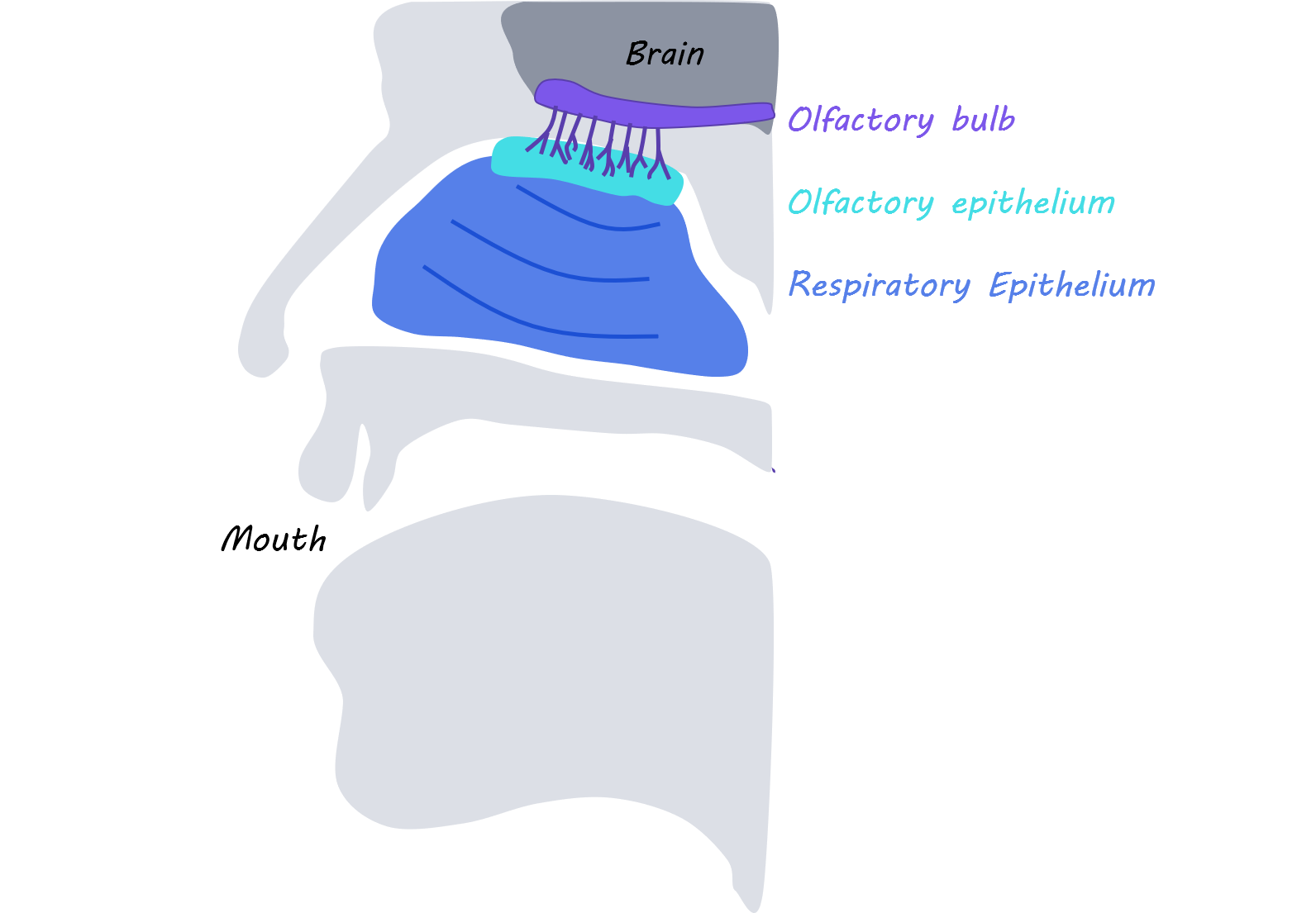
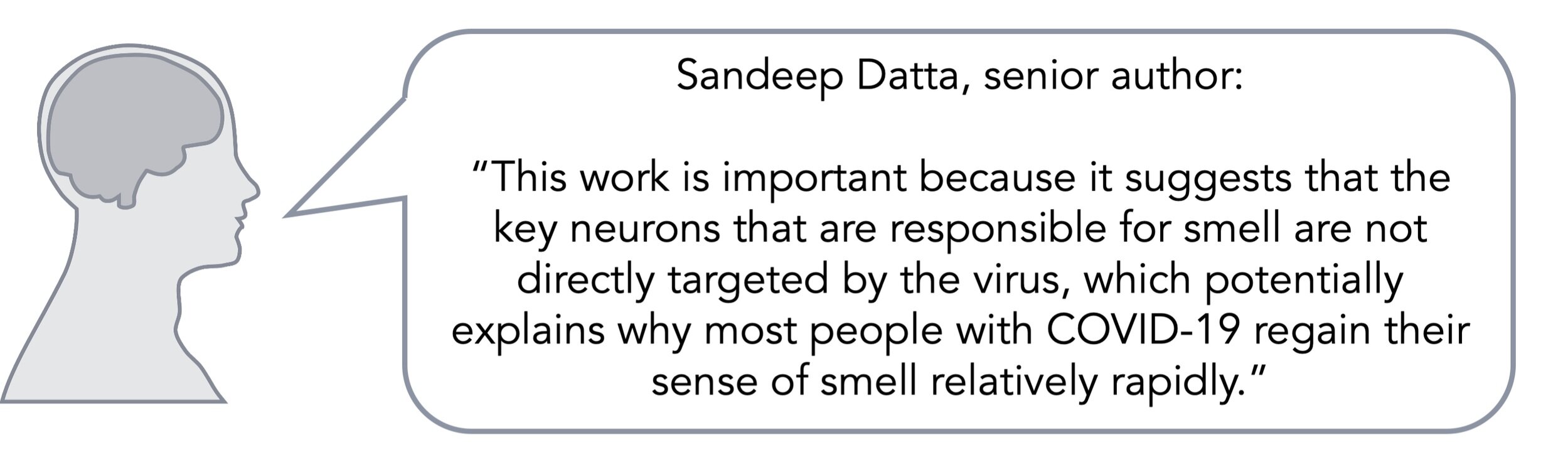
The authors propose that rather than directly infecting olfactory sensory neurons, SARS-CoV-2 impacts our ability to smell by affecting a variety of cells in the olfactory epithelium that houses neurons. Many of the cell types within the olfactory epithelium support and assist olfactory neurons in different ways. First, the cells in the olfactory epithelium may become inflamed. Inflammation of the epithelium may block the nasal clefts or the narrow passages that allow air to reach the epithelium, which prevents us from detecting smells and odors. Second, the inflammation following SARS-CoV-2 infection may cause the release of inflammatory intermediates such as cytokines. Inflammatory intermediates have been reported to reduce the expression of odorant receptors on olfactory neurons. It is the odorant receptors that detect odors that give rise to our sense of smell. Finally, SARS-CoV-2 infecting the support cells may make the microenvironment of the olfactory epithelium detrimental to functioning. For example, Bowman’s glands secrete mucus that is essential for detecting odors. SARS-CoV-2 infection may cause changes in the secreted mucus, meaning that olfactory functioning is inhibited. The result of each of the proposed mechanisms is an indirect interruption of olfactory neuronal function, interfering with our sense of smell and taste.

lincoln.png

What's the bottom line?

Current evidence suggests that neural function is indirectly altered as a result of SARS-CoV-2 infecting smaller cells that surround and support neurons, rather than the neurons themselves. Cooper and colleagues use COVID-19 to highlight how little we know about the non-neuronal cells and structures that support our ability to taste and smell.  Continuing to study SARS-CoV-2 will help us better understand how viruses can specifically disrupt our senses and more generally affect our neuronal connections. 

Datta_quote_Jul14.jpg

Cooper et al. COVID-19 and the Chemical Senses: Supporting Players Take Center Stage. Neuron (2020). Access the original scientific publication here.

Acute Psychological Stress in Trauma Survivors is Predictive of Post-Traumatic Stress Disorder

Post by Shireen Parimoo

What's the science?

Post-traumatic stress disorder (PTSD) is a psychiatric disorder resulting from a traumatic experience. Symptoms like persistent distress, intrusive thoughts, and flashbacks to the event, among others, can significantly disrupt many aspects of life, such as finding a stable job. People who experience a life-threatening traumatic event are often at risk of developing PTSD. Research shows that self-reported stress and blood biomarkers (e.g., cortisol levels) immediately after trauma are predictive of whether someone is at risk of developing PTSD. However, most hospitals do not screen for PTS symptoms, making it difficult to determine the extent to which psychological stress and physiological factors contribute to the risk of developing PTSD. This week in Nature Medicine, Schultebraucks and colleagues developed and validated an algorithm using medical records and self-reported stress of trauma survivors to predict the trajectory of their PTS symptoms.

How did they do it?

Patients who had experienced a life-threatening traumatic event and were admitted to the emergency department at one of two US hospitals (Grady Memorial, Bellevue Hospital) participated in a prospective longitudinal study. Immediately following the trauma, physiological information like vitals and blood biomarkers were recorded as part of their medical record at the hospitals, along with self-reported measures like immediate stress. These measures were used as predictors to assess the risk of developing PTSD. Following discharge from the hospital, participants’ symptoms were assessed at 1, 3, 6, and 12 months post-trauma using the modified PTSD symptom scale (mPSS; Grady Memorial) or the PTSD checklist (PCL-5; Bellevue). The scores on these scales were used to classify symptoms into categories like non-remitting and resilient. Moreover, although the mPSS and PCL-5 are not diagnostic tools, they can be used for a provisional diagnosis for PTSD based on cut-off scores of 21 and 33, respectively.

The authors developed an algorithm to predict the progression of participants’ PTS symptoms after discharge from Grady Memorial Hospital (the model development sample). They used latent growth mixture models – a statistical technique that accounts for heterogeneity in individual trajectories – to predict symptom trajectory over time. Specifically, the mPSS was used to assess the model’s accuracy in distinguishing between (i) non-remitting symptoms and resilience, and (ii) non-remitting symptoms compared to other symptom categories. They identified predictors that significantly contributed to the model’s diagnostic accuracy and validated the algorithm in the Bellevue participant cohort (the external validation sample). Finally, they developed an algorithm to predict a provisional PTSD diagnosis outcome one year after the traumatic experience. To do this, they trained the algorithm on the development sample and tested it on the validation sample.

shireen (1).png

What did they find?

Nearly a third of the participants received a provisional diagnosis of PTSD one month after the traumatic experience. After 12 months, this percentage dropped to 15.5% and 22% in the Grady Memorial and the Bellevue cohorts, respectively. The model successfully discriminated between non-remitting and resilient trajectories with 83% accuracy in the development sample and 84% accuracy in the validation sample. Self-reported stress, immune markers, and chloride levels were the best predictors of the model’s accuracy. Moreover, the model distinguished between non-remitting and the other symptom trajectories with 96% accuracy, although accuracy dropped to 78% in the validation sample. Lastly, the model predicted a diagnosis of provisional PTSD with 87% accuracy in the validation sample. Altogether, these results demonstrate that self-reported measures of stress are predictive of whether someone will go on to exhibit non-remitting PTS symptoms and might be at risk of being diagnosed with PTSD.

What's the impact?

The authors developed a novel predictive algorithm that uses self-report and medical information collected immediately after a life-threatening traumatic experience to assess the risk of PTSD, which has important implications for performing individualized risk assessment and treatment planning for trauma survivors. In particular, the finding that psychological stress was one of the main predictors of symptom trajectory highlights the importance of collecting self-report measures of stress and PTSD symptoms in trauma centers.

Schultebraucks et al. A validated predictive algorithm of post-traumatic stress course following emergency department admission after a traumatic stressor. Nature Medicine (2020). Access the original scientific publication here.