
Two Basal Forebrain Cholinergic Neuron Types Show Distinct Properties

Post by Stephanie Williams

What's the science?

The basal forebrain contains many neurons that release a neurotransmitter called acetylcholine. Collectively, cholinergic (acetylcholine-releasing) neurons have been associated with many different broad cognitive processes, including arousal-regulation, memory, and attention. There is some previous evidence that cholinergic neurons are not a homogenous group, and that there may be subtypes of cholinergic neurons in the basal forebrain that are functionally distinct. This week in Nature Neuroscience, Laszlovszky and colleagues perform both in vivo and in vitro experiments to examine the heterogeneity of cholinergic neurons.

How did they do it?                             

The authors performed a series of electrophysiological and optogenetic experiments in mice performing behavioral tasks (“in vivo”) and in slices of brains that had been extracted from mice (“in vitro”). During the in vivo experiments, the authors recorded from the brains of awake and behaving mice using extracellular tetrodes. Cholinergic neurons were engineered to contain a photosensitive protein called channel rhodopsin that would respond to a particular light, which allowed them to be identified in the basal forebrain. The authors analyzed their recordings to characterize the firing properties of these cholinergic neurons in awake behaving mice. They also used the behavior of mice in conjunction with the in vivo electrophysiological recordings to investigate whether there were distinct subtypes of cholinergic basal forebrain neurons that were linked to behavioral outcomes. They analyzed the activity of cholinergic basal forebrain neurons after reward and punishment to understand if cholinergic neurons signalled information about reinforcements. The authors also recorded from 2 or 3 cholinergic neurons simultaneously to determine whether the cholinergic subtypes showed synchronous activity.  

During the in vitro experiments, the authors wanted to evaluate whether there were two distinct types of basal forebrain cholinergic neurons. They applied current to elicit spikes from cholinergic neurons in basal forebrain slices and measured these using whole-cell patch clamp recordings. The authors used recordings from auditory cortex and from basal forebrain to examine the relationship between basal forebrain cholinergic neurons and cortical activity. They confirmed that the cholinergic neurons were connected to cortical circuits by using a light to activate cholinergic neurons and looking for corresponding activity in cortical areas. They then examined whether the amount of synchrony between basal forebrain cholinergic neurons and auditory cortex was behaviorally significant during an auditory task.

What did they find?

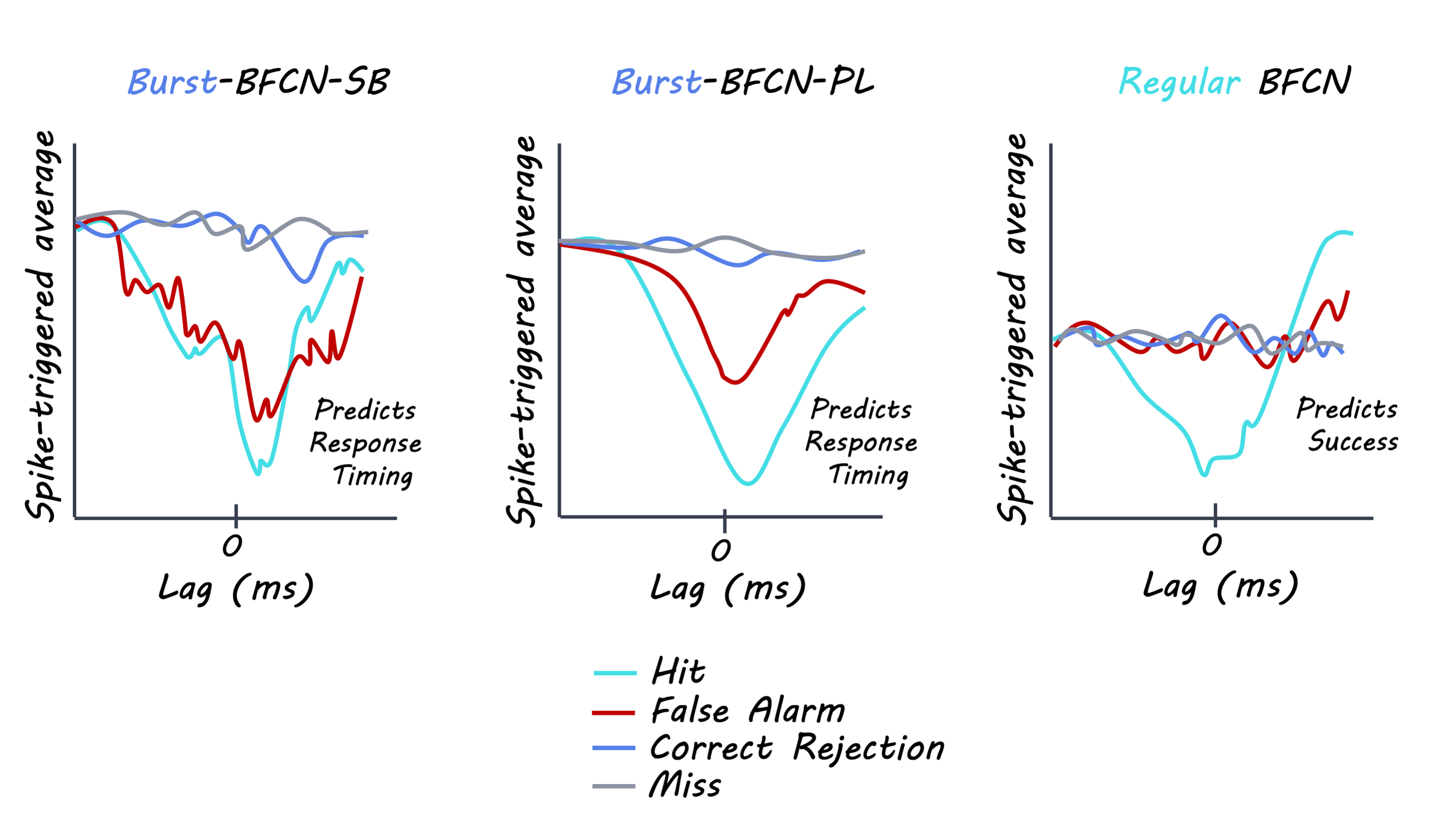
The authors identified two types of cholinergic basal forebrain neurons that showed distinct firing patterns in vivo and in vitro: 1) burst-firing neurons and 2) rhythmic, non-bursting neurons in the posterior basal forebrain. The spiking activity of the burst neurons depended on their membrane potential and the strength of the input to the cell. Sometimes the burst-firing cells fired bursts of discrete action potentials (coined burst-BFCN-SBs), and other times they showed a pattern of spikes with irregular timing between the spikes (coined burst-BFCN-PLs). The bursts of these neurons usually occurred after either administering either water (reward) or an air-puff (punishment), suggesting that the bursting neurons may represent salient stimuli. When the authors compared the activity of cholinergic basal forebrain neurons to the activity of other non-cholinergic basal forebrain neurons, they found that only a small few were capable of the regular rhythmic pattern.

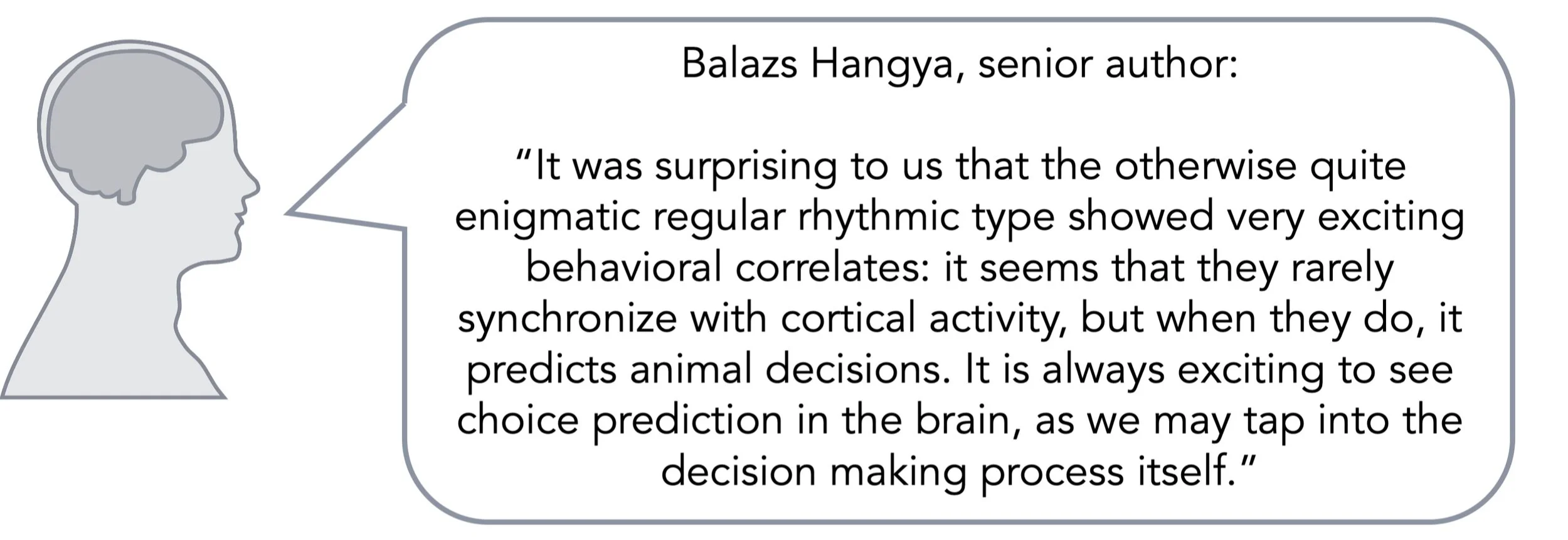
When the authors recorded activity from basal forebrain cholinergic neurons, they found that pairs of bursting basal forebrain neurons often showed synchronous firing (“zero-phase” synchrony). The authors also found that the bursting cholinergic neurons showed synchronization to cortical theta-band oscillations. On the other hand, regular rhythmic basal forebrain neurons did not show strong synchronization to the cortical oscillations, despite the intrinsic theta-rhythmic firing of the rhythmic basal forebrain neurons. They also found that the two subtypes of basal forebrain cholinergic neurons had distinct relationships with behaviour during an auditory task. The synchronization of the bursting neurons with activity in the auditory cortex during the auditory stimulus presentation could predict behavioral response timing (any type of response). Alternatively, the synchronization of regular rhythmic basal forebrain neurons with activity in the auditory cortex was strongest before successful behavior, and predicted correct responses on the auditory task. This finding suggests that the bursting basal forebrain cholinergic neurons may convey unspecific, fast and efficient information.  
BFCN_image_July7.png

What's the impact?

The authors provide clear in vivo and in vitro evidence that there are two basal forebrain cholinergic cell types. They reconcile previous seemingly contradictory evidence by identifying two functionally distinct types of basal forebrain cholinergic neurons, and by characterizing the properties of these two types of neurons.
Hangya_quote_Jul7.jpg

Laszlovszky et al. Distinct synchronization, cortical coupling and behavioral function of two basal forebrain cholinergic neuron types. Nature Neuroscience. (2020). Access the original scientific publication here.
What Underlies Vulnerability to Drug Addiction?

Post by Flora Moujaes

What's the science? 

Why does regular drug use lead to addiction in some people but not others? Many factors can increase the risk of developing an addiction. For example, a family history of drug addiction has been shown to make people eight times as likely to develop a drug addiction. We know that drug addiction compromises the neural systems involved in goal-directed behaviour, shifting behavioural control of drug-related decisions towards the habit system. Drug addiction may also weaken cognitive control, which enables the flexible regulation of goal-directed and habitual actions, and intervenes when behaviour becomes maladaptive. Much less is known about resilience to developing a drug addiction. One hypothesis is that high-functioning drug users may be able to function at a normal level by recruiting compensatory brain systems, which may buffer the impact of their drug use. This week in PNAS, Ersche et al. use resting-state functional magnetic resonance imaging (rs-fMRI) to explore how addiction risk and resilience may be associated with changes in the functioning of key neural systems. 

How did they do it?

In order to examine the risk and resilience factors associated with drug addiction to either amphetamines or cocaine, the researchers collected data from 162 individuals who either 1) have a diagnosed drug addiction and a family history of drug addiction, 2) high-functioning drug use without diagnosis and no family history of drug addiction, 3) no drug use and family history of drug addiction, or 4) no drug use and no family history of drug addiction. They collected rsfMRI data which measures fluctuations in the brain’s blood-oxygen-level-dependent (BOLD) signal while an individual is at rest, and looked at six key striatal brain regions.

What did they find?

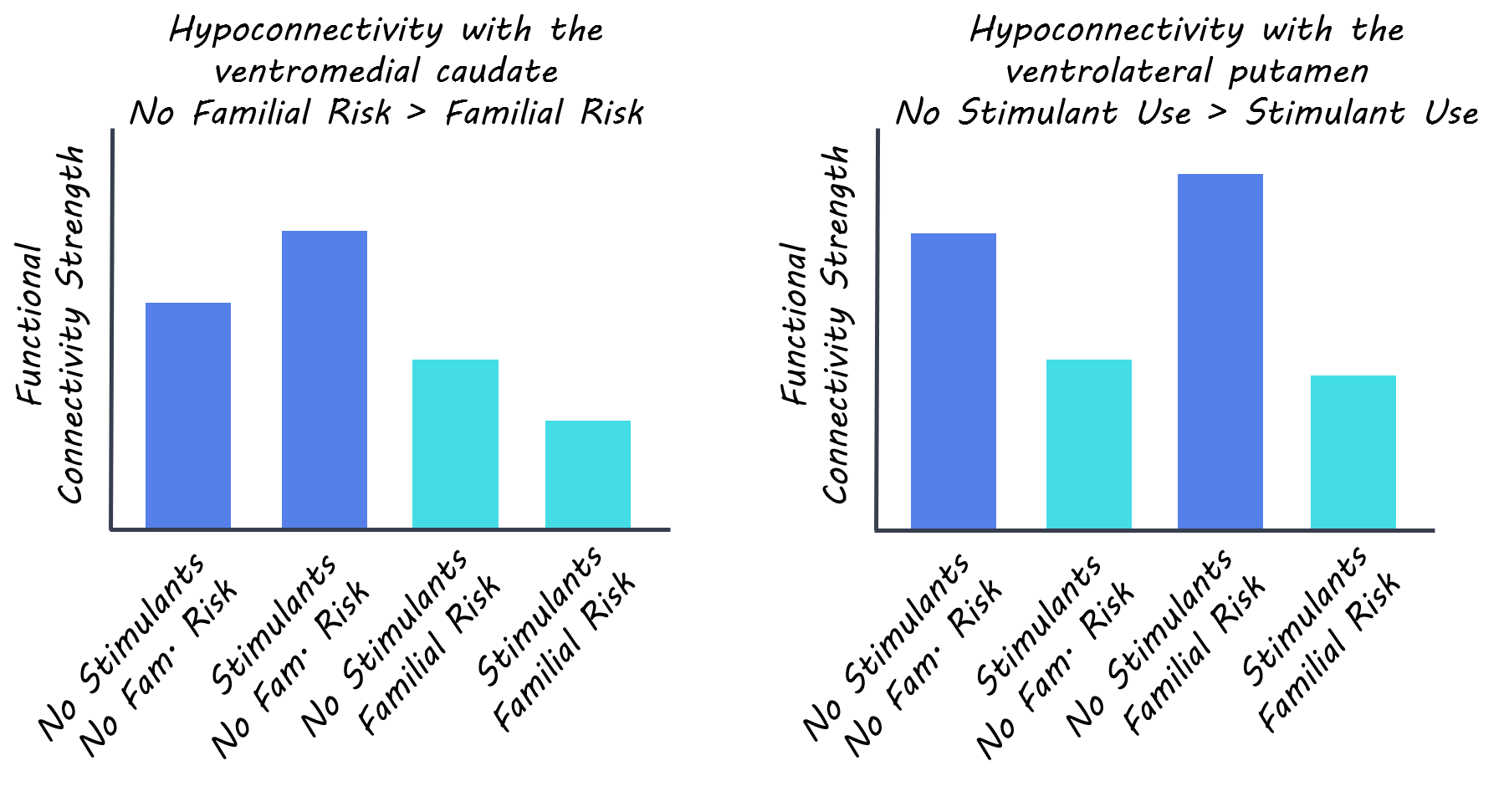
Familial risk and addiction: First, in order to examine how familial risk is associated with drug addiction, the authors compared individuals with a family history of drug addiction to individuals with no family history of drug addiction. They found that in individuals with high familial risk, whether drug users or siblings of drug users, there was reduced connectivity in two fronto-striatal pathways that are critical for goal-directed decision making: the orbitofrontal and ventromedial prefrontal cortical-striatal circuits. This indicates that individuals with a family history of drug addiction may be at greater risk of developing a drug addiction due to impaired goal-directed decision-making. 

Stimulant use and addiction: Secondly, in order to examine how stimulant use is associated with drug addiction, they compared individuals who regularly took stimulant drugs (both those who were officially diagnosed with drug addiction and high-functioning non-diagnosed drug users) to individuals who had not taken stimulant drugs (both the siblings of addicted individuals and healthy controls). They found that stimulant use was associated with reduced connectivity between areas associated with emotional awareness and habituation to pleasant or painful stimuli.

PNAS.png

Resilience against addiction: Finally, they examined the interaction between familial risk and stimulant use. They found that the two groups who showed resilience to drug addiction (high-functioning non-diagnosed users and non-addicted siblings of drug users) showed increased connectivity in two regulatory control networks: 1) a network implicated in top-down inhibitory control, and 2) a network implicated in the regulation of habits. This indicates that defying the risk of developing a stimulant drug addiction may require increased efforts to control behaviour.

What's the impact?

Overall this study suggests that familial vulnerability for drug addiction and the administration of stimulant drugs are associated with reduced functional connectivity in networks implicated in goal-directed learning, including the pathway associated with negative feedback processing. This may increase the risk of maladaptive behaviours, such as drug use, becoming compulsive. On the other hand, resilient individuals appear to counteract the drive to addiction through increased connectivity in networks associated with goal-directed behaviour and the habitual control of behaviour. This study provides valuable insights into possible interactions between familial risk and stimulant drug use for the regulation of behavioural control. Such insights may inform novel strategies for therapeutic and preventative interventions for drug addiction.

Ersche et al. Brain networks underlying vulnerability and resilience to drug addiction. PNAS (2020). Access the original scientific publication here.
Immune Proteins Play a Role in Neural Growth

Post by Anastasia Sares

What's the science?

The protein IL-33 is part of a large family of proteins related to immune function. Outside of the brain, it is mostly known for its role in inflammation, such as in asthma or auto-immune conditions. However, IL-33 also supports tissue repair and is necessary for proper neural development. In studies of brain injury and Alzheimer’s disease, IL-33 has been shown to increase plasticity and reverse memory deficits. But how can an immune system protein support memory? This week in Cell, Nguyen and colleagues examined IL-33’s role in memory formation in the hippocampus and showed that it involves the brain’s immune cells to clear a path for branching neurons. 

How did they do it?

The research team employed a number of techniques for identifying cells producing IL-33 or its receptor, IL1RL1, in genetically modified mice. Some of the mice had a code for a fluorescent protein inserted right next to the IL-33 gene so that cells producing IL-33 could be seen with a fluorescent microscope. Others had genetic manipulations to knock out the IL-33 gene so that it no longer worked. The authors were also able to express extra IL-33 in mice using a lentivirus.

Their analyses of brain tissue included flow cytometry, which involves streaming a solution full of cell nuclei in a small tube one cell wide. As the nuclei passed one by one in front of a laser, they could measure many different properties of the scattered laser light to detect different proteins (including the fluorescence from the IL33 gene). The authors also raised mice in different conditions. Some of them experienced temporarily enriched environments, known for increasing neuronal growth and plasticity, while others experienced brief social isolation, which does the opposite. Still, others underwent fear conditioning to see how well they learned the association between a stimulus and a mild shock. 

What did they find?

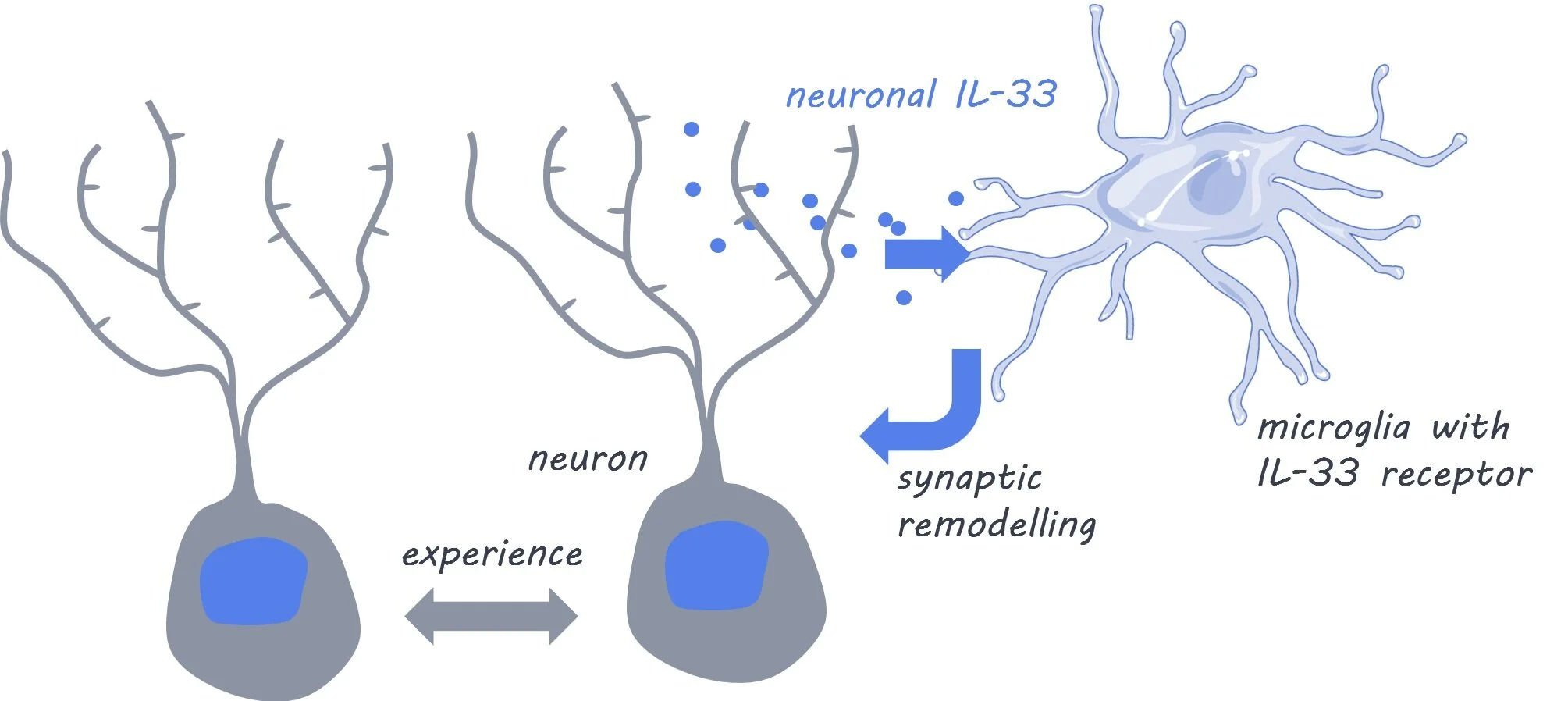
In the hippocampus, IL-33 was expressed primarily in neurons (and especially neurons in the dentate gyrus). This is different from elsewhere in the brain, where it is mostly found in astrocytes. The receptor, IL1RL1, was located in microglia, which are cells acting as the primary form of immune defense in the central nervous system.

IL-33 levels increased in the mice who had enriched environments and decreased in those undergoing social isolation. IL-33 also decreased with age and memory loss. Deleting IL-33 or its receptors on the microglia caused mice to have fewer dendritic spines on existing neurons, fewer new neurons, and less precise memory for fearful stimuli. Extensive testing indicated that IL-33 might induce the microglia to clear out the extracellular matrix (the web of structural proteins around the cells). This clearance would then pave the way for the growth and branching of new neurons

Anastasia.jpg

What's the impact?

IL-33 may have neuroprotective benefits in diseases like stroke, traumatic brain injury, ALS, and even Alzheimer’s disease (which specifically affects memory and could be related to inflammation in the brain). Understanding the mechanisms behind synapse development and memory maintenance will help us to fight these diseases. This research also emphasizes and expands the role of immune cells like microglia in brain function.

Nguyen_quote_Jul7.jpg

Nguyen et al. Microglial Remodeling of the Extracellular Matrix Promotes Synapse Plasticity. Cell (2020). Access the original scientific publication here.