
Mechanism Underlying Hippocampal Post-Tetanic Potentiation

Post by Shireen Parimoo 

What's the science?

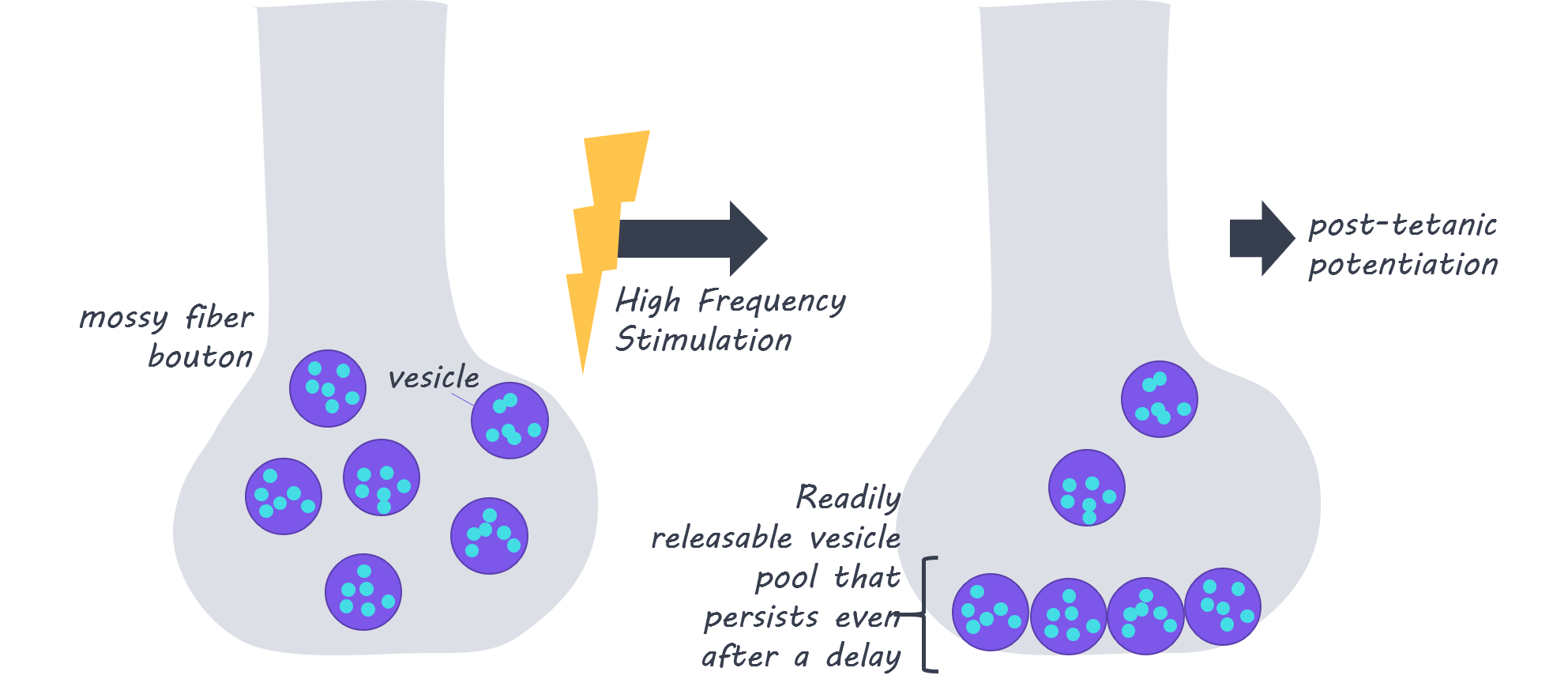
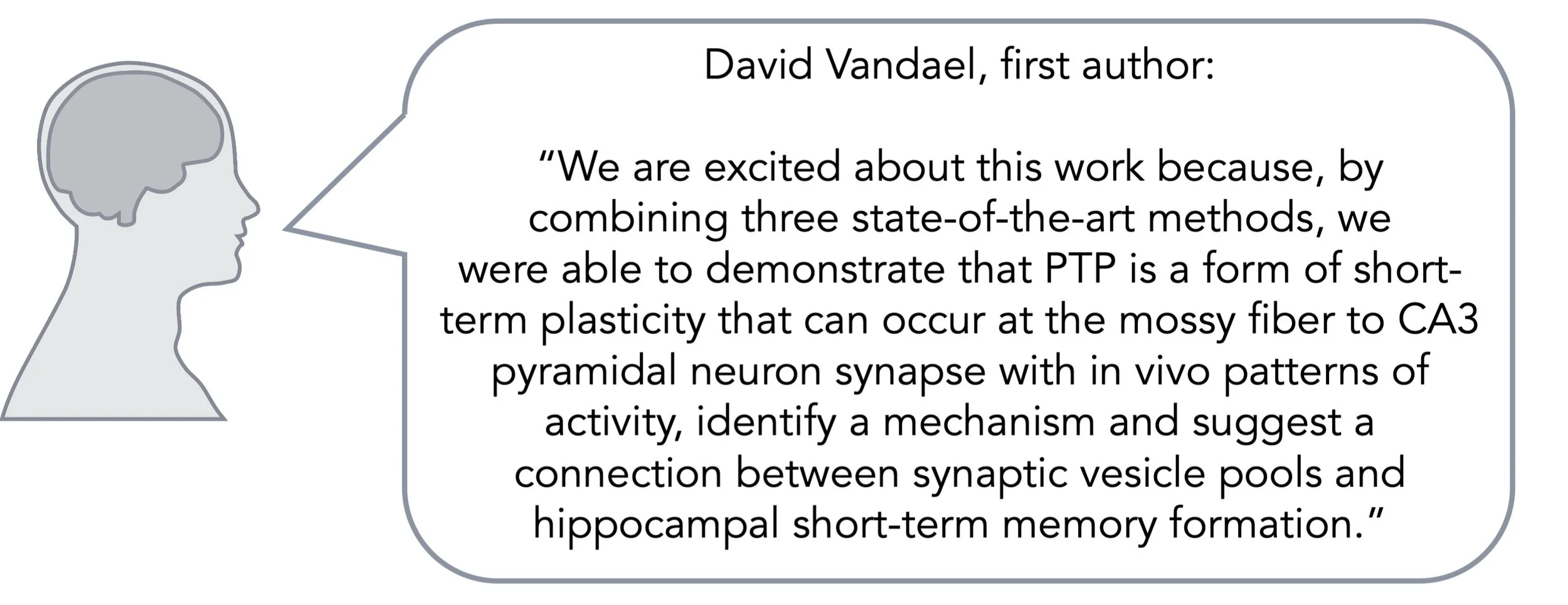
Short-term memories are memories that can persist for several minutes and are formed in the hippocampus. Post-tetanic potentiation (PTP) at hippocampal mossy fiber synapses between granule cells and CA3 neurons is a potential candidate to support the formation of short-term memories. PTP is a type of synaptic plasticity that occurs in response to high-frequency stimulation (HFS). In a synapse in the auditory system, for example, HFS results in PTP by increasing the probability of vesicle release from the pre-synaptic neuron. However, it is not known how PTP occurs at hippocampal mossy fiber synapses. This month in Neuron, Vandael and colleagues used electrophysiological recordings and functional electron microscopy to examine the structural and functional mechanisms underlying PTP generation in the rodent hippocampus.

How did they do it?

First, the authors characterized spiking activity in the hippocampal granule cells of head-fixed mice using in vivo electrophysiological recordings. They stimulated single mossy fiber boutons and recorded excitatory post-synaptic currents at the level of CA3 neurons to determine if PTP occurs at the unitary level. They then compared the magnitude of PTP resulting from naturally occurring activity using standard HFS protocols. They identified the threshold for PTP induction in vitro and tested if granule cell superburst activity would suffice to induce PTP.

Next, the authors investigated two possible mechanisms underlying PTP: (i) an increase in the probability of vesicle release from the pre-synaptic terminal, and/or (ii) an increase in the size of the pool of pre-synaptic vesicles available for release, or the ‘readily-releasable pool’. They applied HFS stimulation at the level of single mossy fiber terminals and measured changes in excitatory post-synaptic currents to quantify the size of the vesicle pool and the probability of vesicle release. A structural correlate of the readily-releasable pool is the pool of vesicles docked at the active zone in the presynaptic terminal. Thus, they used flash and freeze electron microscopy to explore whether more docked vesicles would be available for release after PTP induction. Specifically, they optogenetically stimulated mossy fiber terminals, froze them immediately or after a 20-second delay, and recorded the number of docked vesicles using electron microscopy. Lastly, to explore the physiological relevance of PTP, they applied HFS to induce PTP and then measured if the potentiation could still be observed after delays of up to 5 minutes.

What did they find?

In active hippocampal granule cells, natural activity is composed of single action potentials, bursts, and/or “superbursts” (i.e. bursts of bursting activity). Superburst patterns in vivo were strong enough to induce PTP at mossy fiber boutons in vitro. Moreover, PTP was accompanied by a large increase in the size of the readily-releasable pool, whereas the probability of vesicle release did not change significantly. There was also a reduction in the number of docked vesicles immediately after HFS, but at a 20 second delay after PTP induction, both the number and size of the docked vesicles increased. Thus, HFS induces PTP by altering the number of vesicles available for release at the pre-synaptic terminal, which effectively forms an engram (i.e. a memory trace). The effects of PTP on neural activity and the size of the vesicle pool decayed over time in response to additional stimulation. Interestingly, however, the absence of pre-synaptic activity following PTP induction did not abolish PTP, suggesting PTP is preserved by saving the extra vesicles for release for an extended period of time.
shireen.png

What's the impact?

This study is the first to identify the mechanism underlying post-tetanic potentiation in the mossy fiber pathway of the rodent hippocampus. These findings provide a deeper insight into our understanding of how hippocampal PTP might potentially enable the formation of short-term memories.
Vandael_Jun16.jpg

Vandael et al. Short-term plasticity at hippocampal mossy fiber synapses is induced by natural activity patterns and associated with vesicle pool engram formation. Neuron (2020). Access the original scientific publication here.
Environmental Sensitivity is Heritable and Correlates with Personality Traits

Post by Amanda McFarlan

What's the science? 

Environmental Sensitivity is a phenomenon that describes an individual’s sensitivity to being influenced by environmental factors, with some individuals being more susceptible than others. These sensitivities can have both positive and negative effects. For example, an individual may receive a greater benefit from a positive environment while also being more reactive to adverse events. It has been suggested that Environmental Sensitivity likely has a genetic component, however, there have yet to be any studies examining its heritability. This week in Molecular Psychiatry, Assary and colleagues investigated the heritability of Environmental Sensitivity. Additionally, they determined whether the heritability of Environmental Sensitivity shared genetic factors that overlap with common personality traits.   

How did they do it?

In order to study the heritability of Environmental Sensitivity, the authors used a subset of data that was collected from pairs of 17-year-old monozygotic, same-sex dizygotic and opposite sex twins as part of a large, longitudinal twin study known as the Twins Early Development Study. To assess the heritability of sensitivity, the authors analyzed the data collected from the Highly Sensitive Child scale which measures three key components of sensitivity: low sensory threshold, ease of excitation, and aesthetic sensitivity (i.e. appreciation for aesthetics, details). Additionally, they analyzed data from the five factor model rating form, a personality test that measures levels of neuroticism, openness, conscientiousness, agreeableness, and extraversion. The authors used three different models to quantify different aspects of their data. First, they used a univariate model to assess the heritability of sensitivity. Second, they used the common pathway model to determine the degree to which common and specific genetic effects contribute to the variance of each of the three components of sensitivity. Finally, they used the independent pathway model to investigate the degree to which common and specific effects, either genetic or environmental, contribute to the variance of sensitivity and personality traits.

What did they find?

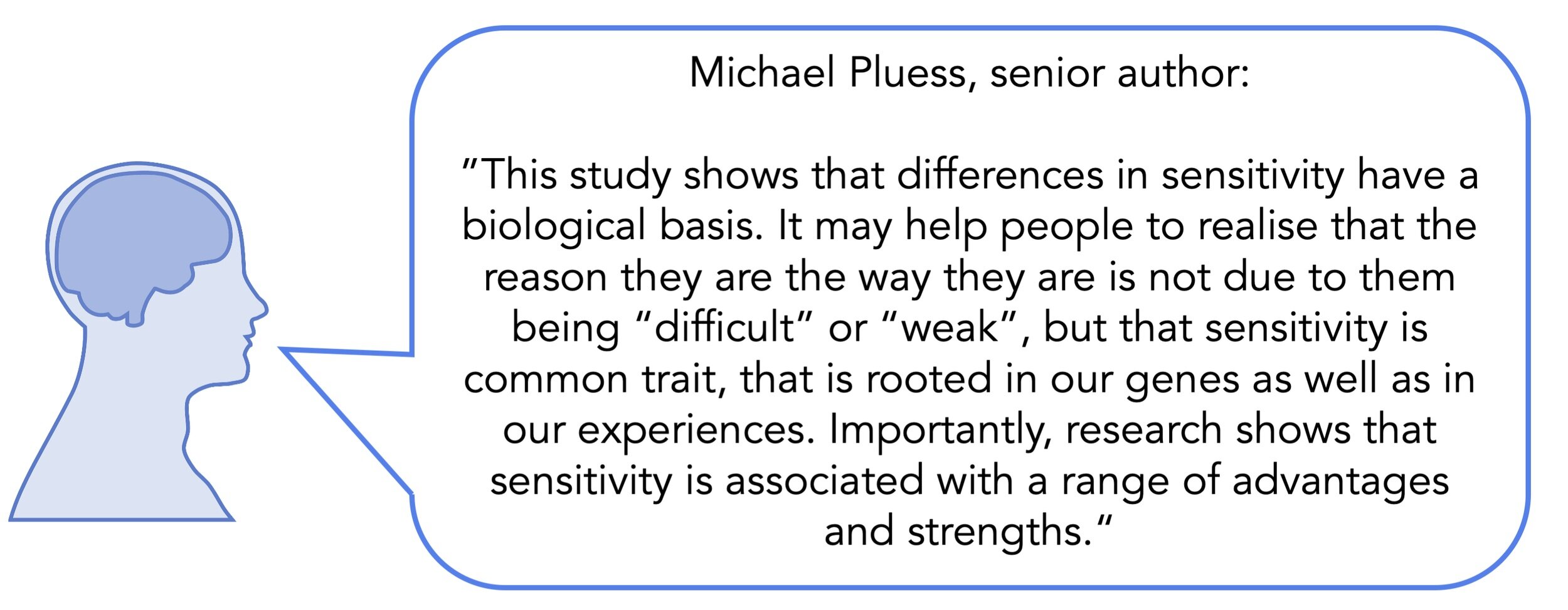
The authors determined that 47% of the variation in Environmental Sensitivity could be attributed to genetic influences, while non-shared environmental influences accounted for the remaining 53%, suggesting that sensitivity is a heritable trait. Next, the authors found that each of the three components of Environmental Sensitivity was heritable, with ease of excitation demonstrating the strongest level of heritability, followed by low sensory threshold and aesthetic sensitivity. They found that common genetic and environmental influences explained most of the variance for ease of excitation, while the majority of variance for aesthetic sensitivity was explained by genetic and environmental influences that were specific to that component. The variance for low sensory threshold, however, was explained by genetic and environmental influences that were both common and specific to that component. Finally, of the five personality traits that were measured, the authors found that genetic influences associated with neuroticism and extraversion also contributed to the heritability of sensitivity. Conversely, they did not find any correlation between the environmental factors that influence the five personality traits and those that contribute to the heritability of sensitivity. 

What’s the impact?

This is the first study to show that Environmental Sensitivity is a heritable trait that shares genetic influences with neuroticism and extraversion. The authors also found that all three components of Environmental Sensitivity, as measured by the Highly Sensitive Child Scale, were heritable. Together, these findings provide many promising avenues for future studies, including uncovering the specific genetic factors that are shared between sensitivity and personality traits.

Pluess_Jun16.jpg

Assary et al. Genetic architecture of Environmental Sensitivity reflects multiple heritable components: a twin study with adolescents. Molecular Psychiatry (2020). Access the original scientific publication here.
How White Brains Process Black Faces

Post by Anastasia Sares

What's the science?

Social identity theory, proposed by Henri Tajfel in the late 1970s, highlighted the fact that we tend to separate people into an “in-group” and an “out-group,” attaching our identity and self-esteem to the in-group. We focus on the positive qualities of our own group and the negative qualities of the out-group, which leads to discrimination, stereotyping, and unequal division of resources. Divisions can occur along racial, religious, political, and class lines (to name a few).  One important feature of in-group/out-group dynamics is that we view people in our in-group as unique individuals while viewing people in the out-group as mostly the same.

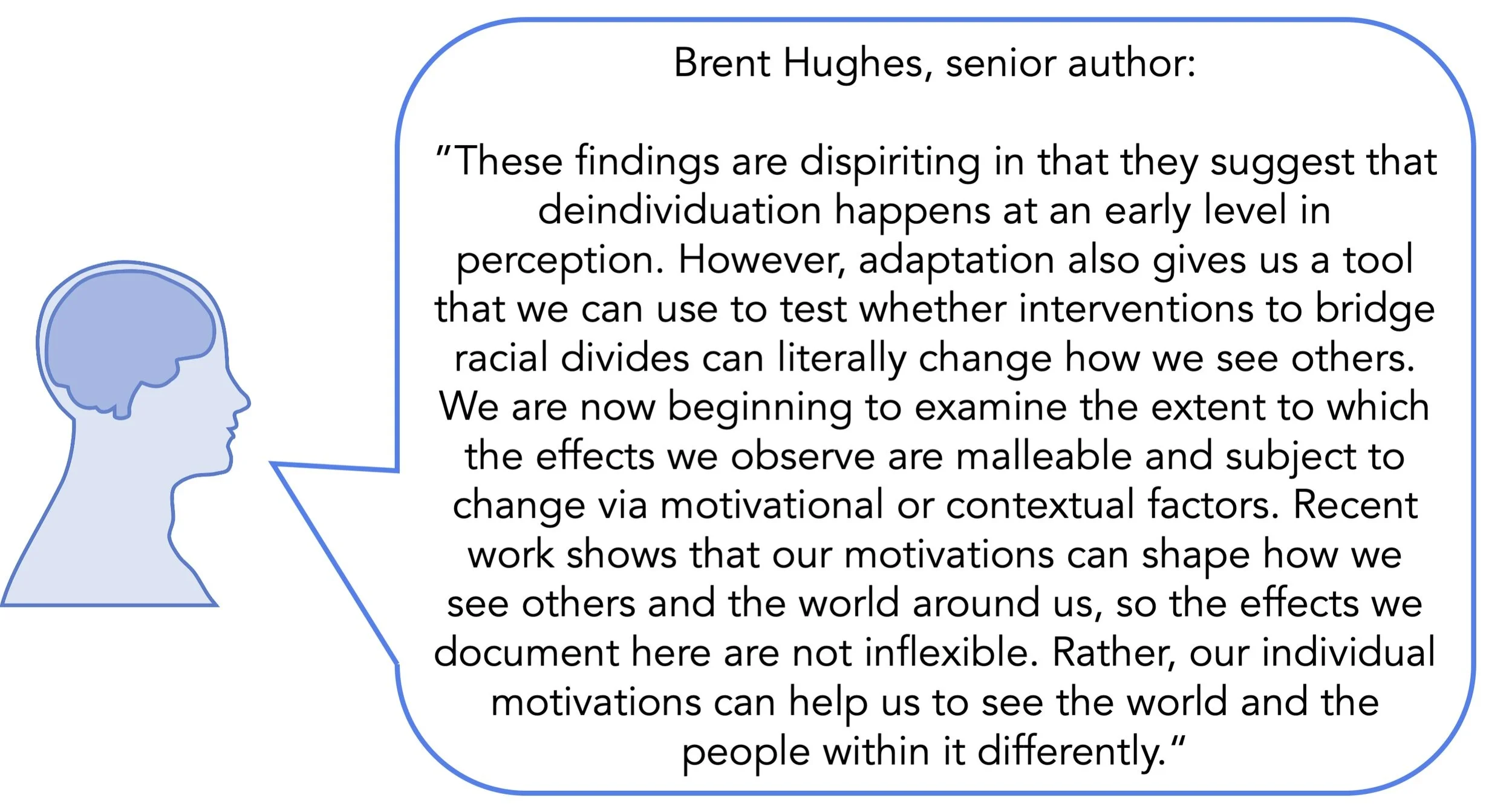
In Proceedings of the National Academy of Sciences, Hughes and colleagues used functional Magnetic Resonance Imaging (fMRI) to show that self-identified White participants, on average, perceived Black faces as more similar (less distinct) than White faces. In their own words, “Our results suggest that biases for other-race faces emerge at some of the earliest stages of sensory perception.”

How did they do it?

Hughes and colleagues used a technique called neural adaptation. One might think of it as “the brain getting used to things.” Imagine you are being shown a series of faces. The first few are very engaging, but after a while, you may feel your attention wane. Your perception of the faces isn’t as sharp, and you might have trouble telling them apart. If all the faces are different and interesting, you might stay engaged, but if you’re shown the same face over and over again, you will quickly lose interest. We can watch this happen in the brain with fMRI. Over time, if a stimulus happens over and over again, the signal in the relevant brain area will decrease as the brain adapts, or gets used to, the stimulus. The rate of adaptation is slower for stimuli that are distinct from one another: in other words, the signal in the brain takes longer to decrease. On the other hand, the brain will adapt quickly to stimuli that are perceived as more similar, or as belonging to the same category.

In this study, the authors wanted to see how quickly the brains of self-identified White participants got used to seeing White faces versus Black faces. Using face-morphing technology, they created many different faces, making sure that the variability in visual features was exactly the same between the White and Black faces. Then, they measured the rate of neural adaptation in the participants’ brains for each group of faces. They focused on a brain area known for its sensitivity to faces: the fusiform face area. Following the fMRI experiment, they further tested participants on their ability to discriminate and remember faces.

What did they find?

To begin with, overall brain activity for viewing White faces was higher than for viewing Black faces in face-related brain areas. In the fusiform face area specifically, White participants showed more adaptation to the Black faces, indicating that the participants’ brains perceived these faces as less distinct. The follow-up tests were consistent with the neuroimaging results: most participants judged Black faces to be more similar to each other.

anastasia_pic (1).png

What's the impact?

Recent events involving racially-charged police violence have raised awareness of systemic racism in society. It is important to recognize that racial bias is built into perception in order to counteract it. The brain devotes more processing power to things that are familiar, and previous work suggests this is determined by exposure and experience. Research shows that we can combat our perceptual biases by changing the exposure factor - encouraging diversity in the workplace, media, and our social lives, and by raising awareness of these biases. Cognitive control may also play a role, so actively confronting our own racial bias may be another effective strategy. 

Hughes_Quote_Jun9.jpg

Hughes et al. Neural adaptation to faces reveals racial outgroup homogeneity effects in early perception. Proceedings of the National Academy of Sciences of the United States of America (2019). Access the original scientific publication here.