Selective Rehearsal and Active Inhibition Allow us to Intentionally Forget New Information

Post by Stephanie Williams 

What's the science?

The mechanisms that allow us to intentionally forget or remember new information have been a topic of debate in the neuroscience community. There is some evidence that we may reduce our selective rehearsal of that information. There is also evidence that we may actively suppress unwanted memory traces. This week in Current Biology, Fellner and colleagues characterize electrophysiological signatures that show how we recruit both active suppression and passive reduced recruitment in order to suppress unwanted memories. 

How did they do it?                             

The authors recorded electroencephalography (EEG) while 23 subjects performed a task in which they tried to forget or remember real-world objects. The authors used EEG to track how objects were represented, and how those representations changed between forgotten and remembered items. The memory task consisted of a large number of objects, which would flash briefly on a screen. Participants were cued to either forget or remember the item that they had just seen. After viewing all objects, subjects were distracted by a 3-minute counting exercise, and then viewed a new series of images consisting of a mixture of old and new objects. They were then asked to rate how well they recognized each of the images on a 1-6 scale that represented their confidence in their recognition. The authors used the participant’s recognition responses to track whether objects were “forgotten” or “remembered”. Before the experiment began, all subjects were told that they should voluntarily forget the to-be-forgotten objects as they wouldn’t be tested on those objects, so that they would be able to better remember the to-be-remembered objects. 

Although subjects were always cued to remember or forget, sometimes participants forgot objects they had been cued to remember and remembered objects they had been cued to forget. This allowed the authors to group trials into unintentional forgetting (subjects intended to remember, but didn’t), and intentional forgetting (subjects intended to forget, and did indeed forget). The same applied to unintentional remembering and intentional remembering. To understand how participants’ representations of objects changed depending on whether they were asked to forget to remember the object, the authors calculated “item-cue similarity”: the correlation between the electrophysiological activity 1) during the object presentation and 2) right after the memory cue appeared. The authors used different combinations of time windows to calculate the item-cue similarity scores, which resulted in a matrix of scores. They then applied cluster-based permutation statistics to the matrix of scores to identify clusters of activity. Their results led them to focus on a spectral band between 8 and 13 Hz called the alpha band. They used source localization techniques in order to understand which brain areas (eg. occipital vs. parietal areas) contributed to the patterns that they found. They used these results to compare the topography of item representation changes and alpha power changes. 

What did they find?

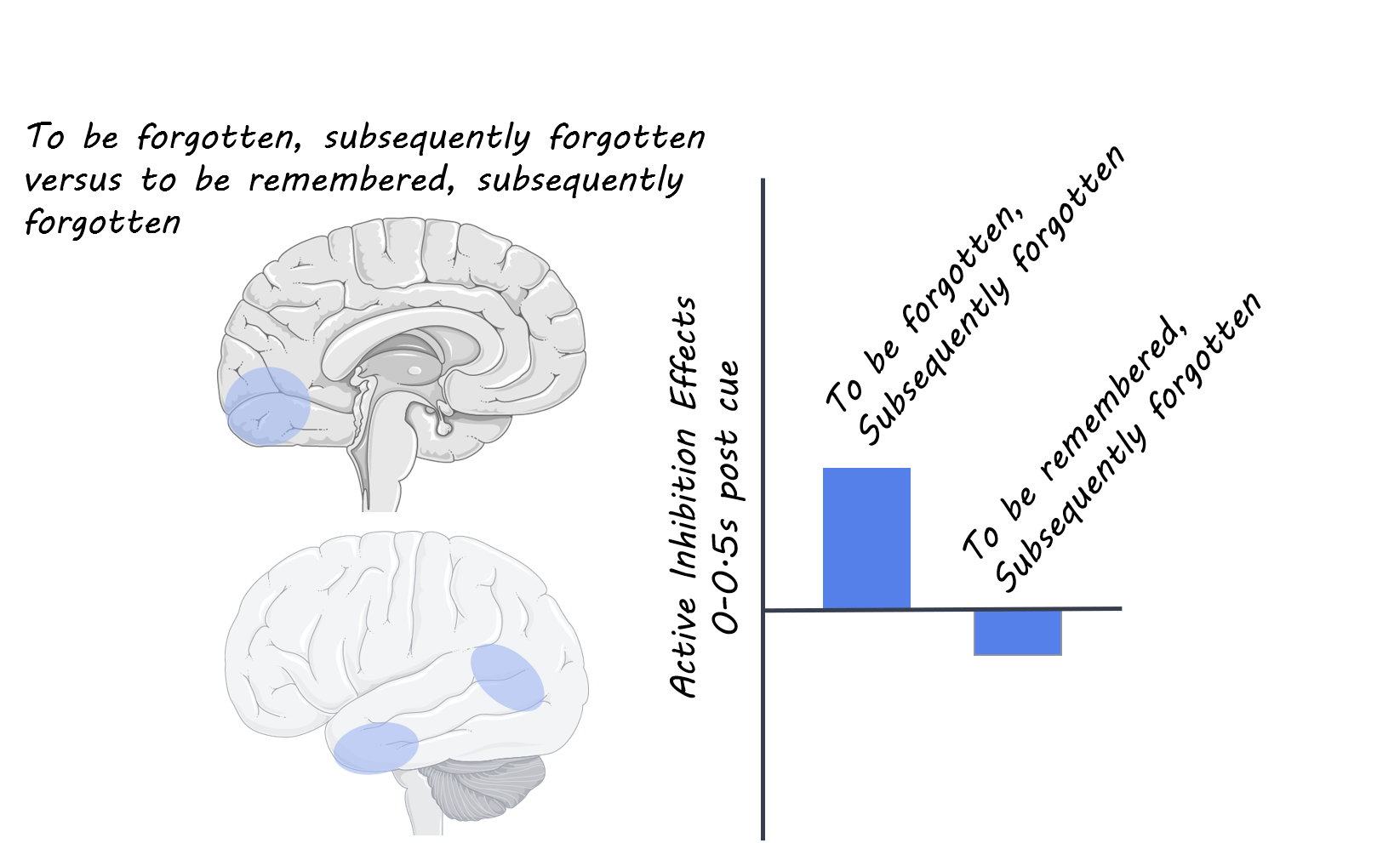
As expected, the participant’s ratings showed that on average they did remember the “to be remembered’ items better than they remembered the “to be forgotten” items. When the authors applied cluster-based permutation statistics to the matrix of item similarity score patterns, they found two major clusters, an early and a late cluster. When the authors compared the item-cue-similarity scores during the early cluster in the intentional and unintentional forgetting groups, they found that the scores were reduced during intentional forgetting compared to unintentional forgetting, consistent with the changes in object representation expected for active suppression. If participants were actively suppressing item representations, then the item representations would be lower when subjects were intentionally forgetting objects than when they were attempting (but failing) to remember objects. When the authors compared the item-cue-similarity scores during the late cluster period, they found that the scores were significantly higher for the intentionally remembered versus the unintentionally remembered items, consistent with changes in object representation expected for reduced rehearsal

stephanie.png

The authors also found a significant increase in spectral power in the alpha band during forgotten trials. The authors split the alpha power changes into two broad categories, early and late. Early alpha power was mostly confined to the occipital electrodes, while late alpha power extended across occipital, posterior temporal, parietal, and posterior midline. The authors found that early alpha power only increased for forgotten items. Their results suggest that early occipital alpha power increases during successful suppression of new information, and may represent active downregulation of memory traces. Late alpha power, which was accompanied by beta power increases, was increased for intentionally remembered objects relative to unintentionally remembered objects. These results suggest that late alpha power may index selective rehearsal, and represent a suppression of potentially distracting information. Topographically, the authors found that the overlap of alpha power changes with item representations tracked successful voluntary forgetting.

What's the impact?

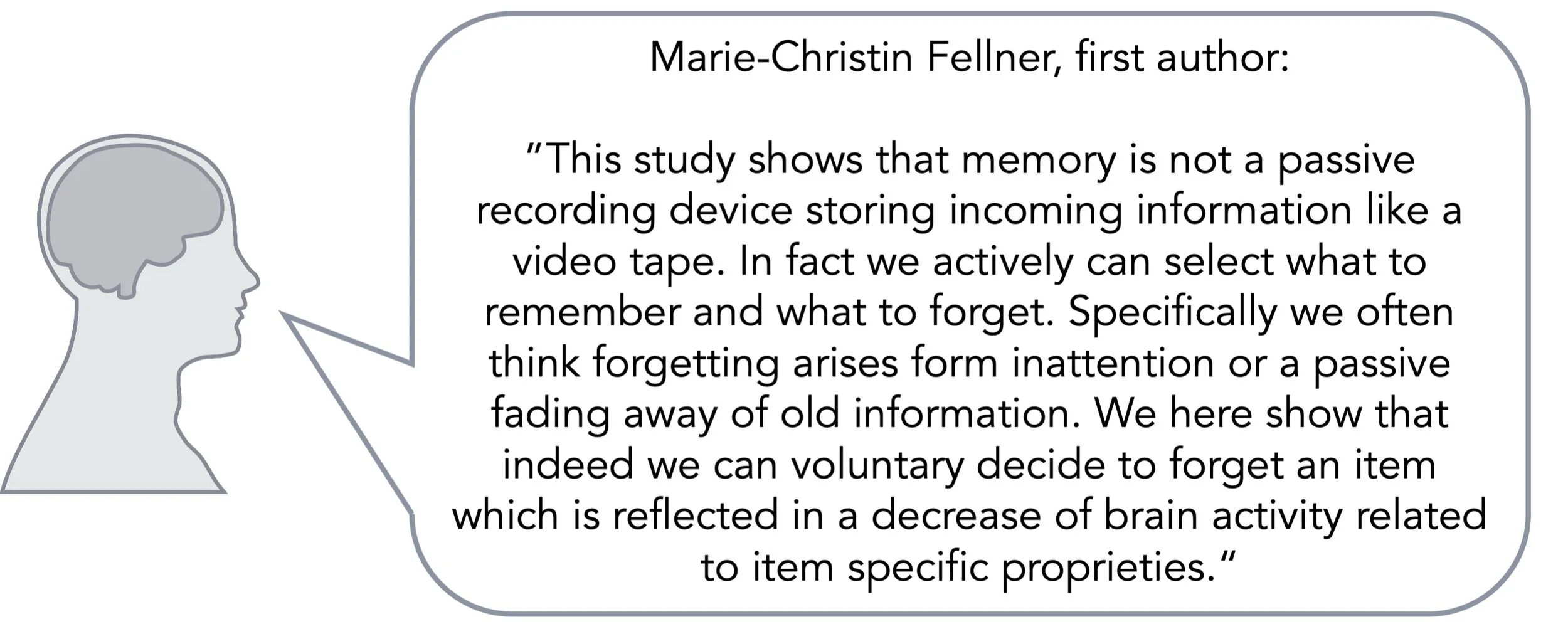
The authors show that two distinct processes, reduced rehearsal, and increased suppression of memory traces, both independently contribute to intentional control of memories. Their findings advance our understanding of how memory formation can be voluntarily controlled. 
forgetting_quote_May26.jpg

Fellner et al. Tracking Selective Rehearsal and Active Inhibition of Memory Traces in Directed Forgetting. Current Biology. (2020). Access the original scientific publication here.
 

An International, Modern Replication of Prospect Theory

Post by Lincoln Tracy 

What's the science?

In 1979, Kahneman and Tversky first proposed prospect theory, which describes some principles for how people tend to value and compare financial gains and losses. For example, one aspect of prospect theory is the ‘reflection effect’: people are more likely to act in a risky manner when making decisions about potential gains than about potential losses. Over the past 40 years, prospect theory has become one of the most influential frameworks in behavioral science, specifically in the context of decision-making under risk. The original study involved 20 items involving two financial choices occurring at a certain probability (e.g., would you prefer an 80% chance of receiving $4,000 or a 100% guarantee of receiving $3,000). Kahneman and Tversky organized these 20 items into 13 contrast pairs. While prospect theory has subsequently had huge impacts on science, industry, and policy, it (and many other canonical theories) has been criticized for small samples, over-interpretation of findings, and failures to replicate. This week in Nature Human Behavior, Ruggeri and colleagues directly challenge these criticisms by testing the original methods in a modern and major cross-cultural setting following the critical standards of reproducibility in behavioral science.

How did they do it?

The authors attempted to replicate the items used in Kahneman and Tversky’s original paper as closely as possible. However, they adjusted the financial values in each item towards the median (or mean) net household income in each location in June 2019 to ensure that participants were being exposed to choices representing the same wealth as the original study. They then recruited participants from 19 countries across Asia, Europe, North America, South America, and Oceania, covering 13 different languages. Participants were primarily recruited through convenience sampling, although a small proportion were recruited through an online sampling platform. All data were collected online. To ensure the collected data was accurate, they excluded participants via a series of checks to ensure participants were actively paying attention and providing legitimate responses. They then replicated the original analyses to evaluate whether the response distribution significantly differed from random chance for each item and country, before determining the change in effect sizes for individual items and the 13 contrast pairs compared to the original study.

What did they find?

The final sample consisted of 4,098 participants. The authors reproduced findings for 16 of the 17 items in the original study. All the observed effects were in the same direction as the original study, giving a replication rate of 93.8%. Interestingly, 77% of the effects measures in the replication were smaller than the effect sizes reported in the original. They also replicated all but one of the theoretical contrast pairs. Item and contrast pair replication rates were 70% or better when examined on a country-by-country basis.

What's the impact?

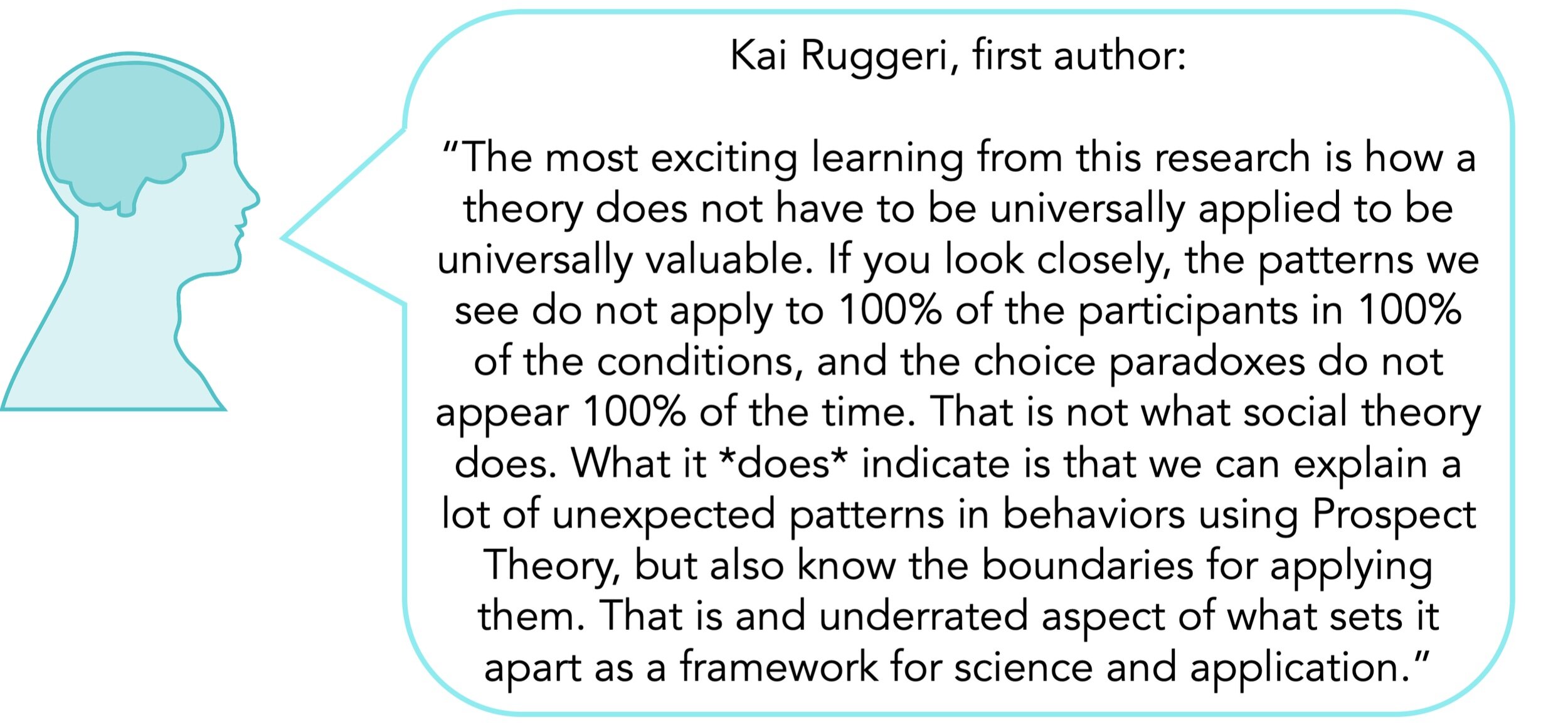
Overall, this study shows that Kahneman and Tversky’s 1979 prospect theory broadly replicates in a large-scale, international setting. While the effects observed in the replication study were smaller than those of the original study, this can potentially be attributed to how much easier it was to access participants in the replication, rather than casting doubt over the original conclusions. This large scale and international replication demonstrate that prospect theory is a viable explanation for the behavior of individuals. Consequently, prospect theory remains a valuable tool for informing public policy across the globe for a variety of areas

prospect_quote_May26.jpg

Ruggeri et al. Replicating patterns of prospect theory for decision under risk. Nature Human Behavior (2020). Access the original scientific publication here.
How the Heartbeat Influences Conscious Perception

Post by Flora Moujaes 

What's the science? 

The heart and the brain are two of the most important organs in the body. It is common knowledge that the brain influences the heart. For example, when we experience danger the heart beats faster. But does the heart influence the brain? A number of recent studies have shown that even though humans are mostly not aware of their heartbeats, the state of the heart (e.g. whether it is contracting or expanding) can influence their perception of external stimuli. This week in PNAS, Al et al. combine electroencephalography and electrocardiography to explore how and why the heartbeat influences conscious perception. 

How did they do it? 

To investigate how the heartbeat influences conscious perception, weak electrical stimuli were administered to either the left index or middle finger of 37 participants. After each stimulus, participants were asked if they could detect the electrical stimuli, and if so if they could identify which finger the stimuli had been administered to. Electrocardiography (ECG) was used to measure the electrical activity of the heart, and electroencephalography was used to measure a number of key brain responses including (1) The heartbeat-evoked potential (HEP) which indicates the brain’s response to the heartbeat and so is a marker of cardiac interoception; (2) The P300 response, which is related to conscious external somatosensory perception. 

What did they find? 

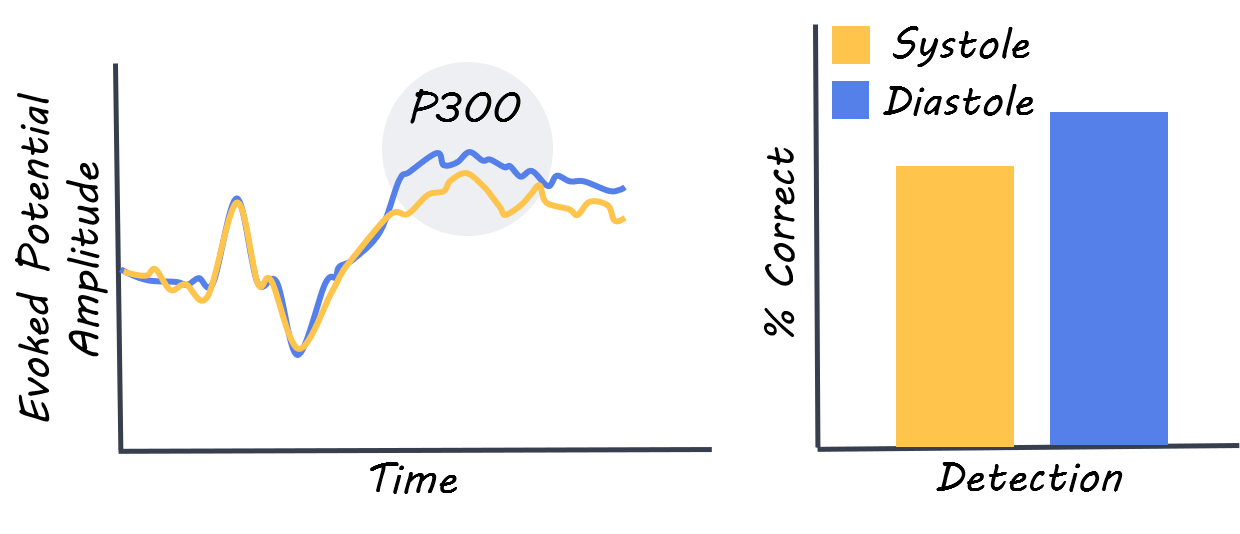
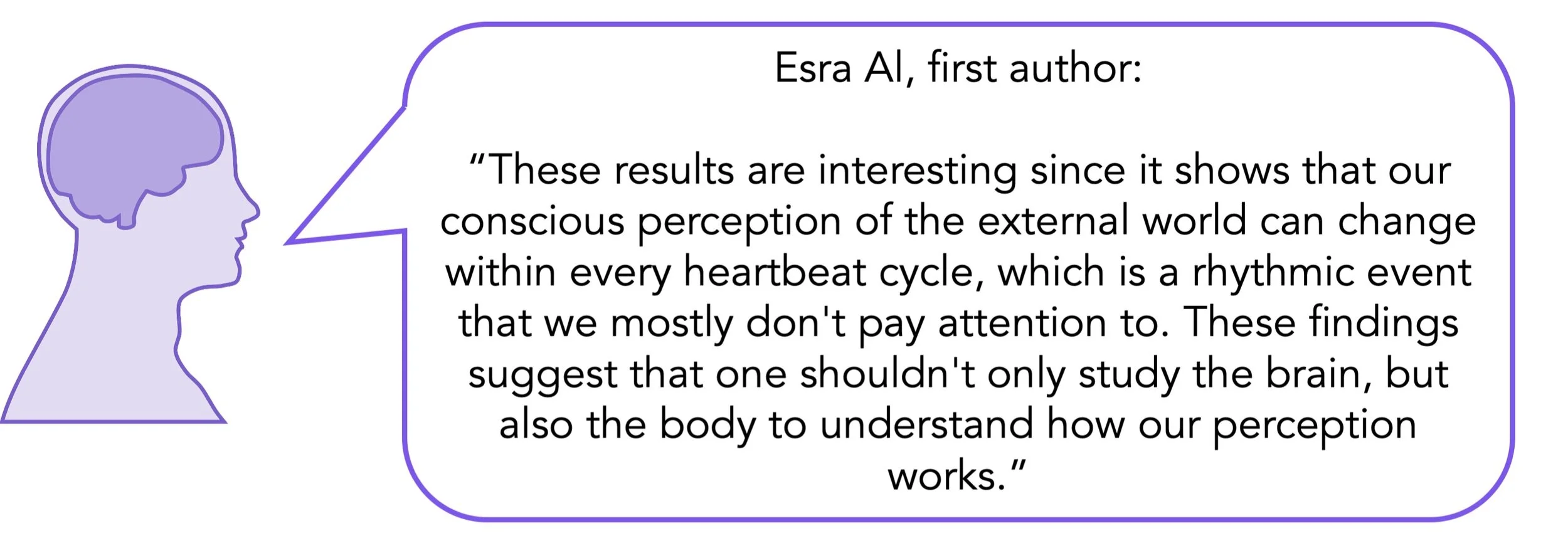
The brain’s attentiveness to the heartbeat influenced conscious perception. The researchers found that if the brain’s response to the heartbeat, measured using the HEP, was higher, people were less able to detect the stimulus. The researchers explained that this might be due to the fact that the brain divides its attention between external signals in the environment and internal signals within the body. If the brain is more focused on internal signals such as the heartbeat, it may then be less aware of external signals from the outside world. This is further evidenced by the fact that higher HEPs were followed by decreases in brain responses related to conscious external somatosensory perception (e.g., P300). 

flora.png

The timing of the stimulus relative to the cardiac cycle influenced conscious perception. The researchers also found that if the stimulus was presented during systole when the heart was contracting, participants were less able to detect or localize it. This was also reflected by the fact that if stimuli were presented during systole there was a decrease in the P300 response: the brain response related to conscious external somatosensory perception. This indicates that during systole, external perception becomes less sensitive. The researchers understood this finding using a predictive coding framework, which posits that the brain is continuously producing and updating a model of sensory input. In the predictive coding framework, the heartbeat is treated as a predictable event and so is largely ignored by the brain. As the human finger contains a lot of blood vessels, weak neutral external stimuli at the finger may be mistaken as heartbeat-pulse associated noise and ignored by the brain. 

What's the impact? 

Overall this study shows that both the timing of the stimulus relative to the cardiac cycle and the brain’s attentiveness to the heartbeat influence the conscious perception of external stimuli. The researchers also offer an explanation for why the heartbeat may influence conscious perception: spontaneous shifts between interoception and exteroception may affect our conscious perception, while the predictive coding mechanism that allows the brain to ignore predictable events such as the heartbeat may result in similar stimuli also being ignored. These results are important as they further our understanding of how body-brain interactions can shape our cognition.

heartbeat_quote_may19.jpg

Al et al. Heart–brain interactions shape somatosensory perception and evoked potentials. PNAS (2020). Access the original scientific publication here.