The Indirect Effect of Serotonin on Reward Sensitivity and Mood

Post by Shireen Parimoo

What's the science?

Major depression is characterized by persistent low mood, as well as a heightened sensitivity to negative information and reduced attention to positive information. Cognitive and behavioral treatments often target these negative thought patterns by emphasizing positive thoughts and experiences, whereas pharmacological interventions like selective serotonin reuptake inhibitors (SSRIs) alleviate symptoms by altering neurotransmitter levels. It typically takes several weeks for antidepressants to become effective. Recent research indicates that antidepressants might influence the processing of positive and negative information during this time, but it is not clear how that impacts mood. This week in Nature Communications, Michely and colleagues used pharmacological intervention, cognitive testing, and computational modeling to investigate the effect of SSRIs on the interaction between reward processing and mood in healthy adults.

How did they do it?

Sixty-four healthy adults participated in four laboratory sessions over the course of a week. During the baseline pre-drug session, participants completed various affective questionnaires and a reward learning task. At the end of the baseline session, they took the medication (20 mg citalopram or placebo) before returning for the first testing session three hours later. Half of the participants were assigned to the citalopram group and the other half were assigned to the placebo group, and they took their respective medication daily. They completed the reward learning task on each subsequent testing session and they completed the questionnaires again during the final session. 

The reward learning task consisted of two learning blocks and a test block. During the learning blocks, participants chose between two images with different reward probabilities and received feedback with a monetary reward or no reward. They were also repeatedly prompted to indicate their current mood, via a happiness rating, in between trials. The test block was the same as the learning block except that no reward feedback was provided. In the test block, participants were asked to choose between images with the same reward probability but learned about in different learning blocks, which allowed the authors to evaluate preference for individual images. The authors added a mood manipulation with a wheel-of-fortune draw between learning blocks. In the draw, participants received an unexpected monetary reward or loss, which generated large prediction errors and had a substantial impact on the mood. This enabled the authors to examine whether distinct mood states, during learning, affected their preference for specific images (“mood bias”) in the subsequent test block. The authors then used reinforcement learning models to understand how mood impacts the computational mechanisms of learning from prediction errors, associated with positive and negative outcomes. They identified a dynamic learning model that showed how mood, at time of learning, biased the perception of outcomes, such that sensitivity to reward was upregulated in a positive mood state, and downregulated in a negative mood state. Lastly, they examined whether the model’s learning rate and reward sensitivity bias parameters for positive and negative mood differed between the two treatment groups.

What did they find?

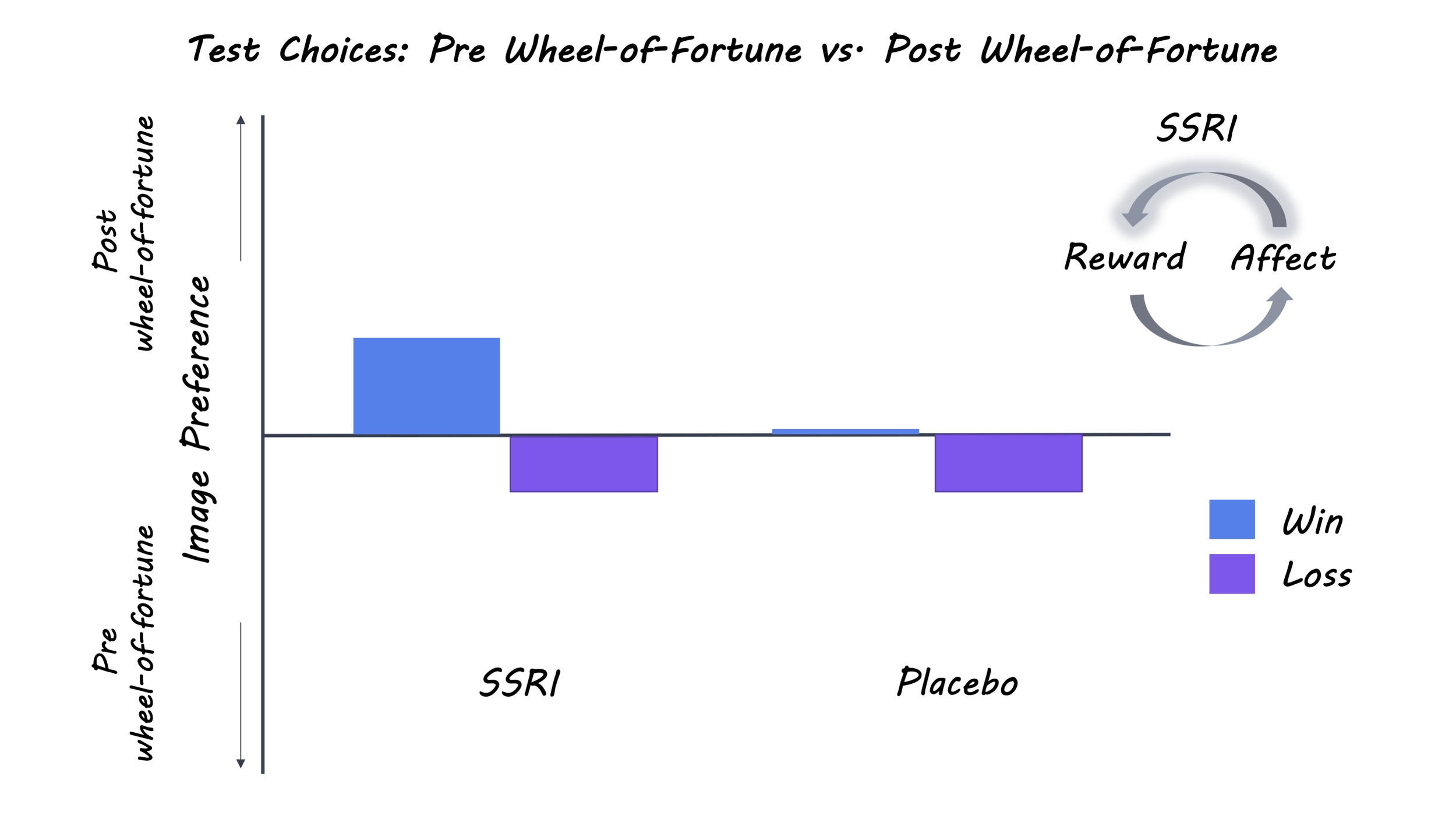
Participants successfully learned about the images’ associated reward probability, but basic learning mechanisms were not different for participants in the citalopram and placebo groups across testing sessions. Additionally, participants were happier following a wheel-of-fortune win than after a loss, but this did not differ between the two treatment groups. Thus, SSRIs did not differentially affect reward learning or mood directly over the one-week treatment. Critically, after winning the wheel-of-fortune draw, participants preferred the images from the second learning block (which they had learned when they were happier), whereas after losing the wheel-of-fortune, they disliked the images from the second learning block (when they were in a low mood). Importantly, the positive effect of mood on learning was boosted by the SSRI treatment. This was shown in the dynamic learning model in which the computational parameter governing reward sensitivity in a positive mood was enhanced in the SSRI group. Moreover, this positive mood bias further extended into the test block, as participants in the citalopram group reported being happier following a wheel-of-fortune win and less unhappy following a loss, as compared to the placebo group. Overall, these results show that SSRIs selectively enhanced a positive mood bias, which had a subsequent delayed effect on participants’ mood ratings.
SSRI_image_may19.png

What's the impact?

SSRIs are the most commonly prescribed class of antidepressants, but thus far, the cognitive and computational mechanisms underlying their treatment effectiveness remain unclear. In this study, the authors identified a potential cognitive mechanism by which antidepressants alleviate the symptoms of major depression. Specifically, SSRIs increase a bidirectional interaction between mood and reward perception, where rewards led to improved mood, which in turn enhances subsequent sensitivity to future reward. This ‘vicious cycle of positivity’ can result in a positive biased perception of experience and thus to further mood improvement over time. Future studies in patients with clinical depression may test whether this mechanistic account of antidepressant drug action can help to build better treatment prediction models.
SSRI_quote_may19.jpg

Michely et al. A mechanistic account of serotonin’s impact on mood. Nature Communications (2020). Access the original scientific publication here.
Characterizing Changes in Functional Connectivity that Underpin a Learned Feeding Behavior

Post by Cody Walters

What’s the science?

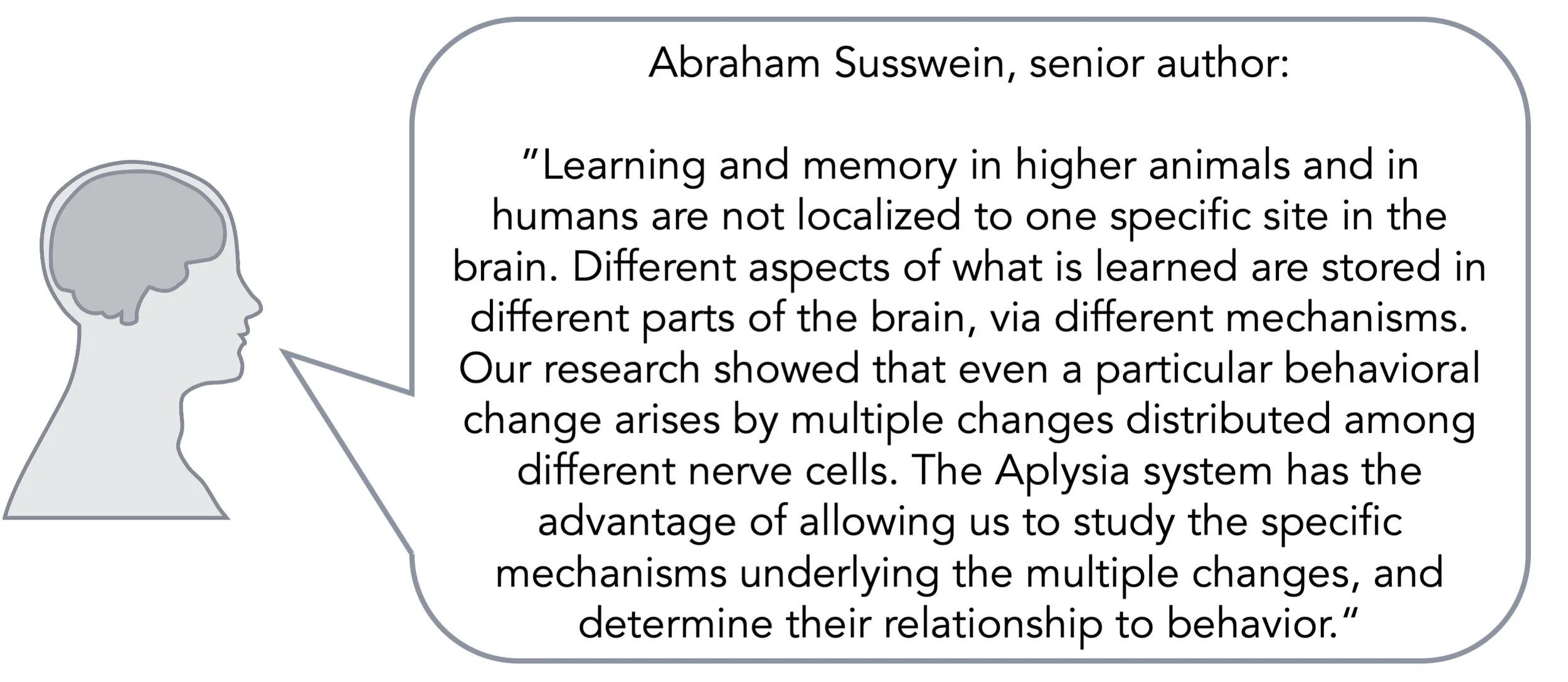
Learning a new behavior necessitates changes in patterns of synaptic connectivity. While studies often focus on how these changes occur at individual locations in the brain, multiple regions undergo synaptic modifications during memory formation. This week in The Journal of Neuroscience, Tam et al. characterize a suite of synaptic changes affecting several sensorimotor pathways following learning in Aplysia (sea slugs). 

How did they do it?

The authors trained Aplysia (sea slugs) by presenting them with tough, inedible food (seaweed wrapped in a plastic net). Initially, food presentation triggered biting and swallowing behavior, but over the course of training the Aplysia learned to reject the food (i.e., expel it from their mouths without attempting to swallow it). Animals were tested the following day to ensure long-term memory formation. The authors then extracted the buccal ganglia for electrophysiological analysis. The buccal ganglia contain mechano-afferents (which receive sensory information from the mouth) as well as interneurons and motor neurons that synapse on buccal muscles. These muscles play a central role in a variety of feeding behaviors such as protraction and retraction of the radula, the Aplysia’s tongue-like structure. The authors then conducted current-clamp recordings in individual neurons in the buccal ganglia preparations using glass electrodes.

What did they find?

The authors found that trained Aplaysia rejected a non-food item (a cannula) more rapidly than the naive Aplysia, a finding which suggests that the memory formed during training with the inedible food translated to a more general bias toward rejection behavior. To investigate the neural correlates of this learned rejection bias, the authors examined the monosynaptic connection between sensory neurons (group S1 buccal ganglia mechano-afferents) and their downstream interneurons/motor neuron targets (called ‘followers’). They electrically stimulated S1 neurons with a depolarizing current and recorded from follower neurons involved in feeding behavior. They discovered a diverse connection profile, with a subset of followers receiving unique combinations of excitatory and inhibitory projections from S1 mechano-afferents.

cody.png

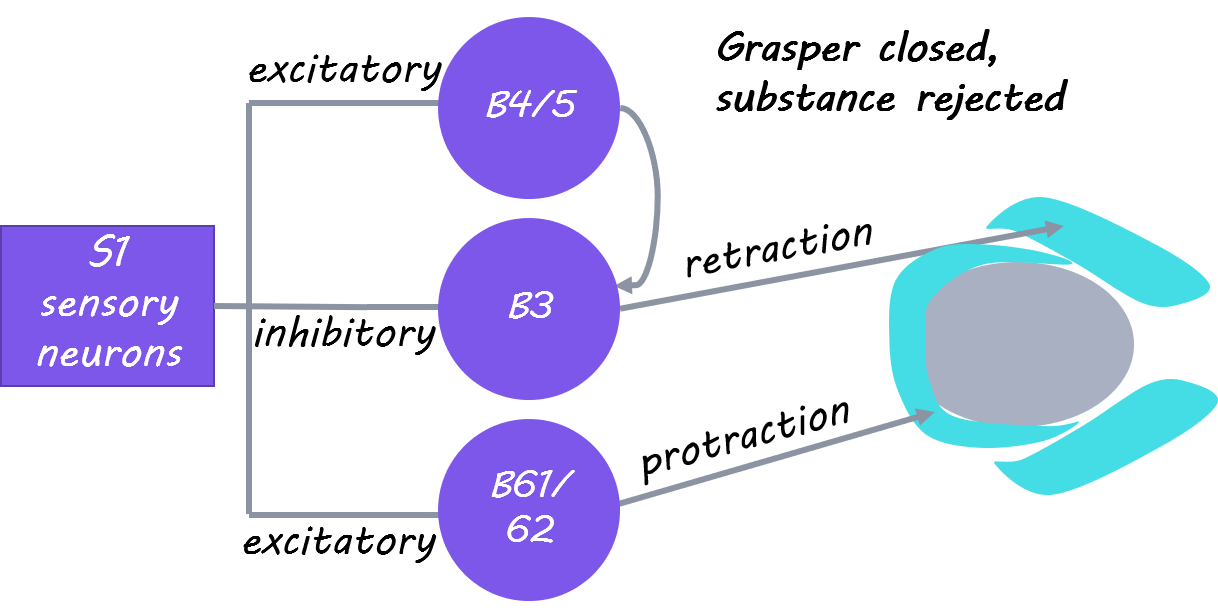
In trained Aplysia relative to naive controls, they found 1) an increase in the excitatory strength of S1-to-B4/B5 connections (B4/B5 neurons coordinate food rejection motor patterns), 2) an increase in the inhibitory strength of S1-to-B3 connections (the B3 motor neuron innervates musculature that retracts the radula and thus draws food particles into the oral cavity), and 3) an increase in the excitatory strength of S1-to-B61/B62 connections (B61/B62 motor neurons innervate musculature that protracts the radula and thus expels of food particles from the oral cavity). Additionally, they observed alterations in the strength and sign of the connections between the mechano-afferents and their downstream targets. Further, the authors found that the patterns of connectivity consistent with a food rejection bias were still maintained in the presence of multiple S1 spikes (in addition to a single S1 spike). Altogether, these synaptic modifications are consistent with a behavioral bias toward food rejection. 

What’s the impact?

Tam et al. explored the neural basis of a learned behavior in Aplysia: a bias to reject food. While on the surface this behavior may appear uncomplicated, the changes that have to occur at the synaptic level to orchestrate this learned response are complex. This study mapped out distinct sensorimotor circuits that undergo specific synaptic modifications following training with inedible food that are consistent with a learned rejection bias. This ability to interrogate a macroscopic behavior by dissecting synaptic alterations across a range of individual neurons is an exciting development in the field of functional connectomics.

learning_quote_may19.jpg

Tam et al. Multiple local synaptic modifications at specific sensorimotor connections after learning are associated with behavioral adaptations that are components of a global response change. The Journal of Neuroscience (2020). Access the original scientific publication here.
Breakdown of Blood-Brain Barrier in APOE4 Carriers is Associated with Cognitive Decline

Post by Amanda McFarlan  

What's the science?

Apolipoprotein E (APOE) is a protein in the body that is important for the metabolism of fats. The E4 variant of this protein (APOE4) is known to be implicated in Alzheimer’s disease and is associated with an increased breakdown of the blood-brain barrier, a semipermeable border that controls which solutes and molecules can pass from the blood into the brain. However, it is still unknown how APOE4 contributes to the memory decline that occurs with Alzheimer’s disease. This week in Nature, Montagne and colleagues investigated the role of the APOE4 gene in blood-brain barrier breakdown and cognitive decline.

How did they do it?

The authors used dynamic contrast-enhanced magnetic resonance imaging to analyze and compare blood-brain barrier permeability in 245 cognitively normal patients who were carriers of either the APOE4 gene (associated with disease states like Alzheimer’s) or the APOE3 gene (considered to confer lower risk for Alzheimer’s). Then, the authors used positron emission tomography to investigate whether the accumulation of Aβ and tau (proteins associated with Alzheimer’s disease) in the brain contributes to the breakdown of the blood-brain barrier in APOE4 carriers compared to APOE3 carriers. They analyzed the uptake of Aβ and tau tracers in four major regions of interest: the hippocampus, the parahippocampal gyrus, the orbitofrontal cortex and the inferior temporal gyrus. Next, the authors investigated whether high levels of soluble platelet-derived growth factor receptor-β in the cerebrospinal fluid, which is known to be associated with blood-brain barrier breakdown and cognitive dysfunction, contributed to APOE4-associated blood-brain barrier permeability. They grouped patients based on whether they had high or low levels of soluble platelet-derived growth factor receptor-β in their cerebrospinal fluid. All patients received a baseline cognitive assessment that was repeated every 2 years for up to 4.5 years. Finally, the proinflammatory cyclophilin A–matrix metalloproteinase-9 pathway has been previously shown to mediate the breakdown of the blood-brain barrier in APOE4, but not APOE3, knock-in mice. Therefore, the authors explored the role of this pathway in APOE4-associated blood-brain barrier permeability and cognitive decline in humans by measuring levels of cyclophilin A and matrix metalloproteinase-9 in cerebrospinal fluid as well as cognitive impairment in APOE4 and APOE3 carriers. 

What did they find?

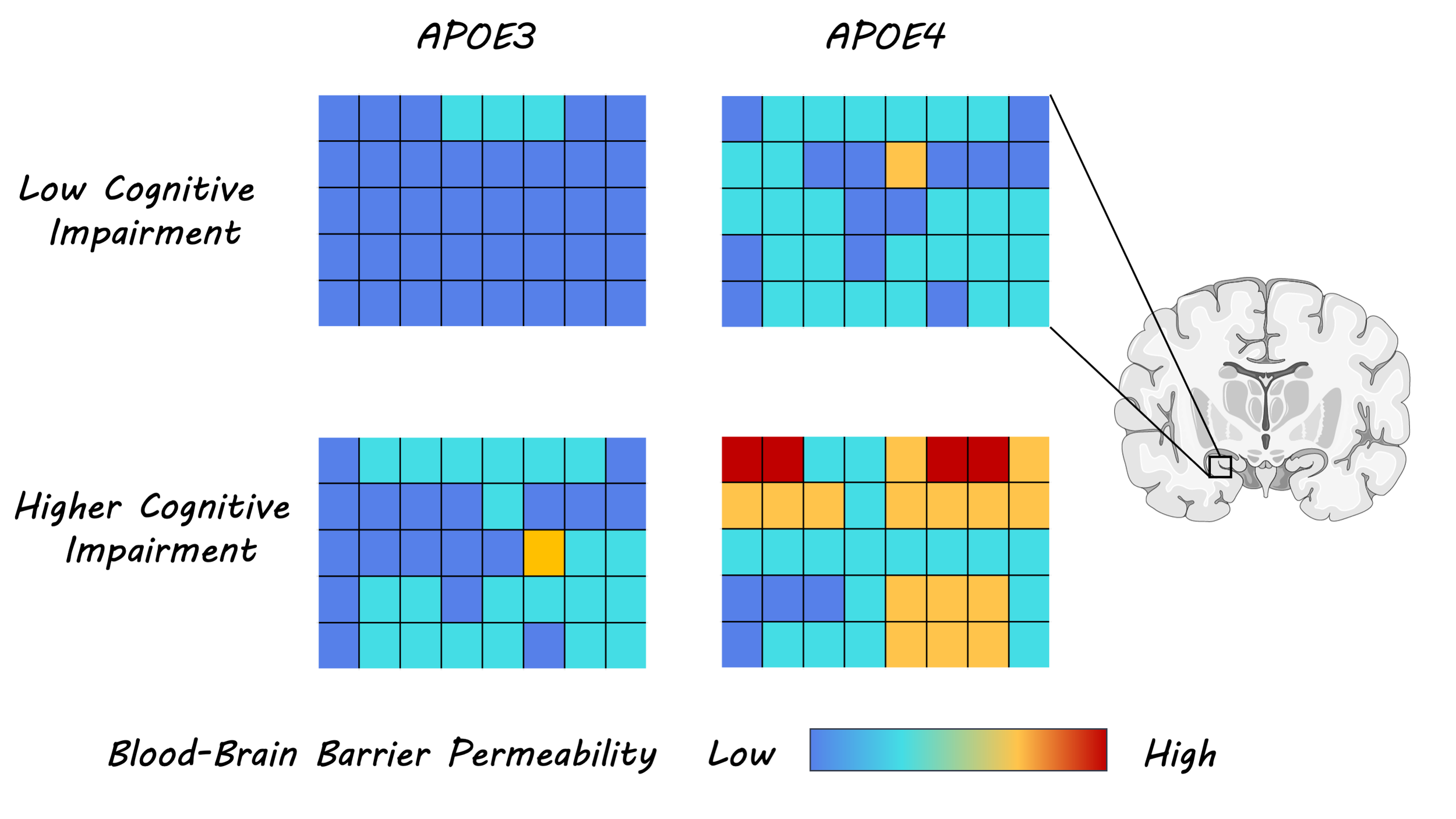
The authors determined that cognitively normal patients who were carriers of the APOE4 gene had higher levels of blood-brain barrier breakdown in the hippocampus and parahippocampal gyrus compared to homozygote carriers of the APOE3 gene. This permeability was shown to increase even further with cognitive impairment in APOE4 carriers, but not APOE3 carriers. APOE4 carriers also had significantly higher levels of accumulated Aβ, but not tau, in the orbital frontal cortex compared to APOE3 carriers. The orbital frontal cortex, however, did not show any evidence of increased blood-brain barrier permeability. Conversely, there was no difference in Aβ or tau levels in the hippocampus, parahippocampal gyrus, or inferior temporal gyrus between carriers of the APOE4 gene and APOE3 gene despite evidence for blood-brain barrier breakdown in APOE4 carriers. Together, these findings suggest that the breakdown of the blood-brain barrier in APOE4 carriers begins in the temporal lobe (a brain region important for memory and cognition) and is independent of Aβ and tau pathology.

apoe4_may12.png

Next, the authors revealed that patients with higher levels of soluble platelet-derived growth factor receptor-β in their cerebrospinal fluid at baseline showed an accelerated cognitive decline compared to patients with lower levels. Moreover, they found that higher levels of soluble platelet-derived growth factor receptor-β in APOE4 carriers, but not APOE3 carriers were a consistent predictor of cognitive decline. Finally, the authors determined that APOE4 carriers had increased levels of cyclophilin A and matrix metalloproteinase-9 that were correlated with cognitive impairment. Together, these findings suggest that the breakdown of the blood-brain barrier in carriers of the APOE4 gene contributes to cognitive decline. 

What’s the impact?

This is the first study to show that increased permeability in the blood-brain barrier in APOE4 carriers is associated with cognitive decline that occurs independently of amyloid and tau pathologies. Furthermore, the authors found that baseline levels of soluble platelet-derived growth factor receptor-β in cerebrospinal fluid could be used as a predictor of cognitive decline in APOE4 carriers. Together, these findings highlight the impact of blood-brain barrier breakdown on cognitive decline and provide insight into possible therapeutic targets that may minimize this breakdown in APOE4 carriers.

Zlokovic_May12.jpg

Montagne et al. APOE4 leads to blood-brain barrier dysfunction predicting cognitive decline. Nature (2020). Access the original scientific publication here.