Characterizing the Neural Signature of Preferences

Post by Elisa Guma

What's the science?

When we make a decision, typically we identify our options, estimate the value of those options, and compare the values to select the best option. Several neural and computational approaches have been employed to try to understand the valuation process, and the brain networks involved. However, the mechanisms behind decision making remain poorly understood. A few key brain regions have been identified as playing a key role in subjective valuation, also termed ‘brain valuation system’ including the ventromedial prefrontal cortex, ventral striatum, and posterior cingulate cortex, however, several other regions have also been identified as playing a key role. This week in Nature Neuroscience, Lopez-Persem and colleagues use a large dataset of intracranial electrophysiological recordings in humans (being treated with epilepsy) to better identify which brain regions and what type of underlying activity is involved in generating value signals in judgement tasks.

How did they do it?

The authors’ first goal was to identify brain regions in which value signals were detectable during judgement tasks. In other words: to identify the brain valuation system. The authors collected intracranial electroencephalography (iEEG) data from 4,273 intracranial electrodes in the brains of 36 patients being treated for drug-resistant focal epilepsy (across 3 treatment centers). Each participant had between 12-18 electrodes implanted for seizure localization. Participants performed judgments tasks while neural activity was being recorded via electrodes. Some participants performed a short version of the task, and others performed a longer version. The longer version of the task started with a “distracting task” in which participants were asked to estimate the age of faces and paintings, and rate how confident they felt in their guess. In the second phase of the task, participants were asked to rate the likeability of food items as well as faces and paintings, followed by a confidence rating. In a third phase, participants were given a choice of two pictures belonging to the same category (face, food, painting) and asked to choose the one they liked best. In the short version of the task, participants only completed the second and third phases with food item images and were not asked to rate confidence. 

The authors sought to find the time window in which each brain region of interest was most associated with the value signal by investigating the relationship between the subjective value given by participants and parcellated brain activity (77 regions using the Automated Anatomical Labeling atlas). They focused their analyses on high-gamma-band (50-150Hz) activity because it is thought to be a close reflection of local neuron spiking activity. The authors wanted to know if the electrophysiological activity recordings were related to four core properties of subjective valuation. They assessed anticipation with pre-stimulus activity, generality with the inclusion of non-food items, automaticity by including other types of rating (age), and quadratic coding by measuring confidence in ratings.

What did they find?

The authors identified a quadratic, or U-shaped relationship between first-order ratings (age or likeability of an item) and second-order (confidence in those ratings) ratings. This was true for both food and non-food items as well as age and likeability tasks. The authors also observed that the likeability ratings were reliable estimates of subjective value, able to predict choice, reaction time, and confidence. The authors identified 18 regions of interest (among the 77 analyzed) in which a significant subjective value representation was associated. The authors identified several regions belonging to the brain valuation system: the orbitofrontal cortex OFC (comprising the ventromedial prefrontal cortex and lateral orbitofrontal cortex), and parahippocampal complex (PHC) comprising the hippocampus and parahippocampal cortex. They also found significant associations with other regions including the anterior cingulate gyrus, fusiform area, inferior temporal cortex, and inferior frontal opercularis.   

valuation_April28.jpg

For anticipation (how baseline activity predicts value judgement) they found that OFC pre-stimulus activity was significantly associated with value signaling, but not the PHC activity. In the post-stimulus window, they found a significant association with both food and non-food item likeability rating for all regions, indicative of the generality of the signal. They also found that these regions responded to value in a distractive, or non-value task, reflective of automaticity in subjective valuation. Finally, they found that brain valuation system activity was also associated with a quadratic form of likeability ratings (quadraticity), indicative of a co-representation of confidence.

What's the impact?

This study identified a brain network important for valuation in decision making. Further, these findings indicate this network’s involvement in anticipation, generality, and automaticity in decision making. This work provides important evidence for how the brain assigns value to options during decision making and may help us understand the mechanisms of irrational judgement.
Alizee_quote_april28.jpg

Alizee Lopez-Persem et al. Four core properties of the human brain valuation system demonstrated in intracranial signals. Nature Neuroscience (2020). Access the original scientific publication here
A Novel Pathway Underlying Hippocampal-Neocortical Interactions

Post by Shireen Parimoo 

What's the science?

Interactions between the hippocampus and the neocortex are crucial for learning and forming memories. These interactions are thought to occur via bursts of high-frequency oscillatory activity known as sharp-wave ripples in the hippocampus. For example, hippocampal sharp wave ripples modulate neuronal firing in anatomically connected regions like the prefrontal cortex. However, it is not known how ripples facilitate communication with other regions that don’t have direct connections to the hippocampus. One possibility is through coupling with the granular retrosplenial cortex (gRSC), which is structurally connected to the hippocampus via the subiculum and also has dense connections to the rest of the brain. This week in Nature Communications, Nitzan and colleagues investigated the role of the subiculum and gRSC in mediating hippocampal communication through sharp wave ripples.

How did they do it?

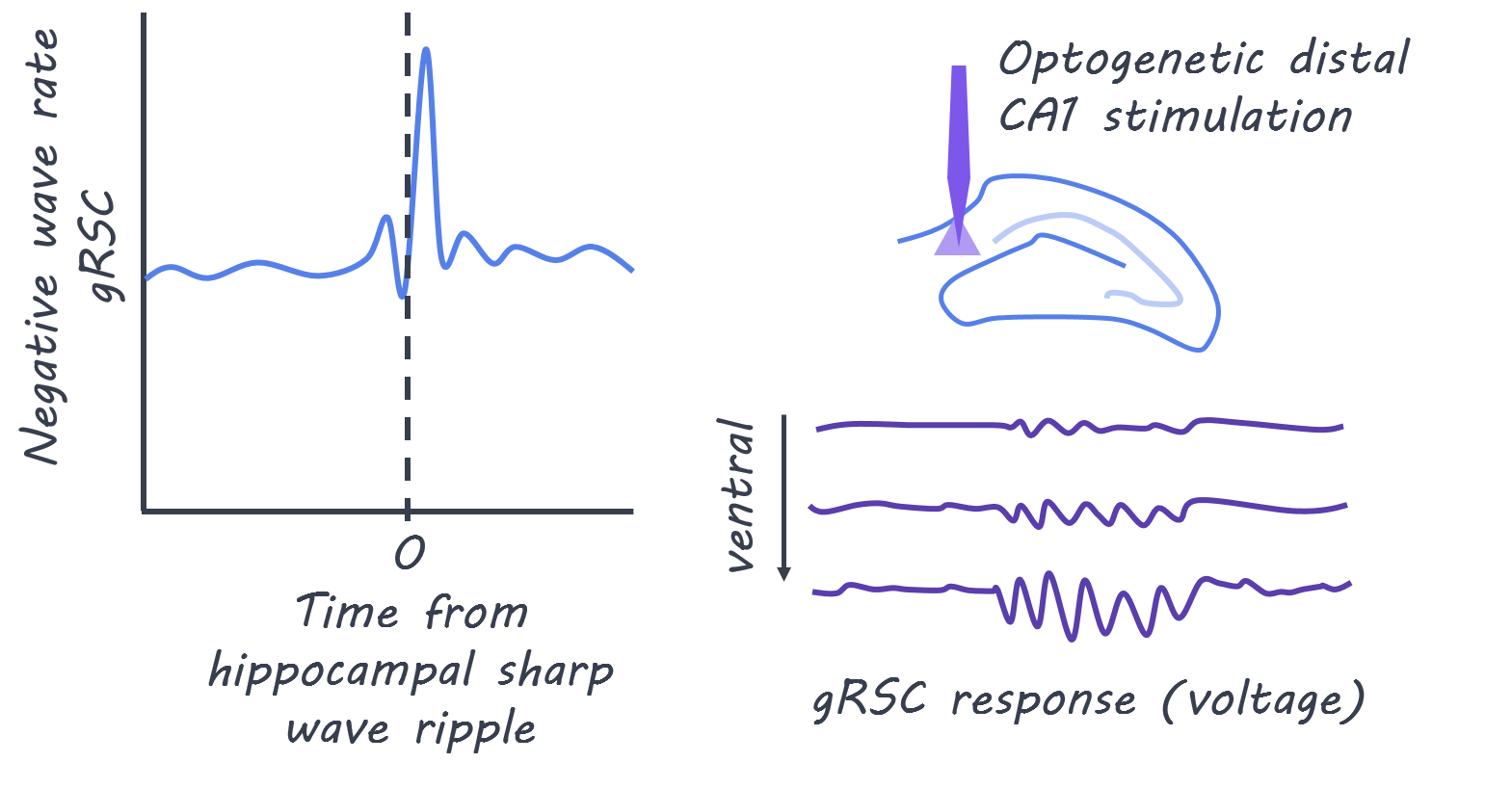
The authors obtained both in vivo and in vitro electrophysiological recordings from the CA1 region of the hippocampus, the subiculum region of the hippocampus, and the gRSC. Using these recordings, they characterized the pattern of oscillatory activity in these regions. First, they assessed whether the time course and strength of hippocampal sharp wave ripples were coupled to ripple activity in the deep and superficial layers of the gRSC. Then, they optogenetically stimulated neurons in the dorsal CA1 and the subiculum to directly observe the effect of hippocampal input on activity in the subiculum and gRSC. They also investigated whether hippocampal-gRSC coupling was modulated by cortical state, which includes neuronal synchronization and desynchronization. During cortical synchronization, the activity of the underlying neuronal population rhythmically alternates between bursts of firing and inactivity. They evaluated whether the relationship between hippocampal ripples and gRSC ripples was altered during periods of synchronization and desynchronization in the gRSC. Finally, to assess whether the effect of hippocampal SWRs on gRSC activity was mediated by the subiculum, they recorded ripple activity in the gRSC while inhibiting subicular axons.

What did they find?

Neurons in the gRSC exhibited ripple-like activity, particularly in superficial layers, which were coupled with hippocampal sharp wave ripples. Specifically, hippocampal ripples were immediately followed by the increased firing of neurons, as well as greater ripple activity in the gRSC. Moreover, the strength of hippocampal ripples was positively correlated with the strength of gRSC ripples. Optogenetic stimulation of the subiculum elicited ripple activity in the superficial layers of the gRSC but suppressed neurons in deeper layers. Hippocampal-retrosplenial coupling was also greater during periods of synchronization in the gRSC, but nearly absent during neuronal desynchronization. Thus, hippocampal sharp wave ripples have a differential effect on neurons in the deep and superficial layers of the gRSC, and this effect is modulated by the cortical state of the gRSC.

Shireen_pic (1).png

Hippocampal ripples also activated bursting neurons in the subiculum. In turn, these bursting subicular neurons modulated activity in the gRSC. Stimulating subicular induced excitatory responses in the superficial gRSC, while non-bursting neurons had little effect on gRSC activity. Additionally, optogenetically inhibiting the subicular neurons reduced ripple activity in the gRSC, even in the presence of hippocampal ripples. This shows that bursting neurons in the subiculum directly mediate the coupling between hippocampal and retrosplenial ripples.

What's the impact?

This study identified a novel mechanistic pathway through which hippocampal sharp wave ripples transmit information to the neocortex, particularly to regions that don’t have direct anatomical connections to the hippocampus. These results pave the way for future research to determine how the interactions between the retrosplenial cortex and other regions of the brain support learning and memory.

Noam_quote_april28.jpg

Nitzan et al. Propagation of hippocampal ripples to the neocortex by way of a subiculum-retrosplenial pathway. Nature Communications (2020). Access the original scientific publication here.

Post-Ingestion Cues Reinforce Food Seeking Behaviours

Post by Amanda McFarlan 

What's the science?

Feeding behaviours are influenced by many factors, including post-ingestive information about the nutrients in our food. The degree to which these post-ingestive cues mediate food seeking behaviour, however, is not well understood. A growing body of evidence suggests that the gut-brain axis may be involved in communicating information about post-ingestive cues to the brain, however, a direct link between the periphery and the brain has yet to be identified. This week in Neuron, Fernandes and colleagues investigated the mechanisms by which post-ingestive sucrose mediates food seeking behaviours. 

How did they do it?

In the first set of experiments, the authors trained mice to lever press for oral delivery of sucrose or of sucralose (non-caloric artificial sweetener) to determine the effect of sucrose on food seeking behaviours. Since there were significant differences in the response to the two solutions, the authors then surgically implanted a gastric catheter in food and water deprived mice and trained them to lever press for gastric delivery of either sucrose or sucralose to investigate the effect of post-ingestive administration of sucrose on food seeking behaviours. In a different group, mice were given a choice between two levers to press, with each lever resulting in gastric delivery of either sucrose or sucralose. Finally, the authors trained knockout mice that were unable to identify sweet taste to lever press for oral delivery of either sucrose or sucralose to determine whether the activation of oral receptors for sweet taste is necessary for the effects of sucrose on food seeking behaviours. 

To better understand the mechanisms underlying the reinforcing effects of sucrose on food-seeking, the authors used deep-brain calcium imaging to measure the activity of dopaminergic neurons in the ventral tegmental area (VTA) in freely moving mice while they received gastric delivery of either sucrose or sucralose. Next, the authors generated transgenic mice with a modified N-Methyl-D-Aspartate receptor (NDMAR) in dopaminergic neurons to disrupt the activity of these neurons in the VTA. They trained these transgenic mice to lever press for gastric delivery of sucrose or sucralose to determine whether the activity of dopaminergic neurons was necessary for sucrose-mediated food seeking behaviours. Finally, the authors investigated the role of the hepatic vagus nerve (thought to be important for post-ingestive nutrient information) in mediating sucrose-related food seeking behaviours. In addition to testing the effects of hepatic vagus nerve lesions on food seeking behaviours, they used deep-brain calcium imaging to measure the activity of VTA dopaminergic neurons in response to gastric delivery of sucrose or sucralose in mice that were surgically denervated at the hepatic vagus nerve and mice that received a sham surgery. 

What did they find?

The authors found that the number of lever presses was much higher when mice received oral delivery or gastric delivery of a sucrose solution compared to sucralose. They also found that when given the choice, mice consistently pressed the lever that resulted in gastric delivery of sucrose rather than sucralose, which suggests that the feedback from post-ingestive sucrose reinforced food seeking behaviours. Finally, the authors determined that lever pressing in knockout mice that were unable to identify sweet taste was increased for oral delivery of sucrose, but not sucralose, further confirming that the reinforcing effects of sucrose are related to post-ingestive feedback rather than the oral activation of sweet taste receptors.

amanda_pic.png

Next, the authors determined that the activity of dopaminergic neurons in the VTA was increased in mice that received gastric delivery of sucrose, relative to those that received sucralose. Lever pressing did not increase and was similar for gastric delivery of both sucrose and sucralose in transgenic mice with altered NMDARs in VTA dopaminergic neurons. However, mice that received a sham surgery (i.e. hepatic vagus nerve intact) had increased activity in VTA dopaminergic neurons after gastric delivery of sucrose compared to sucralose. Conversely, dopamine neuron activity was not different after gastric delivery of sucrose and sucralose in mice that were surgically denervated at the hepatic vagus nerve. Together, these findings suggest that the activity of VTA dopamine neurons is mediated by the hepatic branch of the vagus nerve and is critical for the reinforcing effects of sucrose in food seeking behaviours. 

What’s the impact?

This is the first study to show that post-ingestive sucrose mediates food seeking behaviours through the modulation of dopaminergic neuron activity in the VTA. The authors also revealed that the activity of the VTA dopaminergic neurons is controlled by the hepatic vagus nerve, which suggests that the gut-brain axis is involved in mediating food seeking behaviours. Together, these findings provide insight into the underlying mechanisms of sucrose-mediated food seeking behaviours that connect the central and peripheral nervous systems. 

Albino_quote_April28.jpg

Fernandes et al. Postingestive Modulation of Food Seeking Depends on Vagus-Mediated Dopamine Neuron Activity. Neuron (2020). Access the original scientific publication here.