A Novel Pathway Underlying Hippocampal-Neocortical Interactions

Post by Shireen Parimoo 

What's the science?

Interactions between the hippocampus and the neocortex are crucial for learning and forming memories. These interactions are thought to occur via bursts of high-frequency oscillatory activity known as sharp-wave ripples in the hippocampus. For example, hippocampal sharp wave ripples modulate neuronal firing in anatomically connected regions like the prefrontal cortex. However, it is not known how ripples facilitate communication with other regions that don’t have direct connections to the hippocampus. One possibility is through coupling with the granular retrosplenial cortex (gRSC), which is structurally connected to the hippocampus via the subiculum and also has dense connections to the rest of the brain. This week in Nature Communications, Nitzan and colleagues investigated the role of the subiculum and gRSC in mediating hippocampal communication through sharp wave ripples.

How did they do it?

The authors obtained both in vivo and in vitro electrophysiological recordings from the CA1 region of the hippocampus, the subiculum region of the hippocampus, and the gRSC. Using these recordings, they characterized the pattern of oscillatory activity in these regions. First, they assessed whether the time course and strength of hippocampal sharp wave ripples were coupled to ripple activity in the deep and superficial layers of the gRSC. Then, they optogenetically stimulated neurons in the dorsal CA1 and the subiculum to directly observe the effect of hippocampal input on activity in the subiculum and gRSC. They also investigated whether hippocampal-gRSC coupling was modulated by cortical state, which includes neuronal synchronization and desynchronization. During cortical synchronization, the activity of the underlying neuronal population rhythmically alternates between bursts of firing and inactivity. They evaluated whether the relationship between hippocampal ripples and gRSC ripples was altered during periods of synchronization and desynchronization in the gRSC. Finally, to assess whether the effect of hippocampal SWRs on gRSC activity was mediated by the subiculum, they recorded ripple activity in the gRSC while inhibiting subicular axons.

What did they find?

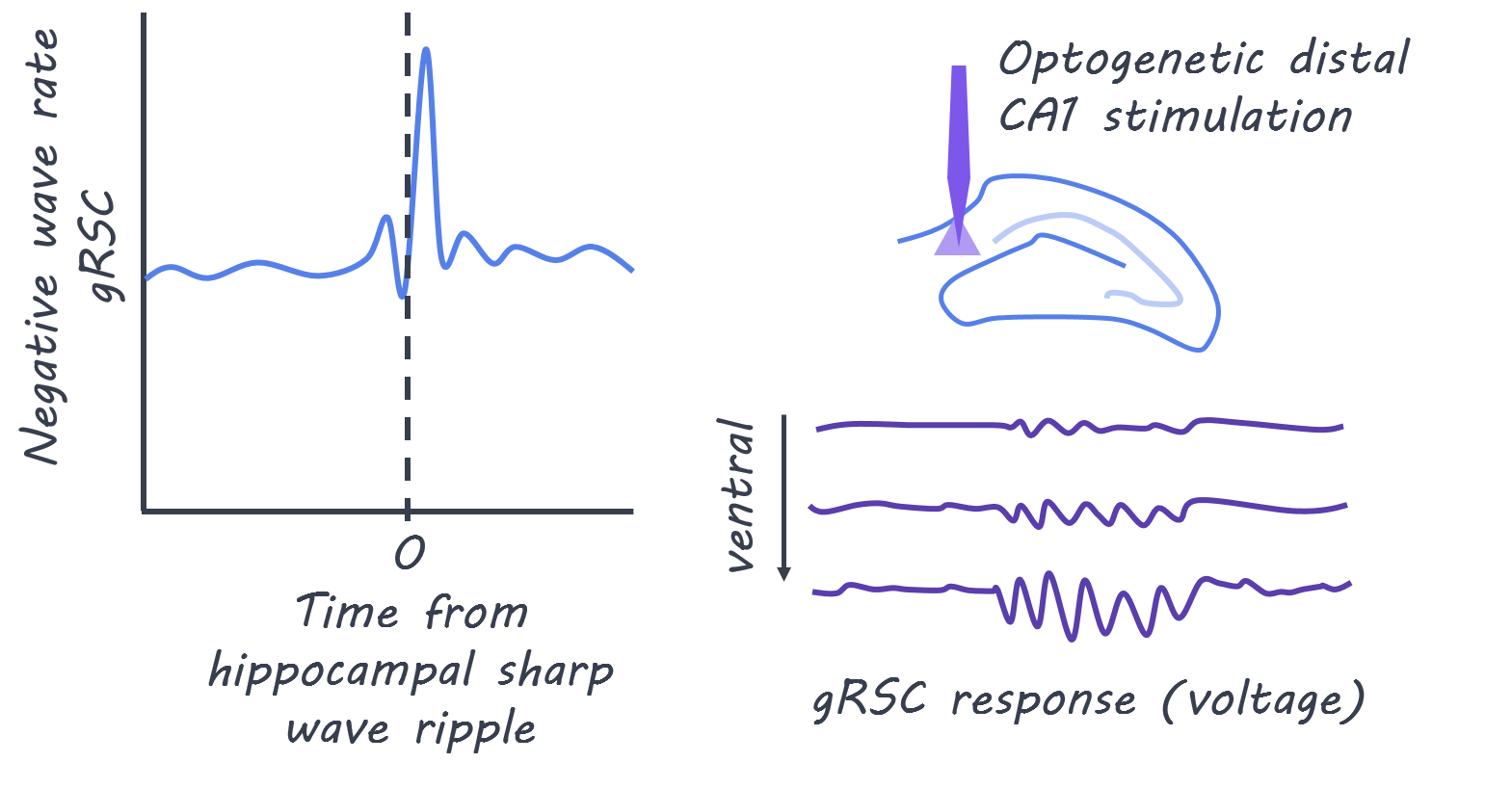
Neurons in the gRSC exhibited ripple-like activity, particularly in superficial layers, which were coupled with hippocampal sharp wave ripples. Specifically, hippocampal ripples were immediately followed by the increased firing of neurons, as well as greater ripple activity in the gRSC. Moreover, the strength of hippocampal ripples was positively correlated with the strength of gRSC ripples. Optogenetic stimulation of the subiculum elicited ripple activity in the superficial layers of the gRSC but suppressed neurons in deeper layers. Hippocampal-retrosplenial coupling was also greater during periods of synchronization in the gRSC, but nearly absent during neuronal desynchronization. Thus, hippocampal sharp wave ripples have a differential effect on neurons in the deep and superficial layers of the gRSC, and this effect is modulated by the cortical state of the gRSC.
Shireen_pic (1).png

Hippocampal ripples also activated bursting neurons in the subiculum. In turn, these bursting subicular neurons modulated activity in the gRSC. Stimulating subicular induced excitatory responses in the superficial gRSC, while non-bursting neurons had little effect on gRSC activity. Additionally, optogenetically inhibiting the subicular neurons reduced ripple activity in the gRSC, even in the presence of hippocampal ripples. This shows that bursting neurons in the subiculum directly mediate the coupling between hippocampal and retrosplenial ripples.

What's the impact?

This study identified a novel mechanistic pathway through which hippocampal sharp wave ripples transmit information to the neocortex, particularly to regions that don’t have direct anatomical connections to the hippocampus. These results pave the way for future research to determine how the interactions between the retrosplenial cortex and other regions of the brain support learning and memory.

Noam_quote_april28.jpg

Nitzan et al. Propagation of hippocampal ripples to the neocortex by way of a subiculum-retrosplenial pathway. Nature Communications (2020). Access the original scientific publication here.

Post-Ingestion Cues Reinforce Food Seeking Behaviours

Post by Amanda McFarlan 

What's the science?

Feeding behaviours are influenced by many factors, including post-ingestive information about the nutrients in our food. The degree to which these post-ingestive cues mediate food seeking behaviour, however, is not well understood. A growing body of evidence suggests that the gut-brain axis may be involved in communicating information about post-ingestive cues to the brain, however, a direct link between the periphery and the brain has yet to be identified. This week in Neuron, Fernandes and colleagues investigated the mechanisms by which post-ingestive sucrose mediates food seeking behaviours. 

How did they do it?

In the first set of experiments, the authors trained mice to lever press for oral delivery of sucrose or of sucralose (non-caloric artificial sweetener) to determine the effect of sucrose on food seeking behaviours. Since there were significant differences in the response to the two solutions, the authors then surgically implanted a gastric catheter in food and water deprived mice and trained them to lever press for gastric delivery of either sucrose or sucralose to investigate the effect of post-ingestive administration of sucrose on food seeking behaviours. In a different group, mice were given a choice between two levers to press, with each lever resulting in gastric delivery of either sucrose or sucralose. Finally, the authors trained knockout mice that were unable to identify sweet taste to lever press for oral delivery of either sucrose or sucralose to determine whether the activation of oral receptors for sweet taste is necessary for the effects of sucrose on food seeking behaviours. 

To better understand the mechanisms underlying the reinforcing effects of sucrose on food-seeking, the authors used deep-brain calcium imaging to measure the activity of dopaminergic neurons in the ventral tegmental area (VTA) in freely moving mice while they received gastric delivery of either sucrose or sucralose. Next, the authors generated transgenic mice with a modified N-Methyl-D-Aspartate receptor (NDMAR) in dopaminergic neurons to disrupt the activity of these neurons in the VTA. They trained these transgenic mice to lever press for gastric delivery of sucrose or sucralose to determine whether the activity of dopaminergic neurons was necessary for sucrose-mediated food seeking behaviours. Finally, the authors investigated the role of the hepatic vagus nerve (thought to be important for post-ingestive nutrient information) in mediating sucrose-related food seeking behaviours. In addition to testing the effects of hepatic vagus nerve lesions on food seeking behaviours, they used deep-brain calcium imaging to measure the activity of VTA dopaminergic neurons in response to gastric delivery of sucrose or sucralose in mice that were surgically denervated at the hepatic vagus nerve and mice that received a sham surgery. 

What did they find?

The authors found that the number of lever presses was much higher when mice received oral delivery or gastric delivery of a sucrose solution compared to sucralose. They also found that when given the choice, mice consistently pressed the lever that resulted in gastric delivery of sucrose rather than sucralose, which suggests that the feedback from post-ingestive sucrose reinforced food seeking behaviours. Finally, the authors determined that lever pressing in knockout mice that were unable to identify sweet taste was increased for oral delivery of sucrose, but not sucralose, further confirming that the reinforcing effects of sucrose are related to post-ingestive feedback rather than the oral activation of sweet taste receptors.

amanda_pic.png

Next, the authors determined that the activity of dopaminergic neurons in the VTA was increased in mice that received gastric delivery of sucrose, relative to those that received sucralose. Lever pressing did not increase and was similar for gastric delivery of both sucrose and sucralose in transgenic mice with altered NMDARs in VTA dopaminergic neurons. However, mice that received a sham surgery (i.e. hepatic vagus nerve intact) had increased activity in VTA dopaminergic neurons after gastric delivery of sucrose compared to sucralose. Conversely, dopamine neuron activity was not different after gastric delivery of sucrose and sucralose in mice that were surgically denervated at the hepatic vagus nerve. Together, these findings suggest that the activity of VTA dopamine neurons is mediated by the hepatic branch of the vagus nerve and is critical for the reinforcing effects of sucrose in food seeking behaviours. 

What’s the impact?

This is the first study to show that post-ingestive sucrose mediates food seeking behaviours through the modulation of dopaminergic neuron activity in the VTA. The authors also revealed that the activity of the VTA dopaminergic neurons is controlled by the hepatic vagus nerve, which suggests that the gut-brain axis is involved in mediating food seeking behaviours. Together, these findings provide insight into the underlying mechanisms of sucrose-mediated food seeking behaviours that connect the central and peripheral nervous systems. 

Albino_quote_April28.jpg

Fernandes et al. Postingestive Modulation of Food Seeking Depends on Vagus-Mediated Dopamine Neuron Activity. Neuron (2020). Access the original scientific publication here.
Stopping Tau in its Tracks: Investigating the Spread of Tau Protein in the Brain

Post by Anastasia Sares 

What's the science?

The protein tau is an important factor in many kinds of dementia, including Alzheimer’s disease. It normally stabilizes the structural scaffolding of a neuron (the microtubules). In dementia, tau proteins can accumulate and form tangles, harming the function of the cell and eventually leading to cell death. From there, misbehaving tau proteins can also spread and replicate in nearby neurons. However, this spread depends on the tau proteins entering new cells. This week in Nature, Rauch, and colleagues demonstrated that a protein called LRP1 is a key regulator that allows tau to be taken up into the cell and that inactivating LRP1 can stop the spread of this protein.

How did they do it?

The authors used multiple steps to show the effects of LRP1 on tau uptake, starting in vitro (with isolated cells in a petri dish) and then moving to in vivo (inside the tissue of a living animal). In vitro, they used CRISPR-Cas9 technology to edit the genes of cells in a dish, and then exposed them to tau to see how their genetic manipulations affected tau uptake.

Next, the team used viral technology to affect the levels of LRP1 in living mice (in vivo). Half of the mice were exposed to a genetically-modified retrovirus containing a gene that interfered with LRP1 throughout the brain. Then, all mice were exposed to a second retrovirus carrying instructions to generate a tau protein in the hippocampus. The authors monitored the spread of the tau protein from its original region.

What did they find?

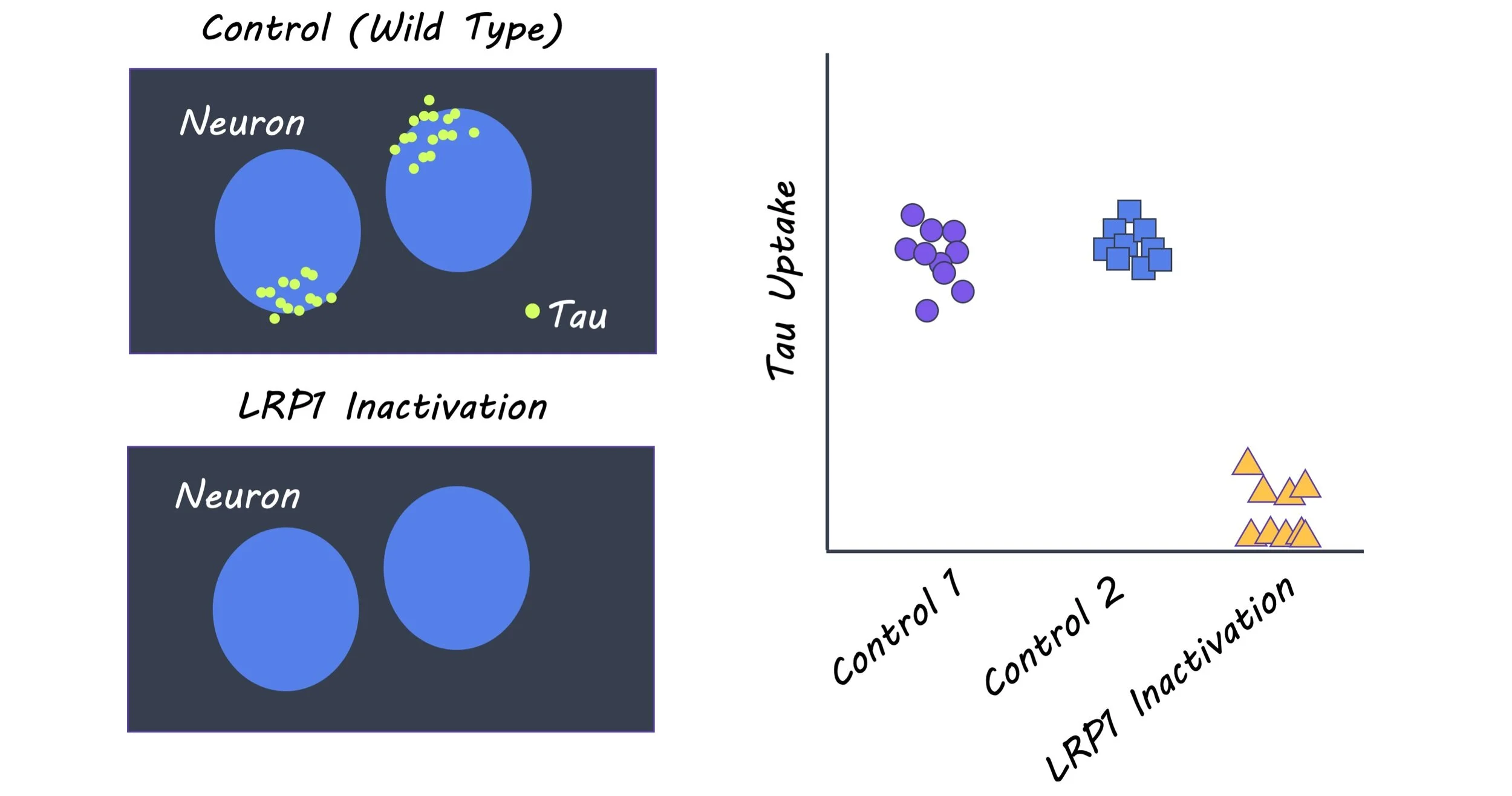
In vitro, cells that were manipulated not to produce LRP1 did not allow tau in, and further tests manipulating sub-regions of LRP1 showed that two specific regions of this protein were involved in transporting tau into the cell (MLRP4 and MLRP2).

Tau_image_Apr21.jpg

In vivo, the animals that had LRP1 inactivated showed less spread of tau to other regions of the brain. Tau introduced to one side of the hippocampus did not make it to the other side, nor did it spread to the cortex as it did in mice who had normal LRP1 activity. These experiments demonstrate that LRP1 is 1) involved in taking up tau into the neuron and 2) the spread of tau across the brain.

What's the impact?

In addition to regulating the spread of tau, the protein LRP1 is known to affect amyloid accumulation, the second major factor in neurodegenerative disease. Therefore, this study and others strongly point to LRP1 as an important target for gene therapy, medication, or other treatments.

Kosik_quote_Apr21.jpg

Rauch et al. LRP1 is a master regulator of tau uptake and spread. Nature (2020). Access the original scientific publication here.