Could the COVID-19 Virus Be Neuroinvasive?

Post by Flora Moujaes 

What's the science? 

In late February 2020, a few days before the World Health Organization declared COVID-19 a pandemic, Li and colleagues from Jilin University in eastern China published an article proposing that the COVID-19 virus may be able to enter the brain and spinal cord. The hypothesis that COVID-19 is neuroinvasive suggests that the respiratory distress experienced by COVID-19 patients is not just due to inflammatory structural damage to the lungs, but also due to damage to the respiratory centers of the brain that control breathing. This could help explain why some patients develop acute respiratory failure and others do not. This week in the Journal of Medical Virology, the researchers published a follow-up article outlining the additional evidence for this hypothesis that has emerged in the last month, as COVID-19 continues to spread around the world.  

What’s the theory? 

When Li and colleagues first published their hypothesis that the COVID-19 virus may be neuroinvasive, their theory was mainly based on the evidence that other similar coronaviruses are neuroinvasive. For example, the severe acute respiratory syndrome (SARS) epidemic, which began in the early 2000s and resulted in 774 deaths, was caused by a similar coronavirus to COVID-19. The SARS virus has been found in neurons in the brains of both patients and experimental animals, particularly in the part of the brain known as the medulla, the brain’s primary respiratory control center. If like the SARS virus, the COVID-19 virus is able to invade brain regions such as the medulla, this invasion could be partly responsible for the acute respiratory failure seen in COVID-19 patients. It would also explain why one 24-year-old COVID-19 patient described losing her ability to breathe involuntarily, and why a small number of initial COVID-19 patients reported neurological symptoms such as headaches (8%) and nausea and vomiting (1%). 

What’s new? 

At the time of publishing their initial hypothesis that COVID-19 may be neuroinvasive, there were less than 90,000 confirmed cases worldwide. One month later, Li and colleagues published a follow-up article outlining the additional evidence for the hypothesis that emerged as the number of worldwide cases surged to over 1.5 million:

(1)   A study on 214 COVID‐19 patients in Wuhan found that neurological symptoms were more common than previously thought and that severe patients were more likely to display neurological symptoms: 36.4% of patients showed neurological symptoms while severe patients were more likely to display neurological symptoms such as acute cerebrovascular diseases (5.7%), impaired consciousness (14.8%) and skeletal muscle injury (19.3%). 

(2)   Loss of smell and taste has also been reported in COVID‐19 patients in several countries, and a similar olfactory dysfunction was also reported in SARS patients. While this symptom can commonly be caused by changes in the nasal cavity during illness, loss of smell can also result from damage to the olfactory nerve through which the virus may enter the brain.

(3)   A limited number of individual case studies demonstrated that the COVID-19 virus is able to infiltrate the brain. For example, in Japan a 24-year-old COVID-19 patient showed meningeal irritation: inflammation of the membranes that cover the brain and spinal cord. Meanwhile, in Beijing a 56-year-old COVID-19 patient presented with encephalitis: inflammation of the brain most commonly caused by a viral infection. Cerebrospinal fluid samples from both patients tested positive for the COVID-19 virus.

(4)   It is still unclear why some patients develop respiratory failure and others do not. For example, a study on 81 COVID‐19 patients in Wuhan showed both asymptomatic and symptomatic patients displayed lung lesions. If neuroinvasion of COVID-19 affected an individual’s breathing, it could help explain the differences in disease progression between these two groups of patients.

What’s the bottom line?

There is growing evidence that the COVID-19 virus may be neuroinvasive. If this is the case, lung infections may not be the only contribution to COVID-19-related breathing difficulties; brain infiltration and damage to the key brain structures involved in the control of respiration like the medulla could play a role. More research is needed to confirm this hypothesis, and the current severity of the pandemic limits the capacity to conduct the necessary research. A greater understanding of the potential brain and spinal cord infiltration of COVID-19 could be critical for the prevention and treatment of this virus. In particular, understanding whether the virus is neuroinvasive may help explain why some patients develop respiratory failure while others do not. Neuroinvasion may also explain why complete clearance of the virus may not be guaranteed even after patients have recovered from acute infection.

Li et al. Response to Commentary on “The neuroinvasive potential of SARS‐CoV‐2 may play a role in the respiratory failure of COVID‐19 patients”. Journal of Medical Virology (2020). Access the original scientific publication here.

Stanford Accelerated Intelligent Neuromodulation Therapy for Treatment-Resistant Depression

Post by Stephanie Williams

What's the science?

Recently, the FDA approved an effective treatment for treatment-resistant depression called intermittent theta burst stimulation. The treatment involves noninvasively passing an electric current through a magnetic coil in order to excite areas of the brain and relieve symptoms associated with Major Depressive Disorder. In one study, when intermittent theta-burst stimulation was applied daily for 6 weeks, it was found to achieve a remission rate of 32%. However, questions still remain about how to optimize the stimulation protocol in order to maximize the treatment effect. Specifically, three aspects of the treatment protocol could be optimized 1) the timing and repetition of stimulation, 2) the intensity of the dose, and the 3) the process of tailoring the stimulation location to individual anatomy. This week in the American Journal of Psychiatry, Cole and colleagues developed and tested a new protocol for intermittent theta burst stimulation treatment aiming to treat depression symptoms. 

How did they do it?                             

The authors designed and tested a protocol to deliver high-dose intermittent theta burst stimulation using functional connectivity magnetic resonance imaging (MRI) -guided targeting to a group of individuals (N=21) who were currently experiencing an episode of severe or treatment-resistant depression. Some of the participants (N=6) had previously tried a 6-week cycle of conventional TMS stimulation and did not respond to that treatment. The authors delivered stimulation to participants across 5 days, in 10 sessions per day. Each session was spaced apart by 50 minutes. This intersession interval time was a key aspect of the protocol, as previous studies employing inter-session intervals of 40 minutes or less did not show a cumulative effect on synaptic strengthening. The dose that the authors used was five times the dose approved by the FDA for iTBS protocol, and it was used at a higher density than the previously approved method (90,000 pulses across 5 days compared to 18,000 pulses in 6 weeks). The authors chose the target region for stimulation by selecting the sub-region within the dorsolateral prefrontal cortex that was maximally anticorrelated (meaning, the two regions were active at opposite times and may inhibit each other) with the subgenual anterior cingulate cortex (a region implicated in depression). This step, which allowed the authors to target a functional subunit of the dorsolateral prefrontal cortex specific to each individual, distinguishes this protocol, coined Stanford Accelerated Intelligent Neuromodulation Therapy (“SAINT”), from other stimulation protocols that do not use individualized targeting methods. To track symptoms of depression across the course of the treatment, the authors administered several self-report and clinical assessments before the 5-day stimulation period, including the Montgomery-Asberg Depression Rating Scale, and 17-item Hamilton Depression Rating Scale and Beck Depression Inventory-II. Suicidality was addressed in one item on the 17-item Hamilton Depression Rating Scale, one item in the MADRS, and with the Columbia-Suicide Severity Rating Scale. Participants reported their depressive symptoms on a short 6-item Hamilton Depression Rating Scale at the end of each stimulation day. The authors also administered a neurocognitive battery to check for any cognitive side effects.

SAINT_img.jpg

The primary outcome measure in the study was the change in participant depression symptom score immediately following the 5-day stimulation period, as measured by the Montgomery-Asberg Depression Rating Scale. The authors used the two other measures of depression severity – the Hamilton Depression Rating Scale and the Beck Depression Inventory—as their secondary outcomes. They used cutoff scores on the scales to define two outcome categories: 1) Response to treatment, which they defined as a reduction of fifty percent or more on the baseline Montgomery-Abserg Depression Rating Scale score and 2) Remission, which they defined as a score less than an accepted threshold adjusted for each of the scales. They used the daily 6-item Hamilton scores to calculate the number of stimulation days required for each subject to reach the two criteria, reduction and remission. 

What did they find?

The authors found that 90.48% of the subjects met remission criteria after the five-day period without any negative side effects. There was a significant effect of the testing day and week on the mean depression symptom score measure by the 6-item Hamilton Depression Rating Scale. The average number of stimulation days it took for participants to meet the response criterion was 2.3 days, and the average number of days it took for participants to meet the remission criterion was 2.6 days. The subgroup of participants who previously had not responded to TMS treatment showed an overall treatment effect that was similar to other participants, however, it took them longer to respond. On average, the previous TMS non-responders took 3 days to reach the response criterion, and 3.2 days to reach the remission criterion. 19 of the participants reported some degree of suicidality before the 5-day stimulation cycle began. The authors also found statistically significant reductions in suicidality scores after the treatment period.

What's the impact?

The authors demonstrate the efficacy and safety of accelerated, high-dose functional connectivity-guided intermittent theta burst stimulation treatment protocol, which they coin as “SAINT”, for alleviating symptoms of treatment-resistant depression. Their results suggest that high dose intermittent theta burst stimulation is safe and effective, and that other rTMS protocols may benefit from higher pulse doses. Their protocol could be used in larger, randomized control studies in the future to confirm the efficacy of this treatment. 

Cole_quote_April13.jpg

Cole et al. Stanford Accelerated Intelligent Neuromodulation Therapy for Treatment-Resistant Depression. The American Journal of Psychiatry. (2020). Access the original scientific publication here.
Representation of Abstract Event Units in the Hippocampus

Post by Cody Walters 

What’s the science?

There is a growing body of literature on how the brain represents information about continuous variables such as space and time. However, it remains comparatively unclear how experiences (which are continuous) become integrated and represented as unitary events (which are discrete). This week in Nature Neuroscience, Sun et al. provide evidence suggesting that individual neurons in the mouse hippocampus encode event information in a generalizable and abstract format. 

How did they do it?

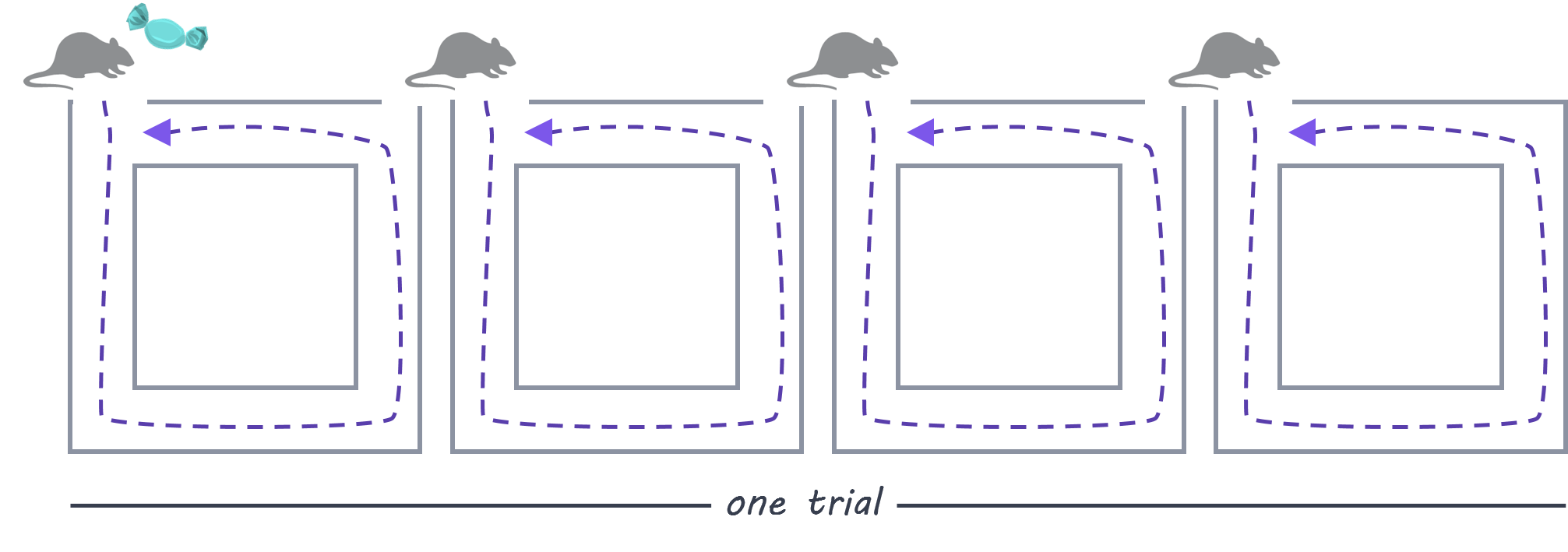
The authors trained mice to run laps in a square maze. Before running the first lap, mice received a reward (a sugar pellet) in a reward box attached to the maze. After running four laps, the mice once again received a reward. Therefore, four laps were treated as one trial, with the reward marking the transition between trials. 

The authors injected an adeno-associated viral vector encoding the calcium indicator GCaMP6F into layer CA1 of the dorsal hippocampus (dCA1) of Wfs1-cre transgenic mice. Throughout the study, they used a microendoscope positioned over dCA1 to measure calcium activity in freely behaving mice. Because dCA1 neurons are known to respond to a variety of situations and behaviours, the authors fit a linear regression model (with regressors for 1) spatial location, 2) head direction and 3) running speed) to the activity of each neuron. They then subtracted the model-explained calcium activity from raw calcium activity. The result of this subtraction (the ‘model-corrected calcium activity’) effectively reflected the activity of dCA1 neurons while minimizing the effect of the three regressors. 

What did they find?

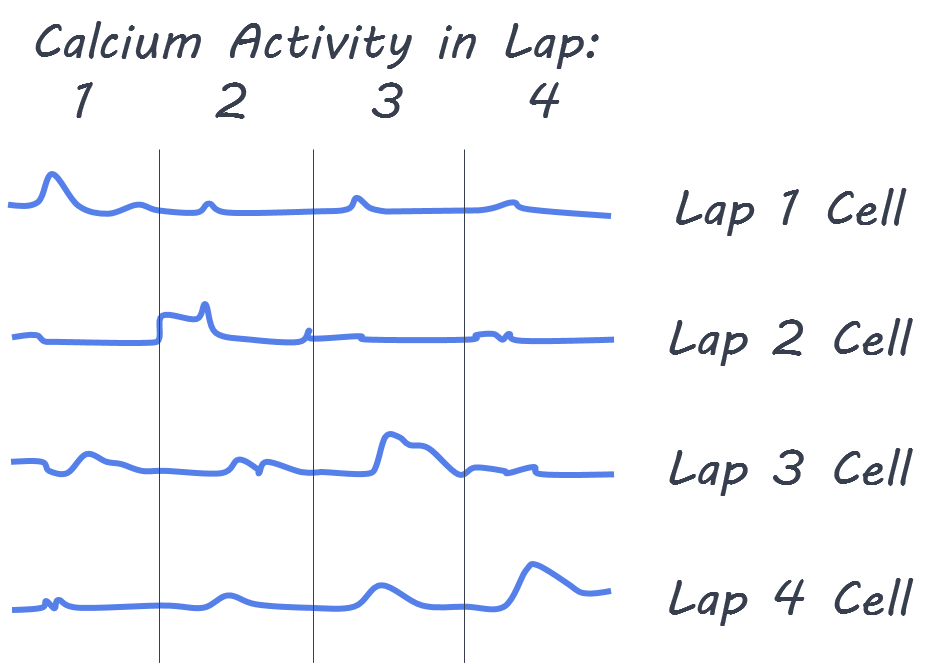
The authors found a subset of dCA1 neurons (~30%) that exhibited an increase in calcium activity during one of the four identical laps. This phenomenon was called event-specific rate remapping (ESR). If a reward was delivered at the outset of every lap instead of every fourth lap, the number of these lap-modulated ESR cells decreased significantly. ESR activity within individual neurons was preserved across days - the correlation between the ESR activity profiles (which were model-corrected) for day 1 and day 2 was significantly higher than chance (i.e., compared to shuffled data). To investigate whether cells were simply tracking time elapsed or distance traveled, they engineered a variation of the experiment that involved two versions of the maze: the original shorter square track and an elongated rectangular track. Under various combinations of track length per trial (e.g., short, short, long, long), they still observed ESR correlation values (across different track length trial types) that were higher than chance. This result provides support in favor of the view that these lap-modulated neurons are responding to laps as fundamental events regardless of their length or duration. 

To further test this hypothesis, the authors conducted an experiment in which they used the square maze on day 1 and a circular maze on day 2. Once again, the correlated ESR activity across days remained significantly above chance levels despite place fields (the region in the environment that a spatially selective neuron responds to) remapping to new preferred positions in the circular maze. In another experiment, the authors extended each trial to include 5 laps instead of 4 and found that neurons typically active on the third lap or fourth lap respectively were now active on the fourth or fifth lap respectively.

Due to prior evidence suggesting that the medial entorhinal cortex contributes to the structuring of experience in the hippocampus, the authors decided to optogenetically inhibit medial entorhinal cortex neurons that terminated in dCA1. They found that the ESR activity correlation between light-on (inhibited) and light off trials was reduced to chance levels once these neurons were inhibited, while place field positions remained unaffected. In the final experiment, mice ran on a treadmill in the first arm of the square maze and the authors measured ESR activity during a 12 second period of time (representing a continuous but essentially non-spatial experience). They discovered that there was a lap-modulation effect wherein dCA1 neurons (~20%) exhibited increased activity when mice were walking on the treadmill only on specific laps. 

Cody_pic2.png

What’s the impact?

These data provide evidence that spatial representations and event representations are jointly expressed in individual hippocampal cells, yet these representations are dissociable from one another: one can have persistent event representations despite place field remapping (e.g., the circular track experiment) as well as stable spatial representations despite disruption in event-specific rate remapping (e.g., the fifth lap experiment and the entorhinal inhibition experiment). This study marks a step forward in our understanding of how the brain processes continuous experience and segments it into generalized event units.  

Hippocampal neurons represent events as transferable units of experience. Nature Neuroscience, (2020). Access the original scientific publication here.