
The Effects of Exercise on Cognition

Post by Shireen Parimoo

What's the science?

Exercise has a positive impact not only on our physical health but also our mental health and cognitive abilities. For example, exercise might protect against cognitive decline in older age and may be an effective treatment option for major depressive disorder. However, research on the cognitive benefits of exercise is not always clear-cut. Does exercise really enhance cognition in healthy individuals? This week in Nature Human Behavior, Ludyga and colleagues conducted a meta-analysis of previous studies to determine whether exercise has a beneficial effect on cognitive performance.

What do we already know?

Research on this topic is mixed, with some studies reporting positive effects of exercise on cognitive performance and others finding no effect. This is because the results not only vary depending on the type, intensity, duration, and frequency of exercise but also factors like someone’s age and sex. For example, some studies find that endurance exercises like running and swimming are better for cognitive outcomes than strength-based exercises, while other studies suggest that both are equally effective. Similarly, different studies report opposite effects of exercise on men and women, but they differ in the age groups of their participants. As it’s not feasible to include all of these variables in a single experiment, most studies – including previous meta-analyses – only examined a limited number of these variables, making it difficult to draw a definitive conclusion on the topic.

What’s new?

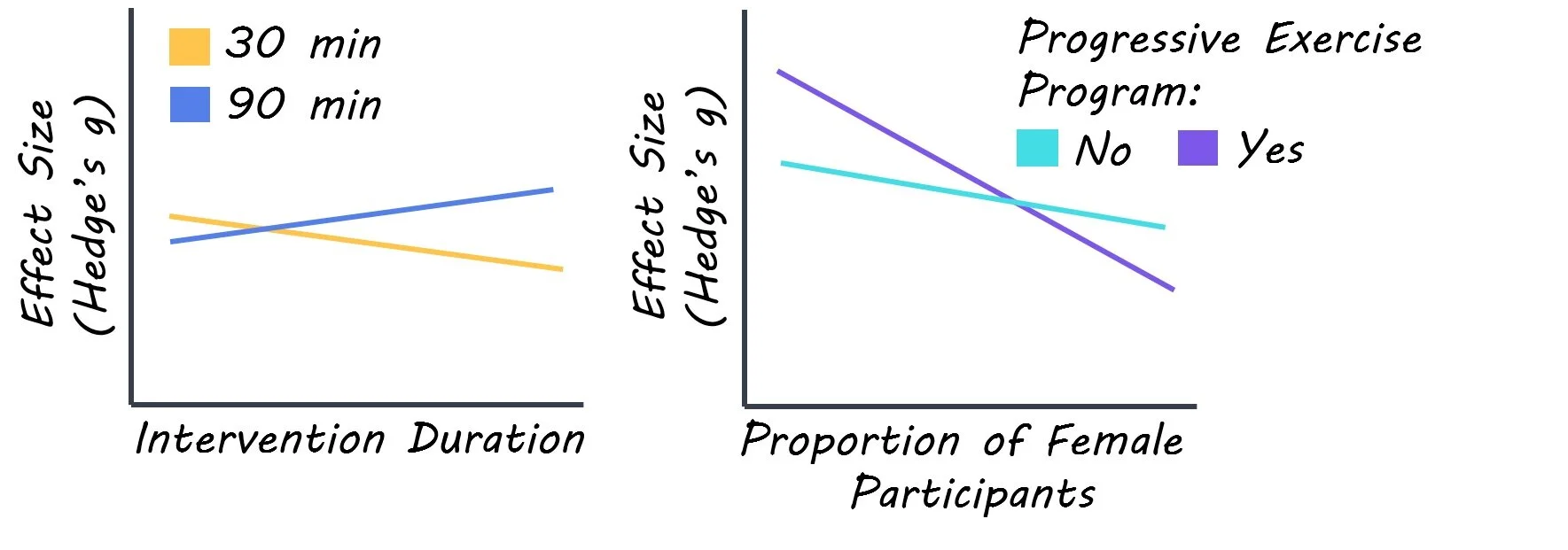
The authors performed a meta-regression on 80 randomized controlled trials and found that overall, exercise had a small effect on cognitive functions like complex attention, executive functioning, and memory. These effects on cognition were similar after different types of exercise, which included endurance, resistance/strength, and coordinative exercises (e.g. dancing). In short-term exercise programs, short exercise sessions (e.g. 30min) were found to enhance cognitive performance, whereas, in programs lasting longer than 5 months, longer sessions (e.g. 60min) had a larger impact on cognition compared to shorter ones. Interestingly, the effects of different types of exercise and intensity varied based on participant characteristics. Women, children, and older adults saw the greatest effects from low intensity and coordinative exercises, which the authors speculate could be because coordinative exercises pose greater demands on cognition and recruit similar brain regions as cognitive tasks. On the other hand, men were more likely than women to benefit from progressive (becoming more intense over time) and high-intensity exercises of all types.
Shireen_pic.jpg

What's the bottom line?

The effect of exercise on cognition depends on many variables ranging from the type of exercise to someone’s age. Overall, exercise is associated with improvements in cognitive function. These findings have important implications for people’s life outcomes, as cognitive abilities are closely related to school and job performance, as well as for future research to further explore the differential relationship between exercise and cognition in different populations.

exercise_quote_Apr7.jpg

Ludyga et al. Systematic review and meta-analysis investigating moderators of long-term effects of exercise on cognition in healthy individuals. Nature Human Behavior (2020). Access the original scientific publication here.
Social Framing Effects in the Brain

Post by Deborah Joye

What's the science?

It’s appealing to believe that our choices and thought processes are based on logical, rational judgment, but much of our thinking is subject to various cognitive biases. One of these cognitive biases is the framing effect, in which an identical situation can be described (framed) in opposing ways. For example, someone is more likely to buy an 80% fat-free yogurt (positive framing) compared to a 20% fat yogurt (negative framing). However, the framing effect can have different outcomes in social situations. When making a non-social decision, like gambling, people tend to make their decisions based on which option is more beneficial for them as an individual. But when making social decisions, people consider how their decision might affect others. Research investigating the brain circuitry underlying framing effects has overwhelmingly focused on non-social tasks. Since social framing results in more complex considerations of how our choices affect others, it is likely that the brain circuitry underlying social framing is different from non-social framing. This week in The Journal of Neuroscience, Liu and colleagues use a social framing task combined with brain imaging and neural manipulation to demonstrate that the activation of the right temporoparietal junction specifically underlies the social framing effect and does not impact non-social framing.

How did they do it?

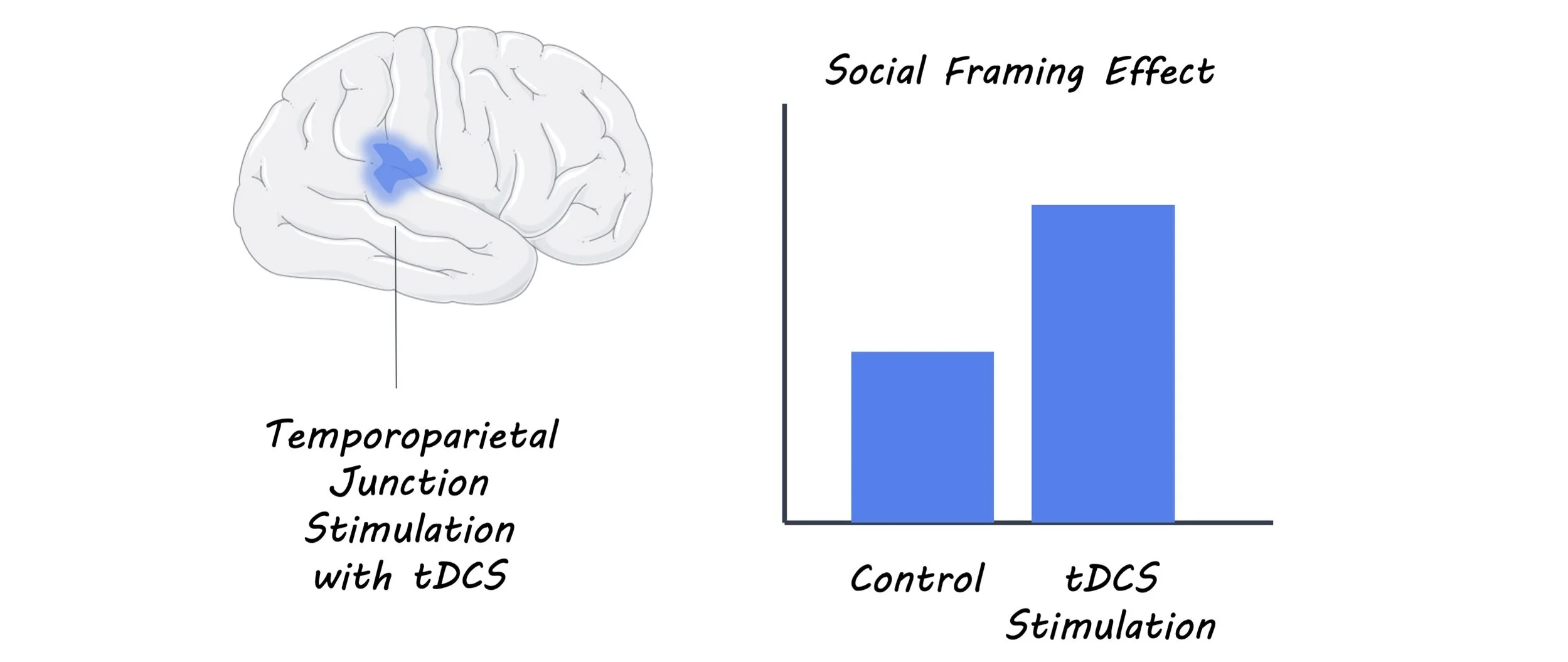
The authors first recruited 33 participants to undergo their novel behavioral task where they were asked to either “not harm” or “help” another person. The actual situation was always the same but the wording differed. In the “Harm frame” participants had to decide between a “harm” option or a “not harm” option which would cost them a small amount of money. In the “Help frame” participants had to decide between a “not help” option, or a “help” option, which would cost them a small amount of money. Participants performed this task in a functional magnetic resonance imaging machine (fMRI) so that the authors could investigate which brain regions showed activity connected with performance on the task. After they determined brain regions of interest, the authors recruited 60 new participants to undergo transcranial direct current stimulation (tDCS). This technique can increase or decrease neuronal excitability within brain regions, allowing them to test whether turning a region “on” or “off” affected performance in a behavioral task. The authors then manipulated neural activity during both a social and a non-social task to determine whether the regions of interest were involved with a specific task type.

What did they find?

The authors found that participants were much more likely to pay to “not harm” a fellow participant than they were to “help” them, demonstrating that this task had a strong social framing effect. Several brain regions were active during this task, but the right temporoparietal junction was strongly activated during both Help and Harm frames, leading the researchers to focus on this region specifically. Interestingly, regions typically associated with non-social tasks, including the amygdala and the anterior cingulate cortex were not activated by this task. The authors also found that the right temporoparietal junction showed functional connectivity to the medial prefrontal cortex, and the strength of that connection predicted how strongly participants were affected by the social framing. The authors then tested whether manipulation of right temporoparietal junction activity with tDCS could change how participants performed on social and non-social framing tasks. They found that when the right temporoparietal junction was excited, the social framing effect was significantly increased relative to sham stimulation. Interestingly, they also found that the framing effect was decreased when the right temporoparietal junction was inhibited. Importantly, neither excitation nor inhibition of the right temporoparietal junction altered performance on a non-social framing task, suggesting that this region may be specific to social framing.

social_framing_Apr7.jpg

What's the impact?

This study reveals that the neural circuitry underlying social and non-social decision-making is different. Specifically, the right temporoparietal junction and its connectivity to the medial prefrontal cortex contribute significantly to the social framing effect but manipulation of this region does impact non-social framing effects. These findings are important because a deeper understanding of the differences between social and non-social decisions and how the brain processes them could increase understanding of how to enhance prosocial behavior

Liu et al., The Neural Mechanism of the Social Framing Effect: Evidence from fMRI and tDCS Studies, Journal of Neuroscience (2020). Access the original scientific publication here.
Learning Involves Flexibly Switching Between Imitation and Emulation Strategies

Post by Shireen Parimoo

What's the science?

Much of learning occurs through observation. Children learn how to act and interact with objects by watching their parents, while adults observe others to figure out how to act in an unfamiliar situation. Two observational learning strategies include imitation and emulation, which are beneficial under different circumstances. In choice imitation, an individual’s choices are based on simply copying someone else's previous actions, whereas emulation involved inferring the goals and intentions of others.  How one learning strategy is selected over the other, and the mechanism that supports this selection process remains unknown. This week in Neuron, Charpentier, and colleagues used fMRI and computational modeling to determine when and how the imitation and emulation strategies are selected during observational learning, as well as the neural signatures associated with each strategy.

How did they do it?

Across two studies, participants completed an observational learning task with the goal of choosing a slot machine to obtain a valuable token. There were three slot machines and three tokens (red, blue, green), and the slot machines dispensed tokens with certain probabilities (e.g. 75% red, 20% green, 5% blue). Participants were told that the valuable token would switch throughout the task but were not told which token was valuable. Instead, they had to learn this by watching a partner who was aware of the valuable token play (“observe” trials) and use this knowledge to choose the slot machine on their turn (“play” trials). The authors manipulated how frequently the valuable token changed (1 = low volatility, 5 = high volatility), as well as the probability distribution of getting the tokens from each slot machine (high or low certainty). The authors assessed when participants’ choices were guided by their partner’s past actions (suggesting choice imitation strategy) or by inferring which token was valuable from the partner’s choice (suggesting emulation strategy).

To determine how learning strategies were selected, they tested a series of computational models, including emulation and imitation models, as well as an arbitration model - a model that involves comparing both learning strategies and selecting the best one at a given point in time. The single-strategy models were based on choosing the action that was most recently selected by the partner (imitation model) or updating the probability that each token is valuable given the partner’s choice (emulation model). The arbitration model computed the reliability of emulation; when high, emulation was assigned a higher weight, and when low, imitation became more likely. The models were then compared with each other to identify which one predicted behavior. Finally, the authors examined neural activity associated with emulation and imitation when observing the partner's choice (this is when learning occurs), and the arbitration signal. 

What did they find?

Participants used both the choice imitation and emulation strategies to make decisions. The emulation model only predicted choices that were driven by token value, which was common when uncertainty about the slot machine’s token distribution probability was low. On the other hand, the imitation model only predicted imitation-guided choices, and this strategy was preferred under uncertain but low volatility conditions (i.e. the valuable token was not likely to change). The arbitration model was most successful in predicting behavior associated with both learning strategies. Specifically, emulation was selected under volatile and certain conditions, while imitation of the partner’s most recent choice was preferred when emulation was not reliable. These results show that people adaptively use both imitation and emulation strategies under different conditions during observational learning.

arbitration_img_March31.jpg

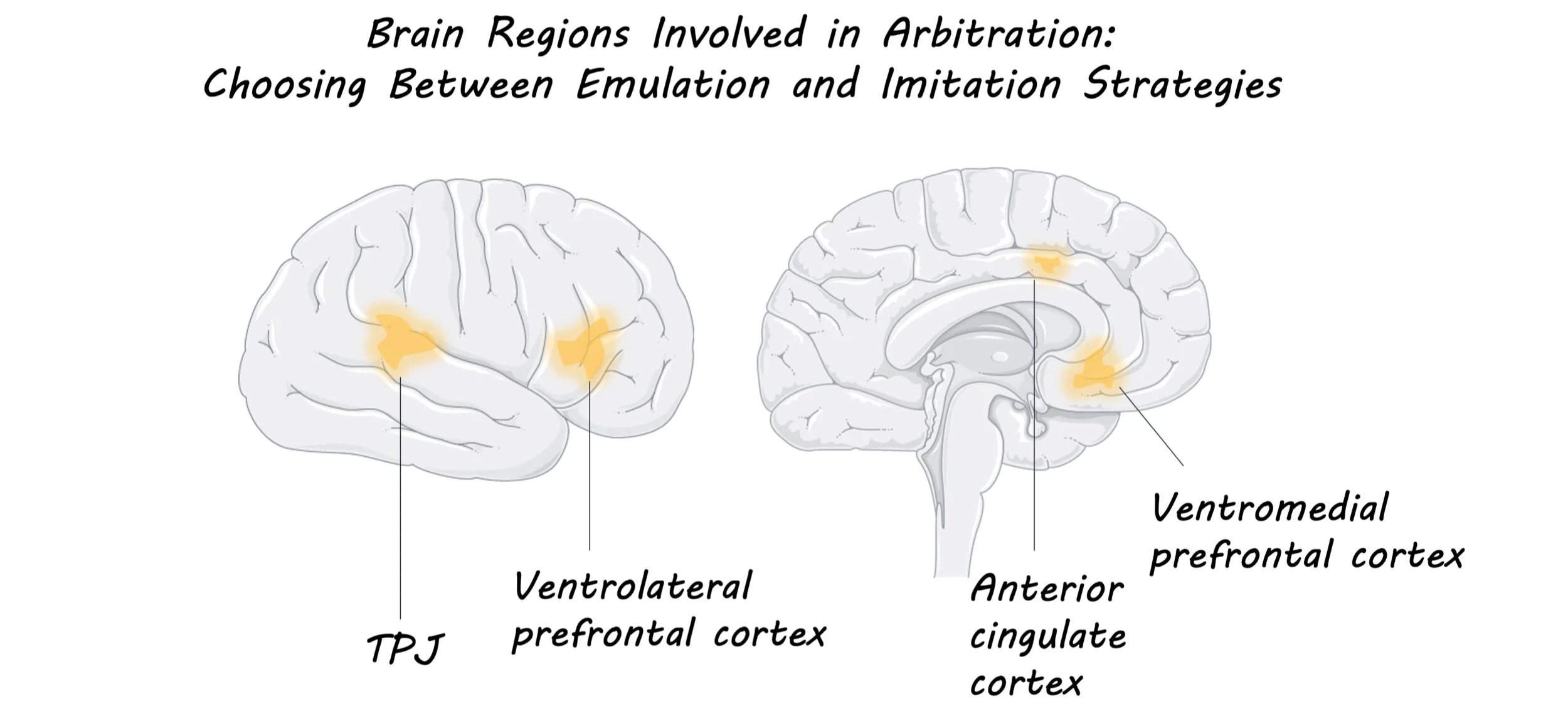
Emulation activated regions of the mentalizing network, including the dorsomedial prefrontal cortex, insula, and the temporoparietal junction, while activity in motor regions like the pre-supplementary motor area and the motor cortex was observed during imitation. These neural signals likely reflect updating of token values (emulation) or of the preferred slot machine choice (imitation) based on the partner’s actions. Finally, activation of cognitive control areas, such as the ventrolateral prefrontal cortex and the anterior cingulate cortex, was associated with arbitration between the two learning strategies.

What's the impact?

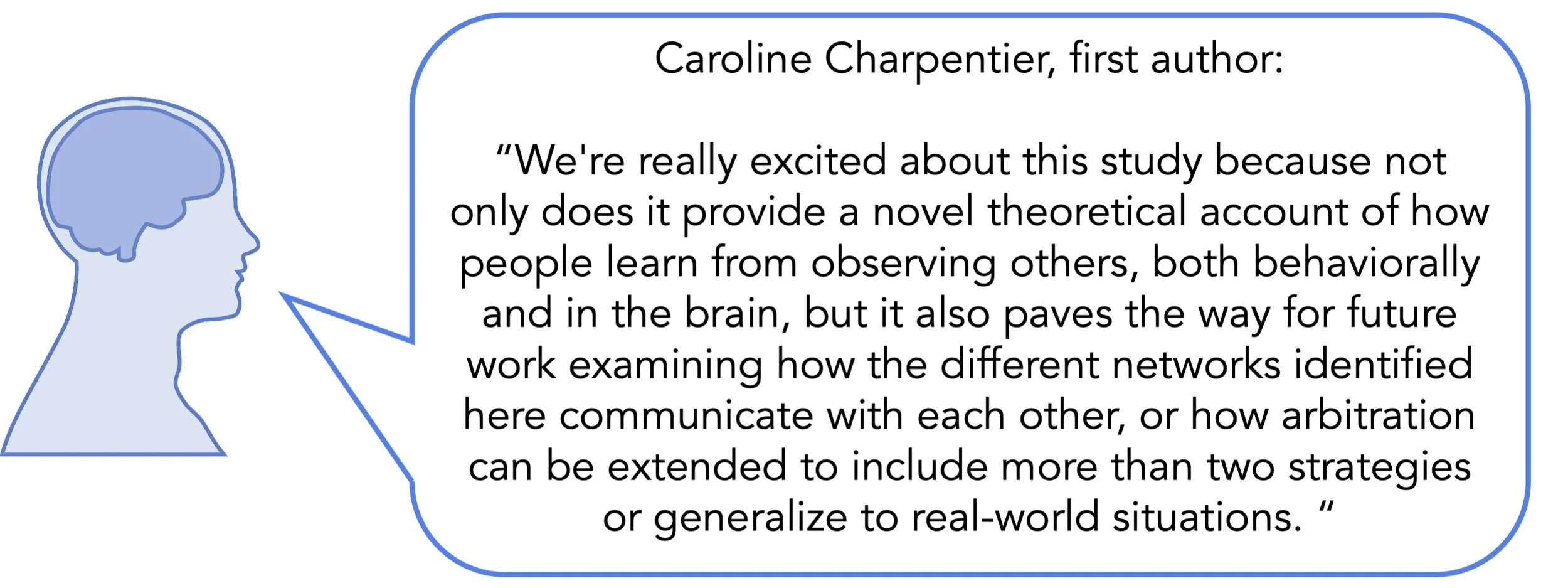
This is the first study to demonstrate that flexible arbitration between the emulation of others’ goals and imitation of others’ actions occurs during observational learning. The authors further showed that distinct brain networks are recruited for imitation and emulation, while regions previously implicated in cognitive control support arbitration between the two strategies. These findings pave the way for future research on how arbitration between these learning strategies changes in development.

arbitration_quote_March31.jpg

Charpentier et al. A neuro-computational account of arbitration between choice imitation and goal emulation during human observational learning. Neuron (2020). Access the original scientific publication here.