
Genes Associated with Alzheimer’s Disease Show Accelerated Evolution

Post by Amanda McFarlan

What's the science?

Alzheimer’s disease (AD) is a neurodegenerative disorder that is characterized by the presence of amyloid-beta plaques and neurofibrillary tangles in the brain. The development of AD is specific to humans —even non-human primates cannot develop a complete form of AD— which suggests that there may be an evolutionary component to the disease. Yet, there is very little information on the evolutionary age of AD-associated genes. This week in Molecular Psychiatry, Nitsche and colleagues used genome-wide RNA profiling to analyze the conservation of both protein-coding and non-protein-coding RNA transcripts associated with AD. 

How did they do it?

The authors collected post-mortem brain tissue from 17 people with AD and 19 healthy controls who had no history of neurological disease. To establish their genome-wide RNA profile of AD-associated protein transcripts, the authors used genome tiling arrays, along with a custom array approach that allowed for the inclusion of computationally predicted gene loci and gene expression. They compared the brain tissue from individuals with AD and healthy controls to identify any differences in the expression of coding-RNAs and non-coding-RNAs. Next, the authors investigated the evolutionary conservation of these coding- and non-coding-RNAs by analyzing splice sites (regions where RNA splicing takes place) across 18 different vertebrates. As part of their analysis, they first identified whether a gene was present or absent across the different species to determine its evolutionary origin. Then, they determined whether the exact intron-exon structure of a gene was conserved since structural changes in a gene are likely to lead to functional changes as well.

What did they find?

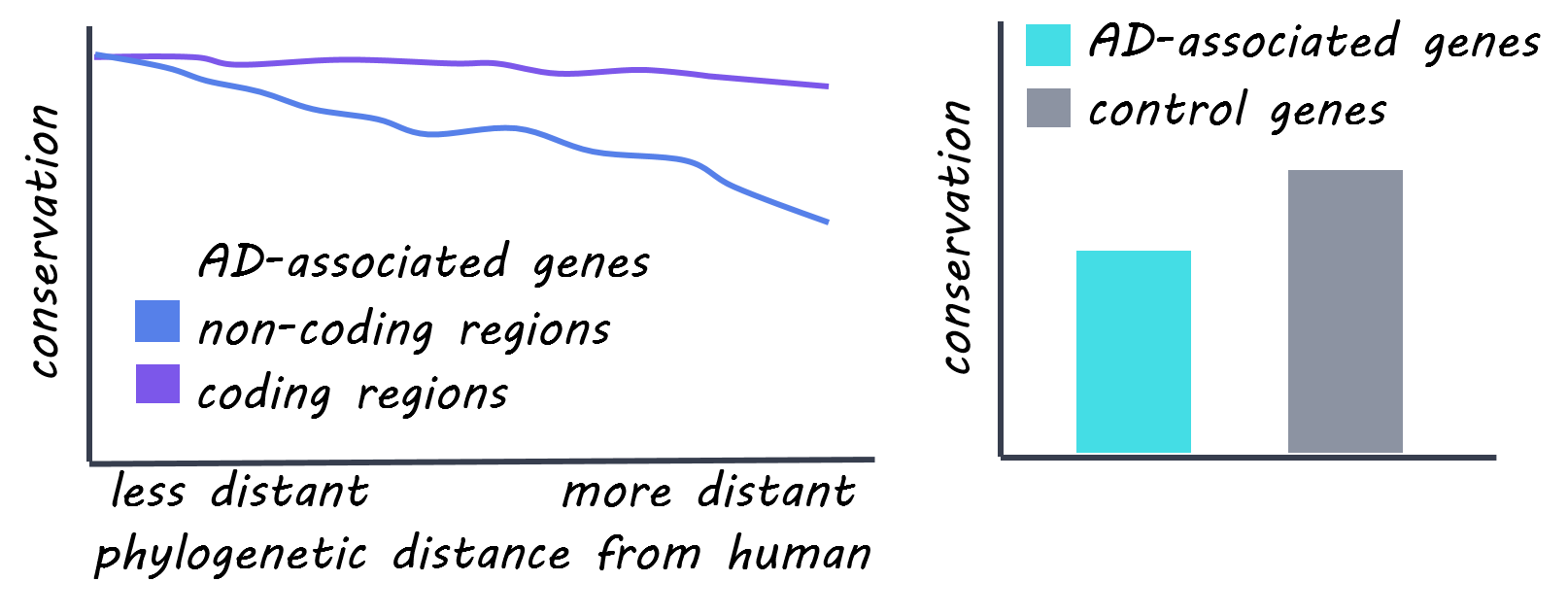
The authors identified 154 coding-RNAs and 141 non-coding-RNAs that showed differences in gene expression between individuals with AD and healthy controls. Next, the authors determined that there was no difference in the conservation rate between AD-associated protein-coding genes and all protein-coding genes, suggesting that AD-associated protein-coding genes are evolutionarily conserved. Conversely, they found that the conservation rate of AD-associated non-coding RNAs decreased over time, suggesting that these genes were not well conserved and evolved quickly. Moreover, the authors determined that the exact intron-exon gene structure was not as well conserved in AD-associated non-coding-RNAs compared to non-coding-RNAs in general, suggesting that the evolution of gene structure for AD-associated non-coding-RNA has occurred at an accelerated rate.
amanda.png

What’s the impact?

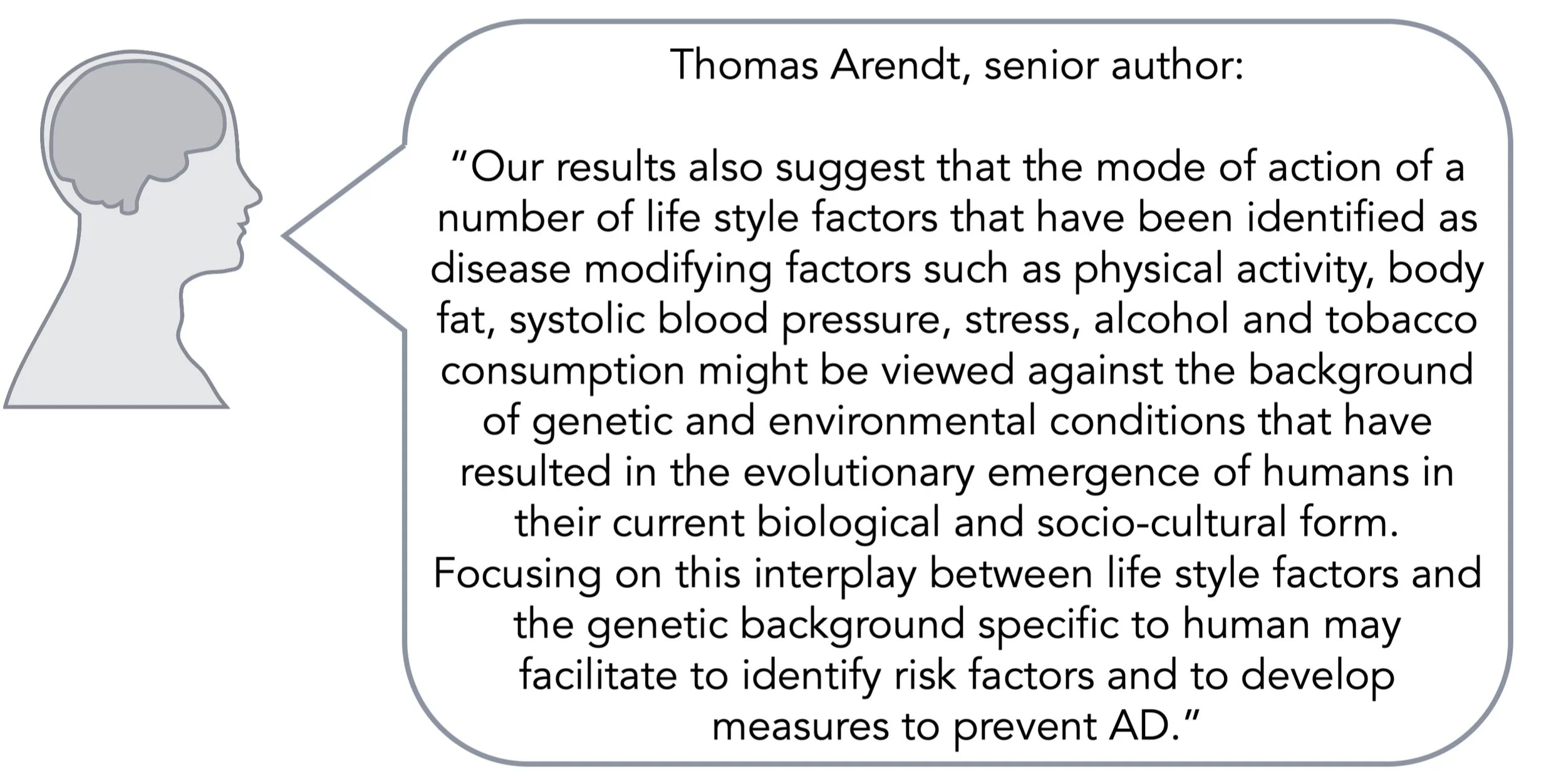
This is the first study to show that AD-associated genes have evolved at an accelerated rate compared to the genome at large. Notably, the authors revealed that AD-associated non-coding-RNAs, but not coding-RNAs, were poorly conserved throughout evolution, suggesting that these genes that may play an important role in AD. In all, this research has shed light on how a phylogenetic approach to studying AD may help to shed light on the mechanisms involved in the progression of AD. 
AD_quote_March31.jpg

Nitsche et al. Alzheimer-related genes show accelerated evolution. Molecular Pyschiatry (2020). Access the original scientific publication here.
Dynamics of Recovery from Anesthesia-Induced Unconsciousness

Post by Stephanie Williams

What's the science?

Many research groups have attempted to understand how anesthetics alter local and global neural activity during the loss and recovery of consciousness. Significant progress has been made in understanding how the brain changes during a loss of consciousness, but the relationship between dynamics that occur during anesthesia-induced loss of consciousness and during the recovery from anesthesia-induced unconsciousness is not well understood. This week in Brain, Patel, and colleagues recorded neural activity from primate cortex to characterize the dynamics that distinguish recovery from propofol-induced unconsciousness from loss of propofol-induced unconsciousness. 

How did they do it?                             

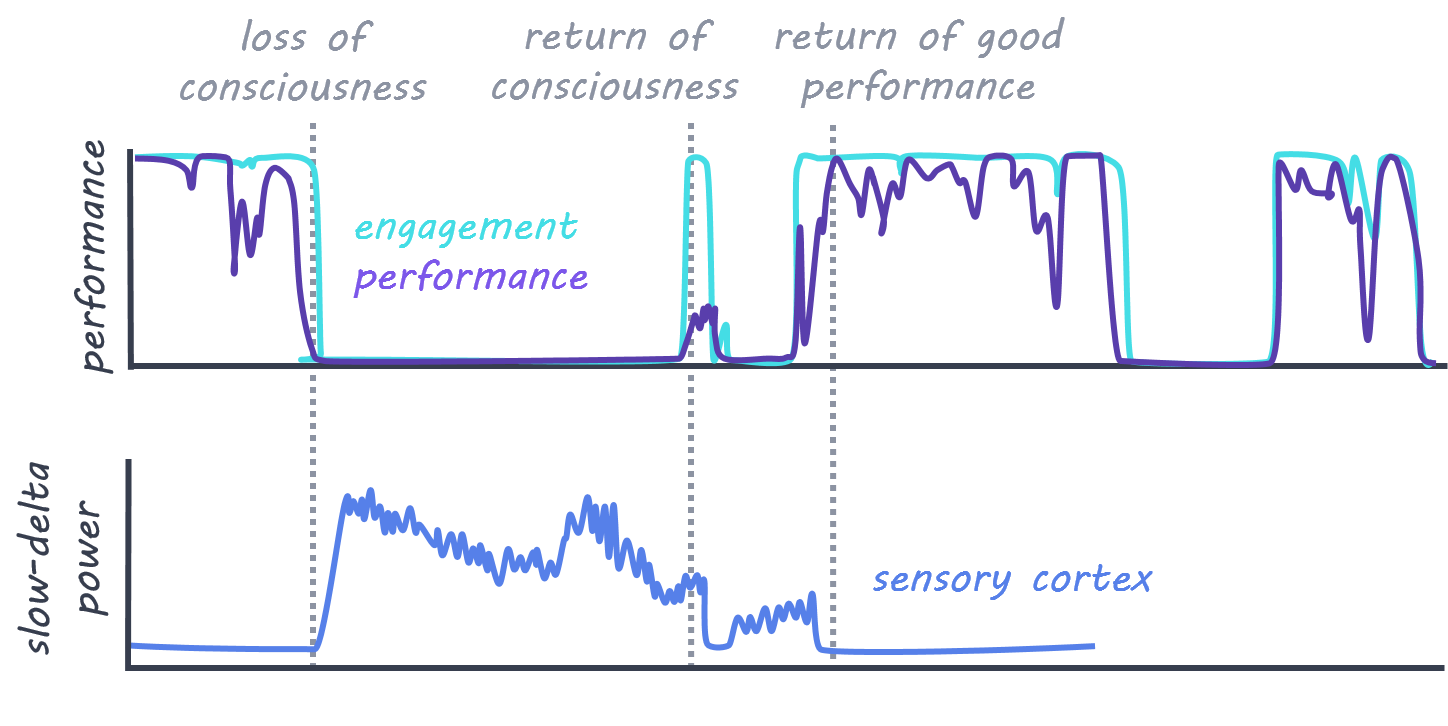
The authors recorded neural activity from the primary somatosensory cortex, secondary somatosensory cortex, and ventral premotor area of 2 adult male monkeys during the induction, maintenance, and cessation of propofol anesthesia. The authors designed a task that required 1) a behavioral response from the monkeys, and also consisted of 2) multisensory stimulation that did not require a response. The monkeys were required to press a button within 1.5 seconds of hearing a sound, and keep their hand on the button until the end of the trial in order to receive a juice reward. During the task, the authors randomly presented sound stimuli or a combination of sound and air-puff stimuli. The button press portion of the task allowed the authors to track behavioral state (as monkeys lost, and then subsequently recovered, consciousness). The sensory stimulation portion (sound, air puff) allowed the authors to track neural dynamics in response to sensory stimulation across all behavioral states, The authors focused on two behavioral metrics: 1) the monkey’s task engagement — whether the monkey made any attempt to initiate a response during a trial even if it was incorrect, and 2) the monkey’s task performance — the probability of a correct response. Separating these two behavioral endpoints allowed the authors to distinguish both whether the monkey was conscious and whether the monkey was performing the task well.

After the monkey had performed the task, the authors began a propofol infusion and recorded local field potentials and spiking activity. They also performed a series of spectral analyses to understand how power at different frequencies changed as the animals transitioned between different behavioral states. The authors performed clustering analyses on the local field potential data - they analyzed the velocity of the transition between different clusters to understand state transitions. Next, the authors investigated how communication between brain regions changed as the animals regained consciousness by calculating local and regional coherence. The authors analyzed single neuron responses across different stages of consciousness from 1) neurons that responded to both air puffs and sound with increased firing rates, 2) neurons that responded to air puffs and sound with decreased firing rates, 3) neurons that only responded to air puffs and 4) neurons that only responded to sound. 

What did they find? 

As the monkeys regained consciousness, the authors observed an abrupt shift marked by increases in beta oscillations and disruptions in slow-delta oscillations in the somatosensory and premotor cortex. Clustering analysis showed two distinct high-density clusters and a high-velocity transition between the clusters. The clusters, which corresponded to anesthesia and wakefulness, were distinguishable by the level of the monkey’s task engagement.  Coherence analysis revealed that beta oscillations were immediately coherent both locally and inter-regionally when the animals regained consciousness and began performing the task again. The authors observed that interregional coherence significantly increased in power as the animals transitioned to a behavioral state in which they were performing the task at a pre-anesthesia level. 

stephanie.png

The average neuronal firing rate decreased during the propofol anesthesia and began increasing again after the end of the propofol infusion, consistent with previous reports. The recovery of firing rates tended to differ between the regions the authors recorded. Recovery of firing rate in ventral premotor area neurons preceded recovery in somatosensory areas, suggesting that there are region-specific firing responses during changes in consciousness. When the authors analyzed the response of individual neurons to puffs of air or noises across different behavioral states, they found that neurons that had previously responded to puffs of air continued to do so. In contrast, neurons that had previously responded to sounds no longer showed a significant response. The authors found the recovery of single-neuron responses to the pre-anesthesia baseline as correlated with behavioral performance recovery, not simply the duration of the recovery time. 

What's the impact?

This study characterizes the neural dynamics of recovery from propofol induced-unconsciousness and complements our understanding of how local field potentials and single neural dynamics relate to specific behavioral endpoints. Importantly, the authors suggest the changes that occur during the recovery of consciousness are not merely an inverse of the change that occurs during the loss of consciousness, and instead can be described as an abrupt shift of dynamics that include the return of inter-regionally coherent beta oscillations.

Patel et al. Dynamics of Recovery from Anesthesia-Induced Unconsciousness Across Primate Neocortex. Brain. (2020). Access the original scientific publication here. 
Your Brain on YouTube: Predicting Clicks and Watch Times with Neural Data

Post by Anastasia Sares 

What's the science?

With the advent of the internet and social media, many barriers to communication are broken down. This means that we can access all kinds of content almost instantaneously; however, there is more information than we can ever hope to digest. Each person must choose how they will spend their time and which voices they will listen to. The competition is fierce: from Instagram influencers to national news to companies running ads. This is known as an attention market. Many people would like to predict how users will engage with different types of content, and some are turning to the brain for clues. This week in Proceedings of the National Academy of Sciences (PNAS), Tong and colleagues used functional MRI (fMRI) to examine Youtube video engagement. 

How did they do it?

The authors used videos from the Youtube channels National Geographic, Animal Planet, and Discovery, whose usage data was publicly available. They analyzed the metadata from these videos (number of views, average watch time, etc.) and they also had a group of participants rate the thumbnails of these videos for emotional content.

In a functional magnetic imaging (fMRI) task, the authors selected videos that had the most variability in engagement and emotion ratings. The goal was to have videos that generated a large range of responses. While undergoing fMRI, participants first performed a video selection task, where they viewed the thumbnails of each video and indicated whether they would be interested in watching the video. In a second task, a series of videos was played and the participants could watch as long as they liked, pressing a button if they wanted to skip the video. The goal of the analysis was to see whether brain data from a small group of individuals could predict the number of views and watch time in the general population.

What did they find?

The authors found expected responses in well-known brain areas that deal with emotion and decision-making. Activity at the onset of the video in the nucleus accumbens (an area known for dopamine signaling, learning, and motivation) was positively correlated with viewing frequency and watch time for the videos. On the other hand, a significant decrease in activity in the anterior insula (another region in the evaluation circuit), was correlated with these metrics. Activity in the medial prefrontal cortex over the whole video also predicted watch time in the fMRI sample but failed to predict online behavior. In some cases, neural activity was a better predictor of the video’s online performance than ratings from people explicitly evaluating engagement. 

attention_img_Mar24.png

The first two aforementioned brain regions were probably an anticipatory emotional response, reflecting the viewer’s expectations and excitement about watching the video. The final region (medial prefrontal cortex) was involved in the ongoing evaluation of the video to see whether it lived up to these expectations. In the case of videos, the anticipatory effect seemed to be the most robust in predicting online engagement. 

What's the impact?

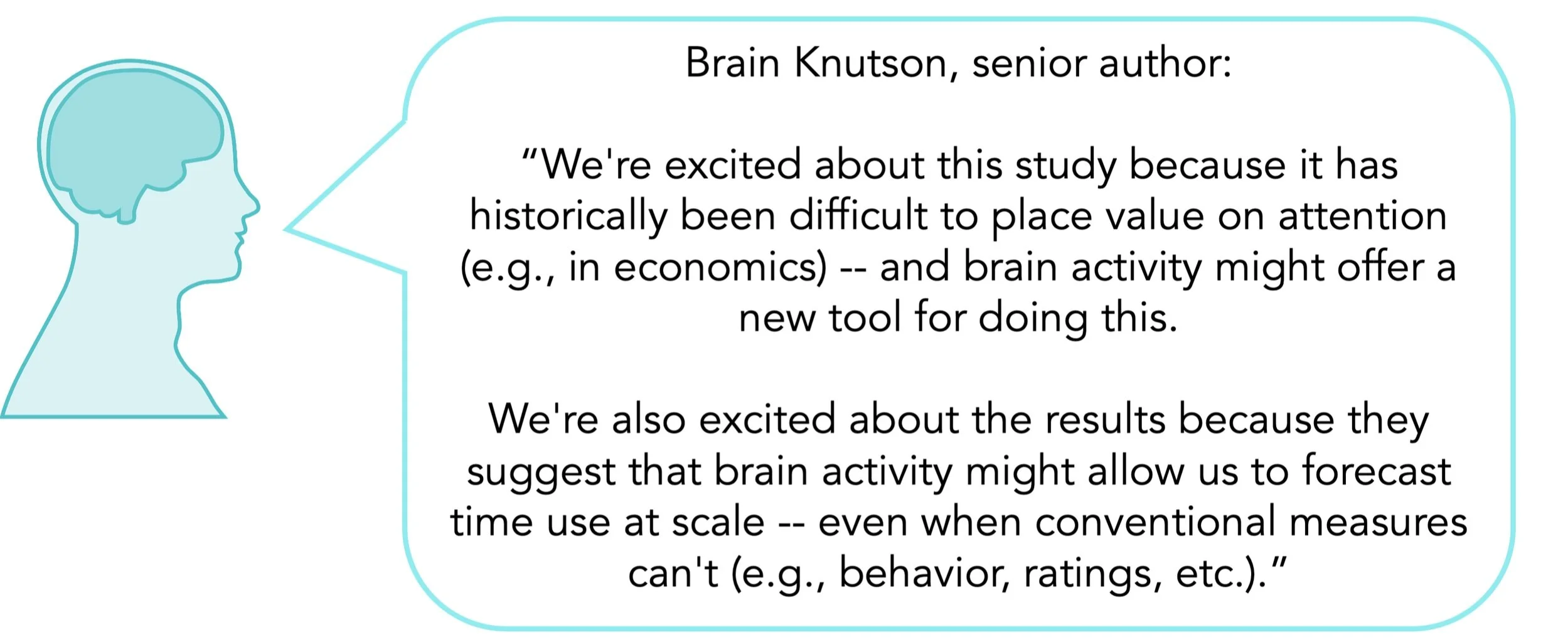
Understanding and using neural data may help people predict what kinds of content will go viral, among other applications. Although fMRI is very expensive, some groups may find it worth the price to gain an edge in a fiercely competitive attention market. Of course, ethics are important— the way in which this information is leveraged is up to us, and it can be used to have both positive and negative social effects. 

attention_quote_Mar24.jpg

Tong et al. Brain activity forecasts video engagement in an internet attention market. Proceedings of the National Academy of Sciences (2020). Access the original scientific publication here.