Dopamine Increases Our Sensitivity to Benefits

Post by D. Chloe Chung

What's the science?

We tend to avoid certain tasks that require too much work because our brain thinks that the costs of completing them will outweigh the benefits that we will receive. The neurotransmitter dopamine has been reported to mediate this process of comparing the costs and the benefits of cognitive work. Indeed, the brain-stimulating drug methylphenidate (or Ritalin) that is commonly used to treat attention-deficit/hyperactivity disorder (ADHD), increases the amount of dopamine in our synapses by preventing its reuptake. However, it’s still not well understood exactly whether dopamine increases willingness to expend cognitive effort or, if so, how. This week in Science, Westbrook, and colleagues show that dopamine increases our willingness to execute cognitively demanding tasks by increasing our sensitivity to their benefits.

How did they do it?

The authors recruited 50 healthy young adults and used positron emission tomography (PET) to measure the rate at which neurons synthesize dopamine in the brain, specifically in the striatum where dopamine is abundantly released. Next, the participants were asked to choose between a more difficult task that comes with a higher monetary reward and an easier task with a smaller reward. During this test, their eye movements were tracked to find out what components on the test screen they pay the most visual attention to the difficulty level of tasks (costs) or the amount of money they will receive upon task completion (benefits). This way, the authors were able to make connections between dopamine levels and what participants were most attentive to. The authors also wanted to understand how changing the dopamine level in the brain can impact people’s decisions to perform difficult tasks. To test this, participants received either dopamine-boosting drugs or a placebo while taking this test multiple times. Neither authors nor participants knew which drug was given at the time of these tests.

What did they find?

The authors first found that participants were more likely to avoid tasks the more cognitively challenging they were and in participants who synthesized dopamine more slowly. Interestingly, participants with a low dopamine level became more eager to perform difficult cognitive tasks when they received dopamine-enhancing drugs, showing that it’s possible to motivate people to do more cognitive work by manipulating dopamine levels. Based on a computer simulation, a higher dopamine level was predicted to make participants become more sensitive to the benefits and less sensitive to the costs of cognitive tasks. This prediction was proven to be correct, as participants with a high base level of dopamine and those whose dopamine level was increased with the drugs both showed higher sensitivity to the task benefits and lower sensitivity to the costs. Also, when participants paid more attention to benefits versus costs, they were more likely to choose to perform challenging tasks, suggesting that greater attention to benefits increases motivation. Importantly, this effect was amplified in individuals with higher dopamine levels, whether the high levels were present at baseline or only after drug administration, again highlighting the important role of dopamine in sensitizing our brain to benefits.

cost_benefit_img_Mar24.jpg

What’s the impact?

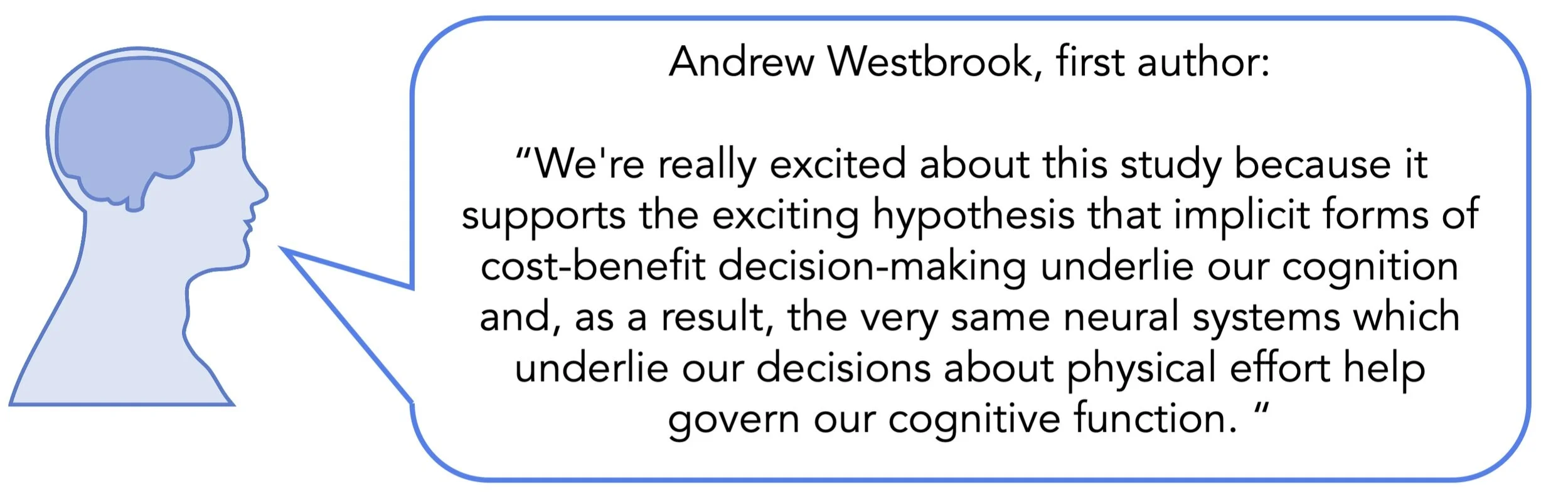
In this study, the authors show the first evidence that dopamine can motivate us to do difficult cognitive work by increasing the effects of benefits versus costs. Their findings suggest that dopamine-enhancing medications like Ritalin, which is often misused to improve focus while studying among students, exert their effects by increasing our willingness to invest cognitive efforts, rather than by making us “smarter”. Importantly, however, the effect seems to be restricted to people with low dopamine levels at baseline - those with high levels weren't helped and there was even some evidence that things got worse. This study will also help to inform future research on dopamine modulation in ADHD and other neurological disorders with impaired cognitive motivation, such as Parkinson’s disease.
cost_benefit_quote_Mar24.jpg

Westbrook et al. Dopamine promotes cognitive effort by biasing the benefits versus costs of cognitive work (2020). Access the original scientific publication here.
One Memory Engram, Two Functionally Distinct Neuronal Populations

Post by Elisa Guma

What's the science?

Engrams are defined as biological changes that take place in the brain to encode specific experiences or memories. Each engram is thought to be made up of a sparse population of neurons that is activated by specific learning experiences, with long-lasting synaptic modifications. However, it is unclear whether there is functional heterogeneity within each memory engram, and whether separate neuronal populations encode distinct aspects of memory. This week in Cell, Sun and colleagues present causal evidence to show neurons within a single memory engram are functionally heterogeneous to allow for different aspects of the memory to be individually represented and regulated.

How did they do it?

Mice underwent contextual fear conditioning: first, they were exposed to foot shocks (fear stimulus) in context A. 24 h later, they were exposed to either 1) the conditioned context A, 2) unconditioned context B similar to A, or 3) very distinct context C. Using a novel technique called Robust Activity Marking (RAM) the authors identified neuronal ensembles in the fear memory engram by the transcription output of immediate early genes (IEGs) as a proxy for neuronal activity, Fos and Npas4 (F-RAM+ and N-RAM+ neuronal ensembles). To confirm that F-RAM+ and N-RAM+ neurons are dependent on Fos and Npas4 gene expression, the authors knocked out the expression of Fos or Npas4 genes in the dentate gyrus of a separate group of mice prior to fear conditioning. They also used a mouse line (FosTRAP) that expresses a fluorescent protein Fos when neurons are active to show colocalization between Fos expression and F-RAM+ neurons. Further, they characterized the synaptic properties of these two populations using patch-clamp electrophysiology experiments.

To assess differential roles in memory discrimination-generalization, the authors exposed mice to either context A, B, or C 24 hours after fear conditioning and measured F-RAM+ and N-RAM+ neuron activity first by immunostaining of IEGs, then by fiber photometry, which measures calcium signals as a proxy for neuronal activity. To assess their role in memory recall in vivo, the authors then manipulated the activity of these neurons using chemogenetics (designer receptors exclusively activated by designer drugs). To identify which circuit inputs were driving F-RAM+ and N-RAM+ dentate gyrus cells they used electrically, chemogenetically, or optogenetically stimulated axonal fibers of different pathways that synapse onto dentate gyrus neurons while measuring activity of the F-RAM+ and N-RAM+ neurons.

What did they find?

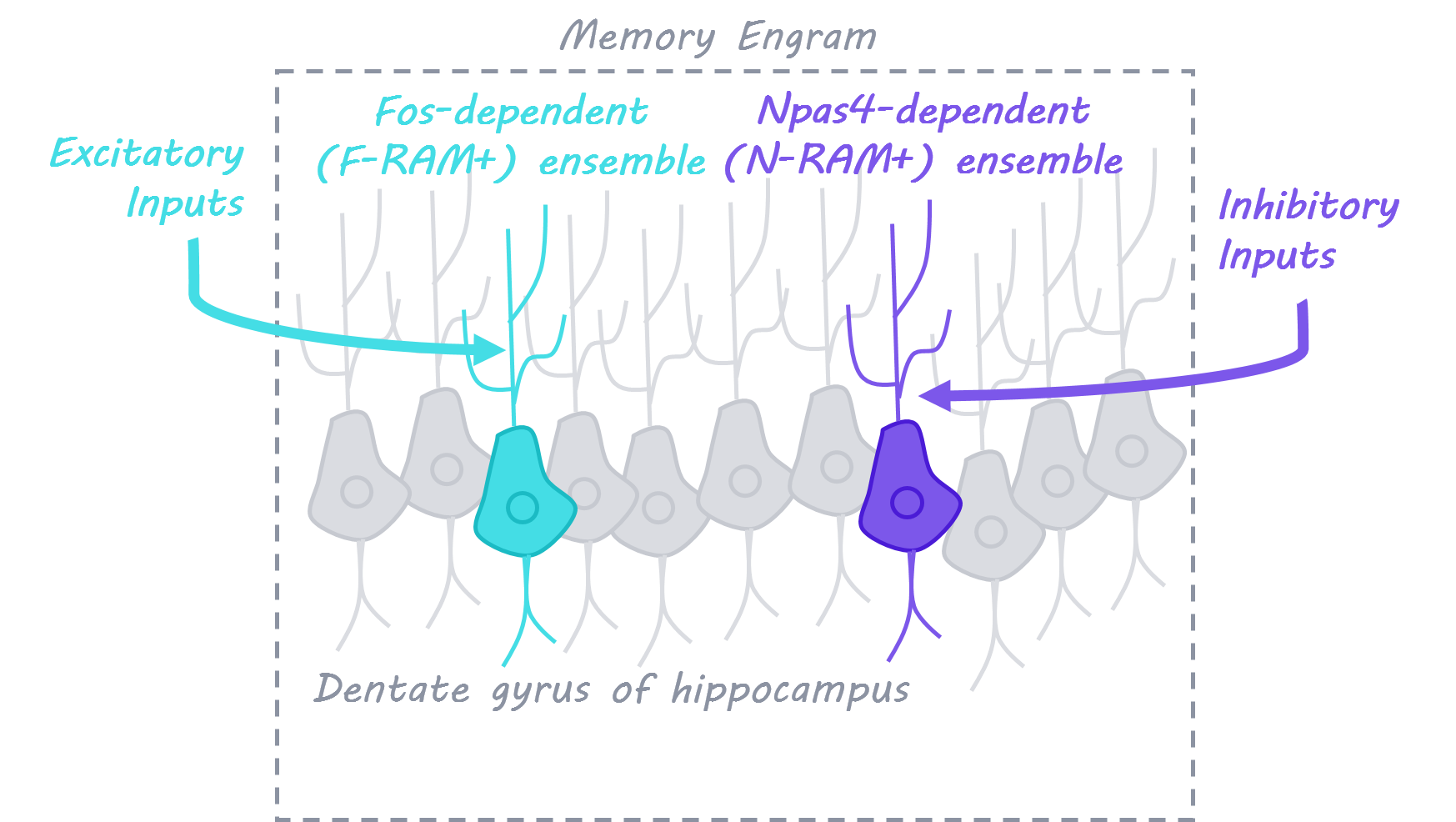
The authors observed distinct identities between the two neuronal ensembles: F-RAM+ neurons received stronger excitatory inputs, whereas N-RAM+ neurons received stronger inhibitory inputs. Selective knockout of Fos and Npas4 inhibited the formation of F-RAM+ and N-RAM+ ensembles, respectively. Further, in the FosTRAP mice there was substantial colocalization and similar electrophysiological properties between Fos positive cells and F-RAM+ neurons, but not the N-RAM+ cells.

The authors observed a similar activation of F-RAM+ neurons (as measured by the number of activated cells and calcium imaging) in both contexts A and B, but less in context C, suggesting that this ensemble is not sensitive to small differences in context and favours memory generalization. N-RAM neurons, however, seemed to play a greater role in memory differentiation in similar contexts as they were significantly less activated in context A than B (and not very activated in context C suggesting they were not responding to novelty). The chemogenetic inhibition of F-RAM+ neurons during recall enhanced the discrimination between contexts A and B, suggesting that memory generalization was impaired. Inhibiting N-RAM reduced memory discrimination between similar contexts A and B, but not between A and C. The authors identified the medial entorhinal cortex to be the main pathway innervating F-RAM+ neurons, and that optogenetic inhibition of this pathway decreased the number Fos+ cells in the dentate gyrus specifically and disrupted memory generalization (enhanced discrimination between context A and B).

Elisa_pic.png

With a combination of optogenetics and pharmacology, they identified cholecystokinin-expression GABAergic neurons as the main inhibitory drivers to N-RAM+ neurons, and that chemogenetic inhibition of these interneurons impaired memory discrimination (by abolishing discrimination between contexts A and B and reduced discrimination between A and C).

What's the impact?

This thorough study presents compelling, causal evidence for the hypothesis that there is functional heterogeneity within the memory engrams. They identify the synaptic and circuit mechanisms used by two different neuronal ensembles associated with the same fear memory and show their roles in regulating the balance between memory discrimination and generalization. This study sheds important light on some important, and previously poorly understood, cellular and circuit mechanisms underlying memory formation, and is the first to provide evidence for heterogeneity within engram neuronal populations.

engram_quote_Mar24.jpg

Sun et al. Functionally distinct neuronal ensembles within the memory engram. Cell (2020). Access the original scientific publication here.
Theta Oscillations in the Orbitofrontal Cortex and Reward Learning

Post by Stephanie Williams

What's the science?

Theta oscillations (brain activity waves at a frequency of 4-8 Hz) have been implicated in a wide range of brain functions, such as memory, exploration, and navigation. Recently, a research study noted increased theta-band power in a brain region called the orbitofrontal cortex during a task that involved reward. However, it remains unclear whether increased power in the theta-band is causally related to reward-guided behaviour. Further, there is a relationship between theta oscillations in the orbitofrontal cortex and theta oscillations in the hippocampus, and this relationship could also play a role in reward-guided behaviour. This week in Neuron, Knudsen, and Wallis used a closed-loop paradigm to disrupt theta activity to demonstrate a causal relationship between hippocampal and orbitofrontal theta activity in rewarded-guided behavior.

How did they do it?                             

The authors recorded local field potentials from two macaque monkeys while the monkeys performed a task. During each task session, the authors presented the monkeys with 3 new pictures that were associated with a probability for a reward. A reward probability was assigned to the pictures such that there was one each of high, medium, and low reward probability. In some trials, the monkeys made choices between two pictures by fixating on their choice, and in other trials, the monkeys saw only one picture. When asked to make a choice, the monkeys tended to choose optimally, choosing the more valuable picture a majority of the time. During a single session, the authors manipulated the reward contingencies for each picture and tracked how well the monkeys were able to update their choices. To investigate the causal relationship between the 4-8 Hz oscillations and task behavior, the authors applied a targeted stimulation paradigm to disrupt the 4-8 Hz oscillations without changing single neuron firing rates. They delivered the stimulation during different parts of the task, and also delivered “de-coupled” stimulation as a control test. They implemented an identical paradigm using information extracted from a different frequency range (13-30 Hz) as another control test. The authors tracked the phase at which each stimulation pulse was delivered, and calculated the corresponding change in power that the pulse evoked. They then looked to see whether the pulse changed behavior during the task. The authors also analyzed the activity of single neurons during stimulation periods to understand why disruption during that epoch might change behavior.  

To understand the relationship between the 4-8 Hz activity in the hippocampus and the 4-8 Hz activity in the orbitofrontal cortex, the authors recorded from both areas and measured the degree to which the phases of the signals in the two regions were aligned. To better understand the directionality of the information flow between the hippocampus and orbitofrontal cortex, the authors computed how well one of the signals could predict the future values of the other signal, a value called generalized partial directed coherence. Finally, the authors stimulated the hippocampus using their closed-loop stimulation paradigm, while recording from both the hippocampus and the orbitofrontal cortex.

What did they find?

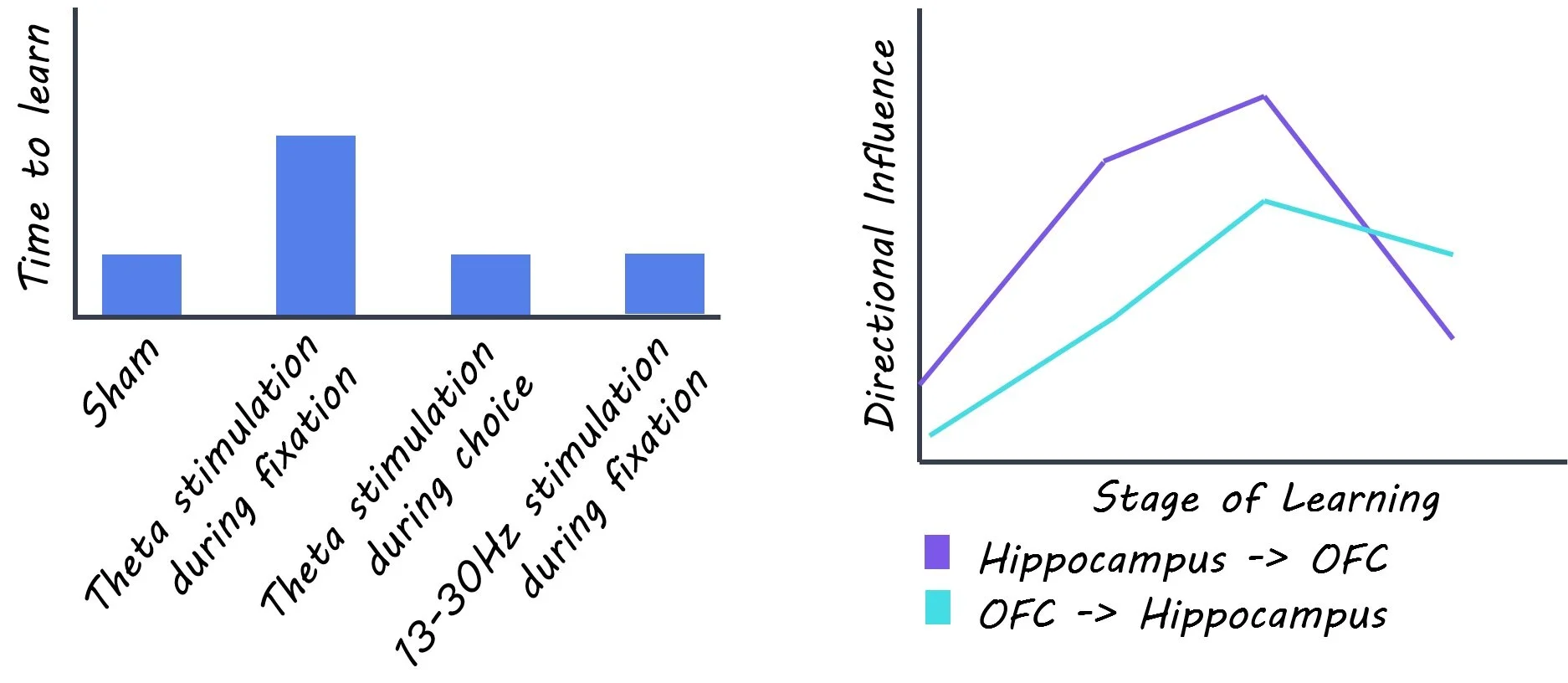
The authors confirmed that there were significant increases in 4-8 Hz power in the orbitofrontal cortex relative to other frequency ranges during major events of the reward task. During the set of stimulation experiments, the authors found that delivering theta stimulation during the fixation epoch of the reward task severely disrupted the monkey’s ability to update their choices. Strikingly, the authors found that a single pulse of microstimulation on a single electrode in the orbitofrontal cortex could disrupt behavior. Stimulation during the choice epoch did not affect the monkey’s learning. When the authors delivered either the decoupled stimulation or the stimulation in the 13-30 Hz range, they found no disruption of the task. These control experiments allowed them to conclude that the behavioral disruption they observed was not a non-specific result of electrical stimulation, but rather is specifically caused by the 4-8 Hz stimulation.

The authors observed a negative relationship between power and phase alignment during theta stimulation, compared to sham stimulation. They found that when they delivered stimulation on the rising cycle of the oscillation, there was an increase in 4-8 Hz power. When they compared the behavioral effects of the pulses delivered at different points in the oscillation cycle, they found that pulses delivered at the positive phase were more disruptive to behavior than those delivered at negative phases. These findings suggest that the phase alimented of the 4-8 Hz oscillations is related to adapting behavior to changing reward contingencies. The authors, therefore, suggest that firing of the orbitofrontal neurons that encode rewards may preferentially occur at a specific phase in the 4-8 Hz oscillation. Analysis of single-unit activity during the stimulation confirmed that the 4-8 Hz stimulation did not change the firing rate of individual neurons. The authors found that half of the single neurons they recorded from fired spikes that were phase-locked to the 4-8 Hz oscillation during the fixation period.

Neuron_pic.jpg

When the authors compared the 4-8 Hz oscillations in the hippocampus and orbitofrontal cortex, they found that there was a strong phase alignment during the fixation period. There were changes in the synchrony of the two regions that matched changes in behavior: when the subjects had to adapt to new reward contingencies and their performance initially dropped, the synchrony between the hippocampus and orbitofrontal cortex decreased. Once the new rules were learned, and the monkeys showed improved performance on the task, the authors observed a corresponding increase in synchrony between the hippocampus and orbitofrontal cortex. The authors found that information primarily flows from the hippocampus to the orbitofrontal cortex and that there is more influence between the two areas during the drift period than during the stable periods in the learning cycle. These results suggest that the hippocampus provides theta input to the orbitofrontal cortex to enable value learning.

What's the impact?

This study used closed-loop microstimulation to show the causal importance of 4-8 Hz oscillations in the orbitofrontal cortex in reward-guided behavior, which in turn depends on hippocampal input. Their findings advance our understanding of how single neurons may encode value during reward tasks, by phase locking to underlying theta rhythms. Future work could build on these findings to develop treatments that apply microstimulation to disrupt maladaptive patterns of activity.

Neuron_quote_March17.jpg

Knudsen and Wallis. Closed-loop Theta Stimulation in the Orbitofrontal Cortex Prevents Reward-Based Learning. Neuron. (2020). Access the original scientific publication here.