Altered Hierarchical Interactions in Visual Processing in Autism Spectrum Disorder

Post by Flora Moujaes

What's the science?

Autism spectrum disorder (ASD) is a neurodevelopmental disorder characterized by difficulties in social communication and interaction, restricted interests and repetitive behaviours. We still don’t fully understand the changes in brain function underlying ASD. There are two basic types of neurotransmission in the brain: excitation and inhibition. One theory that has gained traction in recent years is that ASD involves a higher neural excitation to inhibition ratio, resulting in an increase in neural response. However, findings in the literature have been inconsistent. We know that the brain is organized in a hierarchy of various regions and networks that interact: later processing stages may inherit and build upon earlier (input level) stages, and also influence and shape of earlier stages by top-down modulation. This means that the perceived increase or decrease in neural response in ASD could depend on the stage being measured. This week in The Journal of Neuroscience, Kolodny, and colleagues leverage the well-known hierarchical structure of the visual motion pathway in the brain to examine how fMRI response changes in adjacent stages of processing in ASD.

How did they do it?

The researchers measured sensory-driven fMRI responses in the visual cortex of 24 adults with ASD and 24 demographically matched neurotypical control adults. In the main task, simple visual stimuli were presented to participants during fMRI scanning. Moving stimuli (drift grating stimuli) were presented to the participants in blocks of either low (3%) or high (98%) contrast. Response to the stimuli was measured at two places in the visual cortex: (1) the visual cortex’s primary input region, V1 and (2) the higher-order motion-processing region, the middle temporal area (MT). These two regions were chosen as it is well established that the visual system is hierarchically organized, with information traveling forward from V1 to MT (feedforward projections) as well as backward (feedback projections). Two measures were used to ensure that participants were focusing on the center of the visual stimuli: (1) participants were asked to press a button when a green circle appeared at the center of the visual stimuli, and (2) eye-tracking data was collected so that eye movements could be monitored. A control task involving static non-moving stimuli was also conducted.

What did they find?

Does fMRI response magnitude in participants with ASD vary between adjacent stages of processing in the visual pathway? The researchers found that individuals with ASD showed reduced responses in V1 and increased responses in the MT area. Thus, ASD responses were reduced in a primary visual area but amplified in a subsequent higher-order area. This pattern was stimulus-specific, as V1 responses were reduced for moving stimuli but not for static stimuli.

Is there a relationship between early (V1) and higher order (MT) visual areas? There was a significant negative correlation between V1 and MT response to high contrast stimuli among individuals with ASD. This means that the same participants with lower V1 responses also showed higher MT responses. This could suggest a causal link between the decrease in V1 and the increase MT, and that the observed dissociation in neural response is driven by amplified suppressive feedback from MT to V1.  Is there a relationship between ASD symptom severity and visual cortex response? The researchers found that response magnitudes in both V1 and MT were differentially correlated with autism symptom severity, which suggests that response magnitude in the visual cortex in ASD may be clinically relevant.

ASD_image_March17.jpg

What's the impact?

This is the first study to show a neural response dissociation between the adjacent stages of visual processing in ASD, as fMRI responses were reduced in a primary visual area but amplified in a subsequent higher-order area. This study uncovers a previously unknown cortical network alteration in autism. It also highlights that while neural response magnitude is altered in ASD, this altered response may be increased or decreased depending on the stage of the visual motion pathway. More research is needed to understand how these interactions between regions in the visual motion pathway may relate to the basic excitation/inhibition model of the brain.

ASD_quote_March17.jpg

Kolodny, et al. Response Dissociation in Hierarchical Cortical Circuits: a Unique Feature of Autism Spectrum Disorder. Journal of Neuroscience (2020). Access the original scientific publication here.

Anterior Cingulate Cortex Is Involved in Changing Plans

Post by Deborah Joye

What's the science?

Imagine that you are driving a car, stopped at a red light. We know that when the light turns green, we are supposed to begin driving again. But if a pedestrian steps into the path unexpectedly, we must quickly change our plan of action to avoid hitting them. This processing of conflicting cues in our environment happens extremely fast and is thought to be helped by a brain region called the anterior cingulate cortex. In general, we think that the anterior cingulate cortex processes the conflicting signals, then sends information to other brain regions that control motor planning, such as the dorsal medial striatum, so that our actions reflect the new information from the environment. While we have inferred from research in humans that the anterior cingulate cortex is involved in the ability to abruptly change plans, no one has demonstrated it experimentally. This week in PNAS, Brockett, and colleagues developed a rodent model to demonstrate that the anterior cingulate cortex is necessary for deciding what to do when signals in the environment change suddenly.

How did they do it?

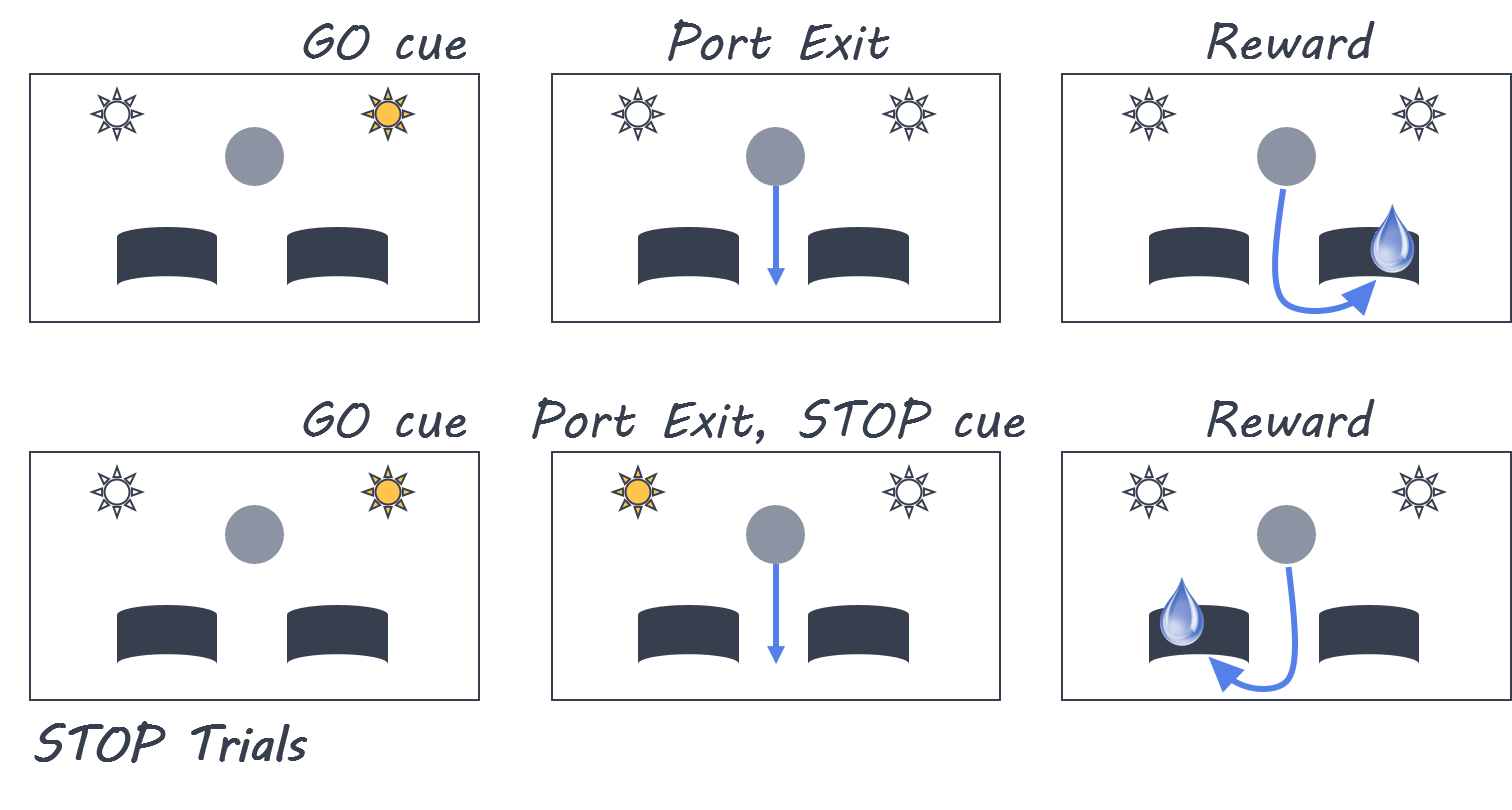
The authors first modified a STOP-signal task for use in rats. The STOP-signal task is commonly used to test cognitive control in human clinical populations and generally involves asking participants to respond to a cue, such as pressing a button when a light comes on the screen. In some of the trials, another cue will flash which tells the participants to not press the button or to do something else entirely. This model tests how well our brains can respond to cues which conflict with one another. The authors designed this test for use in rats by showing a light that indicates which direction a rat must go to in order to receive a sugar reward. In some of the trials, a second light is shown after the first, indicating that the rat must go the opposite direction instead. The authors then tested the necessity of the anterior cingulate cortex in this task by damaging one side of it in both male and female rats. After recovery from the procedure, rats were trained on the STOP-signal task. The authors also recorded electrical activity from neurons within the dorsal medial striatum to investigate how information from the anterior cingulate cortex is processed in this region before a behavior is produced.

What did they find?

The authors found that damage to the anterior cingulate cortex made the STOP-signal task harder. Specifically, lesioned rats had slower response times and were less accurate when they were forced to change their response direction suddenly (STOP trials) but had similar response times to control rats when they did not have to change their response selection suddenly (GO trials). Interestingly, after the presentation of one STOP trial, rats without an anterior cingulate cortex still performed better on the next consecutive trial if it was also a STOP trial. This shows that lesioned rats were still able to learn about conflicting signals. 

In control rats, neuronal activity in the dorsal medial striatum increased in response to the first light cue, then decreased in response to the second light cue. This means that the majority of recorded dorsal medial striatum neurons changed their firing in response to the conflicting cue. During STOP trials where the rat was able to successfully cancel the initial response, neural firing was delayed in rats with a damaged anterior cingulate cortex. However, when control rats made an error on STOP trials, firing for the initial — but incorrect — movement resembled firing on GO trials in lesioned rats, suggesting that anterior cingulate cortex is necessary for applying a brake on neuronal firing to cancel the first response. This effect was not seen in rats with a lesioned anterior cingulate, again suggesting that this region normally acts as a brake on activity in other brain regions.

deb.png

What's the impact?

While the function of the anterior cingulate has been inferred based on previous research it has remained controversial. This study is the first to experimentally demonstrate that the anterior cingulate cortex is necessary for processing and correctly responding to conflicting environmental cues. It also provides useful experimental tools for testing this type of higher-level cognition while simultaneously monitoring neuronal activity in rodent models. Overall, these findings present an important contribution to figuring out exactly what the anterior cingulate cortex does and how it sends information to other brain regions that ultimately affect our behavior.

ACC_image_march10.jpg

Brockett et al., Anterior cingulate cortex is necessary for adaptation of action plans, PNAS (2020). Access the original scientific publication here.

Synaptic Plasticity in CA1 Pyramidal Dendrites Depends on Specific Input Patterns

Post by Amanda McFarlan

What's the science?

Pyramidal neurons in the brain receive many complex inputs, and these electrical signals are then integrated and propagated by dendrites to the cell body of the neuron. Although dendritic activity is known to be involved in long term potentiation (LTP), the classical Hebbian view of plasticity still considers the backpropagating action potential (propagation back towards the dendrites) to be critical for inducing LTP. However, recent studies have shown that local dendritic activity may play an important role in mediating synaptic plasticity. This week in the Journal of Neuroscience, Magό and colleagues used 2-photon glutamate uncaging to investigate the plasticity rules at proximal (near the neuronal cell body) and distal (far from the neuronal cell body) dendritic spines.

How did they do it?

The authors used 2-photon glutamate uncaging to activate dendritic spines in CA1 pyramidal neurons that were targeted for whole-cell recording in acute hippocampal slices from adult male rats. To investigate the plasticity rules at these dendritic spines, the authors first recorded baseline excitatory post-synaptic potentials (EPSPs) in response to asynchronous activation of either proximal or distal dendritic spines. Then, they applied an LTP induction protocol whereby specific clusters of proximal or distal dendritic spines were synchronously activated and recorded proximal and distal dendritic spine EPSPs to measure LTP-induced changes in synaptic function.  

Next, the authors investigated whether dendritic spiking plays a role in inducing plasticity at proximal and distal dendritic spines. Dendritic spiking allows for non-linear amplification of electric inputs that are spatially and temporally correlated. To study this, they activated small clusters of either proximal or distal dendritic spines during the LTP induction while simultaneously inducing dendritic spiking. Then, they explored the spatial rules of plasticity at distal dendrites by applying the LTP induction protocol to distal dendritic spines that were spread out along the dendrite (rather than clustered together) with and without dendritic spiking. Finally, the authors investigated whether changes in plasticity in targeted clusters of dendritic spines induced heterosynaptic plasticity (when a change in synaptic strength in one neuron occurs following the activation of another neuron or pathway) in nearby spines. 

What did they find?

The authors found that the activation of proximal dendritic spines resulted in robust and long-lasting LTP only when it was coupled with dendritic spiking, suggesting that inducing LTP at synapses located on proximal dendrites requires a large depolarization from a local or backpropagating action potential. Next, the authors revealed that unlike proximal dendritic spines, the coactivation of a few distal dendritic spines alone was sufficient to induce LTP when the spines were located close in proximity to one another. They also showed that LTP was induced in distal dendritic spines that were spread out along the dendrite when their activation was coupled with dendritic spiking. Additionally, they found that LTP was induced using a much lower stimulus number in distal dendritic spines when the activation of these spines was coupled with dendritic spiking. Together, these results suggest that dendritic spiking is not required for the induction of LTP in synapses located in the distal dendrite but can be beneficial for reducing the number of coincident activity events required for LTP induction and for allowing cooperativity between spatially distant dendritic spines. Finally, the authors determined that following the LTP induction and dendritic spiking, dendritic spines that were not directly targeted for activation, but that were in close proximity to activated spines, showed evidence of LTP. Wash-in experiments with blockers revealed that this effect was abolished when the NMDA receptor, as well as the MEK/ERK pathway (important for mediating local plasticity of GTPases), were inhibited. Together, these results suggest that the activation of nearby dendritic spines by dendritic spiking induces heterosynaptic plasticity that is mediated by NMDA receptor and MEK/ERK signaling. 

Amanda_img_march10.png

What’s the impact?

This is the first study to show that several mechanisms are involved in facilitating LTP at dendritic spines. The authors found that the LTP is induced when distal dendritic spines close in proximity to one another are synchronously activated. Additionally, they revealed that dendritic spiking coupled with dendritic spine activation enables cooperativity between dendritic spines that are spatially distant as well as induces heterosynaptic plasticity at nearby synapses. Together, these findings provide insight into the many forms of plasticity that are occurring locally at the dendrite and are allowing neurons to store new information in the absence of somatic firing. 

synapse_quote_march10.jpg

Magό et al. Synaptic Plasticity Depends on the Fine-Scale Input Pattern in Thin Dendrites of CA1 Pyramidal Neurons. Journal of Neuroscience (2020). Access the original scientific publication here.