Modeling the Propagation of Neurodegeneration in Amyotrophic Lateral Sclerosis

Post by Elisa Guma

What's the science?

Amyotrophic lateral sclerosis (ALS) is a progressive neurodegenerative disease that causes muscle weakness, paralysis, and ultimately, respiratory failure. It has been hypothesized that a misfolded protein (phosphorylated 43 kDa TAR DNA-binding protein) spreads through the brain of patients in a ‘prion-like’ manner, causing neurodegeneration as it spreads. Impairment is thought to begin in the motor regions of the brain, but it’s unclear if and how the spreading occurs. Further, there is a lot of heterogeneity in survival times following symptom onset. It is difficult to assess this network spreading hypothesis in vivo or in post-mortem tissue of ALS patients, and therefore computational approaches are appealing. This week in the Annals of Neurology, Meier, and colleagues examine the propagation model for disease progression in ALS and aim to predict disease progression by using network analyses of brain imaging data from patients.

How did they do it?

The authors leveraged a longitudinal dataset of 60 participants with ALS who underwent four magnetic resonance image (MRI) scans (comprising of a structural and a diffusion-weighted scan) over the course of their illness. They also used a different dataset with 120 controls matched at each timepoint for age and sex. To construct the connectome, the authors first parcellated the brain (using the structural MRI scan) into 68 cortical and 14 subcortical regions. Next, white matter connections between parcellated brain regions were estimated based on the diffusion-weighted scans. The authors applied network-based statistics to find the largest grouping of impaired brain regions in ALS patients. Brain region impairment was defined by the number of  impaired white matter connections/streamlines (with lower fractional anisotropy than normal) attached to that brain region

A random walker model was used to model disease progression. They started the model in regions shown to be impaired first in ALS and tested all the possible connections coming out of that region. Regions with a higher number of connections had a greater likelihood of being traversed by the random walker in the model. Upper motor neuron burden was also calculated per brain region. Their models were compared to regions known to be affected at four stages of disease progression. Finally, they used a deep learning model to predict patient survival. They used a previous model they had built but included the random walker aggregation levels to assess whether they could improve their prediction accuracy. They examined 30 ALS patients and 30 controls from an external dataset who were scanned three times longitudinally for validation.

What did they find?

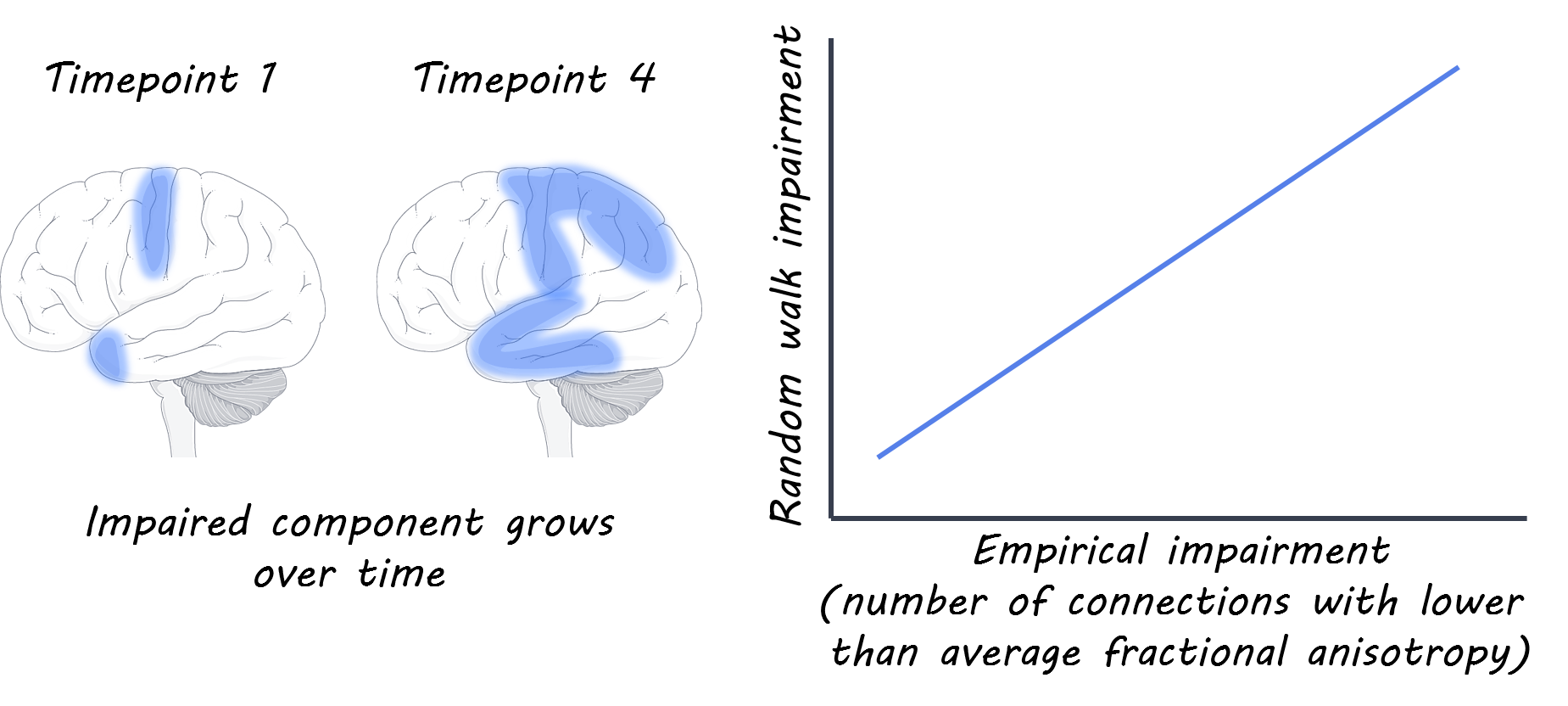
Based on their network-based statistics analysis, as well as the random walker model, the authors found that ALS patients had an impaired connectome that seemed to spread in a spatiotemporal manner, in line with the hypothesis they were testing. Impairment based on the network-based statistics analysis and the random walker was correlated. More importantly, impairment overlapped with known stages of disease progression, suggesting that the computational model is reflective of disease progression. When their computational model was tested on a dataset, they found a similar correlation between simulated disease spread and known stages of disease progression.  They also found that the level of upper motor neuron burden for each region correlated with their model of disease spread, suggesting that patients with higher upper motor neuron burden had more widespread aggregation, and patients with lower burden had higher variance and aggregation. Finally, the authors found that including the random walker model in their prediction algorithm improved their ability to accurately predict survival time for ALS patients from 79.6% to 83.3%.
Elisa.png

What's the impact?

This study provides compelling evidence for the utility of computational network models to predict neurodegeneration in ALS. The authors show that a random walker model based on MRI scans could predict degeneration over time in ALS patients, with overlap between known stages of disease progression and upper motor neuron burden. These results support the hypothesis that ALS impairment begins in the motor cortex and spreads along white matter tracts in a spatiotemporal manner. Future work is needed to investigate the impact of various genetic mutations associated with ALS on network degeneration.


Jil M. Meier et al. Connectome-based propagation model in amyotrophic lateral sclerosis. Annals of Neurology (2020). Access the original scientific publication here.
Distinct Patterns of Cortico-Limbic Connectivity Underlie Social Concern for Others

Post by Shireen Parimoo

What's the science?

Other-regarding preference (ORP) is a social phenomenon referring to concern for others’ well-being in addition to one’s own. Social decision-making requires complex cognitive operations and relies on communication between a distributed network of brain regions. This includes the basolateral amygdala (BLA), which is sensitive to reward-related decisions about oneself and others, and the gyrus of the rostral anterior cingulate cortex (ACCg), which is involved in encoding reward outcomes for others. It is not known how the BLA and ACCg interact with each other during social decision-making in primates. This week in Nature Neuroscience, Dal Monte and colleagues investigated the neural mechanism of ORPs during a social-interaction task in monkeys.

How did they do it?

Two male “actor” monkeys and two female “recipient” monkeys participated in a social-interaction task while the authors recorded neural activity from the BLA and ACCg. The monkeys completed the task in pairs, with one actor and one recipient participating in each interaction. The task was to decide how to allocate a juice reward. On half of the trials, the actors could keep it for themselves or they could receive the reward as well as deliver it to the recipient (Self/Both condition). On the other half of the trials, the actor had to choose between delivering it to the recipient or to an empty bottle (Other/Bottle condition). Therefore, the actor always received juice in the Self/Both condition but never received juice in the Other/Bottle condition. In a control condition, the actors were delivered juice by a computer, and did not need to make a decision.. The authors computed a preference index for the actors that indicated how often they chose the recipient over the bottle (positive ORP) and themselves over the recipient (negative ORP). To examine neuronal communication, the authors computed spike-field coherence between the BLA and the ACCg. Spike-field coherence represents the relationship between spiking activity (action potentials) in one region and local field potentials (rhythmic neuronal activity) in another region. They first identified neurons in the ACCg and the BLA that were sensitive to the actor’s decisions during the task and then computed spike-field coherence in the beta (15-25 Hz) and gamma (45-75 Hz) frequency bands. They also calculated partial directed coherence, which is a statistical technique used to determine the direction of communication between two brain regions (i.e. which region drives activity in the other region). Finally, they performed linear discriminant analysis to determine whether neural activity could be used to decode the actor’s decision. To do this, they trained a linear classifier (a type of statistical model used for classification) on spike-field coherence from 75% of the trials and tested the classifier’s accuracy at identifying the actor’s decisions on the remaining trials. 

What did they find?

In the Other/Bottle condition, when their own interests were not involved, the actors looked at and gave the reward to the recipient more than the bottle, reflecting a positive ORP. On the other hand, a negative ORP was observed in the Self/Both condition, with the actors choosing to receive the reward themselves rather than giving it to the recipient at the same time.

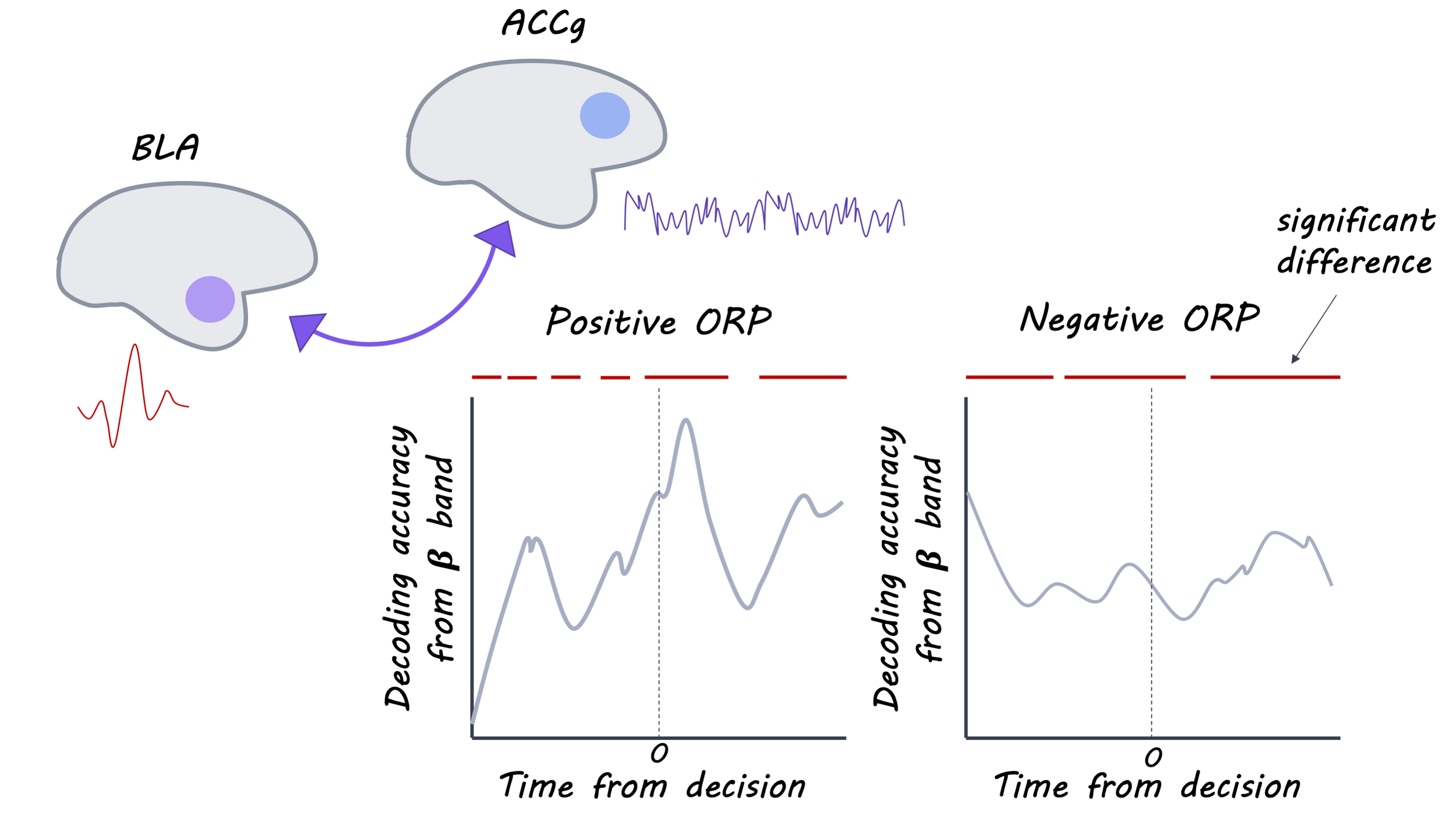
Spike-field coherence following decisions was enhanced for positive ORPs and suppressed for negative ORPs. Specifically, positive ORPs were associated with greater BLAspike–ACCgfield coherence in the beta band and greater ACCgspike–BLAfield coherence in the gamma band, whereas this was suppressed for negative ORPs. Importantly, this was not observed during the control condition, which means that spike-field coherence was specific to the decision rather than the reward outcome itself. Moreover, the direction of information flow in the beta and gamma bands differed for positive and negative ORPs. For positive ORPs, BLA activity led ACCg activity, whereas ACCg activity led BLA activity for negative ORPs. Finally, the classifier successfully distinguished between the actor’s decisions based on spike-field coherence values. For positive ORPs, classifier performance was greater for beta band BLAspike–ACCgfield coherence occurring around the decision point and gamma band ACCgspike–BLAfield coherence later in the post-decision period. Classifier accuracy for negative ORPs showed a similar pattern but was much lower overall and did not vary as much over the time course of the trial. Thus, spike-field coherence between the ACCg and BLA reliably distinguished between reward decisions related to the self and to others, particularly for positive ORPs

social_image_Mar3.png

What's the impact?

This study is the first to highlight differential patterns of inter-regional communication and transfer of information during social decision-making in primates, particularly between the BLA and the ACCg. These findings point to an important role of cortico-limbic connectivity in social decision-making processes that promote social cohesion.  

shireen_quote_Mar3.jpg

Dal Monte et al. Specialized medial prefrontal-amygdala coordination in other-regarding decision preference. Nature Neuroscience. (2020). Access the original scientific publication here.
Replay of Spatial Paths in the Medial Prefrontal Cortex Facilitates Strategy Shifting

Post by Cody Walters 

What’s the science?

Planning and decision-making often require remembering specific routes and locations. The hippocampus and prefrontal cortex have been shown to replay task-relevant spatial trajectories following learning, and this reactivation of behavioral sequences has been viewed as a possible neural mechanism for memory consolidation and retrieval. However, how hippocampal and prefrontal cortex replay relate to one another and whether they play dissociable roles in learning and memory remains unclear. This month in Neuron, Kaefer et al. identified novel properties of prefrontal replay in rats navigating a rule switching task. 

How did they do it?

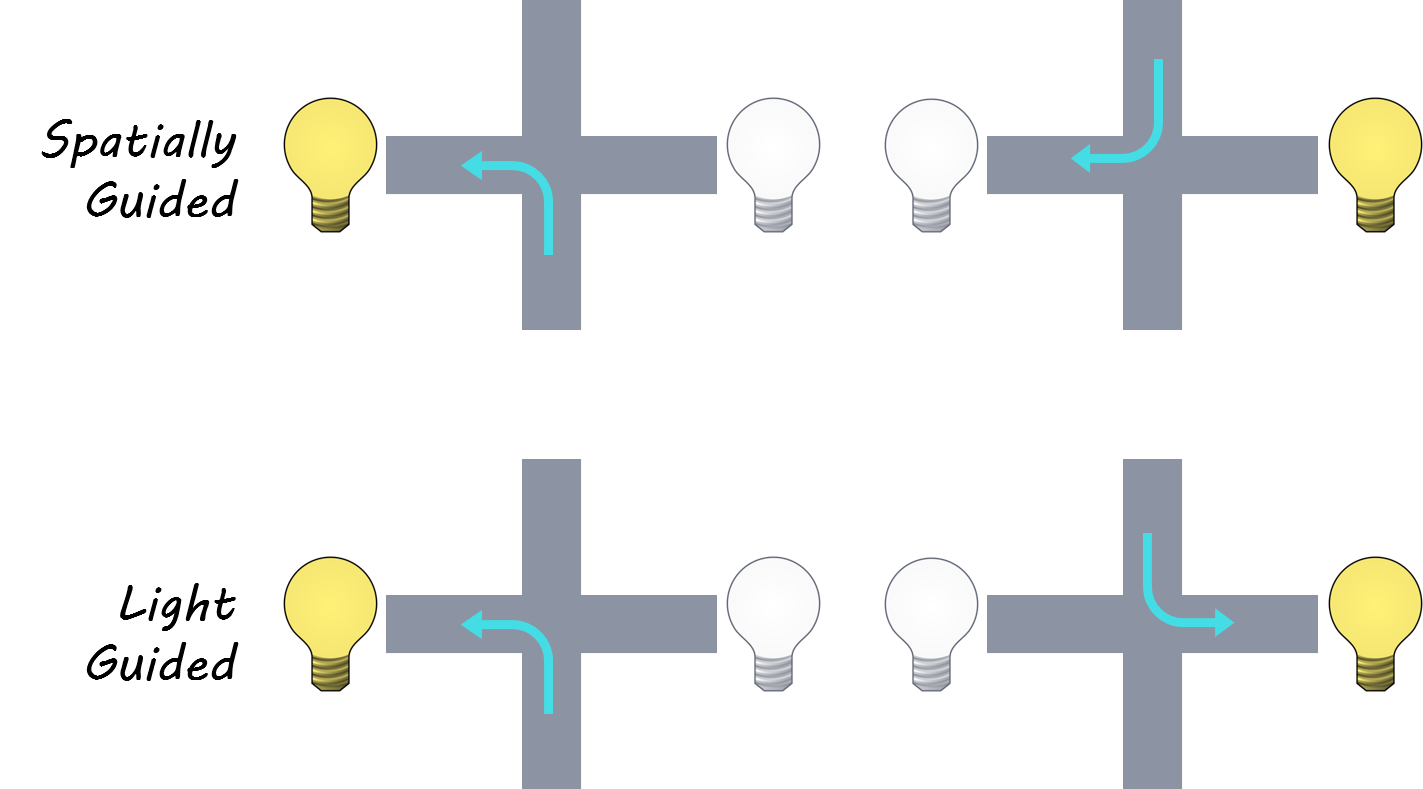
The authors trained four rats to perform a rule switching task on a plus maze (a maze with four arms, shaped like a plus sign). Rats were placed at the end of either the north or south arm and then had to navigate to either the east or west arm to receive a food reward. Importantly, there were two rules: under the spatial rule, one of the two horizontal arms was consistently rewarded, while under the visual rule rats had to go to the arm that had a light cue to receive food. Each session started off with one of the two rules in play until the animal reached a set performance criterion, at which point there would be an unannounced rule switch. They recorded neural activity from the medial prefrontal cortex (mPFC) and the dorsal hippocampus (HPC) of the rats as they performed the task. This allowed the authors to explore the differences and similarities between how the HPC and mPFC encode information about space, replay spatial paths, and respond to rule changes.

March2_Cody.png

What did they find?

They found that, unlike hippocampal place cells, most mPFC neurons had symmetrical spatial representations of the environment (e.g., an mPFC neuron that responded to the middle location on the north arm of the maze also responded to the middle location on the south arm of the maze). They also observed both forward (start arm to goal arm) and backward (goal arm to start arm) spatial trajectory replay in the mPFC. Importantly, these mPFC replay events did not significantly co-occur with HPC replay. At the goal location (where the rats received food), the rate of mPFC replay was positively correlated with rule switching performance (i.e., the number of laps it takes before shifting over to the correct strategy following a rule switch). On the other hand, the rate of HPC replay at the goal location was negatively correlated with rule switching performance. Interestingly, when rats were at the center of the plus maze (just prior to making a choice to either go left or right) there were more mPFC forward replays on error laps and more backward replays on correct laps (whereas the HPC exhibited an increase in both forward and backward replays on correct laps relative to error laps at the center of the maze).  

What’s the impact?

Previous work has shown that mPFC task-relevant replay occurs during sleep, but this study suggests that mPFC replay 1) occurs in awake states, 2) facilitates behavioral flexibility in a dynamic environment, and 3) might be largely independent of HPC replay. These findings advance our understanding of how different networks respond to the challenge of shifting environmental contingencies and highlight replay as potentially being a more general neural computation with structure-specific function.

cody_quote_Mar3.jpg

Kaefer et al. Replay of Behavioral Sequences in the Medial Prefrontal Cortex during Rule Switching. Neuron, (2020). Access the publication here.